
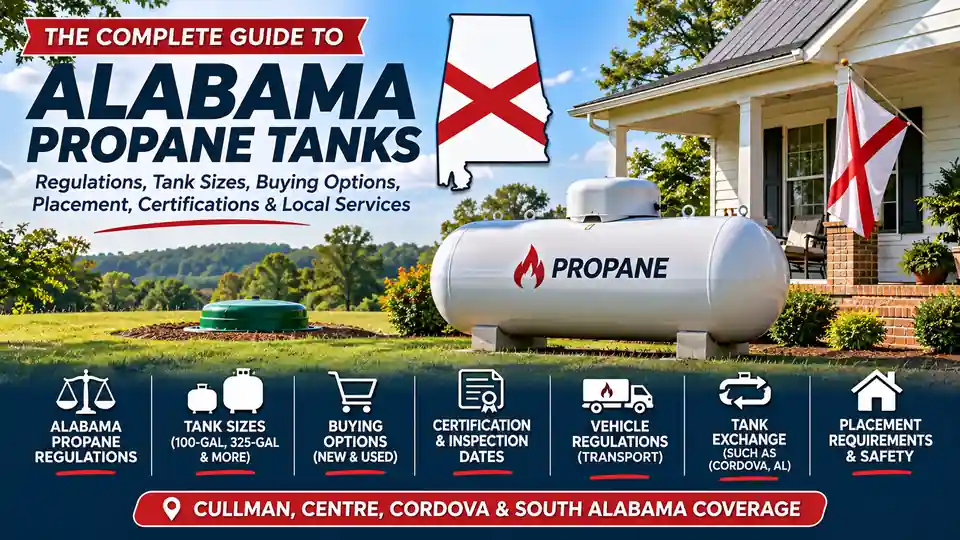
Alabama propane tank guide • Updated January 2027 for 2027 planning
If you’re installing, replacing, or buying a propane tank in Alabama, I recommend starting with three questions: What does the state require? What size tank will your home actually use? And can a qualified supplier safely install and service it at your address?
Propane is used for Alabama home heating, water heaters, cooking equipment, standby generators, fireplaces, farm equipment, and outdoor appliances. But buying a tank isn’t as straightforward as comparing online prices. The correct tank has to suit the fuel demand and the installation site, and it must meet the applicable storage and safety standards.


In this guide, I’ll explain Alabama propane tank regulations and placement rules, how to read cylinder certification dates, what to consider when transporting cylinders, how to choose a tank size, and how to look for new or used tanks around Centre, Cullman, Cordova, and South Alabama. I’ll also use original calculations to compare storage capacity, refill budgets, and realistic delivery intervals.
Pricing disclaimer: This guide is prepared for 2027 planning using information available in 2026. Equipment prices and fuel examples are estimates, not quotes or confirmed inventory. Always verify current rules, pricing, and dealer service areas before committing.
Quick Answer: What Are Alabama’s Propane Tank Rules?
Alabama’s principal propane regulator is the Alabama Liquefied Petroleum Gas Board. The Board’s published adopted standards include NFPA 58 (2020 edition) for LP-gas storage and handling and NFPA 54 (2021 edition) for fuel-gas installation, with applicable state amendments. Typical 125–500-gallon above-ground tanks generally require 10 feet of separation from important buildings and buildable adjoining property lines, but the full placement rules depend on the container and site. Used underground containers require prior Board inspection and approval before they can be installed or reinstalled in Alabama.
| Common question | Short answer |
|---|---|
| Who regulates propane tanks? | Alabama Liquefied Petroleum Gas Board |
| What codes apply? | Adopted NFPA 58 and NFPA 54, plus Alabama rules |
| 500-gallon above-ground tank setback? | Generally 10 feet for key building/property-line separation; other clearances apply |
| Can I buy a used tank? | Potentially, after confirming ownership, condition, and supplier acceptance |
| Can I reinstall a used underground tank? | Not without the Alabama Board’s required inspection and approval |
| Can I refill an expired DOT cylinder? | No; it must qualify for requalification or replacement first |
| How much fuel fits in a 500-gallon tank? | Approximately 400 gallons at 80% liquid fill |
1. What Are the Propane Tank Regulations in Alabama?
Who Regulates Propane Tanks in Alabama?
The Alabama Liquefied Petroleum Gas Board oversees many activities involving LP-gas storage, handling, transport, and installation. Its rules cover industry participants and equipment safety. If you’re researching an installation, start with the Board’s published laws and regulations rather than a generic guide that might describe another state’s code.


The major standards are NFPA 58 for LP-gas equipment and storage, NFPA 54 for fuel-gas systems and appliances, and the Alabama Administrative Code’s rules for the LP-gas industry. Federal hazardous-material rules also apply to qualifying portable cylinders and certain transport activities. The legal details can change, so the adopted edition and state amendments are important.
Do You Need a Permit to Install a Propane Tank?
That depends on the tank, the work involved, and local jurisdiction. An installation may involve licensed or permitted propane work, local building or fire approval, excavation requirements, and gas-piping or appliance inspections. Do not assume that buying the tank gives you permission to place it anywhere on your lot.
I would ask an installation company three questions before paying a deposit: Who obtains any required approvals? Who inspects and tests the completed system? And are those costs included in the quotation? If a contractor cannot answer clearly, compare another quote.
Can You Install a Residential Tank Yourself?
For a permanent tank feeding a house, I recommend a qualified propane installer. Regulators, piping size, supports, leak testing, pressure requirements, and separation distances have to work together. An attractive do-it-yourself equipment price may become much more expensive if the system must later be moved or rebuilt. You can participate in planning the site, but let the appropriate professionals perform regulated installation and commissioning work.
What If an Installation Doesn’t Meet Code?
Noncompliant equipment can be refused service or require repairs, relocation, or reinspection. If the tank is too close to a structure, for example, correction can mean crane work, ground preparation, and replacing gas lines. Planning before purchasing is less expensive than correcting an installation after the fact.



2. What Are Alabama Propane Tank Placement Requirements?
How Far Does a Propane Tank Need to Be From a House?
Required separation depends on water capacity, above-ground versus underground installation, nearby ignition sources, property boundaries, and detailed code exceptions. The table below gives common planning figures—not a final site approval.
| Container capacity and type | Common planning separation |
|---|---|
| Small cylinders below 125-gallon water capacity | Special requirements; do not assume zero clearance |
| 125–500 gallons, above ground | Generally 10 feet from important buildings and buildable adjoining property lines |
| 501–2,000 gallons, above ground | Generally 25 feet, subject to code-specific exceptions/reductions |
| Underground containers up to 2,000 gallons | Generally 10 feet for key building/property-line separation; fittings require separate evaluation |
Verify the applicable NFPA 58 table and Alabama amendments with your supplier. Doors, windows, relief outlets, ignition sources, overhangs, multiple containers, and site-specific conditions can change the design.
Do Fences, Driveways, or Property Lines Matter?
Yes. You need to consider more than the distance to the house. A property line can limit a tank’s position even if the tank is far from your home. Fencing must not prevent safe access or ventilation. A driveway or parking area can introduce vehicle-impact risk, and protective measures may be required. Avoid positioning a tank where a delivery truck can’t reach it or maintenance personnel can’t safely inspect it.
Above-Ground Versus Underground Placement
An above-ground tank is usually simpler to install, monitor, and replace. An underground installation reduces the visible profile but requires equipment specifically rated for burial, suitable excavation and backfill, corrosion protection, and a location suitable for periodic access. Underground burial is not a workaround for normal separation requirements.


For a rural property with plenty of accessible space, I would normally price an above-ground option first. For a landscaped yard where appearance is critical, I would request a separate underground quote so that the added excavation and maintenance requirements are transparent.
3. How Do You Check an Alabama Propane Tank Certification Date?
Portable DOT Cylinders Versus Stationary ASME Tanks
A portable DOT cylinder and a large stationary ASME tank should not be treated as the same kind of container. The small cylinders used for grills, RVs, and certain forklifts carry DOT manufacture and requalification markings. A residential ASME tank has different identification and inspection requirements; it does not simply expire because 12 years have passed.
How Do You Read a DOT Cylinder Date?
Look on the protective collar or shoulder for the stamped month and year. For example, a manufacturing mark of 06-2021 means June 2021. In the standard case described by current DOT guidance, an eligible cylinder without an intervening requalification would require requalification within 12 years, or by June 2033. This is not permission to fill a visibly damaged cylinder.
| Marking or method | What it generally means |
|---|---|
| Manufacture date, eligible DOT cylinder | Initial requalification typically due within 12 years |
| Requalification marking ending E | External visual requalification; commonly a five-year interval |
| Requalification marking ending S | Proof-pressure test; commonly a ten-year interval |
| Other approved markings | Check the cylinder specification and applicable DOT rules |
DOT’s 2023 cylinder safety guidance explains date markings and requalification. A refill operator should evaluate eligibility before filling. For help finding authorized services, read our guide to who recertifies propane tanks.
What About Older ASME Home Tanks?
Ask your propane supplier to inspect the manufacturer’s data plate, visible condition, regulator installation, and service history. Rust, damaged piping, leaking valves, and improper installation are more relevant to serviceability than an assumed universal expiry date. A tank can require attention well before an arbitrary age threshold.
4. What Are Alabama Propane Tank Vehicle Regulations?
Transporting Portable Propane Cylinders in a Personal Vehicle
Transport and vehicle-fuel rules are two different subjects. When carrying a portable cylinder for refilling or exchange, secure it upright, keep the valve closed, protect it from damage, maintain suitable ventilation, and keep it away from heat or ignition sources. Do not store a cylinder inside a hot enclosed vehicle. Follow the applicable limitations on quantities, container types, and commercial shipments.
A large stationary storage tank requires specialist handling and transportation. I would not attempt to move an empty or partially filled stationary vessel with ordinary household equipment. Arrange transport through the supplier or an appropriately equipped contractor.
Vehicles That Run on Propane
Alabama has a separate regulatory framework for vehicles using LP-gas motor fuel, including tax-related decal requirements for qualifying vehicles. Conversion equipment, installation, registration, and commercial use can raise additional issues. If you are converting a truck or operating a fleet, confirm current requirements with the relevant Alabama agencies and an experienced vehicle-propane installer rather than relying on grill-cylinder instructions.
5. What Size Propane Tank Do I Need in Alabama?
This is the decision I spend the most time on. You want enough storage to cover normal use and delivery lead times without spending unnecessarily on an oversized container. House size alone won’t answer the question: the number of propane appliances, their rated input, operating hours, winter weather, and generator runtime all matter.
Propane Tank Size and Usable Capacity Chart
| Container size | Approximate fuel at normal full level | Common use |
|---|---|---|
| 20-lb cylinder | About 4.7 gallons | Grill or portable appliance |
| 100-lb cylinder | About 23.5 gallons | Portable and limited auxiliary use |
| 100-gallon stationary tank | 80 gallons | One or a few lower-demand appliances |
| 250-gallon tank | 200 gallons | Moderate residential demand |
| 325-gallon tank | 260 gallons | Intermediate residential storage |
| 500-gallon tank | 400 gallons | Several appliances or sustained demand |
| 1,000-gallon tank | 800 gallons | High-use residential, farm, or commercial systems |
For stationary tanks, the listed usable gallons reflect the conventional 80% fill limit, not a promise that every delivery adds that amount. For pound-rated cylinders, the stated weight is propane capacity rather than tank water capacity.
Calculate Appliance Propane Consumption
Propane contains approximately 91,500 BTU per gallon. For a steady appliance load, a useful starting calculation is:
Suppose an appliance has a 30,000 BTU/hour fuel-input rating and runs four hours daily. It uses about 1.31 gallons daily, or about 39.34 gallons over 30 days. Over 90 days, that’s approximately 118 gallons. Actual demand may be lower if the appliance cycles, or higher when additional appliances run.
How Often Will You Need a Delivery?
Imagine your household uses 90 gallons per month. If you plan deliveries when a stationary tank gauge drops from 80% to around 20%, only 60% of nominal tank capacity is available between those reference points.
| Tank | Gallons used from 80% to 20% | Months at 90 gallons/month |
|---|---|---|
| 100 gallons | 60 | 0.7 |
| 250 gallons | 150 | 1.7 |
| 325 gallons | 195 | 2.2 |
| 500 gallons | 300 | 3.3 |
| 1,000 gallons | 600 | 6.7 |
These are theoretical intervals. Your supplier may require a different reorder point. Cold spells, a growing household, or generator use can shorten the interval significantly, so don’t plan deliveries around an optimistic average alone.
Which Tank Size Would I Choose?
For a grill, a portable cylinder is often all you need. For a cooking range or a limited appliance load, compare a 100- to 250-gallon system. For a standby generator and several household appliances, a 250- or 500-gallon tank deserves evaluation. If propane handles substantial home heating, consider a 500- or 1,000-gallon option after a supplier calculates peak demand and delivery requirements.
Remember that sizing is not just about gallons in storage: regulators and tank vaporization capacity must also meet the appliances’ peak fuel-input demand, especially in cold weather.
6. Where Can You Find Used Propane Tanks for Sale in Alabama?
Are Used Propane Tanks Worth Buying?
A used tank can lower your equipment expense. But a lower asking price doesn’t prove the tank is safe, serviceable, or suitable for your property. Ownership is a major concern: some tanks installed at homes are leased from suppliers and should not be sold by the homeowner.
You may find used equipment through propane dealers, agricultural equipment sellers, auctions, or private listings. I would always ask a qualified supplier to evaluate the container before committing, and confirm that a fuel provider is willing to service it.
| Used-tank check | What to confirm |
|---|---|
| Ownership | Seller can legally transfer the tank |
| Data plate | Manufacturer and pressure-vessel markings are readable |
| Condition | No unacceptable corrosion, dents, or structural damage |
| Valve assembly | Suitable fittings and relief devices |
| Prior use | Known history and proper specification |
| Delivery and setting | Qualified hauler and installer are available |
| Fuel provider | Willing to accept and service the tank |
Can You Reinstall a Used Underground Tank?
Alabama Administrative Code Rule 530-X-2-.09 expressly requires Board inspection and approval before a used underground LP-gas container is installed or reinstalled in the state. This rule is particularly important when comparing a secondhand burial-rated tank with a new one. Read the official Alabama rule.
Ask how the inspection, transport, corrosion protection, reinstallation, and documentation will be handled. A used underground tank that initially appears cheap may cost more after compliance work than a new tank bought through a local installer.
7. Where Can You Buy 100-Gallon Propane Tanks Around Centre, Alabama?
Finding Dealers Near Centre and Cherokee County
If you’re in Centre, start with propane suppliers serving Cherokee County and nearby areas. Ask whether they sell 100- or 120-gallon stationary tanks, lease them, and offer on-site installation. I recommend comparing a dealer-installed package against an online tank-only listing because freight, labor, regulators, and inspection services can materially change the final price.
When calling, tell the supplier your ZIP code, appliances, expected monthly consumption, whether you already have gas piping, and whether the tank must be above ground. That lets the supplier determine whether the proposed capacity is suitable and whether it serves your address.
How Much Does a 100-Gallon Tank Cost Near Centre?
For an early equipment-only budget, I would allow roughly $500–$1,200 for a new 100- to 120-gallon tank. This is an illustrative U.S. planning range, not a verified Centre dealer price. Installation, first fill, delivery, and regulators may be extra.
Do not buy the container before checking that a local supplier will fill it. Some companies have restrictions or inspection requirements for customer-owned equipment.
8. Where Can You Find 325-Gallon Underground Propane Tanks for Sale in South Alabama?
Are 325-Gallon Underground Tanks Common?
Availability varies. Suppliers may advertise nearby nominal capacities as 320, 325, or 330 gallons. Ask for the exact model’s water capacity and manufacturer documentation instead of assuming the numbers represent identical tanks. Confirm that the vessel is manufactured and approved specifically for underground installation.
A nominal 325-gallon tank provides about 260 gallons at the typical 80% liquid fill. At an illustrative $3.69 per gallon, that quantity of propane costs $959.40 before applicable taxes or fees. This calculation covers fuel alone, not the tank or burial work.
What Matters for a South Alabama Underground Installation?
In the southern part of the state, the installation contractor should evaluate drainage, groundwater, soil conditions, and any flooding risk specific to the property. Depending on the site and tank model, additional anchoring, drainage measures, or corrosion-protection systems may be needed. Ask for itemized costs for excavation, bedding, backfill, gas piping, protective systems, and restoration of landscaping.
If an underground supplier quotes only the vessel, ask for a complete installed quotation and service plan. The most useful comparison is the long-term total cost, not just the price on a tank reseller’s page.
9. Where Can You Buy a New Propane Tank in Cullman, Alabama?
How to Compare New Tank Offers in Cullman
Cullman homeowners should ask several local propane suppliers for proposals that include the exact tank capacity, ownership arrangement, delivery service area, and installation scope. Statewide companies and independent local businesses may have different equipment options and lease terms. A written quote makes it easier to compare them fairly.
Should You Buy or Lease the Tank?
| Factor | Buying | Leasing |
|---|---|---|
| Initial cost | Usually higher | Often lower |
| Ownership | You own equipment | Supplier usually owns equipment |
| Fuel supplier flexibility | Potentially greater | Usually limited by contract |
| Maintenance terms | Your responsibility or as agreed | Check lease responsibility |
| Moving or selling property | You must manage equipment disposition | Subject to lease and removal terms |
I would review minimum annual fuel purchase, rental charges, tank-removal costs, and any automatic-delivery requirements. A lease can be an affordable way to begin using propane, but it may carry restrictions that outweigh the lower initial cost.
10. Where Can You Exchange a Propane Tank in Cordova, Alabama?
Exchange Versus Refill Around Cordova
If you need a grill cylinder in Cordova, check local hardware stores, convenience retailers, and grocery stores for exchange cages, and call ahead to confirm that stock is available. Nearby Walker County communities may offer additional exchange or refill options. A retail exchange normally replaces your empty cylinder with a different inspected cylinder containing a specified amount of propane.
Be careful to compare the actual propane fill weight. An exchange cylinder may contain 15 pounds even though the steel container itself is a 20-pound-capacity cylinder.
| Illustrative comparison | Refill | Exchange |
|---|---|---|
| Example payment | $18 | $25 |
| Propane purchased | 20 lb | 15 lb |
| Cost per pound | $0.90 | $1.67 |
| Keep same cylinder? | Yes | No |
These are scenario values, not Cordova store quotes. If the cylinder is safe and in date, I usually favor an economical refill. Exchange is useful when convenience is more important or you need to swap an old cylinder, subject to the exchange company’s acceptance rules.
11. Alabama Propane Tank Prices: Equipment, Delivery, and Installation
Illustrative New Tank Purchase Budgets
| Tank capacity | Illustrative equipment-only budget |
|---|---|
| 100–120 gallons | $500–$1,200 |
| 250 gallons | $900–$1,700 |
| 325–330 gallons | $1,200–$2,200 |
| 500 gallons | $1,200–$2,500 |
| 1,000 gallons | $2,200–$4,500 |
Broad budget assumptions for comparison only, not confirmed Alabama listings. Underground-rated models and unusually equipped tanks may cost more.
What Does an Initial Propane Fill Cost?
To understand fuel expense, compare several possible per-gallon prices. Below, I assume filling a completely empty stationary container to 80%. In normal service, a refill adds only the gallons needed to bring the tank from its current level to the intended level.
| Tank | Gallons at 80% | $3.00/gal | $3.69/gal | $4.50/gal |
|---|---|---|---|---|
| 100 gal | 80 | $240 | $295.20 | $360 |
| 250 gal | 200 | $600 | $738 | $900 |
| 325 gal | 260 | $780 | $959.40 | $1,170 |
| 500 gal | 400 | $1,200 | $1,476 | $1,800 |
| 1,000 gal | 800 | $2,400 | $2,952 | $3,600 |
Worked Example: Total Startup Cost for a 500-Gallon Tank
Suppose a homeowner receives an illustrative quote for a 500-gallon above-ground installation with these components:
| Item | Scenario amount |
|---|---|
| Tank | $1,600 |
| Pad and site preparation | $250 |
| Regulators, piping, and labor | $600 |
| 400-gallon initial fill at $3.69/gallon | $1,476 |
| Total illustrative startup cost | $3,926 |
A different site might require trenching, longer piping, permits, equipment rental, or a more extensive appliance connection. This example is a way to organize a quote; it is not an advertised Alabama installation package.
12. How Do You Choose a Propane Supplier in Alabama?
Once the tank size is narrowed down, I compare companies on the complete service—not just the first propane delivery price. A low fuel price may be balanced by a lease charge, minimum purchase commitment, delivery surcharge, or equipment service restriction.
Ask each supplier for a written quote addressing the tank model and size, purchase versus lease terms, installation and piping, permits, first-fill rate, ongoing fuel pricing, emergency service, scheduled delivery, inspection responsibility, and equipment removal conditions. Request a clear explanation of who owns the tank after installation.
If possible, ask for two or three like-for-like quotes. It’s easier to compare a $3,900 total installed proposal with a $4,100 total installed proposal than a $1,400 tank-only listing with an incomplete installation package.
Quick Decision Guide
| Your situation | What I would compare first |
|---|---|
| Only need propane for a grill | Portable-cylinder refill versus exchange |
| One modest-use household appliance | 100–250 gallon supply arrangement |
| Generator and several appliances | 250–500 gallon storage and peak-load capacity |
| High winter heating demand | 500–1,000 gallon option with delivery plan |
| Need to minimize upfront spend | Lease proposals and lifetime contract charges |
| Want supplier flexibility | Ownership costs and service acceptance |
| Interested in a used underground tank | Board inspection and approval before purchase |
13. Propane Tank Safety and Maintenance in Alabama
After installation, the most useful homeowner habits are simple: keep access clear, monitor fuel level, look for visible damage, and arrange qualified maintenance. I do not recommend adjusting regulator pressure, disassembling valves, or attempting to repair gas leaks yourself.
- Keep vegetation, debris, and combustible storage away from the tank and equipment.
- Make sure the delivery route and service access remain unobstructed.
- Watch the fuel gauge and order before levels become critically low.
- Arrange inspections of regulators, piping, and appliances as the supplier recommends.
- Tell your supplier about landscaping or structural changes near the tank.
- Know how to respond to suspected propane odor or leaks.
14. Frequently Asked Questions About Propane Tanks in Alabama
Do I Need a Permit for a 500-Gallon Tank in Alabama?
Approval requirements depend on the installation and jurisdiction. Ask your local building or fire authority and a properly permitted propane contractor before beginning work. A state industry permit does not automatically resolve every local requirement.
How Close Can a 500-Gallon Tank Be to My House?
A typical above-ground 500-gallon tank generally uses a 10-foot minimum for the primary important-building and buildable-property-line separation. Other code conditions and equipment clearances still have to be checked.
Can I Buy a Used Residential Propane Tank?
Yes, provided the seller legally owns it, the equipment is serviceable and suitable, and the planned installation complies with applicable rules. Confirm a supplier will inspect, install, and fill the tank before you buy it.
Do ASME Propane Tanks Expire After 12 Years?
No universal 12-year expiry rule applies to large stationary ASME residential tanks. The common 12-year first-requalification interval concerns eligible portable DOT cylinders. Stationary tanks still require appropriate inspection, maintenance, and safe serviceability.
Can I Bury a Propane Tank on My Property?
Underground installations are possible with appropriate equipment and compliant professional installation. An above-ground tank should not be buried. Used underground containers require Alabama Board inspection and approval before installation or reinstallation.
Is a 325-Gallon Tank Enough for a House?
It can be, but you should calculate appliance demand, cold-weather needs, and delivery intervals. Nominal capacity by itself does not establish suitability.
Can I Change Suppliers if I Own My Tank?
Owning a tank can offer more flexibility, but the new supplier may impose inspection, ownership-documentation, and service requirements. Ask before purchasing or changing providers.
Final Thoughts: Buying a Propane Tank in Alabama
Whether you’re comparing used tanks statewide, looking for a 100-gallon tank near Centre, sourcing a 325-gallon underground tank in South Alabama, considering a new tank in Cullman, or checking exchange options around Cordova, start with safe installation and realistic fuel demand.
My recommendation is to establish the compliant tank location first, calculate your monthly and seasonal propane use second, and compare complete equipment-plus-installation quotations third. Those steps make it much easier to avoid surprises. A low tank-only price is rarely useful if the container cannot be legally installed or serviced where you live.
For more help with inspection dates and replacement options, see our related guide to propane tank recertification.
Official Resources and Verification

Mike is an experienced propane technician with over 15 years of professional experience in the field. He has dedicated his career to helping customers with their propane needs, from installation to maintenance and repair. Together with Jeremy, he co-founded this website to provide useful information and guidance to customers seeking reliable propane services.


