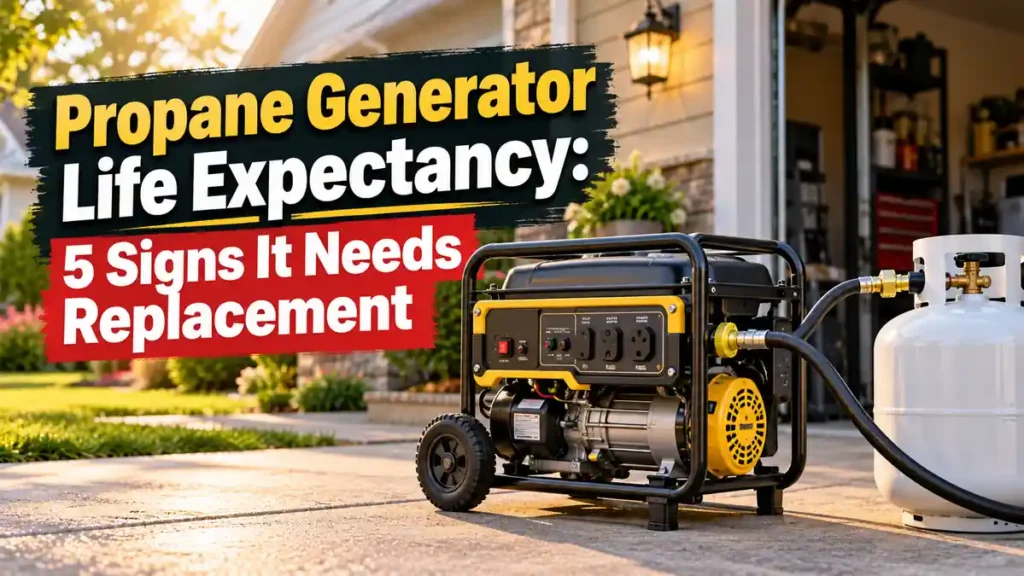
TL;DR — How long does a propane generator last?
A properly maintained home standby propane generator can remain useful for 15–20 years or longer, but there is no fixed expiration date: running hours, maintenance, load, environment, and the specific engine matter more than age alone. Some manufacturers say well-maintained standby models can reach 20+ years; portable models vary widely. My five replacement warning signs are repeated failures, unstable electrical output, serious engine wear, major safety or structural damage, and repair costs that no longer make sense. I would confirm the cause before replacing a generator—many apparent failures are repairable propane-supply or maintenance problems.
Propane generator life expectancy is not a single number I can promise you. A backup generator that runs a few dozen hours each year experiences different wear from one that powers an off-grid cabin every day. I look at the hour meter, service records, reliability during a real outage, and the condition of the engine and alternator before deciding whether the unit is ready for replacement.


In this guide I’ll explain how long portable and standby propane generators may last, the five signs that can justify replacement, which problems are usually worth fixing, and how to compare repair versus replacement costs. I’ll also link to my related propane-generator troubleshooting guides so you can rule out a simple fuel or regulator issue first.
For the preventive care that helps protect that lifespan, I put the oil, battery, spark plug, and propane-system service tasks in my propane generator maintenance checklist and schedule.
To see exactly when portable and standby propane generators need service at specific running-hour milestones, use my propane generator servicing hours guide.
How Many Years Does a Propane Generator Usually Last?
For a residential standby generator that receives routine maintenance and sees occasional backup use, 15–20 years is a reasonable planning window, not a warranty. Generac, for example, says well-maintained home standby generators can last 20 years or more depending on conditions. A unit can fail earlier from neglect, a flood, corrosion, overheating, or poor installation. Another may stay serviceable longer with parts available and a good maintenance history.


For a portable propane or dual-fuel generator, I avoid giving you an unconditional “2,000 hours” or “10 years” promise. Engine class, build quality, maintenance intervals, operating load, and storage conditions differ greatly. A lightly used portable unit may get old without accumulating much engine wear; a heavily used one can reach costly repairs much sooner.
| Generator type | How I judge life expectancy | Biggest risk factors |
|---|---|---|
| Portable propane / dual-fuel | Use condition, manufacturer guidance, service history, and operating hours—not age alone | Long high-load runs, low oil, dust, moisture, poor storage |
| Air-cooled home standby | 15–20+ years may be possible with proper upkeep; confirm model-specific condition | Missed maintenance, heat, weather, corrosion, repeated long outages |
| Liquid-cooled standby | Evaluate engine condition, cooling system, hours, and availability of parts | Coolant issues, overheating, neglected service, high run-hour duty |
| Daily-use off-grid generator | Running hours become especially important, even when calendar age is low | Continuous duty beyond model rating, deferred service, fuel-system faults |
These ranges are planning guidance, not standardized life ratings. When someone tells me their propane generator is “only five years old,” I still want to know whether it has logged 50 hours or 5,000 hours, and whether the machine was maintained for the duty it actually performed.
Generator Age vs. Running Hours: Which Matters More?
I track both, but I start with total engine hours because mechanical wear happens while the machine runs. Calendar time still matters: wiring insulation, batteries, seals, and steel enclosures age in rain, salt air, humidity, and heat even if the engine rarely starts.
| Usage scenario | Annual running hours | Hours after 10 years | What this shows |
|---|---|---|---|
| Standby, occasional outage | 50 | 500 | Old in years; comparatively few operating hours |
| Standby, frequent outages | 200 | 2,000 | Much more running wear at the same age |
| Remote cabin, seasonal use | 500 | 5,000 | Maintenance and duty rating become central |
| Off-grid, heavy daily use | 2,000 | 20,000 | Far beyond the duty of many occasional-use portable models |
These figures are simple mathematical examples, not measured use or guaranteed lifespan: annual hours × 10 years. They make one point clear—calendar age by itself is a poor replacement rule. I would look for the cumulative hours on the control panel, hour meter, service log, or generator monitoring app.
5 Signs Your Propane Generator May Need Replacement
1. It Repeatedly Fails to Start or Shuts Down After Proper Repairs
A generator that starts and stops once is not automatically worn out. I first check the obvious: propane supply, correctly sized tank and regulator, starter battery, oil level, fault codes, and the manufacturer’s maintenance requirements. Weak batteries, low cylinder vaporization, dirty air filters, and restricted fuel lines can imitate severe engine trouble.



The more serious sign is repeat failure after a qualified technician has corrected those causes. If the generator continues to crank poorly, misfire, stop under normal load, or trigger unrelated faults despite proper repairs, I begin evaluating the engine, wiring, control board, and overall economics—not just another quick fix.
If yours starts and dies, my guide on why a propane generator starts and then dies helps distinguish shutdown faults from terminal wear. If a dual-fuel unit works on gasoline but not propane, read why it will not start on propane before concluding the generator needs replacing.
2. Voltage or Frequency Remains Unstable Under Normal Load
Some generator problems look like a weak engine but are actually in the electrical system. I watch for frequent voltage dips, appliances unexpectedly resetting, breakers repeatedly tripping under verified loads, or output that wanders even after the engine and fuel supply have been checked. Unstable frequency can indicate engine-speed or governor problems; voltage issues can involve excitation, voltage regulation, wiring, or alternator defects.
Before calling this a replacement sign, I confirm that the electrical load is within the propane running-watt rating and that starting surges are accounted for. Electrical measurements and load-bank testing belong with trained personnel using suitable instruments. I would not adjust a governor or probe energized panels myself.


| Technical measurement | Typical U.S. 60-Hz generator reference | How I use the information |
|---|---|---|
| Rated voltage | 120 V or 120/240 V on many household units | Compare to the exact nameplate and model tolerance |
| Nominal frequency | 60 Hz for U.S. household units | Look for sustained deviations at a steady, permitted load |
| Propane running watts | Often lower than gasoline rating on dual-fuel models | Use the propane-specific nameplate limit |
| Starting surge | Can exceed continuous running demand briefly | Account for pumps, compressors, and motors |
| Professional load test | Tests stability and capacity at controlled loads | Separates fuel/engine problems from electrical faults |
Important: 120 V and 60 Hz are nominal reference values, not universal pass/fail bands. The manufacturer specifies allowable variation, frequency response, and test conditions. If your machine bogs when appliances start, my guide on propane generator power loss under load covers common non-terminal causes.
3. The Engine Shows Persistent Oil Consumption, Knocking, or Loss of Compression
This is where I become more concerned about the engine itself. I want a technician to investigate repeated oil loss without visible leakage, persistent abnormal knocking, hard starting with acceptable battery and fuel supply, or compression readings outside the manufacturer’s service limits. These can point to internal mechanical wear rather than a simple external adjustment. I also distinguish normal generator sound from unusual knocking and explain whether propane generators are quieter than gasoline generators before treating ordinary noise as a sign of replacement.
Some symptoms are less conclusive than they seem. White vapor in cold weather is not always oil smoke. An occasional puff at startup does not prove a failed engine. A low-oil shutdown might be a sensor problem rather than damaged bearings. What matters is the pattern after proper diagnosis and whether the repair involves expensive internal components.
If the engine has lost compression, has a damaged crankshaft, or requires a major overhaul that approaches the cost of a suitably installed replacement, I start comparing the two options seriously. I would not keep running an engine that knocks severely or shows a real oil-pressure failure merely to see how much longer it lasts.
4. It Has Major Overheating, Corrosion, Fire, Flood, or Fuel-System Damage
There is a difference between routine wear and compromised safety. If the generator enclosure is badly corroded, electrical components have been submerged, wiring is heat-damaged, or the unit has suffered a fire, I would stop using it until a qualified professional assesses it. Water intrusion can make the alternator, control board, or automatic transfer equipment unsafe even if the engine still turns.
Cooling problems deserve prompt attention. Blocked air intakes can make an air-cooled engine overheat; liquid-cooled units can also suffer radiator, coolant, hose, or water-pump failures. A repairable cooling-system fault is not itself a replacement verdict, but overheating accompanied by internal engine damage can change the economics quickly.
Propane odor or a suspected leak is a stop-use safety issue, not proof that the entire generator is worn out. Shut down and isolate the fuel supply only if it is safe to do so, avoid sparks and ignition sources, leave the area, and contact the propane supplier or emergency services. I would never try to “test” a leak with a flame or keep running a generator with an unresolved gas leak.
5. Repairs Keep Growing and Critical Parts Are No Longer Available
One isolated repair does not tell me much; repeated failures do. If you have already replaced the starter, control board, regulator, battery, and ignition components and the generator still fails during outages, it may be time to stop investing in an aging platform. Obsolete controller boards, unavailable alternator parts, and difficult engine rebuilds can make an otherwise repairable unit impractical to keep.
I also consider how essential reliable backup power is. A generator protecting critical home equipment carries a different consequence of failure than an occasional camping unit. When the cost of another repair is large and confidence remains low, I lean toward a replacement with suitable warranty and parts support.
Quick Diagnostic Table: Repair or Replace?
| Symptom | Repairable cause to rule out first | When replacement becomes more reasonable |
|---|---|---|
| Won’t start | Battery, low oil, empty tank, ignition, fuel pressure | Confirmed engine damage or repeated unresolved faults |
| Starts then stalls | Restricted regulator/hose, load fault, sensor, bad fuel supply | Multiple failed repairs and diagnosed major engine/controller failure |
| Bogs under load | Overload, tank vaporization, propane pressure, dirty filter | Persistent internal engine or alternator damage after load testing |
| Surges or hunts | Governor response, fuel mixture, regulator or line issue | Major irreparable component damage or recurring faults despite proper service |
| Oil use or smoke | Correct oil, service intervals, external leaks | Confirmed worn engine requiring uneconomical overhaul |
| Rust or flood damage | Minor enclosure or removable component damage | Compromised winding insulation, frame, control gear, or safety |
| Recurring repair bills | Wear parts and normal servicing | High repair quote plus low reliability and poor parts availability |
If your generator hunts or surges, my propane generator surging and hunting guide can help you identify fuel and governor-related clues. For poor starts caused by low supply pressure, see why propane pressure drops when the generator starts. These are common reasons a healthy engine may appear worn out.
How Much Does It Cost to Repair vs. Replace a Propane Generator?
I compare the total out-of-pocket repair price against the total installed cost of a suitable replacement—not only the online purchase price of a bare generator. A permanent standby installation may involve electrical work, transfer equipment, propane piping, permits, removal, and commissioning. Much of that equipment may be reusable, but you should not assume that it is.
A useful way to start is the repair-to-replacement ratio:
Example: $1,200 repair ÷ $5,000 installed replacement × 100 = 24%.
That result is not a universal “replace at 30%” rule. I treat it as one signal alongside age, hours, warranty, future reliability, and whether the quote fixes the root cause. A relatively small repair may be a bad investment if the generator has multiple unrelated failures; a larger repair may still be sensible on a newer, well-supported unit.
| Illustrative decision | Repair quote | Installed replacement quote | Repair ratio |
|---|---|---|---|
| Minor repair | $300 | $5,000 | 6% |
| Moderate repair | $1,200 | $5,000 | 24% |
| Major repair | $3,000 | $5,000 | 60% |
These dollar figures are invented examples for teaching the formula, not 2026 market estimates. Always get a written diagnostic report and a local installed replacement quote. If the generator is still under warranty, verify the coverage before paying for major work.
Maintenance That Can Extend Propane Generator Life
Propane’s storage advantages do not eliminate engine maintenance. The engine still has lubricating oil, ignition parts, air filters, bearings, and temperature-sensitive components. What I like about properly maintained propane generators is avoiding some fuel-storage headaches of gasoline, but I still follow the exact maintenance schedule for the generator model.
For illustration, Champion portable-generator manuals commonly call for initial oil service around the first 5 hours, then periodic checks and service; recent Generac residential standby schedules include a break-in service near 25 hours and further service at hour- or calendar-based intervals. Those are different products with different requirements. I would never copy a portable generator’s maintenance schedule onto a standby unit or vice versa.
| Maintenance task | Portable generator example | Residential standby example |
|---|---|---|
| Check oil level | Before each use or daily while running | Before use or daily during continuous use |
| Initial engine service | Some Champion models: first 5 hours | Some Generac air-cooled models: after first 25 hours |
| Oil and filter schedule | Often 50–100 hours or season, depending on conditions/model | Model-specific annual and approximately 100/200-hour service milestones |
| Air filter and ignition | Often seasonal or approximately 100-hour checks | Model-specific inspections, including 200/400-hour schedules |
| Battery and connections | Inspect any electric-start battery | Scheduled battery and charge-system inspection |
| Propane lines and regulator | Check approved hose, fittings, and damage | Periodic professional leak and pressure checks |
| Cooling and enclosure | Clear air intakes and dust | Clear louvers and inspect for water or corrosion |
The intervals in this table are examples from manufacturer maintenance schedules, not universal minimums. Harsh heat, heavy loads, dusty operation, and continuous outages may require more frequent service. I keep a written log with the date, accumulated running hours, oil changes, fault codes, and repairs. It makes diagnosis easier and is valuable when deciding whether to repair or replace.
Why a Propane Generator Can Seem Old When the Fuel System Is the Real Problem
I’ve noticed that the most misleading symptoms are loss of power and repeated shutdowns, because they feel like engine failure. But propane-powered engines depend on sufficient vaporization in the tank, properly sized regulators and piping, and stable delivery pressure as electrical load rises.
A small or nearly empty cylinder in cold weather can fail to supply enough propane vapor under heavy demand. A regulator that holds pressure while the engine is off may drop pressure under load. Neither problem means the generator’s engine has reached the end of its mechanical life. See what propane tank size you need for a generator and how to size a standby generator regulator before replacing expensive equipment.
If a portable dual-fuel model behaves differently on gasoline, that’s another useful clue. I want to know whether the engine can make power normally on one fuel before paying for a complete replacement. Switching fuels is appropriate only on a machine designed and approved for dual-fuel operation.
What About Running Costs and Fuel Efficiency as a Generator Ages?
A generator that needs more fuel than expected may be suffering from incorrect loading, poor maintenance, or a developing engine problem, but it may also be operating under a different load from the manufacturer’s test. I compare fuel use at the same measured electrical output, not just gallons per day, because more appliances naturally require more fuel.
If you are budgeting future operation, I use the simple relationship hourly fuel cost = propane gallons per hour × delivered price per gallon. If the cost of ownership matters as much as reliability, I also recommend my article on gasoline versus propane generator running costs.
My Pre-Replacement Checklist
- Record the model, age, and total engine hours. I would photograph the generator nameplate and control-panel hours.
- Review the maintenance history. Note when oil, filters, plugs, batteries, and relevant fluids were serviced.
- List recurring faults. Include alarm codes, whether problems occur during startup, and whether they appear only under load.
- Check the propane supply professionally. Fuel pressure under load and tank vaporization must satisfy the exact model’s specifications.
- Request qualified mechanical and electrical diagnosis. Have engine compression, oil-pressure concerns, voltage regulation, and alternator condition assessed where indicated.
- Get two written numbers. One for a complete repair of the root problem, and one for a replacement installed and commissioned safely.
- Consider the consequences of failure. I weigh the risk of another outage-related breakdown against the remaining value of the existing machine.
Frequently Asked Questions
Can a propane generator last 20 years?
Yes, some properly maintained residential standby generators can remain operational for 20 years or more. That is a possibility, not a guarantee. I would consider accumulated operating hours, service records, corrosion, and whether replacement parts are still available.
Does propane make a generator last longer than gasoline?
Propane does not go stale in storage the way gasoline can, and it avoids gasoline-related carburetor deposits when the engine runs only on propane. But I would not promise longer total engine life without comparing the actual generator designs, maintenance, loads, and operating conditions. Both fuels still require engine maintenance.
How do I know whether my propane generator is worn out?
I look for verified internal engine wear, major electrical failures, chronic overheating or corrosion, repeated failures after correct repairs, and poor repair economics. A single hard start, rough idle, or low-power episode is not enough evidence by itself.
Is it worth repairing a 15-year-old generator?
Often, yes, if the fault is minor, parts are available, and the machine has a sound engine and electrical system. But I would compare the quote against a full installed replacement cost and ask how confidently the repair addresses the cause.
Will a low propane tank damage the generator?
A low tank may cause insufficient vapor delivery and engine stalling, especially in cold conditions. I would not say it automatically causes permanent damage, but repeated rough running or unstable voltage is a reason to stop, diagnose the fuel supply, and avoid powering sensitive loads until the issue is corrected.
What is the biggest mistake people make when deciding to replace a generator?
Replacing it before checking the correct model-specific propane pressure, electrical load, battery, oil level, and fault history. In my view, a proper diagnosis is cheaper than buying a new generator to fix an external fuel-supply fault.
My Final Recommendation
If your propane generator is reliable, properly maintained, and passes professional checks under normal operating load, I would not replace it just because it reached a particular birthday. If replacement is justified, start with my 2026 comparison of reliable whole-home propane generators. I also discuss whether propane generators are reliable and what to expect when choosing a backup setup. But if it has serious verified engine or alternator damage, repeated shutdowns after repairs, unsafe structural deterioration, or expensive and unavailable critical parts, a replacement may be the safer long-term choice.
I would start with the hour meter and service records, then separate the generator’s own condition from tank, regulator, fuel-pressure, and load problems. From there, compare a realistic repair quote against an installed replacement. That is how I would decide whether the generator has more useful years left or it is finally time for a new one.

Mike is an experienced propane technician with over 15 years of professional experience in the field. He has dedicated his career to helping customers with their propane needs, from installation to maintenance and repair. Together with Jeremy, he co-founded this website to provide useful information and guidance to customers seeking reliable propane services.