
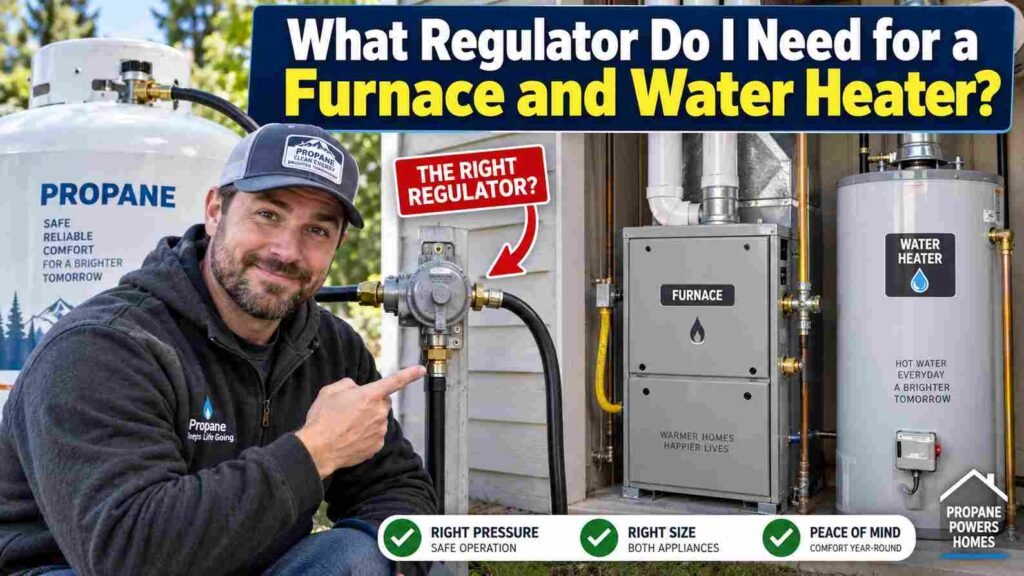
If you are trying to figure out what propane regulator you need for a furnace and water heater, I would not choose one by tank size or pipe connection alone. I start with three things: the required outlet pressure, the combined BTU load, and the type of propane system already installed.
In most residential propane systems, the furnace and water heater are designed to receive low-pressure propane at roughly 11 inches water column. But that does not mean every regulator labeled “11-inch” is automatically correct. The regulator also has to handle the total gas demand, work with the pressure feeding it, and maintain stable pressure when both appliances run together.
In this guide, I’ll show you how I determine the correct regulator type, how I calculate the combined BTU demand, what pressure ranges matter, when a two-stage system is appropriate, and when a 2-PSI system may be used instead.


What Type of Regulator Is Normally Used for a Furnace and Water Heater?
For a normal residential propane installation, the final regulator feeding the house is commonly a second-stage low-pressure regulator or an integral two-stage regulator. Its job is to reduce propane pressure to the low pressure required by household appliances.
RegO describes its residential second-stage regulators as units that reduce first-stage pressure—commonly around 10 PSIG—down to normal burner pressure, typically around 11″ w.c. RegO also identifies these regulators as suitable for normal domestic loads. Cavagna likewise offers second-stage regulators set for low-pressure residential service, including models with 11″ w.c. outlet settings.
The two common layouts I see are:
| System Type | Typical Arrangement | Where It Fits |
|---|---|---|
| Integral two-stage regulator | Tank pressure reduced through two stages inside one regulator body | Many residential systems with relatively simple layouts |
| Separate first-stage + second-stage regulators | First stage reduces tank pressure to an intermediate pressure; second stage reduces it to appliance pressure | Common for larger systems, longer runs, multiple buildings, or more flexible system design |
If you want more background on why two regulators are often used, I explain the layout in Do I Need 2 Regulators for Propane?.


What Pressure Should the Regulator Supply?
For many residential propane furnaces and water heaters, the building gas system is designed around a nominal supply pressure of about 11 inches water column. That is roughly 0.4 PSI.
However, I never assume the exact pressure from a generic rule. I check the appliance nameplate and installation manual because the appliance manufacturer specifies the allowable inlet-pressure range.
| Pressure Point | Typical Residential Propane Value | Important Note |
|---|---|---|
| Second-stage regulator outlet | About 11″ w.c. | Must match the appliance and system design |
| First-stage regulator outlet | Often around 10 PSIG in traditional two-stage systems | This is not appliance pressure |
| 2-PSI system distribution pressure | About 2 PSIG | Requires a line regulator downstream before standard low-pressure appliances |
| Appliance manifold pressure | Manufacturer-specific | Do not confuse manifold pressure with regulator outlet pressure |
If 11″ w.c. is unfamiliar, see my guide What Does 11 Inches Water Column Mean for Propane?.
How Much BTU Capacity Does the Regulator Need?
Pressure is only half the problem. The regulator also needs enough flow capacity to supply the furnace and water heater at the same time.
I calculate the connected load by adding the appliance input ratings:

If the furnace is 100,000 BTU/hr and the water heater is 40,000 BTU/hr:
I would therefore want a regulator that can reliably supply at least that connected load under the expected inlet-pressure conditions. If other appliances such as a range, dryer, fireplace, generator, or pool heater use the same regulator, I add those too.
Example Furnace and Water Heater Loads
| Furnace Input | Water Heater Input | Combined Connected Load |
|---|---|---|
| 60,000 BTU/hr | 40,000 BTU/hr | 100,000 BTU/hr |
| 80,000 BTU/hr | 40,000 BTU/hr | 120,000 BTU/hr |
| 100,000 BTU/hr | 40,000 BTU/hr | 140,000 BTU/hr |
| 100,000 BTU/hr | 75,000 BTU/hr | 175,000 BTU/hr |
| 100,000 BTU/hr | 199,000 BTU/hr tankless | 299,000 BTU/hr |
The last example shows why I pay special attention to tankless water heaters. A high-output tankless unit can consume more propane than the furnace, so replacing a 40,000 BTU/hr storage water heater with a 199,000 BTU/hr tankless model can completely change the regulator and piping requirements.
For the full calculation method, see How Do I Calculate the BTU Capacity Needed for a Propane Regulator?.


Do I Need a Regulator Rated Exactly for My BTU Load?
No. I do not try to find a regulator whose published BTU capacity exactly matches the appliances. I want adequate capacity at the actual operating conditions.
A regulator may be advertised with a large maximum capacity, but that number is tied to specified inlet and outlet conditions. RegO’s selection guidance emphasizes checking regulator performance at the expected load and at the minimum anticipated inlet pressure. That is important because regulator capacity and outlet-pressure behavior change as inlet pressure and flow change.
For example, RegO lists one residential second-stage model with a factory delivery pressure of 11″ w.c. at 10 PSIG inlet and a propane vapor capacity of 935,000 BTU/hr. That does not mean every furnace-and-water-heater system needs a regulator anywhere near that size; it simply illustrates that domestic second-stage regulators are offered in capacities capable of supporting multiple household appliances.
Is a Single-Stage Regulator Enough?
For a permanent residential furnace and water heater system, I generally expect a properly designed two-stage arrangement rather than a simple grill-style single-stage regulator.
Two-stage regulation improves pressure control as tank pressure changes with temperature, fill level, and appliance demand. A first-stage regulator reduces the high and variable tank pressure to an intermediate pressure. The second stage then reduces that intermediate pressure to the low pressure required by the appliances.
An integral two-stage regulator performs both pressure-reduction steps in one assembly. A separate two-regulator system places the first-stage regulator near the tank and the second-stage regulator near the building or appliance distribution point.
I would not use a barbecue regulator to feed a home furnace and water heater. Outdoor cooking regulators may also deliver 11″ w.c., but they are designed for different applications, connections, capacities, venting arrangements, and safety requirements.
When Would I Use a 2-PSI Propane System?
Some homes use a 2-PSI distribution system instead of running the entire building at 11″ w.c. In that layout, a regulator reduces the first-stage pressure down to approximately 2 PSI, and separate line-pressure regulators near appliance groups reduce the pressure again to nominal appliance pressure.
RegO states that its 2-PSI second-stage regulators reduce approximately 10 PSIG first-stage pressure to 2 PSIG and that a downstream line regulator is then required to reduce the 2 PSIG to nominal 11″ w.c.
A 2-PSI system can be useful because higher distribution pressure can carry more gas through smaller pipe over long distances. But it must be designed correctly. I would never connect a standard furnace or conventional water heater directly to a 2-PSI line unless the appliance and its listed controls are specifically designed for that pressure.
Does the Water Heater Type Change the Regulator I Need?
Yes, mainly because the water heater’s BTU demand can change dramatically.
Storage-Tank Water Heater
A conventional residential storage water heater may have an input around 30,000 to 50,000 BTU/hr, although the exact rating varies. When combined with a typical furnace, the total load may remain modest.
High-Recovery Water Heater
High-recovery models can have substantially higher burner input. That extra demand must be added to the furnace load.
Tankless Water Heater
This is the one I watch closely. Whole-house tankless propane water heaters can have input ratings approaching or exceeding 199,000 BTU/hr. Add a 100,000 BTU/hr furnace, and the pair alone may demand nearly 300,000 BTU/hr before I count a range, dryer, fireplace, or generator.
Does the Furnace Size Change the Regulator?
Yes. I use the furnace’s input rating, not its heating output.
If a furnace says 100,000 BTU/hr input and 95,000 BTU/hr output, I use the 100,000 BTU/hr number for propane supply sizing. The regulator and piping must supply the fuel going into the furnace, not the heat that remains after combustion efficiency is considered.
The same principle applies to the water heater. I use the gas input stated on the appliance nameplate or installation manual.
What If Both Appliances Work Alone but Not Together?
If the furnace works normally by itself and the water heater works normally by itself, but pressure drops or one appliance shuts down when both run, I start looking for a capacity or pressure-drop problem.
Possible causes include:
- a regulator that cannot maintain outlet pressure at the combined load;
- undersized gas piping;
- a long pipe run with too much pressure loss;
- low first-stage pressure;
- insufficient propane vaporization from the tank in cold weather;
- a restricted valve, fitting, excess-flow device, or regulator;
- incorrect regulator adjustment; or
- an appliance-specific problem.
This is exactly why I do not diagnose a regulator from static pressure alone. A system may look fine with little or no gas flowing but fall below acceptable pressure when the furnace and water heater fire together.
If pressure drops when another appliance starts, see Why Does Propane Pressure Drop When I Turn On Another Appliance?.
Why Pipe Size Matters Just as Much as Regulator Size
A regulator with enough BTU capacity cannot overcome undersized piping.
Imagine I have a regulator capable of supplying 500,000 BTU/hr, but the pipe between the regulator and appliances is only sized for 150,000 BTU/hr at that length and pressure. The regulator is not the bottleneck—the pipe is.
When I evaluate a furnace and water heater system, I therefore check:
- total connected BTU load;
- length of each piping section;
- pipe material and inside diameter;
- system pressure;
- number and location of branches;
- load downstream of each branch; and
- the applicable sizing table for the installation.
Each pipe section is sized for the load downstream of that section. The main line may carry both the furnace and water heater load, while the final branch to the water heater carries only the water heater load.
What About the Propane Tank?
The tank also needs to vaporize propane fast enough to supply the furnace and water heater, particularly during cold weather.
A regulator does not create propane vapor. It can only control the gas supplied to it. If the tank cannot vaporize enough propane at the outdoor temperature and current liquid level, inlet pressure can fall and appliance performance can suffer even when the regulator itself is correctly sized.
This is especially relevant with large furnaces, tankless water heaters, generators, and smaller propane containers during winter.
Technical Checklist: Furnace + Water Heater Regulator Selection
| Item to Check | What I Look For |
|---|---|
| Furnace input | BTU/hr input from rating plate |
| Water heater input | BTU/hr input from rating plate |
| Other connected loads | Range, dryer, fireplace, generator, pool heater, etc. |
| Required appliance inlet pressure | Manufacturer-specified minimum and maximum |
| Regulator outlet pressure | Commonly nominal 11″ w.c. for low-pressure residential LP systems |
| Regulator inlet pressure | Must match first-stage or upstream system design |
| Regulator capacity | Enough at the actual inlet/outlet pressure conditions |
| Pipe capacity | Enough for downstream load at actual pipe length |
| Tank vaporization | Adequate at expected temperature and fill level |
| Vent location | Installed and oriented according to regulator instructions and applicable code |
Can I Use One Regulator for Both the Furnace and Water Heater?
Yes. In many homes, one properly sized second-stage or integral two-stage regulator supplies the entire low-pressure gas system, including the furnace and water heater.
The regulator does not need to be dedicated to one appliance as long as its pressure setting, capacity, and installation are correct for the total connected load.
If you also have a range, dryer, fireplace, or other propane equipment on the same system, I include all of those appliances in the connected-load calculation.
Do the Furnace and Water Heater Have Their Own Regulators?
Many gas appliances contain internal gas valves and pressure-regulating components, but those do not replace the propane system regulator outside the appliance.
The building regulator supplies gas to the appliance within the inlet-pressure range specified by the appliance manufacturer. The appliance gas valve then controls burner operation and manifold pressure as designed.
This is another reason I do not try to “adjust” a house regulator just to change burner flame appearance. Regulator adjustment should be based on measured system pressure and manufacturer requirements.
Can I Install or Replace the Regulator Myself?
I do not recommend treating a whole-house propane regulator like a simple screw-on appliance accessory. The regulator is part of the fuel-gas safety system.
Installation can involve regulator selection, vent placement, piping modifications, leak testing, lock-up testing, flow testing, pressure measurements, and appliance checks. An incorrect regulator or an improperly located vent can create a serious fire, explosion, or carbon-monoxide hazard.
If the regulator needs replacement or the system is being modified for a new furnace or water heater, I recommend using a qualified propane technician or licensed gas fitter and following the appliance manufacturer instructions and local code. For more detail, see Can I Install a Propane Regulator Myself, or Do I Need a Professional?.
Frequently Asked Questions
What propane regulator pressure do I need for a furnace?
Many residential propane furnaces are supplied by a low-pressure system with a nominal regulator outlet around 11″ w.c., but I always verify the furnace manufacturer’s inlet-pressure range before selecting or adjusting a regulator.
What propane regulator pressure do I need for a water heater?
Many residential propane water heaters also use low-pressure propane supplied at roughly 11″ w.c. system pressure. The exact acceptable inlet range is listed on the appliance rating plate or installation manual.
Can a 100,000 BTU regulator run a 100,000 BTU furnace and a water heater?
No—not if the water heater is also supplied through that regulator. A 100,000 BTU/hr furnace plus a 40,000 BTU/hr water heater creates at least 140,000 BTU/hr of connected load, before any other appliances are added.
Do I need a 200,000 BTU regulator for a 100,000 BTU furnace?
Not based on the furnace alone. I calculate the total connected load and then verify regulator performance at the required pressure conditions. The published capacity should not be treated as the only selection criterion.
What if I replace my storage water heater with a tankless model?
I recalculate the entire gas load. A tankless water heater can have a much higher input rating than a conventional storage heater, which may require changes to the regulator, piping, or propane tank arrangement.
Can a bad or undersized regulator make the furnace shut off?
Yes, inadequate gas pressure under load can contribute to ignition problems or shutdowns, but the regulator is only one possible cause. Piping restrictions, low tank pressure, poor vaporization, appliance controls, or combustion problems can produce similar symptoms.
Bottom Line
For a typical propane furnace and water heater, I normally expect a low-pressure second-stage regulator or integral two-stage regulator that supplies approximately 11 inches water column to the house gas system.
But the pressure setting alone does not tell me which regulator to buy. I add the furnace and water heater input ratings, include every other appliance on the same regulator, check the regulator’s capacity at the actual inlet and outlet conditions, and confirm that the piping and propane tank can support the same load.
A 100,000 BTU/hr furnace and 40,000 BTU/hr water heater create a 140,000 BTU/hr connected load. A 100,000 BTU/hr furnace combined with a 199,000 BTU/hr tankless water heater creates a 299,000 BTU/hr load. Those two systems can require very different gas-supply designs even though both contain “a furnace and a water heater.”
If you are replacing a regulator, adding a high-BTU water heater, or troubleshooting pressure loss when both appliances run, I recommend having a qualified propane professional verify the BTU load, regulator type, pressure settings, pipe sizing, tank vaporization capacity, leak tightness, and appliance inlet pressure under load.
Technical References

Mike is an experienced propane technician with over 15 years of professional experience in the field. He has dedicated his career to helping customers with their propane needs, from installation to maintenance and repair. Together with Jeremy, he co-founded this website to provide useful information and guidance to customers seeking reliable propane services.


