
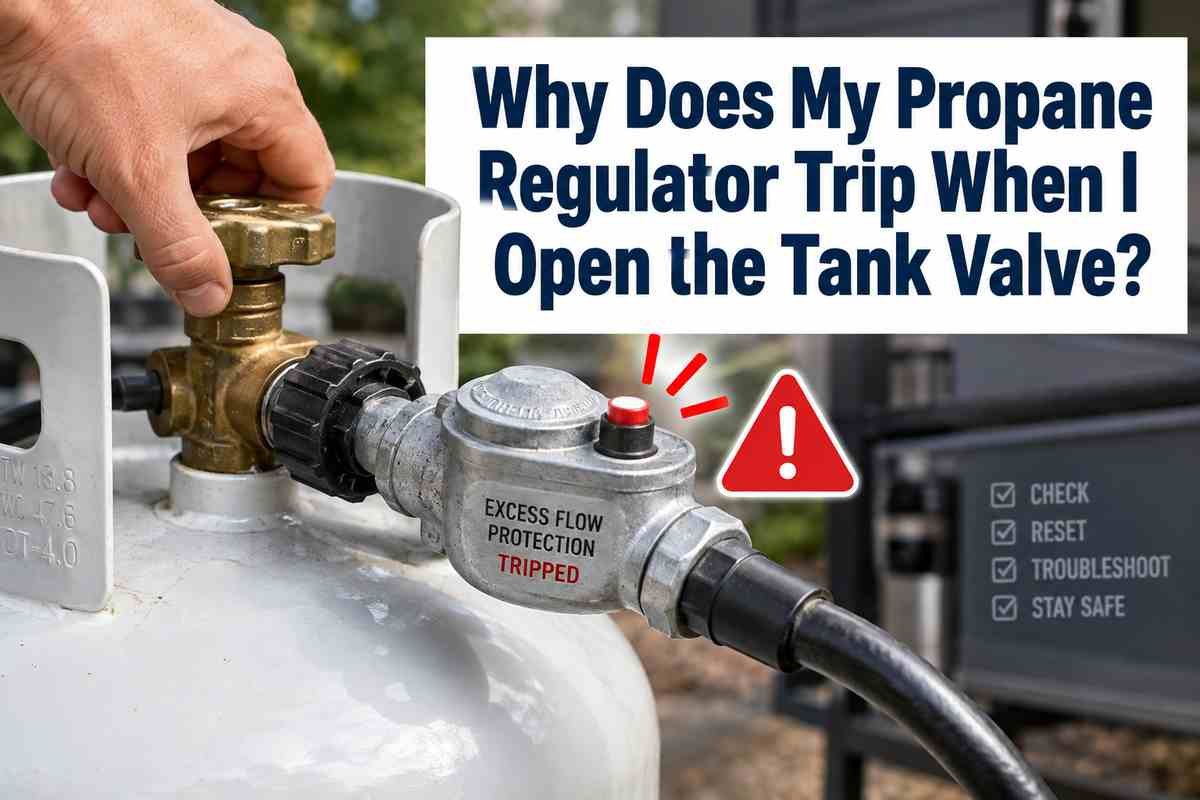
Quick Answer: If your propane regulator seems to “trip” as soon as you open the tank valve, the regulator itself often is not what is tripping. On many portable propane systems, a built-in excess-flow device in the Type I/QCC connector, POL fitting, hose assembly, or cylinder valve can restrict gas when it senses a sudden rush of flow. Opening the tank valve too quickly, leaving an appliance control open, or having a real leak can trigger it. I would first shut the appliance controls off and follow the connector or appliance manufacturer’s reset procedure before assuming the regulator is bad.
Common Causes
| What You Notice | Possible Cause | What I Would Check |
|---|---|---|
| Very small flame right after opening the tank | Excess-flow device activated | Appliance controls off, connection seated, manufacturer reset procedure |
| No useful gas flow after reconnecting a cylinder | QCC/POL connection not fully engaged or excess-flow restriction | Connector condition and correct attachment |
| Restriction happens every time, even with slow opening | Leak, damaged connector, wrong component, regulator fault, or excessive demand | Stop repeated resets and have the system inspected |
| Strong propane odor or sustained hissing | Possible leak | Stop troubleshooting and follow propane leak procedures |
| Flow is normal at first, then drops later | Regulator, tank vaporization, freezing, or load issue | Look beyond an excess-flow trip |
The Regulator Usually Is Not the Part That “Trips”
This is where the terminology gets confusing. Most ordinary low-pressure propane regulators used on grills, heaters, RVs, and portable appliances do not have a homeowner-style reset button that “trips” like an electrical breaker.
Instead, the restriction may be in the cylinder connection or another excess-flow component upstream of the regulator. Marshall Excelsior’s Type I/QCC connector instructions explain that the connector will not allow propane to flow until it is fully engaged and that its excess-flow feature can activate if the cylinder valve is opened too quickly.


Emerson’s Fisher excess-flow valve guidance describes the same basic safety principle: excess-flow valves close when flow exceeds their setting and reopen after pressure equalizes.
If you want a broader look at regulator symptoms, I would also compare the problem with my guide on how to tell whether a propane regulator is working properly.
Why Opening the Propane Tank Valve Too Fast Can Trigger It
When the propane line is empty or at very low pressure, opening the tank valve quickly can send a sharp surge of gas into the hose, regulator, and appliance piping. An excess-flow device reacts to flow rate; it does not know whether that sudden rush is caused by normal startup or by a broken hose.
That is why slow valve opening matters on systems that use this type of protection. Giving the downstream line time to pressurize reduces the initial surge.


An Open Burner or Appliance Valve Can Make the Surge Worse
Before opening the propane cylinder, make sure the connected appliance controls are in the OFF position unless the manufacturer specifically says otherwise. If a burner valve is already open, the downstream system does not simply pressurize—it immediately starts passing gas toward the burner. That can produce more flow and make an excess-flow device more likely to react.
One mistake I would avoid is repeatedly opening and closing the cylinder while an appliance control remains open. That can make diagnosis harder and, depending on the equipment, may allow unburned propane into the appliance area.
If the system keeps shutting down during normal use rather than only at startup, see my separate guide on why a propane regulator keeps shutting off.
A Real Leak Can Trigger the Same Safety Device
This is the part I would take most seriously. Excess-flow protection is not there only to annoy you when the valve is opened too quickly. It is intended to reduce flow during abnormally high discharge, such as a damaged hose or large leak.
If the restriction returns every time, do not keep resetting the system and assume everything is fine. Check for obvious hose damage, loose or damaged connectors, and any sign that the system is leaking. If you smell propane or hear sustained hissing, stop troubleshooting.

The Propane Education & Research Council (PERC) advises people who suspect a propane leak to avoid flames and sparks, leave the area, shut off the gas only if it is safe to do so, report the leak from a safe location, and have the system checked before propane appliances are used again.
For more detail on leaks around this component, see why a propane regulator may appear to be leaking.
How to Reset an Excess-Flow Restriction Safely
There is no one universal reset procedure for every propane connector, regulator, RV, grill, heater, or appliance. I recommend following the instructions for the exact equipment you own.
For example, Marshall Excelsior’s Type I/QCC connector instructions say that if the excess-flow device is activated, the appliance control valves should be closed and the system should be allowed at least 60 seconds to equalize. The company notes that a longer equalization period may be necessary with a longer hose. The cylinder is then used according to the appliance manufacturer’s lighting procedure.


MB Sturgis gives similar guidance for systems containing flow-limiting devices: open the LP-gas container valve slowly and allow time for pressures to equalize before operating gas appliances.
I would use this sequence as a decision process rather than a universal repair procedure:
- Turn the appliance controls off.
- Check the connector. Make sure the approved QCC, POL, or other fitting is correctly and fully engaged according to its instructions.
- Follow the manufacturer’s reset/equalization instructions. Do not improvise by removing safety parts.
- Reopen the cylinder valve slowly when the instructions call for it.
- Light or start the appliance exactly as its manufacturer specifies.
- If the restriction immediately returns, stop repeating the reset. Investigate a leak, damaged component, incorrect sizing, or regulator fault.
Why You May Still Get a Tiny Flame
Some excess-flow devices use a small equalizing passage. That allows pressure on both sides of the device to slowly equalize so the valve can reopen. Depending on the design, you may see extremely limited flow rather than a perfect zero-flow condition.
This is why a grill or heater may produce a tiny weak flame after the safety device activates. The weak flame does not necessarily mean the regulator has suddenly changed its outlet pressure setting.
If low pressure continues after proper startup, you can compare the symptoms with my guide on how propane regulator pressure is checked. Pressure testing on a system with unresolved leak or flow problems should be handled by a qualified propane technician.
The QCC Connector May Not Be Fully Engaged
Another problem that can look like a “tripped regulator” is an incomplete cylinder connection. Type I/QCC connectors commonly include a positive shutoff feature. Marshall Excelsior states that gas will not flow until the connector is fully engaged.
So if you have just replaced a grill cylinder and suddenly have no flow, I would check the basics before condemning the regulator:
- Is the handwheel properly threaded onto the cylinder valve?
- Is the connector damaged, cross-threaded, or unusually loose?
- Is the sealing surface or gasket damaged?
- Are you using the correct connector for that cylinder and appliance?
Do not force a connector that does not fit correctly, and do not modify the internal safety mechanism.
Could the Regulator Actually Be Bad?
Yes, but the timing matters. A regulator can fail, become contaminated, freeze, develop a damaged diaphragm, or become internally restricted. Those problems can also create low flow or unstable appliance operation.
I would suspect the regulator more strongly if:
- the same problem occurs with multiple known-good cylinders;
- the cylinder valve is opened correctly and slowly but flow remains poor;
- outlet pressure is unstable or outside specification;
- the regulator vent smells like propane or discharges gas;
- the regulator is visibly corroded, damaged, or contaminated; or
- the problem appears during normal operation rather than only at tank-valve opening.
If the regulator will not recover after the correct procedure, my guide on what to do when a propane regulator will not reset covers the broader troubleshooting path.
High-BTU Appliances Can Create a Different Kind of Flow Problem
A large propane appliance can require more gas than a small hose, connector, regulator, or cylinder system can deliver. Generators, construction heaters, large burners, commercial cookers, and other high-output equipment may require a much higher flow rating than a basic grill setup.
If the system works with a small burner but restricts flow every time a high-BTU appliance starts, I would have the entire supply arrangement checked against the appliance’s required BTU input, inlet pressure, hose size, regulator capacity, and excess-flow rating.
Do not remove or bypass the excess-flow feature to get more propane. The correct solution is a properly sized propane supply system.
Regulator Trip vs. Excess Flow vs. Low Tank Vaporization
| Symptom Pattern | More Likely Explanation | Key Clue |
|---|---|---|
| Restriction happens immediately when tank valve opens | Excess-flow activation | Sudden startup event |
| Tiny flame after reconnecting cylinder | Excess-flow restriction or incomplete connector engagement | Started after cylinder change |
| Flow starts normal, then weakens during heavy use | Tank vaporization, sizing, regulator, or freezing issue | Delayed rather than immediate |
| Gas odor or hissing | Possible leak | Stop troubleshooting and treat as a leak |
| Pressure remains wrong with careful startup | Possible regulator or system fault | Problem persists beyond initial opening |
What I Would Check First
If this were my propane system, I would focus on the timing of the failure. If the appliance works normally until the cylinder is changed, then immediately develops a tiny flame after I open the valve, I would first look at the cylinder connection and excess-flow behavior.
If the problem happens even when the valve is opened slowly and all appliance controls are off, I would stop treating it as a simple reset problem. At that point the next checks are connection condition, leaks, hose restriction, regulator performance, and whether the propane supply is properly sized for the appliance.
When to Stop Troubleshooting and Call a Professional
I recommend professional service if the flow restriction keeps coming back, the regulator or connector is visibly damaged, the system serves a home or large fixed appliance, or there is any uncertainty about a leak.
PERC advises using a qualified professional for propane system installations, service, and component work. That is especially important when diagnosis requires leak testing, pressure testing, regulator replacement, or changes to gas piping.
You should also stop immediately if you smell propane, hear escaping gas, see a damaged hose, or suspect a connection has failed. A recurring “trip” can be a safety device responding to a real problem.
Frequently Asked Questions
Does a propane regulator have a reset button?
Most ordinary propane regulators do not have a reset button like an electrical breaker. What many people call “resetting the regulator” is actually allowing an excess-flow device or safety connection to equalize and restore normal flow. Follow the instructions for your exact connector and appliance.
Why does my grill have only a tiny flame after I open the propane tank?
A tiny flame immediately after opening or reconnecting the cylinder can be caused by an activated excess-flow device. It can also happen if the QCC connector is not fully engaged. If proper manufacturer startup does not restore normal flow, inspect the system instead of repeatedly resetting it.
How long does an excess-flow valve take to reset?
It depends on the device and the volume of the downstream hose or piping. Marshall Excelsior specifies waiting at least 60 seconds for its Type I/QCC connector after activation and notes that longer hoses may require more equalization time. Always follow the manufacturer’s procedure for your equipment.
Can opening a propane tank too slowly cause a problem?
Opening slowly is commonly recommended for Type I/QCC systems because it reduces the initial surge that can activate excess-flow protection. Once the system has equalized, follow the equipment manufacturer’s instructions for the final valve position and appliance operation.
Can a propane leak make the excess-flow valve trip?
Yes. A significant leak or broken hose can create the high flow that an excess-flow device is designed to detect. If the restriction keeps returning or you smell propane, do not assume it is a harmless false trip.
Should I replace the regulator if this keeps happening?
Not automatically. First rule out an excess-flow device, incomplete connector engagement, leak, damaged hose, or sizing problem. Replace the regulator when testing or inspection shows that the regulator itself is defective or inappropriate for the application.
Bottom Line
If my propane system seemed to trip the instant I opened the tank valve, I would first suspect excess-flow protection rather than immediately blaming the regulator. Start with the appliance controls off, make sure the connector is properly engaged, follow the manufacturer’s equalization/reset procedure, and open the supply as instructed. If the problem comes right back—or there is any odor, hissing, damage, or suspected leak—stop resetting it and have the propane system checked.

Mike is an experienced propane technician with over 15 years of professional experience in the field. He has dedicated his career to helping customers with their propane needs, from installation to maintenance and repair. Together with Jeremy, he co-founded this website to provide useful information and guidance to customers seeking reliable propane services.


