
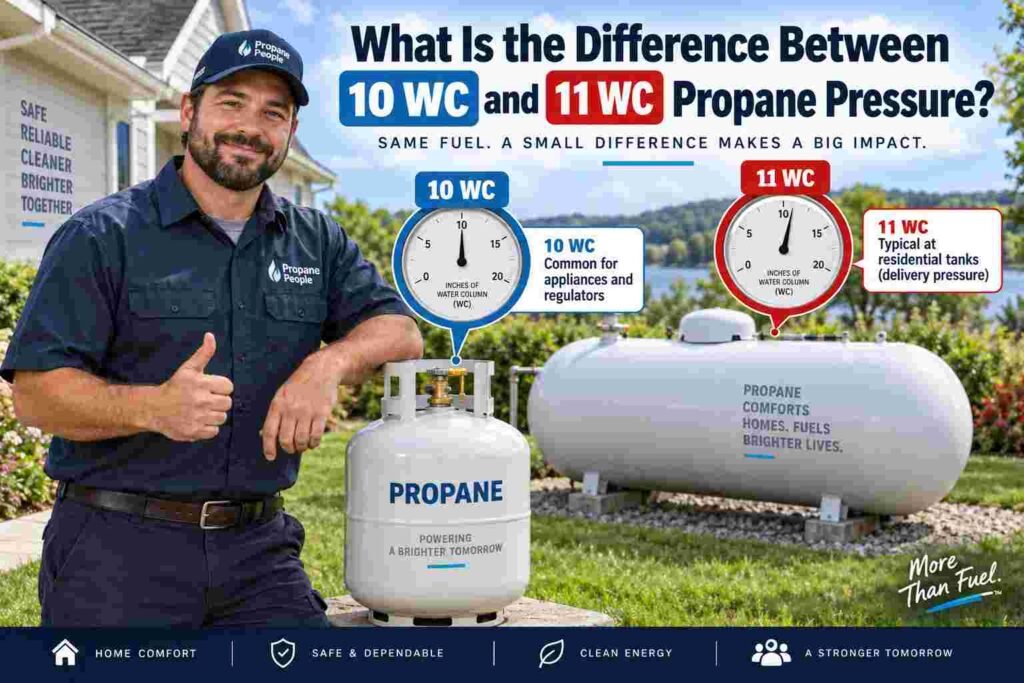
If you are comparing 10 WC vs 11 WC propane pressure, the numbers look almost identical, but they can refer to two different points in the gas system. That is why I do not judge a pressure reading until I know where it was taken, whether the appliance was running, and what pressure the manufacturer actually requires.
In this guide, I will show you exactly what 10 and 11 inches of water column mean, how much difference there really is between them, why both values appear in propane systems, and what I would check if your manometer is reading 10 instead of 11 WC.
10 WC vs 11 WC Propane Pressure: Technical Comparison
First, here is the direct numerical comparison. Water column is a very small pressure unit, which makes it useful for measuring the low gas pressures found downstream of a propane regulator.
| Pressure | PSI | kPa | Approx. mbar | Typical Context |
|---|---|---|---|---|
| 10″ WC | 0.361 psi | 2.49 kPa | 24.9 mbar | Common appliance manifold value on some LP appliances |
| 11″ WC | 0.397 psi | 2.74 kPa | 27.4 mbar | Common low-pressure propane delivery/regulator setting |
| Difference | 0.036 psi | 0.249 kPa | 2.49 mbar | 1″ WC |
According to NIST pressure conversion data, 1 inch of water is approximately 0.0361 psi. So when I move from 10 WC to 11 WC, the absolute pressure increase is small: about thirty-six thousandths of one psi.
Percentage-wise, however, going from 10 to 11 WC is a 10% increase in pressure. Going the other direction, from 11 down to 10 WC, is about a 9.1% reduction. That sounds significant, but it does not automatically mean gas flow or appliance input changes by the same percentage. Burner flow depends on orifice size, gas density, regulator behavior, and pressure differential.
What Does 11 Inches Water Column Mean in a Propane System?
When I see 11″ WC in residential propane work, I usually think of the low-pressure side of the system after the final regulator. A common second-stage or integral two-stage regulator reduces much higher propane pressure to a pressure around 11 inches water column.
RegO, for example, lists standard low-pressure regulators with factory delivery pressure of 11″ WC. Its service guidance also says regulator delivery pressure should be checked at the appliance under load, with approximately half of the total appliance load operating, and that the gauge should read 11 inches water column. RegO also warns that appliance regulators may be preset lower than 11 WC.


That last point is extremely important. I can have 11 WC entering an appliance and still measure 10 WC at the burner manifold because the appliance gas valve or internal regulator intentionally reduces the pressure again.
What Does 10 Inches Water Column Mean for Propane?
Ten inches WC is also a normal propane pressure in the right application. I commonly see 10″ WC listed as the manifold pressure for specific propane appliances. The manifold is downstream of the appliance gas control and feeds gas to the burner orifices.
For example, Suburban lists a manifold pressure of 10″ WC for one of its LP griddles, while also specifying a maximum inlet pressure of 13″ WC. That illustrates why 10 and 11 WC can both be correct in the same general propane system: one number may describe pressure supplied to the appliance, while the other describes pressure after the appliance’s own regulating components.
I never assume that 10″ WC is the correct manifold pressure for every furnace, water heater, range, dryer, fireplace, or generator. Some equipment uses 10.5 WC, some uses 11 WC, and specialized equipment can use entirely different pressures. The data plate and service manual are the authority.
The Main Difference: Supply Pressure vs. Manifold Pressure
The easiest way I explain the difference is to think of the propane system as a series of pressure reductions.
| Location | Possible Pressure | What It Means |
|---|---|---|
| Propane container | Varies widely with temperature | High vapor pressure; not 10 or 11 WC |
| After first-stage regulator | Often several PSI, commonly around 10 PSI in two-stage systems | Intermediate pressure |
| After second-stage regulator | Often around 11″ WC | Low-pressure building/appliance supply |
| Appliance inlet | Must meet appliance specified inlet range | Pressure available to appliance gas control |
| Appliance manifold | Often about 10″ WC on some LP equipment | Pressure feeding burner orifices |
So if you tell me, “My propane pressure is 10 inches WC,” my next question is: Where did you measure it? Ten WC at a burner manifold may be exactly right. Ten WC at the inlet of an appliance that requires 11 WC minimum under load could indicate a supply problem.
Is 10 WC Too Low for Propane?
Not necessarily. Ten WC is only “too low” if it is below the specified pressure for the point you are testing.
If the appliance manufacturer specifies a 10 WC manifold pressure and you measure 10 WC while the burner is operating correctly, the reading can be normal. On the other hand, if you are checking a propane regulator that should deliver 11 WC under load and it is only holding 10 WC, I would investigate why.
The important distinction is between target pressure and measured pressure. A manometer reading has no meaning without a target value.
When 10 WC may be normal
- The appliance rating plate specifies 10″ WC manifold pressure.
- The pressure is measured downstream of the appliance’s internal regulator.
- The manufacturer’s inlet and manifold specifications are both satisfied.
- The burner flame, combustion, and input are within manufacturer requirements.
When 10 WC may indicate a problem
- The final system regulator is supposed to maintain approximately 11″ WC under load.
- The appliance minimum inlet pressure is above your measured value.
- Pressure starts near 11 WC with no load but falls toward 10 WC or lower as appliances turn on.
- Multiple propane appliances become weak at the same time.
- A pressure drop is accompanied by ignition problems, low flame, incomplete heating, or nuisance shutdowns.
Is 11 WC Too High for a Propane Appliance?
Again, it depends on where I measure it. Eleven WC at the inlet to a propane appliance is very common. Eleven WC at a manifold specifically rated for 10 WC may be above its intended setting.
I do not recommend adjusting an appliance gas valve simply because you expect to see a round number. Manufacturer settings vary, and changing manifold pressure can alter burner input and combustion. If an appliance needs adjustment, I would use the manufacturer’s service procedure and combustion requirements rather than a generic rule.
How Much Pressure Is One Inch of Water Column?
Water column is useful because propane appliance pressure is so low that PSI alone becomes awkward. One inch WC is only around 0.036 psi.
| Inches WC | Approx. PSI | Approx. kPa |
|---|---|---|
| 1″ WC | 0.0361 psi | 0.249 kPa |
| 5″ WC | 0.181 psi | 1.245 kPa |
| 10″ WC | 0.361 psi | 2.491 kPa |
| 11″ WC | 0.397 psi | 2.740 kPa |
| 13″ WC | 0.470 psi | 3.238 kPa |
If you want to convert between these units yourself, see my guide on converting propane PSI to inches of water column.
Why Propane Regulators Are Commonly Set Around 11 WC
A propane container can have vapor pressure measured in many PSI depending on temperature. That is far too high for a typical low-pressure appliance. The regulator reduces that pressure to a small, controlled value that the building piping and appliances can use.
For standard low-pressure propane service, manufacturers such as RegO commonly offer second-stage or two-stage regulators factory-set at 11 WC. A representative RegO model has an adjustment range of 9 to 13 WC with an 11 WC factory setting.
That does not mean I should casually turn the regulator adjustment screw until a gauge reads whatever number I want. Regulator sizing, inlet pressure, load, piping, vent orientation, lock-up behavior, and manufacturer instructions all matter.
If you are diagnosing regulator pressure, you may also want my step-by-step article on how to check propane regulator pressure.
Static Pressure and Flow Pressure Are Not the Same
This is one of the most common mistakes I see when people compare 10 WC with 11 WC. They take a reading when nothing is running, see 11 WC, and assume the system is fine.
What I really care about is what happens under load. A system can show acceptable static pressure but experience excessive pressure drop when burners turn on.
| Test Condition | Example Reading | Possible Interpretation |
|---|---|---|
| No appliances operating | 11.5 WC | Static/lock-up-related reading; not enough to judge flow performance |
| Moderate appliance load | 11.0 WC | May be normal if specification calls for 11 WC supply |
| Full appliance load | 10.0 WC | May indicate excessive droop or restriction if regulator should maintain higher pressure |
| Appliance manifold | 10.0 WC | Could be exactly correct if appliance specifies 10 WC manifold pressure |
Those numbers are examples, not universal pass/fail limits. I would compare the actual reading with the regulator and appliance manufacturer’s specifications.
Why Pressure Can Drop From 11 WC to 10 WC
If the pressure point is supposed to stay near 11 WC but falls to 10 WC when demand increases, I would look for a system problem rather than immediately adjusting the regulator.
1. Undersized gas piping
Pipe diameter and length directly affect pressure loss. A line that works with one small appliance can become inadequate when several appliances operate together. Long runs, too many fittings, or an undersized branch can create a pressure drop.
2. Regulator droop under load
Every regulator has flow characteristics. Outlet pressure can decrease as demand rises. Excessive drop can occur if the regulator is undersized, worn, restricted, incorrectly installed, or operating outside its intended inlet-pressure range.
3. Restricted valves or fittings
Partially closed valves, damaged flexible connectors, kinked tubing, debris, or improperly sized fittings can reduce flow. RegO specifically recommends inspecting for restrictions if pressure falls excessively when appliances are operating.
4. Low available vaporization
Cold weather, a small cylinder, or high demand can limit the rate at which liquid propane vaporizes. Tank pressure is a different measurement from 10 or 11 WC, but inadequate vapor supply upstream can eventually affect downstream performance.
5. Regulator icing, contamination, or damage
A regulator that cannot respond correctly to changing demand may show unstable or low outlet pressure. If pressure problems come with freezing, vent blockage, gas odor, or abnormal noises, I would stop treating it as a simple adjustment issue.
For broader symptoms and causes, see my guide to propane regulator valve problems.
What Happens If Propane Pressure Is Too Low?
If an appliance does not receive the inlet or manifold pressure it was designed for, burner input may be reduced. Depending on the appliance, you may notice weak flames, slow heating, delayed recovery, ignition difficulty, or shutdowns.
I would not use flame appearance alone as a pressure gauge. Combustion depends on fuel pressure, air supply, burner condition, orifice size, venting, and appliance design. A manometer and the manufacturer’s service data give me much more reliable information.
What Happens If Propane Pressure Is Too High?
Too much pressure can also create problems. Higher-than-specified manifold pressure can overfire a burner and push appliance input beyond its design. It may change flame behavior, combustion characteristics, heat exchanger temperatures, and emissions.
This is why I do not recommend “splitting the difference” or adjusting everything to 11 WC. If the data plate calls for 10 WC manifold pressure, I use that specification. If the regulator is supposed to supply 11 WC to the appliance inlet, I use that specification at the correct test point.
How I Would Test 10 WC vs 11 WC Pressure
A qualified technician typically uses a manometer connected to an approved pressure test port. The exact test procedure varies by regulator and appliance, but the diagnostic logic is consistent.
| Step | What I Check | Why It Matters |
|---|---|---|
| 1 | Appliance label/service manual | Establishes correct inlet and manifold specifications |
| 2 | Regulator model and rating | Confirms expected outlet range and capacity |
| 3 | Pressure at correct test port | Prevents confusing supply pressure with manifold pressure |
| 4 | Static/no-flow reading | Provides baseline and helps identify abnormal lock-up |
| 5 | Pressure under load | Shows whether supply holds when gas is flowing |
| 6 | Full system load if appropriate | Reveals undersized piping, restrictions, or capacity problems |
Propane is flammable, and pressure adjustment can affect combustion. If you are not trained to work on LP-gas systems, I recommend having a qualified propane technician perform pressure testing and adjustments.
10 WC vs 11 WC: Which One Should You Use?
I would not choose between 10 and 11 WC based on a general internet rule. I use the number specified for the component and test point.
If I am testing the outlet of a standard low-pressure propane regulator, 11 WC may be the intended target. If I am testing the manifold on an appliance whose rating plate specifies 10 WC, then 10 WC is the target. If the appliance specifies 10.5 WC, neither 10 nor 11 is automatically correct.
The safest rule is simple: match the pressure to the manufacturer’s specified test location and operating condition.
Frequently Asked Questions
Is 11 WC the standard propane pressure?
Eleven inches water column is a very common low-pressure propane regulator delivery setting, especially for residential and similar applications. It is not a universal pressure for every appliance or every point in the system.
Is 10 WC normal for propane?
Yes. Ten WC is a common manifold pressure on some propane appliances. It can be completely normal when specified by the manufacturer.
Can an appliance have 11 WC inlet pressure and 10 WC manifold pressure?
Yes. That is a common arrangement. The appliance’s internal gas control or regulator can reduce the inlet pressure to the specified manifold pressure.
How many PSI is 10 WC propane pressure?
Ten inches WC is about 0.361 psi.
How many PSI is 11 WC propane pressure?
Eleven inches WC is about 0.397 psi.
What is the exact difference between 10 WC and 11 WC?
The difference is 1 inch WC, approximately 0.0361 psi, 0.249 kPa, or 2.49 mbar.
Should I adjust my propane regulator from 10 WC to 11 WC?
Not without first confirming that the test point is supposed to be 11 WC and following the regulator manufacturer’s procedure. A 10 WC reading can be correct at an appliance manifold. If system pressure is actually low, the underlying cause may be piping, load, regulator capacity, restrictions, or another problem rather than adjustment alone.
Why does my pressure read 11 WC when nothing is running but 10 WC under load?
Pressure normally changes somewhat with flow, but whether that drop is acceptable depends on the regulator and appliance specifications. A large or abnormal drop can indicate regulator droop, undersized piping, a restriction, or insufficient upstream supply.
Bottom Line
The difference between 10 WC and 11 WC propane pressure is only 1 inch of water column, or about 0.036 psi. But the more important difference is often where those pressures are measured.
I commonly treat 11 WC as a low-pressure propane delivery value from the final system regulator, while 10 WC is a common manifold pressure for certain appliances. Those are examples, not universal settings.
If you measure 10 WC when you expected 11 WC, do not adjust anything until you confirm the correct test point, appliance inlet requirement, manifold specification, regulator rating, and whether the reading was taken under load. When I diagnose propane pressure, the manufacturer’s specification always comes before a generic number.
Technical Sources

Mike is an experienced propane technician with over 15 years of professional experience in the field. He has dedicated his career to helping customers with their propane needs, from installation to maintenance and repair. Together with Jeremy, he co-founded this website to provide useful information and guidance to customers seeking reliable propane services.


