
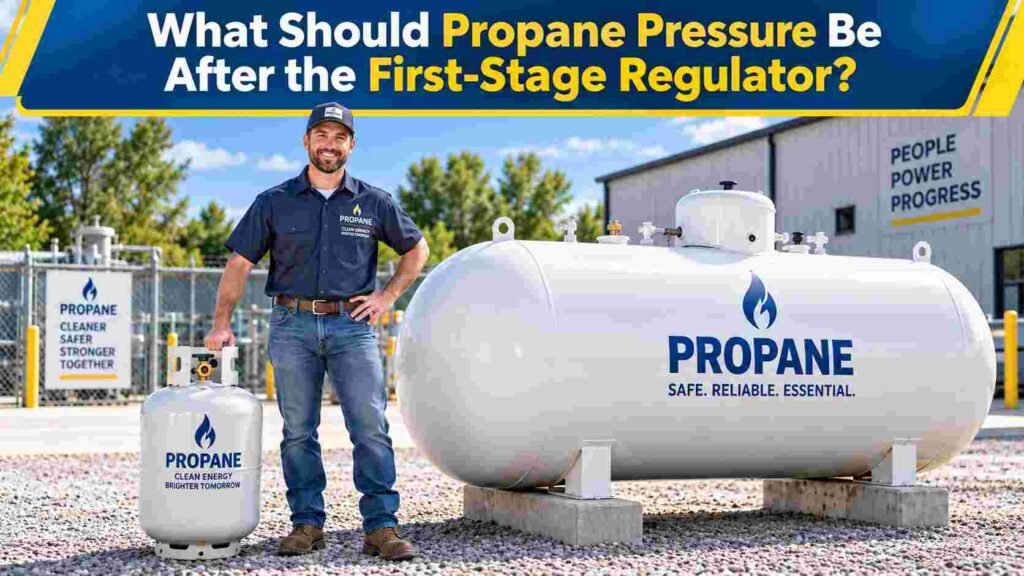
If you ask me, ‘What should propane pressure be after the first-stage regulator?’ the number I want you to remember is about 10 PSI for a conventional two-stage propane installation. But I also want you to understand what that number means, because confusing first-stage pressure with appliance pressure can lead to bad troubleshooting and, more importantly, unsafe adjustments.
The first-stage regulator is not normally supposed to reduce propane all the way to the pressure used by your furnace, water heater, range, or other appliance. Its job is to take the relatively high container pressure and reduce it to a stable intermediate pressure. A second-stage regulator then reduces that intermediate pressure to the low pressure used by the building’s gas piping and appliances.
What Should Propane Pressure Be After the First-Stage Regulator?
For many residential and light-commercial propane systems, I expect a properly selected first-stage regulator to deliver approximately 10 PSIG. Marshall Excelsior describes first-stage regulators as typically reducing container pressure to 10 PSI, and RegO offers domestic first-stage regulators factory-set to 10 PSIG. Some first-stage regulator models have an outlet adjustment range from approximately 5 to 10 PSIG, so the correct reading depends on the exact regulator and system design.
| Pressure Point | Typical Pressure | Approx. kPa | What It Means |
|---|---|---|---|
| After a conventional first-stage regulator | About 10 PSIG | 68.9 kPa | Intermediate pressure feeding the second stage |
| Possible first-stage adjustment range on some models | About 5-10 PSIG | 34.5-68.9 kPa | Model-specific; never assume without checking the data plate/manual |
| After a 2-PSI service regulator | About 2 PSIG | 13.8 kPa | Used in certain elevated-pressure distribution systems |
| After a conventional second-stage regulator | About 11 in. w.c. | About 2.74 kPa | Low-pressure building/appliance supply |
The important point is that 10 PSI after the first stage and 11 inches water column after the second stage are very different pressures. They are not two ways of saying almost the same thing. Ten PSI is roughly 25 times greater than 11 inches water column.
What Does the First-Stage Regulator Actually Do?
I like to think of a two-stage propane system as a controlled pressure staircase. The propane tank is at the top. Tank vapor pressure changes with temperature and propane composition, so it is far too high and too variable to send directly to most household appliances.
The first-stage regulator makes the first big pressure reduction. Instead of allowing full tank pressure into the long gas line, it supplies a much more manageable intermediate pressure—commonly around 10 PSI. That intermediate pressure travels toward the building, where the second-stage regulator makes the final reduction.
First-Stage vs. Second-Stage Propane Pressure
This is where I see the most confusion. If you put a gauge downstream of the first-stage regulator and read around 10 PSI, that may be completely normal. If you measured 10 PSI at a typical low-pressure appliance inlet, however, that would be a serious problem because most household propane appliances are designed for pressure measured in inches of water column, not several PSI.


| Feature | First Stage | Second Stage |
|---|---|---|
| Typical location | At or near the propane container | Near the building/service entrance |
| Typical inlet | Container vapor pressure | About 10 PSI from first stage |
| Typical outlet | About 10 PSI | About 11 in. w.c. |
| Primary job | Reduce tank pressure to intermediate pressure | Reduce intermediate pressure to low appliance/distribution pressure |
If you want a deeper explanation of the low-pressure side, see my guide to checking propane regulator pressure. It helps explain why the gauge and test method must match the pressure range you are actually measuring.
How 10 PSI Compares With Inches of Water Column
Because propane technicians use both PSI and inches of water column, it helps to compare them. NIST lists approximately 27.68 inches of water column per PSI. That means a 10 PSI first-stage outlet is equivalent to roughly 277 inches of water column.
| Pressure | Approx. in. w.c. | Approx. kPa | Typical Context |
|---|---|---|---|
| 5 PSI | 138.4 in. w.c. | 34.5 kPa | Lower end of some first-stage regulator ranges |
| 10 PSI | 276.8 in. w.c. | 68.9 kPa | Common first-stage outlet setting |
| 2 PSI | 55.4 in. w.c. | 13.8 kPa | 2-PSI distribution system |
| 11 in. w.c. | 11 in. w.c. | 2.74 kPa | Common second-stage delivery pressure |
This comparison is useful because it shows why I would never use a low-range appliance manometer to casually test a 10 PSI line. The instrument needs to be rated for the expected pressure, and the test procedure needs to follow the regulator manufacturer’s instructions.
Is 10 PSI Always the Correct First-Stage Pressure?
No. Ten PSI is a very common answer, but I would not treat it as a universal adjustment target.
RegO’s LV3403TR domestic first-stage regulator, for example, is factory-set to 10 PSIG at a stated inlet condition. RegO’s larger LV4403 series includes first-stage models with different settings and adjustment ranges, including models designed for 5 PSI and models designed for 10 PSI. Marshall Excelsior also offers first-stage regulators factory-set around 10 PSI, with some models adjustable over a specified range.
So when I evaluate an actual system, I look at the regulator model, its label or data sheet, the second-stage regulator inlet requirements, total BTU demand, piping design, and applicable code—not just a generic number from the internet.
Why Can First-Stage Pressure Be Too Low?
If a system that should be delivering around 10 PSI is substantially low under the correct test conditions, I would not immediately start turning the adjustment screw. Low downstream pressure can have several causes, and some have nothing to do with regulator adjustment.
| Possible Cause | What May Happen | What I Would Check |
|---|---|---|
| Undersized first-stage regulator | Pressure drops when several appliances run | Regulator BTU capacity vs. total connected load |
| Restricted pigtail or piping | Adequate static pressure but poor flow | Line condition, valves, fittings, pigtail and sizing |
| Regulator icing or contamination | Intermittent pressure or reduced flow | Vent/orifice condition and evidence of moisture or debris |
| Low vaporization capacity | Pressure falls during heavy demand, especially in cold weather | Tank size, propane level, ambient temperature and load |
| Aging or damaged regulator | Unstable, low or abnormal downstream pressure | Regulator condition, service history and manufacturer guidance |
If your pressure is good with no load but drops sharply when another appliance starts, my article on propane pressure dropping when another appliance turns on goes into that symptom in more detail. A flow restriction, undersized regulator or piping limitation can show up only when demand increases.
What If First-Stage Pressure Is Too High?
High first-stage outlet pressure also deserves attention. The downstream regulator and piping have pressure limits, and a first-stage regulator that is not controlling pressure correctly can create an overpressure condition.
Regulator problems can be caused by damage, contamination between the nozzle and seat, vent problems, incorrect installation, the wrong regulator type, or an improper adjustment. RegO specifically warns that regulator faults can result in high downstream pressure, and that blocked vents can interfere with regulator operation.
If you suspect abnormal pressure, I recommend shutting down the system as appropriate and having a qualified propane professional test it. Do not defeat a regulator, plug a vent, or try to compensate for one malfunctioning regulator by adjusting another one.
Static Pressure vs. Pressure Under Load
A number on a gauge is only useful if you know the test condition. I pay attention to whether the reading is static—little or no gas flowing—or whether the system is under operating load.
A regulator may appear to hold a reasonable static pressure and still fail to supply enough gas when the appliances demand flow. This is why capacity charts matter. Regulator manufacturers rate equipment for specific inlet pressures, outlet settings and flow conditions. A first-stage regulator that is too small for the total load can experience excessive pressure droop as flow rises.
How Much Pressure Drop Is Normal?
Every real regulator has some change in delivery pressure as flow changes. Manufacturers publish performance curves showing outlet pressure at different inlet pressures and flow rates. This change is often called regulator droop.
There is no single universal ‘acceptable pressure drop’ that I can apply to every first-stage regulator. The correct limit depends on the regulator model, its set point, inlet pressure, flow and downstream requirements. I compare measured performance with the manufacturer’s published curve and the minimum inlet pressure required by the downstream regulator.
If you see a dramatic fall from the expected first-stage setting whenever load is applied, that is a reason to investigate capacity, restrictions, tank vaporization, icing, installation or regulator condition.
What About a 2-PSI Propane System?
Some systems use another arrangement. Instead of reducing directly from approximately 10 PSI to about 11 inches water column at the building entrance, a regulator can reduce the first-stage pressure to approximately 2 PSI for distribution inside or around a building. Individual line regulators then make the final reduction before appliances or low-pressure branches.
Marshall Excelsior describes a 2-PSI service regulator as reducing the outlet of a first-stage regulator—usually around 10 PSI—to a nominal 2 PSI. This setup can be useful in higher-load or longer distribution systems, but it must be designed specifically as a 2-PSI system. You cannot simply send 2 PSI to appliances intended for 11 inches water column.
How Do You Measure Pressure After the First-Stage Regulator?
First-stage pressure is normally checked at an approved pressure test point using an instrument rated for the expected PSI range. This is not the same as casually attaching an appliance manometer intended for low inches-of-water-column readings.
If you are not trained for LP-gas service, this is one of those jobs I recommend leaving to a qualified propane technician. Propane is flammable, and disturbing regulator fittings or test ports can create a leak if the work is not completed correctly.
First-Stage Regulator Safety Checks I Consider Important
Pressure is only one part of regulator condition. I also pay attention to the vent, installation position, physical condition, corrosion, contamination and age.
RegO warns that vents need to remain clear and unobstructed. Snow, ice, insects, mud, paint and debris can interfere with regulator operation. A vent should be installed and protected according to the manufacturer’s instructions and applicable codes. If a regulator shows damage, severe corrosion, evidence of water entry or abnormal venting, it should be evaluated by qualified personnel.
RegO also notes recommended service-life guidance for its regulators. That does not mean every regulator fails on a particular birthday; it means age and condition belong in the overall safety evaluation. For more background, see my article on older propane regulators and inspection.
Common Symptoms of Incorrect First-Stage Pressure
| Symptom | Possible Pressure-Related Explanation | Important Note |
|---|---|---|
| Weak flames on several appliances | Low supply pressure or inadequate flow | Could also be downstream restriction or appliance-specific |
| Pressure drops as load increases | Regulator capacity, piping restriction or vaporization issue | Requires dynamic testing |
| Pilot lights will not stay on | Low downstream pressure may contribute | Thermocouple, flame sensing or appliance faults are also possible |
| Unusually large flames | Possible overpressure | Shut down and have the system checked |
| Good pressure but little gas flow | Restriction or regulator flow problem | Static pressure alone can be misleading |
If you are getting a normal-looking gauge reading but poor performance, read why a propane regulator can show good pressure but no flow. That distinction is especially useful when troubleshooting restrictions.
Can I Adjust a First-Stage Propane Regulator Myself?
I do not recommend homeowner adjustment of a first-stage propane regulator. An adjustment changes the pressure feeding downstream equipment, and setting it incorrectly can cause poor operation or unsafe overpressure. Some regulators are adjustable, but ‘adjustable’ does not mean ‘user adjustable.’
Frequently Asked Questions
Is 10 PSI normal after a propane first-stage regulator?
Yes. Approximately 10 PSIG is a common factory setting and operating target for residential first-stage propane regulators. Always verify the actual regulator’s data plate and manufacturer documentation because some models use different settings or adjustment ranges.
Can a first-stage propane regulator be set to 5 PSI?
Some first-stage regulator models are designed for settings around 5 PSI, and some product families offer ranges from about 5 to 10 PSI. The downstream system must be designed for that pressure. I would not change a 10-PSI system to 5 PSI without confirming regulator specifications and system requirements.
Is 10 PSI the same as 10 inches water column?
No. Ten PSI is approximately 276.8 inches water column. Ten inches water column is only about 0.36 PSI. This is a major difference, which is why I always write the pressure unit beside the number.
Should the first-stage regulator output 11 inches water column?
Not in a conventional two-stage system. The first stage commonly outputs around 10 PSI. The second stage then reduces that intermediate pressure to around 11 inches water column. An integral two-stage regulator combines both reductions in one assembly, so its final outlet can be in the low-pressure range.
What feeds the first-stage propane regulator?
The inlet is supplied by propane vapor from the tank or cylinder. Container pressure is not fixed; it varies with temperature and propane conditions. The first-stage regulator’s job is to turn that variable high pressure into a more controlled intermediate pressure.
Why is my first-stage pressure below 10 PSI?
Possible causes include the regulator’s intended setting, pressure droop under load, insufficient regulator capacity, restrictions, tank vaporization limits, icing, contamination or regulator wear. I would verify the exact model and test conditions before assuming the regulator needs adjustment.
What pressure should go into the second-stage regulator?
In many conventional systems, the second-stage regulator receives roughly 10 PSI from the first stage. Manufacturer literature commonly describes second-stage regulators designed to accept intermediate pressure from the first-stage regulator and reduce it to approximately 11 inches water column.
Bottom Line
If you need one practical answer, here it is: propane pressure after a conventional first-stage regulator is commonly about 10 PSIG. That equals roughly 69 kPa or 277 inches water column. Some first-stage regulators are designed or adjustable for lower intermediate pressures, often within about 5 to 10 PSI, so the actual regulator specifications matter.
I also want you to keep the stages separate in your mind. Tank pressure is high and variable. The first-stage regulator typically reduces it to an intermediate pressure near 10 PSI. The second-stage regulator then reduces that to approximately 11 inches water column for a conventional low-pressure system. If a 2-PSI distribution system is used, additional regulation is required before standard low-pressure appliances.
Most importantly, pressure readings should be interpreted together with regulator model, flow demand and operating conditions. If the system is showing unstable pressure, weak appliance performance, abnormal flames, gas odor or regulator venting, have a qualified propane professional inspect it rather than trying to correct the problem by trial-and-error adjustment.
Technical Sources
I based the pressure figures in this guide on current manufacturer and measurement references, including RegO first-stage regulator specifications, Marshall Excelsior’s LP-Gas Service Handbook, and NIST pressure-unit conversion data. Regulator selection and field service should also follow applicable NFPA 54/NFPA 58 requirements, local codes and the equipment manufacturer’s instructions.

Mike is an experienced propane technician with over 15 years of professional experience in the field. He has dedicated his career to helping customers with their propane needs, from installation to maintenance and repair. Together with Jeremy, he co-founded this website to provide useful information and guidance to customers seeking reliable propane services.


