
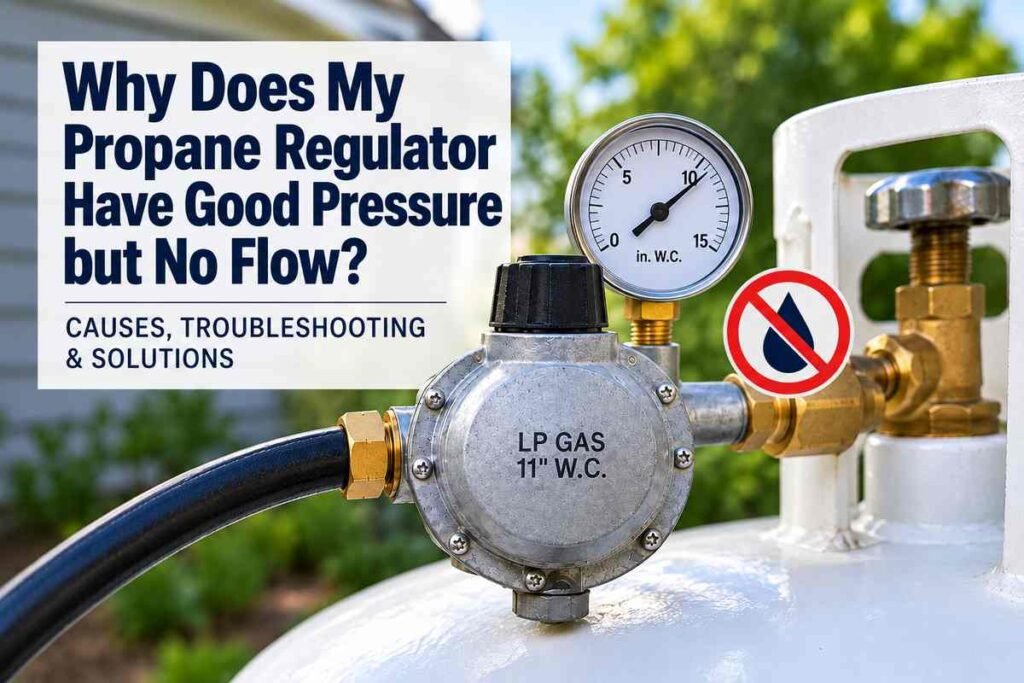
A propane regulator can show apparently good static pressure but still provide little or no usable flow if an excess-flow device is restricting gas, a valve or hose is blocked, the regulator fails under load, the piping is obstructed, or the appliance gas valve is not opening. Static pressure alone does not prove that a system can deliver enough propane when an appliance calls for fuel.
Static Pressure vs. Flow
If the reading is genuinely low even before the appliance opens, compare it with low propane regulator pressure. If pressure falls mainly when another appliance starts, see why propane pressure drops under added appliance load.
| Test Condition | What It Shows |
|---|---|
| No appliance operating | Static/lock-up pressure |
| Appliance operating | Pressure under flow |
| Multiple appliances operating | System performance near higher load |
1. Excess-Flow Device Is Restricting Gas
An excess-flow device can reduce flow after a sudden surge that resembles a broken line. This can happen after a cylinder valve is opened rapidly. Follow the manufacturer’s reset instructions.


2. A Hose or Connector Is Restricted
If the restriction seems to appear when the tank valve is opened, compare it with a regulator that trips when the tank valve opens. Repeated interruptions can also resemble a propane regulator that keeps shutting off.
A damaged, kinked, contaminated, or internally deteriorated hose can allow pressure to build slowly while preventing adequate flow. This explains why a gauge may look normal until the appliance opens.
3. The Regulator Fails Under Load
A regulator may hold pressure with no flow yet be unable to maintain it when gas demand increases. A technician can compare static and dynamic pressure with a manometer.
4. The Appliance Is Not Opening Its Gas Valve
If the trouble began right after swapping cylinders, compare it with an appliance that will not stay lit after changing tanks.


The problem can be downstream of the regulator. Thermocouples, electronic controls, solenoid valves, safety interlocks, ignition modules, and appliance regulators can prevent gas from entering the burner.
5. A Closed or Partially Closed Valve
A service valve or manual shutoff that is not fully in its intended operating position can limit flow. Do not force a stuck valve.
6. Debris or Contamination
Foreign material can obstruct small passages in regulators, fittings, or appliance controls. Propane components should not be cleaned internally with improvised tools.
How to Diagnose Safely
The useful test is pressure under the appliance’s actual operating load. A qualified technician can measure inlet and outlet pressure, verify regulator capacity, inspect connectors, and determine whether the restriction is upstream or downstream.
FAQ
Can I have 11 in. W.C. and still have no flow?
Yes. A closed or restricted system can build static pressure but fail as soon as flow is demanded.

Does replacing the regulator always fix no-flow problems?
No. The restriction may be in the cylinder connector, hose, valve, piping, or appliance.
Why does pressure fall to zero when the burner starts?
A severe upstream restriction, inadequate supply, or regulator failure can cause pressure to collapse under load.
How You Can Have Pressure but Still Have No Propane Flow
A propane system can show apparently normal pressure and still deliver little or no usable flow if a valve, connector, excess-flow device, regulator passage, hose, or appliance control is restricting gas movement. Pressure tells you gas is present at a test point; it does not prove that enough gas can move through the system when an appliance opens.
This is similar to having water pressure behind a closed faucet. A gauge can show pressure on one side of a restriction while almost nothing passes through to the appliance.


| Symptom | Possible Cause | Useful Clue |
|---|---|---|
| Good pressure with appliances off, no flow when opened | Restriction or excess-flow device | Static pressure is present but working pressure collapses |
| No flow after changing cylinders | Connector not seated or excess-flow feature activated | Problem started immediately after reconnection |
| Flow returns after reset | Excess-flow device likely restricted gas | Valve may have been opened too quickly |
| Only one appliance has no flow | Appliance valve, hose, or branch-line issue | Other appliances operate normally |
| No flow in freezing weather | Frozen regulator or moisture restriction | Ice or frost may be visible |
Excess-Flow Devices Are a Common Cause
An excess-flow device can restrict propane when it senses a sudden high flow rate. Some cylinder connections and propane valves include this safety feature. Rapidly opening the tank valve can create a brief surge that resembles a broken hose or major leak, causing the device to limit flow.
When that happens, there may still be enough gas behind the restriction to produce a pressure reading, but not enough flow for normal appliance operation. The result can be tiny flames, an appliance that will not light, or no noticeable gas flow at all.
A Closed or Partially Open Valve Can Fool You
A service valve, appliance shutoff, or internal connector valve can create a no-flow condition even when upstream pressure is normal. Some modern cylinder connectors are designed so propane will not flow until the mating connection is properly engaged. A loose or damaged connector may therefore stop flow intentionally.
Do not force a connector or defeat a built-in safety feature. If a cylinder will not supply gas after proper reconnection, inspect the connection for damage and try another known-good cylinder if the equipment manufacturer permits it.
Hose and Piping Restrictions
A kinked hose, collapsed inner liner, debris, oil contamination, or undersized pipe can restrict gas without eliminating upstream pressure. Flexible hoses can look normal on the outside while being damaged internally. Long runs of small tubing can also produce severe flow loss when appliance demand rises.
If one appliance is affected and others are normal, focus attention on that appliance’s branch piping, connector, shutoff valve, and controls. If every appliance is affected, the restriction is more likely to be near the tank or main regulator.
Can the Regulator Be Internally Blocked?
Yes. Corrosion, moisture, contamination, or mechanical damage can interfere with the regulator seat and internal passages. A regulator can sometimes hold static pressure but fail to pass its rated flow. This is one reason working-pressure testing is important.
Do not disassemble a service regulator to clean the internals. Regulators are safety devices, and a unit with internal contamination or damaged parts is generally replaced with the correct listed model.
Frozen Regulators and Moisture
Ice inside the regulator can block gas flow while pressure remains trapped upstream. This can happen in cold weather when moisture has entered the vent or regulator body. The symptom may disappear as temperatures rise, then return during the next freeze.
Repeated cold-weather no-flow events should prompt inspection of vent orientation, weather protection, tank vaporization, and regulator condition rather than repeated manual resets.
Why the Gauge Reading May Be Misleading
A pressure reading is meaningful only when you know where it was taken and whether gas was flowing at the time. A gauge on the tank side of the regulator does not tell you what pressure is reaching an appliance. Likewise, a static outlet reading can look normal until an appliance opens and the pressure collapses.
A qualified technician uses a manometer at the appropriate test point and compares static, flowing, and lock-up pressure. That testing shows whether the regulator can maintain pressure while delivering the required volume of gas.
Safe Reset Procedure After a Tank Change
If the problem began immediately after changing a portable cylinder, a slow reset may restore flow when an excess-flow device has activated. Follow the appliance manufacturer’s instructions first. A common general approach is to turn all appliance controls off, close the cylinder valve, wait several minutes, confirm the connection is secure, and then reopen the valve slowly.
If normal flow does not return, do not repeatedly cycle the valve or bypass the connector. A recurring trip can indicate an actual leak, damaged hose, defective cylinder valve, or regulator problem.
What a Technician Will Check
A technician will identify where pressure exists and where flow stops. Testing may include container pressure, regulator inlet pressure, outlet pressure under load, excess-flow devices, shutoff valves, hoses, branch lines, and appliance gas valves.
For systems with multiple regulators, the technician may test each stage separately. This helps determine whether the problem is an upstream supply issue or a downstream appliance restriction.
Frequently Asked Questions
Can a regulator show 11 inches W.C. and still be bad?
Yes. A regulator can produce a normal static reading but fail to maintain that pressure when significant gas flow is required.
Why do I get only a tiny flame?
A tiny flame often means propane flow is being restricted rather than completely shut off. An activated excess-flow device, kinked hose, low vaporization, or restricted regulator can all cause this symptom.
Should I bypass an excess-flow device?
No. Excess-flow devices are safety components. If one repeatedly activates, the reason should be identified rather than bypassed.
How Technicians Isolate Where Flow Stops
The fastest way to diagnose good pressure but no flow is to find the point where normal pressure stops translating into usable gas movement. A technician may check pressure before the regulator, after the regulator, and at the appliance while the appliance is trying to operate. If pressure is normal upstream but collapses downstream, the restriction lies between those test points.
This step-by-step approach can identify a partially closed valve, clogged connector, damaged hose, frozen regulator, or appliance gas valve without replacing parts at random. It is especially useful when only one appliance is affected while the rest of the propane system works normally.
Why Flow Capacity Matters as Much as Pressure
A propane component can hold pressure and still be unable to pass enough volume for a high-BTU appliance. Regulators, hoses, excess-flow devices, and valves all have flow ratings. If any one component is undersized, the appliance may behave as though there is no gas even though a gauge shows pressure at rest.
Practical tip: If possible, note whether the no-flow condition affects every appliance or only one. That single observation can quickly narrow the problem to the main supply system or to one branch and appliance.
Bottom Line
Good static pressure with no usable propane flow means you need a dynamic diagnosis, not just another pressure reading. Test the system under load and locate the restriction before replacing components.

Mike is an experienced propane technician with over 15 years of professional experience in the field. He has dedicated his career to helping customers with their propane needs, from installation to maintenance and repair. Together with Jeremy, he co-founded this website to provide useful information and guidance to customers seeking reliable propane services.


