
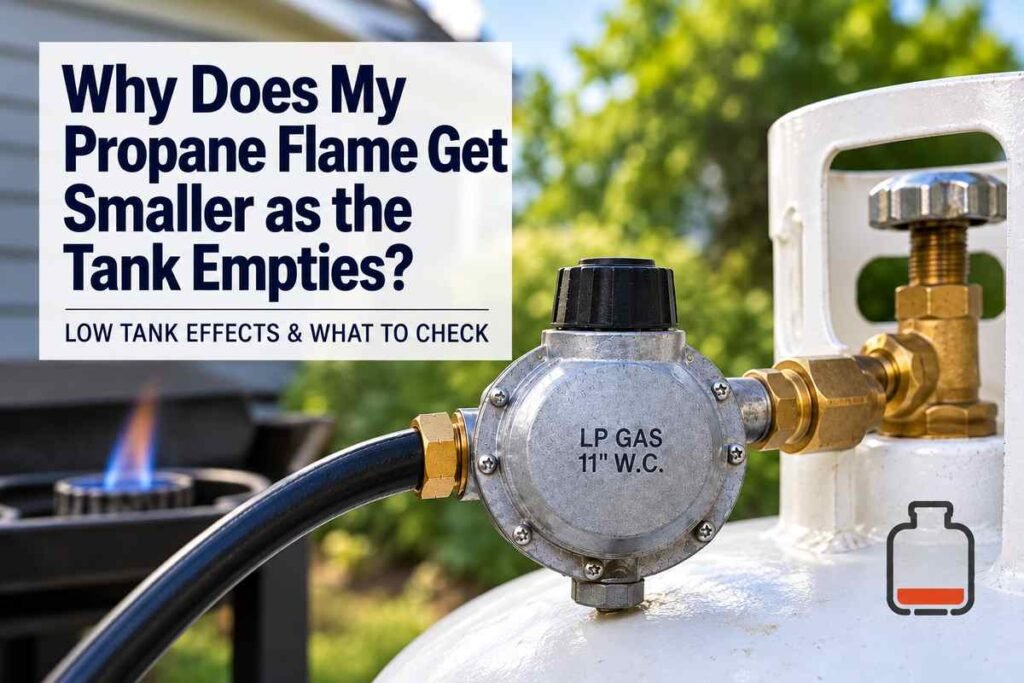
A propane flame can get smaller as the tank empties because a low liquid level, cold temperature, high appliance demand, or a marginal supply system can reduce the tank’s ability to produce enough propane vapor. In a correctly sized system, flame size should not steadily shrink simply because the tank is partially used; the regulator is intended to maintain usable outlet pressure within its operating range.
What Changes as a Tank Empties?
If flames stay weak even with plenty of propane in the tank, compare the symptoms with low propane regulator pressure. If the weakness appears mainly when another appliance starts, see why propane pressure drops under added appliance load.
| Factor | Effect |
|---|---|
| Lower liquid level | Less wetted tank surface to absorb environmental heat |
| Cold weather | Lower vapor pressure and vaporization capacity |
| High BTU load | Faster vapor withdrawal |
| Small cylinder | Less heat-transfer area than a larger tank |
Tank Pressure Is Temperature Sensitive
Propane vapor pressure is influenced much more by temperature than by the percentage of fuel remaining while liquid propane is still present. The more important low-level issue for high-demand equipment is often vaporization capacity.


Why Vaporization Capacity Falls
If cold conditions are producing actual icing, compare it with a propane regulator that keeps freezing up. If you mainly see a white coating while the system still works, review frost on a propane regulator.
Liquid propane needs heat to boil into vapor. The tank absorbs that heat through metal in contact with the liquid. As liquid level falls, the wetted area decreases, which can reduce sustained vapor output under demanding conditions.
Could the Regulator Be the Cause?
A weak or undersized regulator can also produce a small flame, especially under load. If the flame remains weak after installing a properly filled cylinder in suitable weather, investigate the regulator, hose, excess-flow device, piping, and appliance.
Why Small Cylinders Show the Problem First
If the problem started immediately after replacing the cylinder, compare it with an appliance that will not stay lit after changing tanks.


A 20-lb cylinder has far less surface area and stored propane than a large stationary tank. High-BTU burners, patio heaters, and generators can therefore expose vaporization limitations sooner, especially in winter.
Do Not Adjust the Regulator to Compensate
Turning up regulator pressure is not the correct fix for inadequate vapor supply. Appliance inlet pressure must remain within the manufacturer’s specifications.
FAQ
Does propane pressure drop because the tank is half empty?
Not in the same way compressed air pressure falls in a simple air tank. While liquid propane remains, temperature strongly controls equilibrium vapor pressure.
Why does changing to a full cylinder fix the flame?
The full cylinder may provide more wetted surface and better vaporization capacity, temporarily removing the supply bottleneck.
Can frost on the tank confirm high demand?
Frost can be a clue that rapid vaporization is cooling the container, but it is not a complete diagnosis.

Should the Flame Get Smaller Just Because the Tank Is Low?
Usually, no. A properly sized propane system should maintain a stable flame until the container is nearly empty, but low tank level can reduce vaporization capacity enough to cause weaker flames under high demand or cold-weather conditions. Propane pressure while liquid remains in the tank is influenced much more by temperature than by fuel level, so a pressure gauge is not a reliable fuel-level gauge.
The flame gets smaller when the appliance is not receiving enough gas flow or pressure. A low tank can contribute to that problem, but the regulator, hose, excess-flow device, piping, or appliance may also be involved.
| When the Flame Shrinks | Likely Explanation | What to Check |
|---|---|---|
| Only when the tank is nearly empty | Reduced vaporization capacity | Refill or replace the tank |
| Mostly in cold weather | Cold tank cannot vaporize propane fast enough | Tank size, fuel level, and appliance demand |
| After opening the cylinder valve quickly | Excess-flow device may have restricted gas | Reset according to manufacturer instructions |
| On one appliance only | Burner, orifice, hose, or appliance valve issue | Inspect that appliance |
| On several appliances at once | Supply, regulator, or piping problem | Have system pressure tested under load |
Why a Low Tank Can Reduce Vapor Flow
Liquid propane has to absorb heat and boil into vapor before most appliances can burn it. The tank wall transfers heat from the surrounding air into the liquid propane. During heavy use, the tank cools because vaporization removes heat.
As the container gets low, there is less liquid mass and less effective heat-transfer capacity available to support continuous high flow. In mild weather and with a small appliance, you may never notice the difference. With a large heater, generator, or several appliances operating together, the limitation can become obvious.


Cold Weather Makes the Effect Stronger
A low tank is much more likely to cause weak flames when outdoor temperature is low. Cold propane has lower vapor pressure and vaporizes more slowly. This is why a cylinder that seems fine on a warm afternoon can struggle to supply the same appliance on a freezing night.
A visible layer of frost on the lower portion of a cylinder during heavy use can be another clue that vaporization demand is high. The tank may not be empty, but it may be unable to produce vapor fast enough at that moment.
Tank Pressure Is Not the Same as Tank Level
Do not use propane pressure alone to estimate how full a tank is while liquid propane remains inside. At a given temperature, a partly full tank and a nearly full tank can have similar vapor pressure. Pressure drops significantly because of fuel level only when the liquid is nearly exhausted or when rapid vaporization cools the tank.
For portable cylinders, weighing the cylinder is a much better way to estimate remaining propane. The tare weight stamped on the collar indicates the empty-cylinder weight. Subtracting tare weight from total weight gives an approximate amount of propane remaining.
Could the Regulator Be Causing the Smaller Flame?
Yes. A regulator that cannot maintain outlet pressure under load can create the same weak-flame symptom as a low tank. A blocked vent, internal wear, contamination, freezing, or insufficient regulator capacity can all reduce gas delivery.
The key diagnostic clue is whether the problem disappears immediately after installing a full tank. If it does, vaporization or fuel level was probably a major factor. If the flame remains weak with a known-full tank, the regulator, hose, appliance, or piping needs further attention.
Excess-Flow Restriction After a Tank Change
A small flame after changing cylinders can be caused by an excess-flow device rather than by the amount of propane in the tank. Opening the cylinder valve too quickly may create a surge that activates the flow-limiting feature in the connector or valve.
Turn the appliance controls off, close the cylinder valve, wait, and follow the equipment manufacturer’s reset procedure. When reopening the valve, do it slowly. If the restriction returns, check for leaks or damaged components rather than repeatedly resetting the system.
Appliance Problems That Can Mimic a Low Tank
Dirty burner ports, a clogged orifice, a kinked hose, a failing gas valve, or poor air adjustment can also make a propane flame look weak. If only one burner is affected while others remain strong, the problem is more likely to be local to that appliance.
For grills, insects and grease frequently block burner passages. For heaters and furnaces, burner and venting problems should be handled according to the manufacturer instructions, because poor combustion can produce carbon monoxide.
How to Prevent Weak Flames as the Tank Runs Low
Keep enough propane on hand for the expected appliance load and weather conditions. Do not wait until a heating cylinder is almost empty during a cold spell. For high-demand appliances, make sure the tank size is appropriate for the required BTU input.
If you routinely need to run a high-BTU appliance from a small portable cylinder, ask the equipment manufacturer or propane supplier whether a larger container or properly designed multi-cylinder setup is recommended. Never improvise cylinder manifolds or bypass regulators.
When to Call a Professional
Get professional help when weak flames continue with a full tank, affect multiple appliances, or are accompanied by gas odor, soot, yellow flames, regulator icing, or repeated shutdowns. A technician can test pressure under load and determine whether the limiting component is the tank, regulator, piping, or appliance.
Frequently Asked Questions
Does propane pressure decrease steadily as the tank empties?
No. While liquid propane remains, vapor pressure depends primarily on temperature. The tank can be partly full and still show similar pressure to a fuller tank at the same temperature.
Why does a new full cylinder fix my weak flame?
A full cylinder may have better vaporization capacity and more thermal mass, especially in cold weather. It can also confirm that the old cylinder was nearly empty.
Can I use two small cylinders to get more flow?
Only with an approved system designed for multiple cylinders. Do not connect tanks together with improvised fittings or hoses.
Why Cylinder Size Matters for High-BTU Appliances
A small propane cylinder can become the limiting part of the system even when the regulator is correctly sized. High-BTU appliances remove vapor quickly, cooling the cylinder as liquid propane boils. Once the cylinder gets cold enough, vapor production can fall and the flame may shrink.
This is why appliance manuals often specify a minimum cylinder size or recommend a larger stationary tank for sustained high demand. Using a larger approved container can provide more vaporization capacity, but the regulator and hose must still match the appliance requirements.
Use Weight to Estimate Fuel in Portable Cylinders
Weighing a portable propane cylinder is more reliable than judging fuel level from pressure. The tare weight stamped on the collar is the empty-cylinder weight. Subtract that from the cylinder’s actual weight to estimate how many pounds of propane remain. This can help confirm whether weak flames are appearing only when the cylinder is nearly empty.
Practical tip: If the flame becomes weak only when the cylinder is nearly empty, compare performance with a full known-good cylinder. That simple comparison can help separate a fuel-level or vaporization issue from a regulator or appliance fault.
Bottom Line
A shrinking flame near the end of a tank usually points to vaporization or supply limitations rather than a normal requirement for the regulator to lose pressure. Check tank size, temperature, load, restrictions, and regulator performance.

Mike is an experienced propane technician with over 15 years of professional experience in the field. He has dedicated his career to helping customers with their propane needs, from installation to maintenance and repair. Together with Jeremy, he co-founded this website to provide useful information and guidance to customers seeking reliable propane services.


