
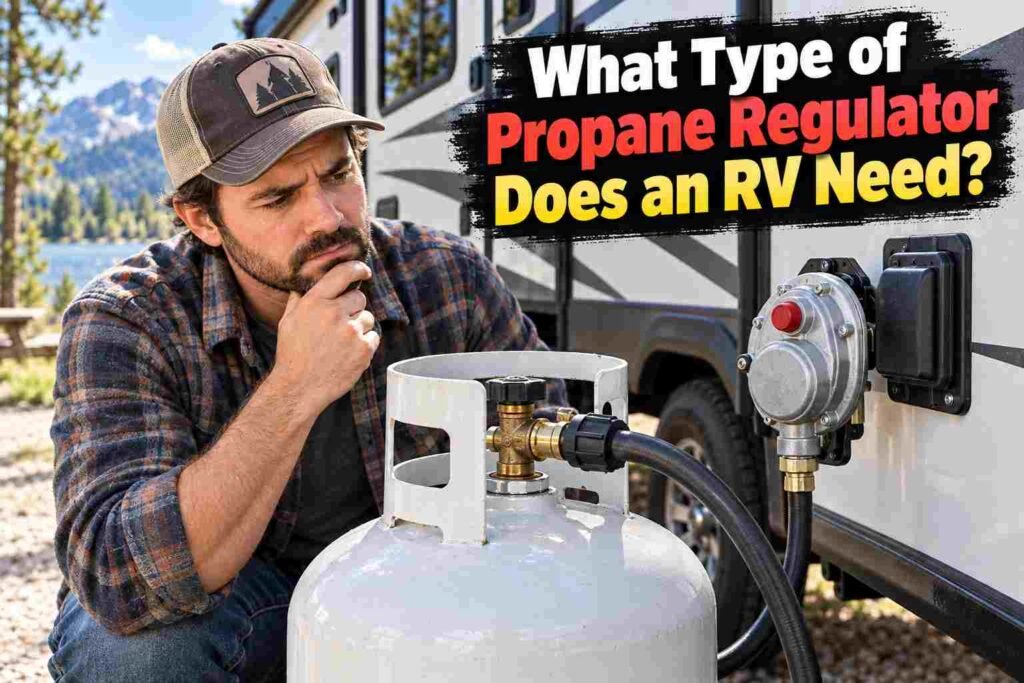
If you are replacing an RV propane regulator, I would not choose one just because the fittings look right. The regulator type, outlet pressure, capacity, connection style, vent position, and the way your RV is plumbed all matter. A barbecue-grill regulator, adjustable high-pressure regulator, or random single-stage regulator may physically connect to a propane cylinder but still be completely wrong for an RV appliance system.
In this guide, I’ll show you what type of propane regulator an RV normally needs, how a two-stage RV regulator works, when automatic changeover makes sense, how to size the BTU capacity, and what specifications I check before installing or replacing one.
What Type of Propane Regulator Does an RV Need?
For a conventional RV propane system, I would start with a two-stage LP-gas regulator rated for RV or mobile applications and set for approximately 11″ w.c. outlet pressure. The two stages reduce propane pressure in steps instead of trying to drop full container pressure directly to appliance pressure in one step.
That staged reduction is important because propane container pressure changes significantly with temperature. Your cylinder pressure may be relatively low on a cold morning and much higher on a hot afternoon, while your furnace, refrigerator, water heater, and cooktop still expect a stable low-pressure supply.
| RV situation | Regulator I would normally expect | Typical outlet | Why |
|---|---|---|---|
| Travel trailer with two cylinders | Automatic-changeover two-stage regulator | About 11″ w.c. | Automatically switches from the service cylinder to the reserve cylinder |
| Fifth wheel with two cylinders | Automatic-changeover two-stage regulator, sometimes with remote-cylinder components depending on layout | About 11″ w.c. | Convenient dual-cylinder operation |
| Motorhome with permanently mounted ASME tank | Fixed two-stage RV/LP regulator | About 11″ w.c. | No cylinder changeover is normally needed |
| Single portable cylinder feeding a standard RV appliance system | Two-stage regulator matched to the RV system | About 11″ w.c. | Stable low-pressure appliance supply |
Why RVs Use a Two-Stage Propane Regulator
A two-stage regulator performs the pressure reduction in two steps inside one regulator assembly or matched regulator arrangement. Current RV owner guidance from Grand Design describes the first stage as reducing container pressure to roughly 10–13 psi and the second stage reducing that intermediate pressure to about 11″ w.c. for the appliances.
The exact internal first-stage pressure depends on the regulator design, so I do not use 10–13 psi as a universal adjustment target for every model. What matters to you as an RV owner is that the final regulated pressure reaching the RV distribution system matches what the appliances and manufacturer require.
| Pressure point | Typical value/example | What it means |
|---|---|---|
| Propane container | Highly temperature-dependent; can be well above 100 psi | Raw vapor pressure before regulation |
| After first stage | Often around 10–13 psi in RV examples | Intermediate regulated pressure |
| Final regulator outlet | About 11″ w.c. | Low-pressure supply to RV appliances |
| 11″ w.c. in psi | About 0.397 psi | Shows how low appliance pressure actually is |
| 11″ w.c. in kPa | About 2.74 kPa | Metric equivalent |
If you want a deeper explanation of that final pressure, see my guide on what 11 inches water column means for propane.


Do I Need an Automatic-Changeover RV Regulator?
If your RV has two propane cylinders, an automatic-changeover regulator is usually the configuration I would prefer. It lets one cylinder act as the service cylinder and the other as the reserve. When the service cylinder is depleted, the regulator changes over to the reserve side without intentionally shutting down the propane supply.
RegO describes its twin-stage automatic-changeover regulator as suitable for portable two-cylinder installations and notes that an empty container can be replaced without interrupting gas service. That is exactly why this style is so useful on travel trailers and fifth wheels.
The changeover feature is not the same thing as pressure regulation. A proper RV automatic-changeover regulator still performs the two-stage pressure reduction needed to supply the RV at low pressure.
How automatic changeover works
With both cylinders connected and open, you select the cylinder you want to use first. That becomes the service cylinder. The regulator draws from that cylinder until its pressure can no longer support normal operation, then the changeover mechanism begins supplying from the reserve side. Many RV regulators use a colored indicator to show whether the selected cylinder still has gas available.
I still check the indicator regularly. Automatic changeover is convenient, but it can also let you unknowingly empty both bottles if you never look at it. When the first cylinder is empty, I switch the selector toward the full cylinder, close and remove the empty bottle, refill it, reconnect it, leak-check the connection, and return it to reserve service according to the regulator and RV manufacturer instructions.
Can I Use a Single-Stage Regulator on an RV?
For the normal built-in RV appliance system, I would not substitute a generic single-stage regulator for the specified two-stage RV regulator. A single-stage regulator may be appropriate for certain dedicated appliances or specialty propane equipment, but an RV distribution system is designed around stable low pressure across changing container pressure and changing appliance load.
This is also why I would not use a grill regulator simply because it screws onto a cylinder. Regulator selection is about more than the connection. You need the correct pressure range, flow capacity, relief/vent design, approved application, and mounting arrangement.
| Regulator type | Typical role | Suitable as the main RV appliance regulator? |
|---|---|---|
| Two-stage RV/LP regulator | Drops container pressure to low appliance pressure in two stages | Normally yes, when matched to the RV |
| Automatic-changeover two-stage regulator | Two-stage regulation plus dual-cylinder changeover | Normally yes for dual-cylinder RVs |
| Single-stage grill regulator | Dedicated portable appliance service | Generally no |
| Adjustable high-pressure regulator | High-pressure burners and specialty equipment | No for standard RV low-pressure appliances |
| 2-psi distribution regulator | Special higher-pressure distribution systems requiring a downstream line regulator | Only if the RV was specifically engineered for that system |
If you are comparing regulator types, my broader guide on whether propane regulators are all the same explains why visually similar regulators are not automatically interchangeable.
What Outlet Pressure Should an RV Propane Regulator Have?
For a conventional RV propane distribution system, the number you will commonly see is 11 inches of water column. Current Grand Design owner guidance states that the second stage reduces intermediate pressure to an operating pressure of 11″ w.c. for the RV appliances. Winnebago also describes approximately 11 inches of water as the pressure used by RV appliances.
Here is how 11″ w.c. compares with other units:
| Unit | Approximate equivalent of 11″ w.c. |
|---|---|
| PSI | 0.397 psi |
| kPa | 2.74 kPa |
| mbar | 27.4 mbar |
| Ounces per square inch | About 6.35 oz/in² |
I treat 11″ w.c. as a system target only when it matches the RV and appliance specifications. The appliance data plate and RV manufacturer instructions always take priority. A regulator should also be checked under load, because outlet pressure can change as gas flow increases. You can read more in my guide on how to check propane regulator pressure.
How Much BTU Capacity Does an RV Regulator Need?
The regulator has to do more than produce the right pressure. It must deliver enough propane at that pressure when several appliances operate at the same time.
I calculate the connected propane load by adding the input ratings on the appliance data plates. I do not size the regulator from the furnace alone. An RV may run the furnace, water heater, refrigerator burner, and cooking appliances at overlapping times.
For example, suppose an RV has the following illustrative input ratings:
| Appliance | Example propane input |
|---|---|
| Furnace | 35,000 BTU/hr |
| Water heater | 12,000 BTU/hr |
| Refrigerator burner | 2,000 BTU/hr |
| Range/oven combined example | 30,000 BTU/hr |
| Total connected load | 79,000 BTU/hr |
Those numbers are examples only; your actual data plates control. Once I know the total load, I select a regulator whose published propane capacity comfortably covers that demand under the manufacturer’s stated inlet and outlet pressure conditions.
RegO, for example, publishes automatic-changeover two-stage regulators with propane capacities in the hundreds of thousands of BTU per hour. That does not mean every RV needs a 400,000-BTU regulator. It simply shows why I compare the actual regulator performance data with the actual RV load instead of shopping by appearance.
If you want to work through the math, see how I calculate the BTU capacity needed for a propane regulator and what BTU capacity means on a propane regulator.
What Regulator Does a Motorhome With an ASME Tank Need?
A motorhome with one permanently mounted ASME propane tank normally does not need an automatic cylinder-changeover function because there are not two removable service cylinders to switch between. I would expect a fixed two-stage regulator designed and approved for the vehicle’s propane installation, with the outlet set to the pressure specified by the RV manufacturer.
The important replacement rule is simple: match the original system design. I check the old regulator label, RV service documentation, outlet pressure, capacity, connection sizes, vent orientation, and mounting position before choosing a replacement.
What Regulator Does a Travel Trailer With Two Propane Tanks Need?
For the common two-cylinder travel-trailer setup, an automatic-changeover two-stage regulator is normally the convenient choice. It combines three jobs: selecting the service cylinder, switching to the reserve cylinder when necessary, and reducing high container pressure to the RV’s low appliance pressure.
I also inspect the pigtail hoses. A new regulator will not fix a restricted, deteriorated, kinked, internally damaged, or incorrectly connected pigtail. Many apparent “regulator problems” are really system problems.
What Connections Should an RV Propane Regulator Have?
I do not choose an RV regulator by pressure and capacity alone. The inlet and outlet fittings have to match the system, and the regulator needs to mount in the correct orientation without putting strain on hoses or tubing.
Dual-cylinder RV regulators commonly connect to high-pressure pigtails from each cylinder. Depending on the RV, cylinder, and regulator, you may see Type 1/QCC-style cylinder connections on the pigtails, POL-related fittings, inverted-flare connections at the regulator, and threaded low-pressure outlets. I match the replacement to the RV manufacturer’s configuration rather than adapting a mismatched regulator with a stack of extra fittings.
| Specification I check | Why it matters |
|---|---|
| Regulator type | Two-stage versus automatic-changeover two-stage must match the RV layout |
| Outlet pressure | Standard RV appliances commonly use about 11″ w.c. |
| BTU/hr capacity | Must cover the expected connected appliance load |
| Inlet connection | Must match the pigtail or tank connection arrangement |
| Outlet connection | Must match the RV low-pressure piping without unsafe improvisation |
| Vent position | Must be oriented as specified so water and debris do not obstruct the vent |
| Mounting/bracket | Keeps the regulator secured and correctly oriented |
| Application approval | The regulator should be intended for LP-gas service and the RV/mobile application involved |
Why the Regulator Vent Must Face Down
This is one detail I would not treat as optional. Current Grand Design owner guidance says propane regulator vents must face downward and that protective covers should remain in place where applicable. The reason is simple: a blocked regulator vent can interfere with diaphragm operation and may lead to unsafe pressure.
I periodically look for mud, road debris, insect nests, ice, and other blockage around the vent area. I do not poke tools into the vent or disassemble the regulator. If I suspect an obstruction or regulator malfunction, I have the unit inspected by a qualified RV or propane technician.
What About the RV’s Low-Pressure Quick-Connect?
Many RVs have an exterior quick-connect downstream of the main regulator. That means the gas at the quick-connect may already be reduced to the RV’s low operating pressure. This matters when you connect an outdoor grill or portable appliance.
Winnebago cautions that feeding already regulated RV propane through another appliance regulator can create a double-regulation problem and leave the appliance with insufficient pressure. I always verify whether an exterior connection is on the high-pressure or low-pressure side before attaching an accessory.
If a grill was designed to receive cylinder pressure through its own regulator, it may not work correctly from an 11″-w.c. quick-connect unless the manufacturer provides an approved low-pressure configuration.
How Do I Know If My RV Propane Regulator Is Too Small?
An undersized regulator may appear normal when only one small burner is operating but struggle when the furnace and water heater start together. This is why I test or evaluate the system under realistic load instead of assuming a good no-load pressure reading proves everything is fine.
| Symptom | Possible regulator/system issue |
|---|---|
| Flames shrink when furnace starts | Capacity shortage, pressure droop, restricted hose, or piping loss |
| Furnace cycles or fails under heavy demand | Low delivered pressure or inadequate vapor supply |
| Appliances work individually but not together | Regulator, pigtail, cylinder vaporization, or piping capacity may be insufficient |
| Pressure looks good with no appliances running but drops sharply under load | Excessive droop or another upstream restriction |
| Yellow flame or soot | Combustion or pressure problem requiring diagnosis; do not assume regulator size is the only cause |
For related troubleshooting, see why propane pressure drops when another appliance turns on and why a propane regulator may have low pressure.
Do I Need a Bigger Regulator for Cold Weather?
Not automatically. Cold-weather propane problems can come from the regulator, but they can also come from the container’s ability to vaporize enough propane. As temperature falls and fuel level drops, a cylinder may not produce vapor as quickly as a high-demand furnace system requires.
I separate those two issues. The regulator needs enough published flow capacity, but the cylinder or tank also needs enough vaporization capacity for the weather and appliance load. Installing an oversized regulator cannot make a cold, undersized cylinder vaporize fuel faster.
Should I Adjust an RV Propane Regulator Myself?
I would not use the adjustment screw as a trial-and-error fix for weak flames. Current RV manufacturer guidance calls for regulator adjustment with a properly calibrated manometer by a dealer or qualified propane service technician. Turning the pressure up without measuring the system can create an unsafe overpressure condition.
If the outlet is wrong, I first want to know why. The cause might be the regulator, but it could also be a restricted pigtail, empty or cold cylinder, excess-flow device, blocked vent, undersized piping, damaged hose, or appliance-side problem.
How I Choose a Replacement RV Propane Regulator
When I replace an RV regulator, I use the original equipment and RV documentation as my starting point. Then I verify the pressure and capacity rather than relying on a “universal RV regulator” label.
| Step | What I verify |
|---|---|
| 1 | Is the RV single-tank, single-cylinder, or dual-cylinder? |
| 2 | Does it require fixed two-stage or automatic-changeover two-stage regulation? |
| 3 | What outlet pressure does the RV manufacturer specify? |
| 4 | What is the total connected BTU/hr appliance load? |
| 5 | Do inlet/outlet fittings and hose ratings match the existing system? |
| 6 | Can the regulator be mounted with the required vent orientation and cover? |
| 7 | After installation, has the system been leak-tested and pressure-tested correctly? |
Frequently Asked Questions
Is an RV propane regulator different from a BBQ regulator?
Yes. A standard RV system normally uses two-stage regulation and must supply multiple appliances at the specified low pressure and total flow capacity. A portable grill regulator is intended for its appliance and should not be assumed interchangeable.
What pressure should an RV propane regulator be set to?
Many conventional RV propane systems use approximately 11″ w.c. at the regulated distribution side. I still verify the RV and appliance specifications before treating that as the required setting.
Does a two-tank RV need two regulators?
Not necessarily. A common configuration uses one automatic-changeover two-stage regulator connected to both cylinders through separate pigtails. Some RV layouts, especially certain fifth wheels with cylinders in separate compartments, can use additional regulator components, so the original system design matters.
Can I use a 30-lb propane tank with the same RV regulator as a 20-lb tank?
The regulator is selected primarily by pressure, application, connections, and gas-flow capacity rather than cylinder pounds alone. However, the cylinder, valve, pigtail, mounting system, and RV must all be compatible. I would not change cylinder size without checking the RV manufacturer’s limits and mounting requirements.
Can a regulator with a higher BTU rating damage my RV appliances?
A higher flow-capacity rating by itself does not force extra propane through an appliance. Outlet pressure is the critical control. However, the replacement regulator still needs to be appropriate for the RV system, and extreme oversizing or using the wrong regulator type can create performance issues. I match both pressure and capacity rather than assuming bigger is always better.
How can I tell whether my automatic-changeover regulator switched tanks?
Many models use an indicator that changes color when the selected service cylinder is depleted. The exact indicator and selector procedure depends on the regulator, so I follow the model instructions rather than assuming every changeover regulator works identically.
Why do my RV appliances work poorly after I changed propane tanks?
Possible causes include an incompletely opened valve, an excess-flow device that was triggered by opening the cylinder too quickly, a restricted pigtail, air in the line, low cylinder vaporization, or regulator trouble. My guide on why an appliance will not stay lit after changing tanks covers that problem in more detail.
Bottom Line
If you ask me what type of propane regulator an RV needs, my starting answer is a properly sized two-stage LP-gas regulator that delivers the RV manufacturer’s specified low pressure, commonly about 11″ w.c. For an RV with two removable propane cylinders, an automatic-changeover two-stage regulator is usually the most convenient setup. For a motorhome with one permanent ASME tank, a fixed two-stage regulator is more typical.
I would not choose the replacement from price, appearance, or fitting size alone. I check outlet pressure, BTU capacity, cylinder/tank arrangement, inlet and outlet connections, vent orientation, mounting, and the RV manufacturer’s requirements. After replacement, the propane system should be leak-tested and the pressure verified with the proper test equipment.
Propane is safe and reliable when the system is correctly designed and maintained, but regulator replacement affects the entire fuel system. If you are not trained to leak-test and pressure-test an RV propane system, this is a job I would leave to an RV service center or qualified LP-gas technician.
Technical References
I based the technical pressure and regulator-type discussion in this guide on current and manufacturer documentation, including RegO twin-stage and automatic-changeover regulator data, Grand Design RV propane-system owner guidance, and Winnebago RV propane-pressure guidance.
Meta description: What type of propane regulator does an RV need? Learn why most RVs use a two-stage 11-inch-WC regulator, when automatic changeover is useful, and how to size it.

Mike is an experienced propane technician with over 15 years of professional experience in the field. He has dedicated his career to helping customers with their propane needs, from installation to maintenance and repair. Together with Jeremy, he co-founded this website to provide useful information and guidance to customers seeking reliable propane services.


