
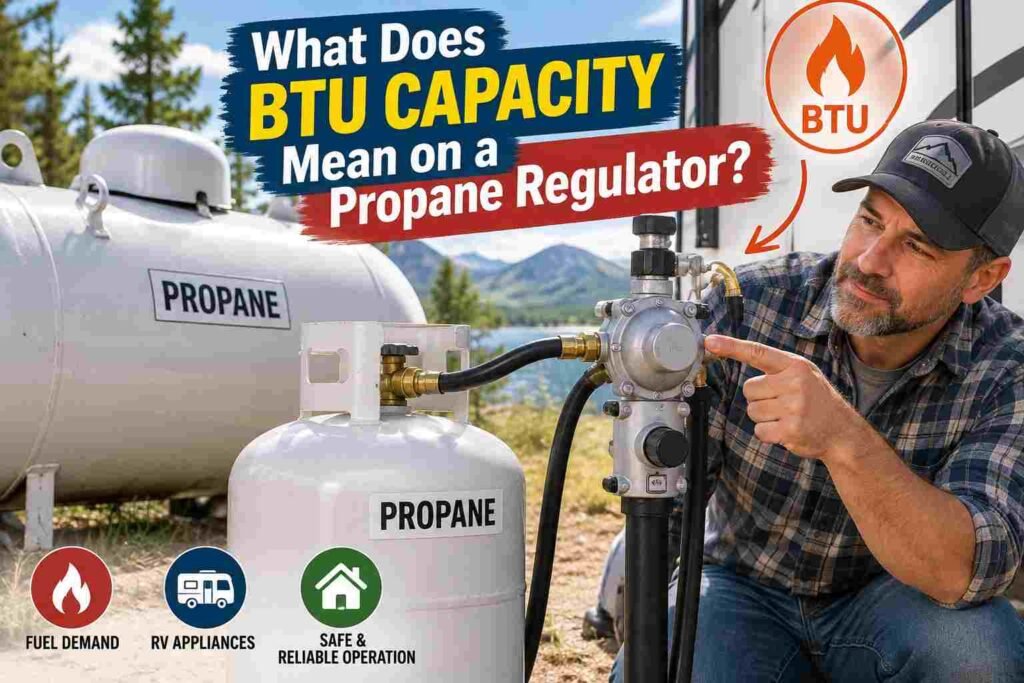
When I look at a propane regulator marked with a number such as 500,000 BTU/hr, 1,000,000 BTU/hr, or 2,500,000 BTU/hr, I treat that number as a flow-capacity rating—not as a pressure rating and not as the amount of propane inside the tank. The BTU capacity tells me how much appliance load the regulator can serve under the conditions used to rate it.
This distinction matters because a regulator can have the correct outlet pressure when very little gas is flowing and still be too small when several appliances turn on at the same time. If the connected load exceeds what the regulator can deliver, outlet pressure may fall, flames may weaken, burners may fail to operate correctly, and appliances may shut down.
In this guide, I’ll show you exactly what BTU capacity means on a propane regulator, how manufacturers determine capacity, how to compare a regulator rating with your appliance load, and why the largest BTU number on the box is not the only specification you need to check.


What Does BTU Capacity Mean on a Propane Regulator?
BTU stands for British thermal unit. One BTU is a unit of energy. Propane appliances are normally rated by how much fuel energy they can consume in one hour, which is why you usually see appliance input listed as BTU/hr.
A propane regulator’s BTU capacity is therefore a convenient way of expressing its gas-flow capacity. Instead of telling you only how many cubic feet of propane vapor can pass through the regulator, the manufacturer converts that flow into the equivalent heat input that the gas can supply.
| Term | What It Means | Typical Unit |
|---|---|---|
| Appliance input | Maximum fuel-energy demand of an appliance | BTU/hr |
| Regulator capacity | Amount of propane flow the regulator can deliver under stated conditions | BTU/hr, SCFH, or kg/hr |
| Outlet pressure | Pressure the regulator is intended to deliver downstream | PSIG or inches w.c. |
| Inlet pressure | Pressure available upstream of the regulator | PSIG |
| Droop | Reduction in outlet pressure as flow increases | Percent or pressure difference |
That is why I never interpret a regulator label by reading the BTU capacity alone. A rating only makes sense together with the conditions under which that capacity was established.
BTU Capacity Is a Rate, Not a Total Amount of Energy
One common source of confusion is the difference between BTU and BTU per hour. A regulator does not have a reservoir containing a certain number of BTUs. It controls the flow of propane vapor continuously.


For example, if a regulator can supply 500,000 BTU/hr, it can theoretically support a 500,000-BTU/hr connected load under the stated rating conditions. If that load operates for two hours, the amount of fuel energy passing through the regulator during that period could be about 1,000,000 BTUs. The regulator’s capacity remains 500,000 BTU/hr because that is the rate of flow.
How Much Propane Flow Does a BTU Rating Represent?
The Propane Education & Research Council lists propane at approximately 2,524 BTU per cubic foot of vapor and about 91,500 BTU per gallon of liquid propane. Those values let me translate a regulator’s BTU/hr rating into a rough gas-flow or fuel-use equivalent.
| BTU/hr Load | Approx. Propane Vapor Flow | Approx. Liquid-Propane Energy Equivalent per Hour* |
|---|---|---|
| 100,000 BTU/hr | 39.6 ft³/hr | 1.09 gal/hr |
| 250,000 BTU/hr | 99.0 ft³/hr | 2.73 gal/hr |
| 500,000 BTU/hr | 198.1 ft³/hr | 5.46 gal/hr |
| 1,000,000 BTU/hr | 396.2 ft³/hr | 10.93 gal/hr |
| 1,500,000 BTU/hr | 594.3 ft³/hr | 16.39 gal/hr |
| 2,500,000 BTU/hr | 990.5 ft³/hr | 27.32 gal/hr |
*The gallon-per-hour column is an energy-equivalent calculation, not a guarantee that a tank can actually vaporize propane at that rate. Tank size, liquid level, ambient temperature, and wetted surface area all affect vaporization capacity.
Why a Regulator’s BTU Capacity Is Not One Universal Number
This is one of the most important things I want you to understand. A regulator may be advertised as having a certain maximum capacity, but the actual usable capacity depends on pressure conditions.
Fisher’s LP-Gas Serviceman’s Handbook specifically notes that the capacity column in its regulator-selection table is for reference and that capacity varies with factors such as pipe size, orifice size, and outlet-pressure setting. Fisher capacity tables also state the inlet pressure and allowable droop used to establish the rating.

RegO does the same thing in its performance charts. Rather than telling you to choose a regulator only by a single catalog number, RegO shows how delivery pressure changes as BTU load rises at different inlet pressures. That is a much better picture of what a regulator is actually doing in service.
| Condition | Why It Changes Usable Capacity |
|---|---|
| Inlet pressure | Lower upstream pressure generally gives the regulator less pressure differential to move gas. |
| Outlet pressure setting | A regulator set for a different delivery pressure can have a different performance curve. |
| Permitted droop | Manufacturers often state capacity at a defined reduction from the set pressure, such as 10% or 20% droop. |
| Orifice and body size | Larger flow passages can support more gas flow under comparable conditions. |
| Piping pressure loss | An adequately sized regulator cannot compensate for an undersized downstream pipe that loses too much pressure. |
| Tank vaporization | The container must be able to produce propane vapor quickly enough to feed the regulator. |
That is also why two regulators with the same nominal outlet pressure can have very different BTU ratings.
How Manufacturers State Propane Regulator Capacity
Manufacturer catalogs are useful because they show how widely regulator capacities can vary even within the same general application. In RegO’s current regulator-selection material, first-stage models are listed around 1.5 million and 2.5 million BTU/hr, while second-stage choices range from roughly 450,000 BTU/hr into the multi-million-BTU range depending on model and application. Fisher likewise lists domestic second-stage regulators from hundreds of thousands of BTU/hr to more than 2 million BTU/hr.
| Regulator Application | Example Published Capacity Range | Typical Job |
|---|---|---|
| First-stage domestic | About 1,500,000 to 2,500,000 BTU/hr in common RegO examples | Reduce tank pressure to an intermediate pressure such as 10 PSIG |
| Second-stage domestic | About 450,000 to 2,300,000 BTU/hr in RegO selection examples | Reduce first-stage pressure to appliance-level pressure |
| Fisher R622 second stage | Up to about 1,400,000 BTU/hr | Residential two-stage systems |
| Fisher HSRL second stage | Up to about 2,600,000 BTU/hr | Higher-load commercial or residential applications |
These are examples, not interchangeable ratings. I would still check the specific model’s performance table, connection size, inlet-pressure requirement, outlet setting, relief arrangement, and installation instructions before choosing it.


How BTU Capacity Relates to Your Appliances
The practical reason you care about regulator BTU capacity is simple: the regulator has to supply the appliances connected downstream of it.
RegO’s sizing guidance says to determine the total load of the installation by adding the input ratings of all appliances. You can normally find those input ratings on each appliance nameplate or in the manufacturer’s literature. I use the appliance input rating, not the output heating capacity, because the regulator supplies fuel input.
Here is a simple example. These figures are illustrative only—your actual appliance nameplates control.
| Example Propane Appliance | Example Input Rating |
|---|---|
| Furnace | 80,000 BTU/hr |
| Tank water heater | 40,000 BTU/hr |
| Range | 65,000 BTU/hr |
| Clothes dryer | 22,000 BTU/hr |
| Fireplace | 35,000 BTU/hr |
| Total connected load | 242,000 BTU/hr |
If all of those appliances are served through the same regulator, I would start with a design load of 242,000 BTU/hr and then choose a regulator whose published performance is adequate at the actual inlet and outlet conditions. For a detailed walkthrough, see my guide on how to calculate the BTU capacity needed for a propane regulator.
Should I Add Extra BTU Capacity?
I do not recommend taking the appliance total and blindly adding an arbitrary percentage without looking at the manufacturer’s selection data. The safer approach is to calculate the connected input load, identify the required regulator type, and select a model that can maintain the required delivery pressure at that load under the worst expected inlet-pressure condition.
In practice, that often means you end up with a regulator whose catalog capacity is higher than the exact appliance total because regulators come in standard sizes. That is fine when the model is appropriate for the application. However, bigger is not automatically better. Regulation characteristics, minimum flow, pressure control, relief protection, piping, and manufacturer instructions still matter. I discuss this separately in what happens if you oversize an LPG regulator.
Why Inlet Pressure Matters to the BTU Rating
A propane regulator needs pressure upstream to push gas through its valve and orifice. As inlet pressure decreases, the amount of gas the regulator can deliver while holding the desired outlet pressure may also decrease.
This is especially important for a first-stage regulator connected directly to a propane tank because tank vapor pressure changes with temperature. RegO’s selection example specifically tells the installer to use the lowest anticipated winter tank pressure when checking a first-stage performance chart. In other words, a regulator that looks fine on a warm day must still be able to deliver the required BTU load under the lowest expected inlet-pressure condition.
For more background on that part of the system, see what propane pressure should be after the first-stage regulator.
Why Outlet Pressure and Droop Matter
When a regulator is flowing little or no gas, its outlet pressure sits near its set point. As demand rises, outlet pressure normally falls somewhat. That reduction is called droop.
Manufacturers therefore have to define the allowable pressure drop when they publish capacity. Fisher, for example, lists certain regulator capacities based on 20% droop, while some of its high-pressure capacity tables use 10% droop. RegO performance curves let you read the actual outlet pressure at a given flow and inlet pressure.
That means two statements can both be true: a regulator may physically pass more gas if you allow the outlet pressure to fall farther, yet that additional flow may no longer be usable because the appliance needs a minimum inlet pressure. I size for usable pressure, not merely maximum possible flow.
| Condition | Example | What I Check |
|---|---|---|
| No/very low flow | Regulator near set pressure | Set pressure and lock-up behavior |
| Moderate load | Several appliances operating | Stable delivery pressure |
| Maximum design load | All connected input included in sizing | Pressure remains above minimum required level |
| Low inlet pressure | Cold-weather tank pressure or low upstream stage pressure | Performance curve still meets load |
If your pressure looks normal with everything off but drops sharply when another appliance starts, read my guide on why propane pressure drops when another appliance turns on.
BTU Capacity Does Not Tell You the Regulator Pressure
A regulator can have a very high BTU capacity and still be designed for low outlet pressure. BTU/hr describes flow capacity; PSI or inches of water column describe pressure. I always check both specifications.
| Specification | What It Answers |
|---|---|
| 500,000 BTU/hr | How much propane load can the regulator serve under its rating conditions? |
| 10 PSIG outlet | At what intermediate pressure is gas delivered? |
| 11 in. w.c. outlet | At what low pressure is gas delivered to the downstream system? |
If you are unfamiliar with low-pressure propane measurements, my article on what 11 inches water column means for propane explains that side of the specification.
The Regulator Is Only One Part of the Propane Supply System
I also avoid assuming that a 1,000,000-BTU/hr regulator automatically creates a 1,000,000-BTU/hr propane system. Every part of the supply path has to support the load.
| System Component | Possible Limitation |
|---|---|
| Propane container | Insufficient vaporization at low temperature or low liquid level |
| First-stage regulator | Cannot maintain intermediate pressure at peak demand |
| Second-stage regulator | Insufficient BTU flow at the required outlet pressure |
| Gas piping | Too much pressure loss because of length, diameter, fittings, or load |
| Appliance regulator/orifice | Incorrect configuration or pressure requirement |
This is why troubleshooting by replacing the regulator with a larger one can miss the real problem. If the tank cannot vaporize the required fuel or the pipe is undersized, increasing regulator capacity alone will not fix the system.
What Happens If the Regulator BTU Capacity Is Too Low?
An undersized regulator may seem normal when only one small appliance is running. The symptoms often appear only when total demand rises. You may see outlet pressure droop excessively, burner flames shrink, furnace or water-heater ignition become unreliable, or appliances shut down when another load starts.
That does not prove the regulator is undersized by itself. Similar symptoms can come from an empty or cold tank, restricted piping, debris, an excess-flow device, or a failing regulator. I would measure pressure under load before deciding which component is responsible. My guide on low propane regulator pressure covers those possibilities in more detail.
Can a Propane Regulator Have Too Much BTU Capacity?
A catalog capacity higher than your connected appliance load is not automatically a problem. Many installations naturally use a regulator with more listed capacity than the exact load because standard regulator sizes are offered in steps. What matters is that the regulator is approved for the application and can control the specified outlet pressure correctly across the expected operating range.
I would not select a regulator solely because it has the biggest BTU rating. The correct regulator type, pressure range, relief or overpressure protection, connection size, installation orientation, venting requirements, and manufacturer instructions are just as important.
How I Read a Propane Regulator Specification
When I review a regulator data sheet, I look at the application first—first stage, second stage, integral two-stage, 2-PSI service, or high pressure. Then I compare the connected BTU load with the capacity table or performance curve at the actual inlet pressure. I verify the required outlet pressure, check how much droop the rating permits, and confirm that connection sizes and overpressure protection match the installation.
If the only information you have is a large BTU number printed on a retail listing, I would not consider that enough information for a permanent propane installation.
Frequently Asked Questions About Propane Regulator BTU Capacity
Is a 500,000 BTU propane regulator enough for a house?
It can be, but the answer depends on the total input ratings of the propane appliances served by that regulator and on the regulator’s published performance at your inlet and outlet pressures. Add the appliance input ratings rather than estimating by house size.
Does a higher BTU regulator increase propane pressure?
No. A higher BTU capacity means the regulator can pass more gas under specified conditions. Outlet pressure is a separate specification controlled by the regulator design and spring setting.
Can I use a 1,000,000 BTU regulator on a 200,000 BTU load?
Potentially, if that specific regulator is designed and approved for the system, pressure range, and application. Capacity alone does not determine compatibility.
Should I use appliance input BTU or output BTU when sizing?
Use the appliance input rating because that represents the fuel energy the gas system must supply. RegO’s sizing guidance specifically directs users to add appliance input ratings.
Does regulator BTU capacity include pipe sizing?
No. The regulator and the piping must each be sized to carry the load. A regulator with adequate capacity can still be followed by a pipe that is too small or too long to maintain adequate pressure.
Why does the same regulator show different capacities in different charts?
Capacity can change with inlet pressure, outlet pressure, orifice configuration, and allowable pressure droop. Always compare ratings under equivalent test conditions.
Bottom Line
BTU capacity on a propane regulator means the rate of propane energy the regulator can supply while maintaining acceptable delivery pressure under specified conditions. It is essentially a gas-flow rating expressed in a unit that makes it easy to compare the regulator with appliance input loads.
When I size or evaluate a regulator, I do not stop at the headline BTU number. I total the appliance input load, identify the regulator stage and required outlet pressure, check the lowest expected inlet pressure, and use the manufacturer’s performance data to confirm that the regulator can carry the load without excessive pressure droop. I also make sure the tank and piping can support that same demand.
That approach gives you a regulator that is not merely large enough on paper, but properly matched to the propane system it has to serve.
Technical Sources
I used current manufacturer and industry technical material from RegO regulator-selection guidance, the Fisher LP-Gas Serviceman’s Handbook, current Fisher R600 Series regulator specifications, and the Propane Education & Research Council Technical Pocket Guide.

Mike is an experienced propane technician with over 15 years of professional experience in the field. He has dedicated his career to helping customers with their propane needs, from installation to maintenance and repair. Together with Jeremy, he co-founded this website to provide useful information and guidance to customers seeking reliable propane services.


