
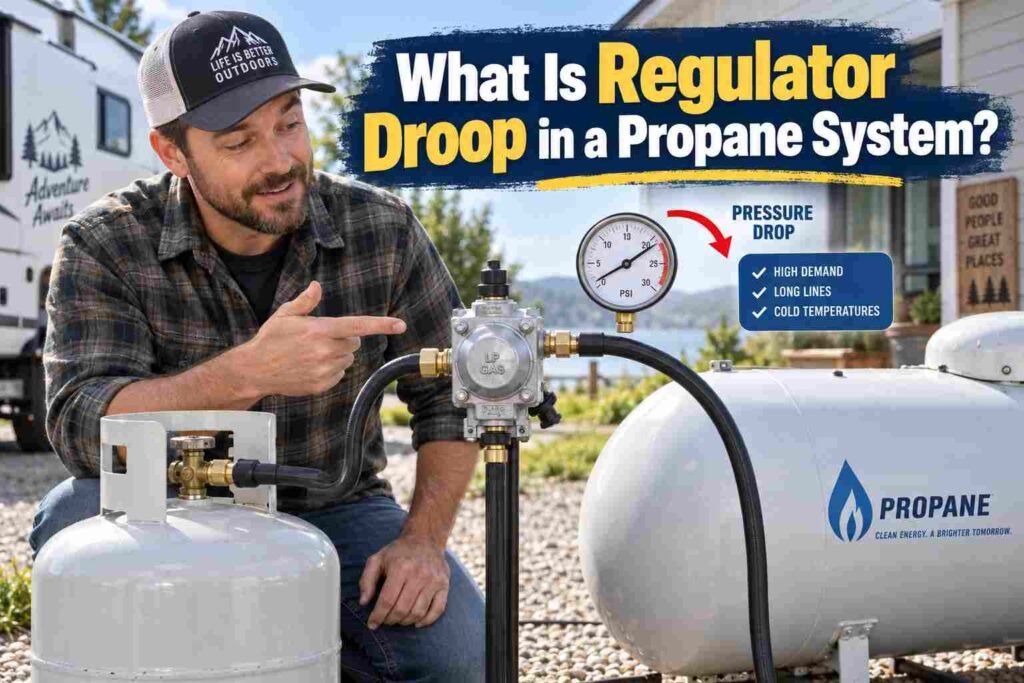
When I troubleshoot a propane system, one of the easiest mistakes to make is to see the pressure fall under load and immediately assume the regulator is bad. A certain amount of pressure drop can be normal. The key is understanding where the pressure is falling, how much it falls, and whether the regulator stays within the manufacturer’s acceptable operating range.
In this guide, I’ll explain what regulator droop means, why it happens, how manufacturers express it, how it differs from line pressure drop and lock-up, and how you can use droop information when sizing or diagnosing a propane regulator.
What Is Regulator Droop in a Propane System?
Regulator droop is the decrease in outlet pressure that occurs as the flow rate through a pressure-reducing regulator increases. Emerson/Fisher also refers to droop as offset or proportional band. In simple terms, the regulator may hold one pressure when very little gas is flowing and a slightly lower pressure when the system is near its rated load.


I like to think of it this way: the regulator has to open farther as your appliances demand more propane. A direct-operated regulator relies on the balance between its spring, diaphragm, outlet pressure, and valve mechanism. As the regulator moves farther open to pass more gas, the outlet pressure usually has to decline somewhat to create the force imbalance that makes that movement happen. That decline is droop.
| Term | What It Means | Typical Direction |
|---|---|---|
| Set pressure | Outlet pressure established at a stated flow condition | Reference point |
| Droop | Outlet pressure reduction as flow increases | Pressure goes down |
| Lock-up | Outlet pressure rise as flow stops and the regulator closes | Pressure goes up |
| Line pressure drop | Pressure lost through pipe, tubing, fittings, valves, and distance | Pressure goes down downstream |
A Simple Example of Propane Regulator Droop
Suppose I have a second-stage propane regulator adjusted to 11 inches water column (11" w.c.) while the system is flowing only a small amount of gas. I then turn on the furnace, water heater, range, and dryer. The outlet pressure falls to 9 inches w.c. while the combined load is operating.
In that example, the regulator experienced 2 inches w.c. of droop between the low-flow setting and the higher-flow condition.
| Condition | Outlet Pressure | Difference From 11" w.c. |
|---|---|---|
| Light load | 11" w.c. | 0 |
| Moderate load | 10" w.c. | 1" w.c. droop |
| High load | 9" w.c. | 2" w.c. droop |
This does not automatically mean the regulator is defective. In fact, Fisher publishes capacities for some LP-gas regulators based on a specified amount of droop. One R632 bulletin, for example, states propane capacities based on 30 psig inlet pressure and 2 inches w.c. droop. That is why I always check the exact manufacturer performance data before calling a measured pressure change abnormal.


How Do Manufacturers Express Regulator Droop?
Droop can be shown in several ways. Depending on the type of regulator and the manufacturer’s data sheet, you may see it expressed as inches of water column, psi, bar, mbar, or a percentage of the outlet pressure setting.
| Droop Format | Example | Meaning |
|---|---|---|
| Inches w.c. | 2" w.c. droop | Outlet is 2" w.c. below its reference setting at the stated flow |
| PSI | 0.5 psi droop | Outlet falls by 0.5 psi |
| Percent | 10% droop | Outlet falls by 10% of the stated reference pressure |
| mbar | 5 mbar droop | Outlet falls by 5 millibars at the stated condition |
The number only makes sense when you know the test conditions. A “1 million BTU/hr regulator” may deliver that flow only at a certain inlet pressure, outlet setting, and allowed droop. Change those conditions and the available capacity can change.
Why Does Droop Happen in a Direct-Operated Propane Regulator?
Most residential propane regulators are direct-operated, spring-loaded devices. Inside the regulator, the spring pushes against a diaphragm. Outlet pressure pushes back against the diaphragm. The valve position changes until those forces reach a working balance.
When you turn on more appliances, downstream pressure begins to fall. That pressure reduction lets the spring move the diaphragm and valve farther open, increasing propane flow. The regulator needs some pressure change to create that movement. As a result, a direct-operated regulator normally has a downward-sloping pressure-versus-flow characteristic.
This is one reason I do not expect the gauge to remain perfectly fixed at exactly 11.0 inches w.c. from pilot-light load all the way to maximum regulator capacity. Real regulators have operating curves.

Regulator Droop vs. Pressure Drop in the Gas Line
These two are often confused, but they are not the same thing.
Regulator droop happens across the regulator as flow increases. Pipe pressure drop happens after gas leaves the regulator and moves through piping, tubing, valves, elbows, tees, and other fittings.
You can have both at the same time. For example, the regulator outlet might fall from 11 to 10 inches w.c. under load, while the pressure measured at a distant appliance drops another 1.5 inches w.c. because of undersized piping. The appliance would then see only about 8.5 inches w.c.
| Pressure Point | Example Under Load | What Happened |
|---|---|---|
| Low-flow regulator outlet | 11.0" w.c. | Reference setting |
| Regulator outlet at high load | 10.0" w.c. | 1.0" w.c. regulator droop |
| Appliance inlet at high load | 8.5" w.c. | Additional 1.5" w.c. piping loss |
This is why a technician may measure pressure at more than one point. If pressure is already low directly at the regulator outlet, I look at regulator supply, capacity, adjustment, condition, or upstream pressure. If the regulator outlet stays acceptable but pressure is low only at the appliance, I start looking harder at the downstream piping system.


For more on this symptom, see why propane pressure drops when another appliance turns on.
Regulator Droop vs. Lock-Up Pressure
Droop and lock-up describe opposite ends of regulator behavior.
Droop is what I watch when demand increases. Lock-up is what I watch when demand stops. As appliances shut off, the regulator valve closes. The downstream pressure may rise above the flowing pressure before the valve seals completely. That final no-flow pressure is the lock-up pressure.
| Characteristic | Droop | Lock-Up |
|---|---|---|
| When it occurs | As flow increases | As flow falls to zero |
| Pressure direction | Downward | Upward from flowing pressure |
| Main concern | Can the regulator hold enough pressure at required flow? | Does the regulator shut off within its allowed pressure limit? |
I cover that no-flow behavior separately in what lock-up pressure means on a propane regulator.
How Much Regulator Droop Is Normal?
There is no single droop number that is “normal” for every propane regulator. The acceptable amount depends on the exact regulator model, outlet-pressure setting, inlet pressure, flow rate, regulator stage, and the manufacturer’s published capacity or performance curve.
For example, one Fisher R632 publication bases rated propane capacity on 30 psig inlet pressure with 2 inches w.c. of droop. Other regulator families use different criteria. Industrial regulators may specify performance at a certain percentage droop. This is why I avoid making a rule such as “anything over 1 inch is bad.” That could be wrong for the equipment and load being tested.
Instead, I compare three things: the actual inlet pressure during the test, the actual outlet pressure under the required load, and the manufacturer’s performance data for that model.
Example: Calculating Droop in Inches of Water Column
If a regulator is set at 11 inches w.c. at low flow and delivers 9.5 inches w.c. at the design load, the droop is:
11.0 – 9.5 = 1.5 inches w.c.
If I want the percentage droop relative to the 11-inch setting:
(1.5 ÷ 11.0) × 100 = about 13.6%
| Low-Flow Setting | Loaded Pressure | Droop | Approx. Percent Droop |
|---|---|---|---|
| 11.0" w.c. | 10.5" w.c. | 0.5" | 4.5% |
| 11.0" w.c. | 10.0" w.c. | 1.0" | 9.1% |
| 11.0" w.c. | 9.5" w.c. | 1.5" | 13.6% |
| 11.0" w.c. | 9.0" w.c. | 2.0" | 18.2% |
These calculations describe the measured change only. They do not tell you whether the regulator passes or fails. For that, you still need the manufacturer’s rating and the appliance/system pressure requirements.
Why Inlet Pressure Matters When You Evaluate Droop
A regulator cannot deliver unlimited gas regardless of what is happening upstream. Available capacity changes with inlet pressure. If first-stage pressure falls, container vaporization cannot keep up, a valve is restricted, or the supply is undersized, the second-stage regulator has less pressure differential available to move gas.
That means a regulator may appear to have excessive droop when the real problem is insufficient inlet pressure.
In a common two-stage propane system, a first-stage regulator may supply roughly 10 psig to a second-stage regulator. A Fisher R222, for example, is designed to reduce a typical 10 psig first-stage supply to about 11 inches w.c. at the low-pressure side. If that expected inlet pressure collapses during peak demand, the second stage cannot be evaluated in isolation.
For a deeper explanation of the two sides of a regulator, see inlet pressure vs. outlet pressure on a propane regulator and propane pressure after the first-stage regulator.
How Droop Affects Regulator BTU Capacity
This is one of the most important practical points. A regulator’s BTU rating is tied to an allowed pressure change. The manufacturer may define capacity at a specific inlet pressure, outlet set point, and droop.
So if a data sheet says a regulator can pass 750,000 BTU/hr, I do not automatically assume it will hold exactly the same outlet pressure from zero flow through 750,000 BTU/hr. The published capacity may correspond to a permitted pressure decrease.
This is why I recommend reading the footnotes in regulator capacity tables. The headline BTU number is only part of the specification.
You can read more in what BTU capacity means on a propane regulator and how to calculate the BTU capacity needed for a propane regulator.
What Can Cause Excessive Pressure Droop?
If the loaded outlet pressure falls farther than the regulator’s published performance allows, I look at the whole gas system instead of turning the adjustment screw immediately.
| Possible Cause | What You May See | Why Pressure Falls |
|---|---|---|
| Regulator undersized for load | Pressure acceptable with one appliance, low with several | Regulator is being pushed beyond intended flow performance |
| Low inlet pressure | Both inlet and outlet pressures sag at high demand | Insufficient upstream pressure differential |
| Restricted inlet screen or valve | Increasing load causes rapid loss of pressure | Restriction limits available flow |
| Undersized upstream piping | Regulator inlet pressure falls under load | Pressure is lost before gas reaches regulator |
| Undersized downstream piping | Regulator outlet may be okay but appliance pressure is low | Excess line loss after regulator |
| Regulator damage, wear, contamination, or icing | Erratic or abnormal pressure response | Valve/diaphragm movement or gas passage is impaired |
| Insufficient tank vaporization | Problems worsen in cold weather or at high continuous load | Container cannot produce vapor as fast as load consumes it |
How Do You Test for Regulator Droop?
Testing propane pressure involves fuel gas and should be performed by someone qualified to work on the system. The basic diagnostic idea is straightforward: measure outlet pressure at a known light-flow condition, then measure it again while a known or representative appliance load is operating.
I also want to know the regulator inlet pressure at the same time whenever excessive droop is suspected. Without that number, you can blame the second-stage regulator for a problem that actually started upstream.
| Measurement | Why I Need It |
|---|---|
| Outlet pressure at light flow | Establishes reference/set pressure |
| Outlet pressure at design/high load | Shows loaded pressure and actual droop |
| Inlet pressure at light flow | Shows available upstream supply |
| Inlet pressure at high load | Reveals upstream pressure collapse or restriction |
| Approximate BTU/hr load operating | Lets you compare test condition with manufacturer capacity data |
A manometer is normally used for low-pressure measurements in inches of water column. Higher-pressure stages may require an appropriate pressure gauge. The instrument must be suitable for the pressure range being tested.
See my step-by-step overview on how to check propane regulator pressure for more background.
Should You Adjust the Regulator to “Fix” Droop?
Not automatically. Increasing the spring setting can raise the outlet pressure, but it does not magically give an undersized regulator more legitimate capacity, repair an upstream restriction, enlarge undersized piping, or increase tank vaporization.
It can also create excessive no-flow or lock-up pressure if adjustment is made without following the manufacturer’s procedure. That is why I would never treat the adjustment screw as the first answer to a loaded-pressure problem.
The correct solution might be a larger-capacity regulator, corrected first-stage pressure, larger piping, a removed restriction, more vaporization capacity, or regulator replacement. The diagnosis has to identify which part of the system is limiting flow.
Why Regulator Sizing Is the Best Defense Against Excessive Droop
If you choose a regulator that is too small for the connected load, you are more likely to operate near or beyond the part of its performance curve where outlet pressure falls too far. That is why I size from the appliance load and then verify the regulator’s published capacity under the expected inlet and outlet conditions.
I do not select a regulator simply because its maximum BTU number is barely above the calculated load. I want to know how that capacity was rated, including the inlet pressure and allowed droop.
For example, if your connected load is 450,000 BTU/hr and the regulator’s 500,000 BTU/hr rating assumes operating conditions that your system cannot provide, the apparent “50,000 BTU cushion” may not be a real cushion at all.
Frequently Asked Questions About Propane Regulator Droop
Is regulator droop the same as a bad regulator?
No. Some droop is a normal characteristic of pressure-reducing regulators. The question is whether the measured pressure at the required flow stays within the manufacturer’s published performance and the system’s required pressure range.
Does outlet pressure always fall when propane flow increases?
With a typical direct-operated regulator, outlet pressure normally changes to some extent as flow changes. Fisher defines droop specifically as the reduction in outlet pressure experienced as flow rate increases.
Can an undersized regulator cause excessive droop?
Yes. If the required flow approaches or exceeds what the regulator can deliver at the actual pressure conditions, the outlet pressure can fall too far under load.
Can undersized piping be mistaken for regulator droop?
Yes. If you measure only at the appliance, you may see low pressure and blame the regulator even though most of the loss occurred in the pipe. Measuring at the regulator outlet and at the downstream point helps separate regulator performance from line loss.
What is a 2-inch water-column droop rating?
It means the manufacturer’s stated capacity or performance point allows the outlet pressure to be 2 inches w.c. lower than the reference setting at the specified flow/test condition. You must read the complete data-sheet footnote because inlet pressure and other conditions also matter.
My Practical Takeaway
When you see propane pressure decrease as demand increases, do not focus on a single gauge reading. I look at the complete relationship between flow, inlet pressure, regulator outlet pressure, downstream pipe loss, and appliance requirements.
Regulator droop itself is normal. Excessive droop is a diagnostic clue. The proper benchmark is the manufacturer’s data for the exact regulator and the real operating conditions of the installation.
If your system pressure is stable with a small load but falls sharply when multiple appliances operate, check the regulator’s BTU capacity, inlet pressure under load, downstream pipe sizing, and tank vaporization before assuming an adjustment is the answer.
Technical Sources
I used current and manufacturer technical material including Fisher/Emerson regulator guidance and RegO’s LP-Gas Serviceman’s Manual. Fisher defines droop as the reduction in outlet pressure as regulator flow increases and notes that it may be expressed as a percentage, inches of water column, or psi. RegO cautions that regulator pressure losses can vary with flow rate and recommends consulting regulator manufacturers for capacity and pressure-drop information.
Manufacturer references: Emerson/Fisher LPG Regulators and RegO LP-Gas literature and service manuals.

Mike is an experienced propane technician with over 15 years of professional experience in the field. He has dedicated his career to helping customers with their propane needs, from installation to maintenance and repair. Together with Jeremy, he co-founded this website to provide useful information and guidance to customers seeking reliable propane services.


