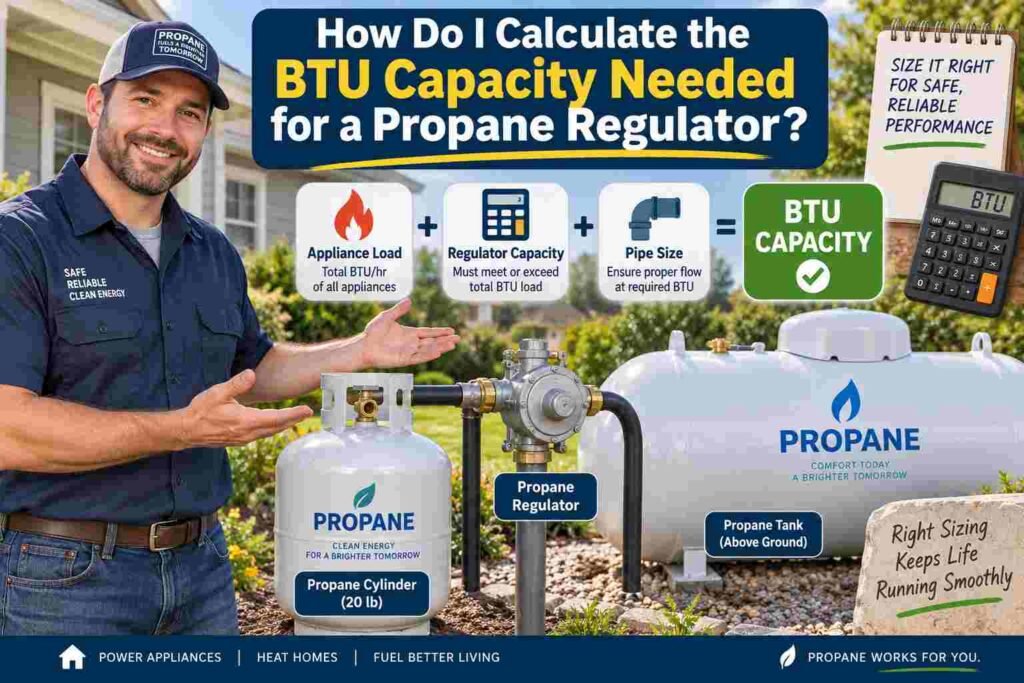
If you are trying to size a propane regulator, the arithmetic is the easy part. The part that causes trouble is assuming that BTU capacity is the only number that matters. I have seen people add up their appliances, buy a regulator with a bigger number on the box, and still end up with weak flames or pressure that collapses when several appliances run together.
In this guide, I will show you exactly how I calculate propane regulator BTU capacity, what numbers I use from appliance nameplates, how I handle future loads, and why inlet pressure, outlet pressure, regulator stage, pipe sizing, and cold-weather tank pressure all matter before I call a regulator correctly sized.
What Does BTU Capacity Mean on a Propane Regulator?
A regulator’s BTU capacity is the amount of propane energy it can pass per hour while maintaining specified pressure conditions. The rating is normally stated in BTU/hr.
That does not mean the regulator “uses” that much gas. It means the regulator is capable of supplying a load up to that rating under the manufacturer’s stated test conditions.
| Term | What It Means | Why It Matters |
|---|---|---|
| BTU/hr | Heat input per hour | Used to total appliance demand |
| Inlet pressure | Pressure entering the regulator | Lower inlet pressure can reduce available capacity |
| Outlet pressure | Pressure leaving the regulator | Must match the downstream system design |
| Droop | Pressure decrease as flow rises | Manufacturer capacity ratings are often tied to a stated droop |
| Regulator stage | First stage, second stage, integral two-stage, or 2-PSI service | Determines expected inlet/outlet pressure and application |
RegO’s regulator-selection guidance says to find the total load by adding the input ratings of all appliances in the installation. Marshall Excelsior similarly identifies appliance load, pipe size, inlet pressure, and outlet pressure as the four major regulator-selection factors.
The Basic Formula I Use
For a typical residential or light-commercial system, I start with this simple equation:
Notice that I use input ratings, not appliance output ratings. A 95,000-BTU furnace output is not necessarily a 95,000-BTU gas input appliance. The nameplate may show a higher input depending on efficiency. For regulator sizing, I want the fuel input figure.


Example: Adding the Appliance Loads
| Propane Appliance | Input Rating |
|---|---|
| Furnace | 100,000 BTU/hr |
| Tank water heater | 40,000 BTU/hr |
| Range/oven | 65,000 BTU/hr |
| Clothes dryer | 22,000 BTU/hr |
| Gas fireplace | 35,000 BTU/hr |
| Total connected load | 262,000 BTU/hr |
For that example, I would not select a regulator rated below 262,000 BTU/hr. I would move to a regulator model whose verified capacity exceeds the connected load under the pressure conditions I expect in the field.
I also do not treat an arbitrary “20% safety factor” as a substitute for manufacturer sizing data. Choosing the next practical capacity above the calculated load can provide useful headroom, especially if future appliances are planned, but the regulator still has to be checked against the manufacturer’s capacity tables or performance curves.
Step 1: Find the BTU Input Rating of Every Propane Appliance
I start at the appliance nameplate or the manufacturer’s installation manual. Most gas appliances list an input rating in BTU/hr. If an appliance has multiple burners or stages, I use the maximum rated input that can be demanded from the gas system.
If the nameplate is missing or unreadable, I do not guess from the appliance’s physical size. I look up the exact model number in the manufacturer’s documentation or have the appliance identified by a qualified technician.
| Appliance Type | Typical Example Range* | What I Actually Use |
|---|---|---|
| Furnace | 40,000–150,000 BTU/hr | Exact nameplate input |
| Tank water heater | 30,000–75,000 BTU/hr | Exact model input |
| Tankless water heater | 120,000–199,000 BTU/hr | Maximum listed input |
| Range/oven | 40,000–80,000+ BTU/hr | Total appliance input rating |
| Fireplace | 20,000–50,000 BTU/hr | Maximum listed input |
| Clothes dryer | 18,000–30,000 BTU/hr | Exact nameplate input |
*These are general examples only, not sizing values for your equipment. Your appliance nameplate or manufacturer data controls.
Step 2: Add the Connected Load
Once I have every appliance input, I add them together. This is the figure RegO calls the total load of the installation. I prefer using the full connected load rather than assuming certain appliances will never run at the same time, unless the system has been specifically engineered and local rules allow another method.
That approach matters because peak demand often happens exactly when several appliances overlap. A winter morning can have the furnace firing, someone taking a shower, the range running, and a fireplace operating at the same time.
Example: Home With a Tankless Water Heater
| Load | BTU/hr |
|---|---|
| Furnace | 90,000 |
| Tankless water heater | 199,000 |
| Cooking range | 65,000 |
| Dryer | 22,000 |
| Total | 376,000 BTU/hr |
A regulator with a catalog capacity of 400,000 BTU/hr might look adequate at first glance. But I would still check the actual performance data before approving it, because a nominal maximum capacity can depend on a particular inlet pressure, outlet pressure, and acceptable pressure drop.
Step 3: Identify Which Regulator Stage You Are Sizing
This is where many sizing mistakes happen. A first-stage regulator and a second-stage regulator do very different jobs, even though both may be rated in BTU/hr.
| Regulator Type | Typical Job | Typical Pressure Relationship |
|---|---|---|
| First stage | Reduces variable tank pressure before a second regulator | Tank pressure down to about 10 PSIG in many two-stage systems |
| Second stage | Supplies low-pressure appliance piping | Commonly around 11 in. w.c. outlet |
| Integral two-stage | Combines both reductions in one body | Tank pressure directly to low-pressure service |
| 2-PSI service regulator | Feeds a higher-pressure building distribution system | Typically set around 2 PSIG, followed by line regulators |
If you want a deeper explanation of the high-pressure side, see my guide to propane pressure after the first-stage regulator.
Step 4: Check the Regulator’s Capacity at the Real Pressure Conditions
This is the step I would not skip. RegO specifically advises checking regulator performance at the actual load and at the minimum LP-Gas inlet pressure expected for that regulator. Its published example uses a 500,000 BTU/hr first-stage load, a minimum 9.5-PSIG delivery requirement, and a 15-PSIG minimum tank pressure, then checks the manufacturer’s performance curve to see whether delivery pressure remains acceptable.
That is much more reliable than choosing a regulator only by the largest BTU number printed in a catalog.
Why Inlet Pressure Changes the Answer
A propane regulator does not have one magical flow capacity that is identical under every condition. Available flow changes with the pressure entering the regulator and the pressure it has to maintain at the outlet. This is why manufacturer capacity tables specify test conditions.
For example, Marshall Excelsior publishes second-stage regulators with capacities in the hundreds of thousands to more than one million BTU/hr, and those ratings are tied to stated inlet pressure and outlet-pressure performance. Its current 2-PSI regulator catalog likewise notes that listed capacities are based on a 10-PSIG inlet and specified droop. That is exactly why I do not compare BTU labels without reading the footnotes.
| Condition | Effect on Sizing |
|---|---|
| High inlet pressure | Regulator may pass more gas than it can at a lower inlet pressure |
| Low winter tank pressure | Can reduce first-stage regulator capacity and available delivery pressure |
| Higher required outlet pressure | Changes the regulator operating point and available flow |
| Greater allowed droop | Can make a catalog capacity look higher, but downstream pressure will fall more under load |
Step 5: Make Sure the Propane Supply Can Vaporize the Same Load
A regulator that can pass 700,000 BTU/hr does not guarantee that the tank or cylinder can vaporize 700,000 BTU/hr in cold weather. These are two separate capacity checks.
Propane boils inside the container and turns from liquid into vapor. The vaporization rate depends on container size, liquid level, outside temperature, and wetted surface area. A small cylinder may not be able to sustain a large appliance load in very cold weather even if the regulator itself is rated high enough.
Step 6: Confirm the Pipe Can Carry the Calculated Load
The regulator can be perfectly sized and the appliances can still starve if the piping is too small, too long, or has excessive fittings. That is why Marshall Excelsior includes pipe size as one of the four main regulator-selection considerations, and NFPA fuel-gas sizing tables are based on pressure, allowable pressure drop, pipe length, and gas characteristics.
If pressure looks good at the regulator but falls at the appliance when load increases, I start looking beyond the regulator. My article on propane pressure dropping when another appliance turns on explains several of those causes.
How Much Regulator Capacity Should I Choose Above the Calculated Load?
My starting requirement is simple: the verified regulator capacity must be at least equal to the calculated connected load under the expected operating conditions. I do not intentionally choose a regulator that is smaller and hope the appliances will not overlap.
At the same time, I do not believe in blindly buying the biggest regulator available. A correctly selected regulator should match the pressure system, connection sizes, relief arrangement, regulator stage, manufacturer instructions, and required flow range. If you are considering a much larger model “just to be safe,” read my guide on what happens when you oversize an LPG regulator.
A Practical Selection Example
Suppose I calculate a connected load of 376,000 BTU/hr. I am comparing three otherwise suitable second-stage regulators.
| Candidate Rating | Compared With 376,000 BTU/hr Load | My Next Step |
|---|---|---|
| 350,000 BTU/hr | Below connected load | Reject for this full-load design |
| 450,000 BTU/hr | Above connected load | Check pressure conditions and performance curve |
| 900,000 BTU/hr | Far above load | Do not assume it is automatically the better choice; verify application and regulation performance |
In this example, the 450,000-BTU/hr model may be a good candidate if its manufacturer data confirms that capacity at my actual inlet/outlet conditions. The 900,000-BTU/hr unit might also be technically usable in some applications, but “bigger” is not my only selection criterion.
Can I Convert Propane Flow in CFH to BTU/hr?
Yes, but I prefer using appliance BTU input ratings whenever I have them. If a flow value is stated in cubic feet per hour (CFH), you can convert it to approximate BTU/hr by multiplying the flow by the heating value used for the design calculation.
Different codes, utilities, manufacturers, and reference tables can use slightly different heating values or design bases, so I use the value specified by the applicable table or manufacturer rather than forcing one universal conversion into every job.
RegO Regulator Capacity Examples
RegO’s regulator-selection guide is useful because it shows how widely regulator capacities vary by application. Its selection examples include first-stage regulators around 1.5 million to 2.5 million BTU/hr, second-stage models ranging from about 450,000 BTU/hr into the multi-million-BTU range, and integral two-stage regulators in lower residential capacity ranges.
| System Type | Example Capacity Class From RegO Selection Guide |
|---|---|
| First stage in two-stage system | About 1.5 to 2.5 million BTU/hr examples |
| Second stage in two-stage system | About 450,000 to 2.3 million BTU/hr examples |
| Second stage in 2-PSI system | About 1.0 to 2.2 million BTU/hr examples |
| Integral two-stage | Roughly 450,000 to 525,000 BTU/hr examples |
Those are selection-guide examples, not universal capacities for every regulator in those categories. I always verify the exact model.
Common Regulator Sizing Mistakes I Would Avoid
1. Sizing for Only the Largest Appliance
If a home has a 199,000-BTU tankless water heater, that does not mean a 200,000-BTU regulator is sufficient. The furnace, range, dryer, fireplace, pool heater, generator, and other propane loads also have to be considered.
2. Using Appliance Output Instead of Input
The gas system supplies fuel input. If you use a heating-output figure from a brochure instead of the rated gas input, you can underestimate the regulator load.
3. Ignoring Minimum Inlet Pressure
A first-stage regulator that performs well with high tank pressure can behave differently when tank pressure falls during cold weather or high vapor demand. RegO specifically recommends evaluating performance at the lowest anticipated inlet pressure.
4. Assuming Pipe Size Does Not Matter
A regulator can deliver enough gas at its outlet while undersized downstream piping still causes unacceptable pressure loss at the appliance. If you are diagnosing an existing system, I explain the test process in how to check propane regulator pressure.
5. Choosing by Connection Size Alone
A 1/2-inch connection does not tell you the regulator’s BTU capacity. Two regulators with the same inlet and outlet connection sizes can have very different orifices, springs, diaphragms, pressure ranges, and flow ratings.
6. Treating “Maximum Capacity” as a Universal Rating
I always look for the conditions behind the capacity number. For example, Marshall Excelsior’s current catalog identifies specific capacity test conditions, including inlet pressure and allowable droop, for its regulator families. The footnote is part of the rating.
7. Forgetting Planned Future Appliances
If you know you will add a propane fireplace, outdoor kitchen, pool heater, generator, or tankless water heater soon, I would include that future load when practical. It can prevent replacing a recently installed regulator and reworking the piping later.
Quick Sizing Worksheet
You can use this simple worksheet before discussing the installation with your propane supplier or licensed gas professional.
| Item | Value to Record |
|---|---|
| Appliance 1 input | _____ BTU/hr |
| Appliance 2 input | _____ BTU/hr |
| Appliance 3 input | _____ BTU/hr |
| Other connected loads | _____ BTU/hr |
| Total connected load | _____ BTU/hr |
| Regulator type/stage | First / second / integral / 2 PSI |
| Minimum expected inlet pressure | _____ |
| Required outlet pressure | _____ |
| Selected regulator verified capacity | _____ BTU/hr at stated conditions |
What Happens if the Propane Regulator Is Undersized?
An undersized regulator may seem normal when one small appliance is running. Problems often appear only when demand increases. You may see weak flames, furnace ignition problems, a tankless water heater that cannot reach full firing rate, or appliances that shut down when another appliance starts.
| Symptom | Possible Sizing-Related Explanation |
|---|---|
| Flame gets smaller when second appliance starts | Regulator, piping, or supply may not support combined load |
| Pressure is normal with no load but low under load | Insufficient flow capacity, excessive piping loss, or inadequate supply |
| Tankless heater faults at high fire | Peak BTU demand may exceed available gas flow |
| System works in mild weather but struggles in severe cold | Lower tank vaporization/inlet pressure may expose marginal sizing |
Those symptoms do not prove that the regulator itself is undersized. A clogged regulator, restricted valve, small piping, low tank vaporization, or other defects can create similar behavior. I cover one version of that diagnosis in why a propane regulator can show good pressure but poor flow.
Frequently Asked Questions
Do I add all appliance BTUs together for a propane regulator?
Yes. For ordinary regulator selection, I start by adding the input BTU/hr ratings of all connected propane appliances. RegO’s published sizing guidance specifically defines total load this way.
Can a propane regulator have too much BTU capacity?
A regulator with a capacity rating above the connected load is not automatically a problem, but capacity alone does not make it suitable. The regulator still needs the correct stage, pressure range, inlet rating, outlet setpoint, connections, venting arrangement, and acceptable performance for the actual flow range.
Is a 500,000 BTU regulator enough for a 400,000 BTU load?
Possibly, but I would not decide from those two numbers alone. I would confirm that the regulator can actually deliver at least 400,000 BTU/hr at the minimum expected inlet pressure while maintaining the required outlet pressure and acceptable droop.
Does a bigger propane tank require a bigger regulator?
Not by itself. Regulator capacity is primarily selected around gas demand and pressure conditions. Container size affects vaporization capacity and supply stability, but a larger tank does not automatically mean the appliances require a higher-BTU regulator.
Does a tankless water heater need a larger propane regulator?
Tankless heaters can have high maximum input ratings—often much higher than a conventional tank water heater—so adding one can significantly increase total connected load. I would recalculate the entire system rather than sizing only for the new heater.
Should I size the regulator for appliances that rarely run together?
I normally use the full connected input load unless an approved design method specifically allows diversity. That keeps the calculation straightforward and follows the manufacturer approach of summing appliance input ratings.
Is propane regulator capacity the same as pipe capacity?
No. They are separate checks. A regulator can have adequate BTU capacity while an undersized or excessively long pipe run limits the amount of gas that reaches the appliance.
My Bottom Line
When you ask me, “How do I calculate the BTU capacity needed for a propane regulator?” my answer is: start by adding the maximum input BTU/hr ratings of every propane appliance the regulator serves. That gives you the connected load.
Then do the part that matters just as much: verify that the exact regulator can supply that load at your minimum expected inlet pressure, required outlet pressure, and acceptable droop. Confirm the regulator stage, pipe sizing, container vaporization capacity, venting requirements, and manufacturer instructions before installation.
A regulator is not correctly sized merely because the number on its label is larger than your appliance total. It is correctly sized when the entire propane system can deliver the calculated demand at the correct pressure under the conditions you actually expect it to operate in.
Technical Sources
- RegO Regulator Selection Guide — total connected load and performance-curve sizing.
- Marshall Excelsior LP-Gas Service Handbook — regulator selection factors and pressure-system guidance.
- Marshall Excelsior 2026 LP-Gas Equipment Catalog — current regulator capacities and rating conditions.
- Propane Education & Research Council (PERC) — Installing Propane — installation planning and code/training guidance.
- NFPA 58: Liquefied Petroleum Gas Code, 2024 edition.