
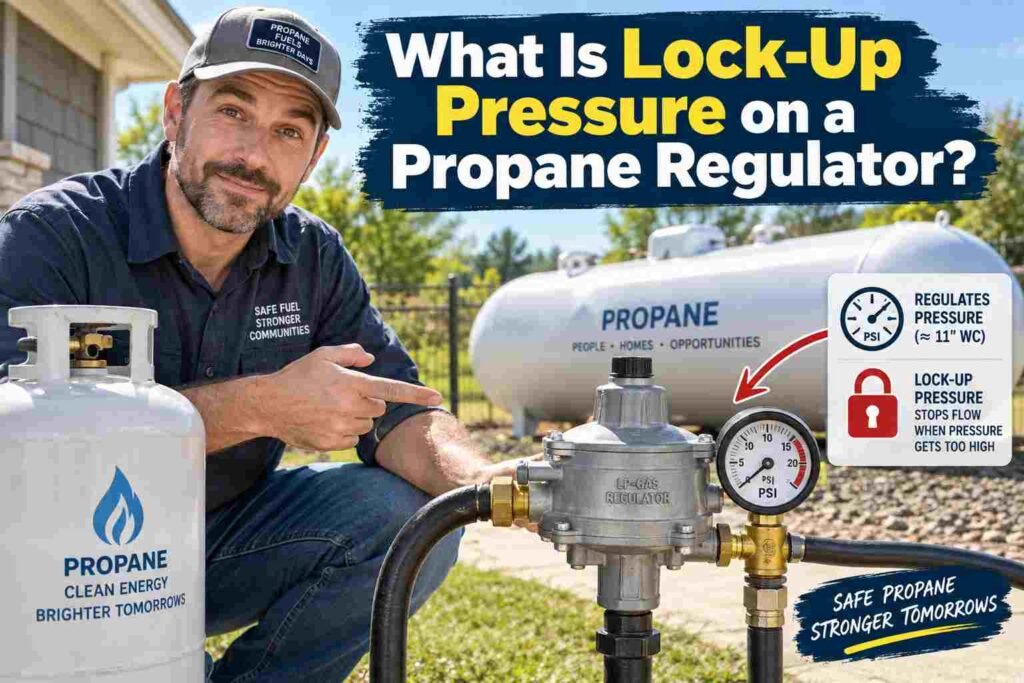
If you have ever connected a manometer to a propane system, you may have noticed something that seems strange at first: the regulator can show one pressure while an appliance is running and a slightly higher pressure after every burner shuts off. That higher no-flow reading is what I mean when I talk about propane regulator lock-up pressure.
In this guide, I will show you what lock-up pressure means, why it rises above normal delivery pressure, what numbers are typical, how it differs from regulator creep and relief pressure, and what a technician looks for when a regulator will not lock up correctly.
What Is Lock-Up Pressure on a Propane Regulator?
Lock-up pressure is the downstream pressure at which a propane regulator fully closes its valve when there is no gas demand. When your furnace, water heater, range, generator, or other appliance stops using propane, gas flow through the regulator drops toward zero. The regulator diaphragm and spring then move the valve toward the closed position.


The valve does not usually close at exactly the same pressure you see while gas is flowing. The downstream pressure normally rises slightly before the valve seats tightly. That stabilized no-flow pressure is the lock-up pressure.
| Pressure term | What it means | When you see it |
|---|---|---|
| Inlet pressure | Pressure entering the regulator | Upstream of the regulator |
| Set/delivery pressure | Nominal outlet pressure the regulator is adjusted to provide | Normally referenced under specified flow conditions |
| Flow pressure | Actual outlet pressure while appliances are consuming gas | Under load |
| Lock-up pressure | Stabilized outlet pressure after flow stops and the regulator closes | No-flow condition |
| Relief pressure | Pressure at which an internal relief mechanism begins protecting against overpressure | Abnormal overpressure condition |
I find that the easiest way to understand lock-up is to think of the regulator as an automatic valve. When appliances need more gas, the valve opens. When demand falls, it moves toward closed. The downstream pressure must rise enough to push the diaphragm to the point where the valve seats. That closing action creates the small difference between flowing pressure and lock-up pressure.
How High Should Propane Regulator Lock-Up Pressure Be?
There is no single lock-up number that applies to every propane regulator. The acceptable value depends on the regulator type, outlet pressure setting, design, spring range, inlet pressure, and the manufacturer’s specification.
For a useful service reference, RegO states that after the appliance valves are shut, a slight pressure rise is expected and that the lock-up pressure should not exceed 130% of the regulator set delivery pressure. RegO also says that if pressure continues creeping upward during a five-minute-or-longer check, the regulator seat is not closing properly.


Here is what the 130% relationship looks like mathematically:
| Example regulator set pressure | 130% of set pressure | Difference above set pressure |
|---|---|---|
| 10 in. w.c. | 13.0 in. w.c. | 3.0 in. w.c. |
| 11 in. w.c. | 14.3 in. w.c. | 3.3 in. w.c. |
| 12 in. w.c. | 15.6 in. w.c. | 3.6 in. w.c. |
| 2 PSIG | 2.6 PSIG | 0.6 PSI |
| 10 PSIG | 13.0 PSIG | 3.0 PSI |
I would not use this table as permission to adjust a regulator to those upper values. It simply demonstrates the 130% guideline. A regulator’s published specification and the appliance/system requirements always come first.
Example: Lock-Up Pressure on an 11-Inch-Water-Column Propane System
A common residential second-stage propane regulator is designed around an outlet setting of approximately 11 inches water column. Fisher, for example, lists 11 in. w.c. (about 27 mbar) as the standard outlet setpoint for several second-stage LP-Gas regulator models.
If I am looking at a system that delivers around 11 in. w.c. while gas is flowing, I expect the pressure to rise somewhat after the appliances shut off. Using RegO’s 130% guideline as a service reference, 130% of 11 in. w.c. is:
11 × 1.30 = 14.3 inches water column

| Measurement | Approximate equivalent |
|---|---|
| 11 in. w.c. | 0.397 PSI |
| 14.3 in. w.c. | 0.517 PSI |
| Pressure increase | 3.3 in. w.c. / about 0.119 PSI |
The important point is not that every 11-inch regulator must lock up at 14.3 inches. Many properly operating regulators will stabilize below that. The important point is that the no-flow pressure should stabilize rather than continue climbing.
If you want a deeper explanation of the units themselves, I have separate guides on what 11 inches water column means for propane and converting propane PSI to inches of water column.
Why Does Pressure Rise When the Regulator Locks Up?
The pressure rise happens because a direct-operated propane regulator balances several forces. The spring pushes on the diaphragm in one direction, while downstream gas pressure pushes against it. The valve mechanism responds to that balance.
While appliances are operating, gas leaving the system causes outlet pressure to fall slightly. The regulator senses that change and opens enough to replace the gas being consumed. As the appliances close, demand drops. Outlet pressure then rises, pushing the diaphragm toward the closing position.


The regulator needs enough downstream pressure to move the mechanism all the way to a tight shutoff. Because of friction, spring force, valve geometry, diaphragm movement, and seat compression, the final no-flow pressure is normally slightly above the pressure observed during flow.
Lock-Up Pressure vs. Flow Pressure
This is one of the most important distinctions I make when diagnosing propane pressure complaints. A regulator can have an acceptable lock-up reading but still perform poorly under load.
| Condition | Gas demand | What the pressure tells me |
|---|---|---|
| Appliances off | Essentially zero | Lock-up and seat shutoff condition |
| Moderate appliance load | Part load | Normal delivery regulation |
| All major appliances operating | High/full load | Capacity, piping loss, regulator droop |
RegO recommends checking delivery pressure with approximately half the total appliance load in use and then checking that pressure is maintained when all appliances are operating. Its service guidance uses 11 in. w.c. at the appliance as the typical low-pressure reference, while also warning that individual appliance regulators may be preset lower.
This matters because a system can sit at a seemingly perfect pressure with everything turned off and then drop too low as soon as a furnace and water heater start together. If that is what you are seeing, read my guide on why propane pressure drops when another appliance turns on.
Lock-Up Pressure vs. Regulator Creep
Lock-up is a normal pressure rise that stops. Creep is a continuing pressure rise after the regulator should already be closed.
This difference is critical. When a regulator reaches lock-up, the outlet pressure should stabilize. If the pressure slowly keeps climbing, propane is continuing to leak past the regulator’s valve seat or another abnormal condition is present.
| Behavior | What the gauge does | Typical interpretation |
|---|---|---|
| Normal lock-up | Rises slightly, then stops | Regulator closes and holds |
| Pressure creep | Keeps rising gradually | Seat may not be shutting off tightly |
| Very rapid abnormal rise | Jumps well above expected range | Requires investigation of regulator/system condition |
| Pressure falls with no demand | Drops instead of holding | Possible downstream leakage or test/setup issue |
RegO specifically recommends continuing the lock-up/leakage test for five minutes or more. If pressure creeps upward, its service manual says to inspect the inlet nozzle and seat disc for dirt, scratches, dents, or wear and replace components where necessary.
What Causes Excessive Lock-Up Pressure?
When I see lock-up pressure clearly above the regulator manufacturer’s limit, I do not assume that turning an adjustment screw is the answer. Several faults can create an abnormal no-flow reading.
Worn, dirty, or damaged valve seat
The regulator seat must stop gas flow when downstream demand reaches zero. Dirt, scratches, dents, hardened seat material, or wear can prevent a tight seal and allow pressure to creep upward. RegO specifically tells technicians to inspect the inlet nozzle and seat disc when creep is present.
Regulator adjusted too high
A regulator may have been turned up to compensate for pressure loss elsewhere. That can hide undersized piping or restrictions while creating excessive no-flow pressure.
Wrong regulator or wrong application
First-stage, second-stage, 2-PSI, integral two-stage, and appliance regulators are not interchangeable. A regulator with the wrong pressure range or capacity can produce unsafe or misleading readings.
Testing at the wrong location
An appliance may have its own regulator set below the building supply pressure. RegO therefore cautions that appliance taps may not be suitable for system lock-up and delivery checks. The test point must match the pressure you actually intend to evaluate.
What Is a Lock-Up Test on a Propane Regulator?
A lock-up test is a pressure test used by trained propane service personnel to see whether a regulator closes and holds pressure correctly when gas demand stops.
At a high level, the technician connects an appropriate pressure-measuring instrument at an approved test point, establishes the regulator’s delivery pressure under the required flow condition, shuts off appliance demand, and watches what the downstream pressure does. The technician compares the stabilized reading with the manufacturer’s lock-up specification and observes whether pressure continues to creep.
I intentionally keep this description at the service-principle level because propane pressure testing involves combustible gas, system isolation, leak checks, purging requirements, and code procedures. If you smell propane, suspect a leak, or do not have the training and instruments for LP-Gas service, stop and contact your propane supplier or a qualified gas technician.
How Long Should a Lock-Up Test Be Observed?
RegO’s LP-Gas Serviceman’s Manual says to continue the test for five minutes or more when checking for a creeping pressure rise. That observation period is useful because a damaged or contaminated seat may not cause an instant jump. Instead, gas can seep past the seat slowly.
| Observation period | Possible gauge behavior | What matters |
|---|---|---|
| First few seconds | Normal small rise as flow stops | Pressure approaches lock-up |
| After stabilization | Reading holds | Expected lock-up behavior |
| Over 5 minutes or more | Reading continues climbing | Possible seat leakage/creep requiring service |
A manufacturer’s service procedure may specify a different test method, timing, inlet pressure, or acceptance limit for a particular model, so I always treat the model-specific documentation as the controlling reference.
Is Lock-Up Pressure the Same as Regulator Relief Pressure?
No. These are two different functions.
Lock-up pressure is the pressure at which the regulator’s main valve closes during normal no-flow operation. Relief pressure relates to an overpressure-protection function that may begin venting or otherwise protecting the downstream system when pressure becomes abnormally high.
| Feature | Lock-up | Relief |
|---|---|---|
| Normal or abnormal? | Normal regulator behavior | Protective response to abnormal overpressure |
| Main purpose | Stop normal gas flow at zero demand | Limit downstream overpressure |
| Should it happen every cycle? | Yes, whenever demand stops | No |
| Typical pressure relationship | Slightly above flowing/set pressure | Higher protective threshold specified by manufacturer |
For example, Fisher describes several second-stage LP-Gas regulators as having internal relief construction, and some models are designed to limit downstream pressure in an overpressure situation. That relief function should not be confused with ordinary lock-up.
Is Lock-Up Pressure the Same as Regulator Droop?
No. In fact, they happen at opposite ends of the operating range.
Droop is the reduction in outlet pressure that occurs as flow demand increases. Lock-up is the increase in outlet pressure that occurs as flow demand falls to zero and the regulator closes.
| Condition | Flow | Outlet pressure tendency |
|---|---|---|
| Lock-up | Zero or near zero | Rises above normal flowing pressure |
| Normal regulation | Moderate | Near intended delivery pressure |
| Droop | Higher demand | Falls as load increases |
If pressure is good when no appliances are operating but weak when several appliances run, I am more interested in regulator capacity, droop, pipe sizing, restrictions, tank vaporization, or supply conditions than in lock-up alone.
Can High Lock-Up Pressure Damage Propane Appliances?
Potentially, yes. Appliances are designed for specific inlet and manifold pressure ranges. Excessive downstream pressure can contribute to improper combustion, overfiring, ignition problems, flame abnormalities, and stress on appliance gas controls.
That is why I do not judge a regulator only by whether gas is reaching the appliance. The regulator has to control pressure correctly at no flow, partial flow, and maximum expected demand.
If you are seeing flame problems, these related guides may help you understand the symptoms: Can a Bad Propane Regulator Cause a Yellow Flame? and Can a Bad Propane Regulator Cause Soot?.
Can a Propane Regulator Have Good Lock-Up Pressure but Still Be Bad?
Yes. A regulator can shut off correctly at zero flow yet lose too much pressure when demand rises because of inadequate capacity, low inlet pressure, restriction, or mechanical wear. The reverse can also happen: flow pressure may look acceptable while the seat fails to shut off tightly. That is why I compare both no-flow and loaded pressure rather than trusting one static reading. My guide on how to check propane regulator pressure explains this in more detail.
What Instruments Are Used to Measure Lock-Up Pressure?
Low-pressure propane systems are normally checked with a manometer or accurate digital low-pressure gauge. Higher-pressure stages require an instrument with the correct PSI range. Instrument range matters: 11 in. w.c. is only about 0.397 PSI, so a coarse tank-pressure gauge is not suitable for evaluating a low-pressure regulator.
Common Lock-Up Pressure Mistakes I Avoid
I do not assume that every pressure number means the same thing. Set pressure, flow pressure, lock-up pressure, inlet pressure, manifold pressure, and relief pressure describe different conditions. I also do not treat every small no-flow pressure rise as a failed regulator; a modest rise that stabilizes is normal.
I also avoid increasing regulator pressure to compensate for weak appliance performance without first finding the cause. Undersized piping, restrictions, inadequate regulator capacity, or supply problems can create low pressure under load, and turning the regulator up can create excessive pressure when demand stops.
When Should a Propane Regulator Be Replaced?
A regulator that cannot hold its specified pressure, creeps because the seat will not seal, has damaged or contaminated components, or fails the manufacturer’s service checks may require replacement. Age, corrosion, vent condition, water intrusion, and physical damage also matter. Fisher currently lists a 20-year recommended replacement life on several residential LP-Gas regulator families, but your model instructions, local requirements, environment, and propane supplier policy should control the decision.
Propane Regulator Lock-Up Pressure FAQ
Is 11 inches water column a lock-up pressure?
Not necessarily. On many residential systems, 11 in. w.c. is a nominal delivery or set pressure. Actual lock-up pressure may be somewhat higher and should be compared with the manufacturer’s specification.
How much can propane pressure rise at lock-up?
RegO’s service manual says lock-up should not exceed 130% of the regulator set delivery pressure. For an 11 in. w.c. setting, that mathematical reference is 14.3 in. w.c.; it is not a universal adjustment target for every regulator.
What is regulator creep?
Creep is a continued rise in downstream pressure after the regulator should already be closed. It can indicate leakage past the regulator seat from wear, debris, or damage.
How long should lock-up pressure be observed?
RegO recommends continuing the check for five minutes or more to identify a creeping pressure rise. The pressure should stabilize rather than keep increasing.
Can I adjust a propane regulator based only on lock-up pressure?
I would not. A regulator has to meet its model-specific set, flow, lock-up, capacity, and overpressure requirements, while the piping and appliances must also be correct. A qualified technician should diagnose the full system before adjustment.
Bottom Line
Lock-up pressure is the stabilized outlet pressure a propane regulator reaches after gas demand stops and the regulator valve closes. It is normally a little higher than the flowing delivery pressure. What I want to see is a modest rise followed by a stable reading—not a pressure that keeps climbing.
RegO’s service guidance says lock-up should not exceed 130% of the regulator’s set delivery pressure and recommends watching for pressure creep for five minutes or more. For an 11 in. w.c. low-pressure regulator, 130% works out to 14.3 in. w.c., but the exact acceptable range for your regulator should always come from the manufacturer’s instructions.
If lock-up is excessive, pressure continues to creep, or appliances show symptoms such as yellow flames, soot, repeated shutdowns, or unstable operation, I recommend having the propane supplier or a qualified gas technician evaluate the regulator and the complete system rather than adjusting the regulator blindly.
Sources
- RegO Products, LP-Gas Serviceman’s Manual — regulator flow pressure, lock-up, leakage, and 130% lock-up guidance.
- Emerson/Fisher, R600 and HSRL Series LP-Gas Regulators Instruction Manual — standard outlet setpoints, regulator ranges, relief features, and operating specifications.
- Emerson/Fisher LP-Gas regulator product documentation — second-stage regulator applications and 11 in. w.c. domestic outlet pressure.

Mike is an experienced propane technician with over 15 years of professional experience in the field. He has dedicated his career to helping customers with their propane needs, from installation to maintenance and repair. Together with Jeremy, he co-founded this website to provide useful information and guidance to customers seeking reliable propane services.


