
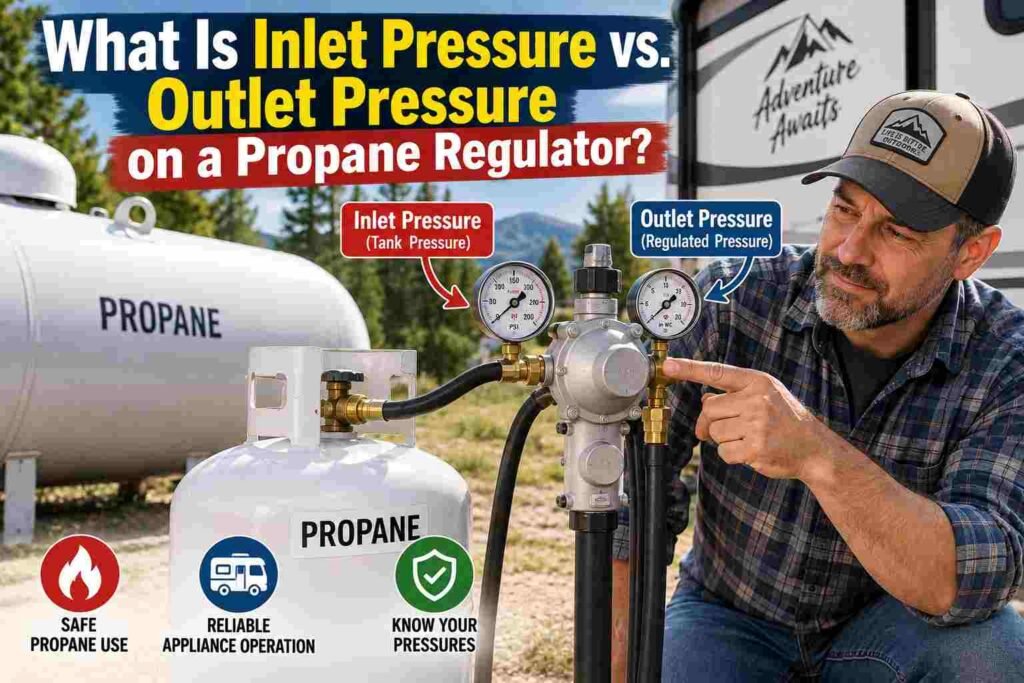
If you have ever looked at a propane regulator label and seen terms such as maximum inlet pressure, outlet pressure, delivery pressure, or set pressure, it can seem like several different measurements are being discussed. In reality, most of those numbers describe one simple process: propane enters the regulator at one pressure and leaves at a lower, more controlled pressure.
I find it useful to think of the regulator as a pressure reducer and stabilizer. The propane tank does not send gas to your appliances at one perfectly fixed pressure. Tank vapor pressure changes with temperature and operating conditions. The regulator’s job is to take that changing upstream pressure and deliver a downstream pressure that is appropriate for the next regulator stage, the piping system, or the appliance.
Inlet Pressure vs. Outlet Pressure: The Basic Difference
| Term | What It Means | Where It Is Measured |
|---|---|---|
| Inlet pressure | Pressure entering the regulator | Upstream side of the regulator |
| Outlet pressure | Pressure leaving the regulator | Downstream side of the regulator |
| Set pressure / delivery pressure | The outlet pressure the regulator is adjusted or designed to maintain | Regulator outlet under specified conditions |
| Maximum inlet pressure | Highest upstream pressure the regulator is rated to receive | Regulator specification |
The easiest rule is this: inlet means before the regulator; outlet means after the regulator. When I troubleshoot a propane pressure problem, I never assume that a good inlet reading automatically means the outlet is correct. A regulator can receive adequate pressure but still deliver too little, too much, or unstable pressure if it is damaged, undersized, contaminated, incorrectly adjusted, or operating outside its intended range.


How a Propane Regulator Changes Inlet Pressure Into Outlet Pressure
Inside a typical propane regulator are a diaphragm, spring, valve mechanism, and seat. The spring applies force that helps determine the desired outlet pressure. The diaphragm senses downstream pressure. As appliance demand changes, the diaphragm and valve move to admit more or less propane.
When an appliance starts using gas, outlet pressure tends to drop. The regulator responds by opening its valve farther so more propane can flow. When demand decreases, outlet pressure rises and the regulator moves toward closed. This constant balancing action is why a properly sized regulator can deliver relatively stable pressure even when the inlet side is not perfectly constant.
But the regulator cannot create pressure. It needs enough pressure on the inlet side to maintain the required outlet pressure while gas is flowing. That is why the pressure difference across the regulator matters.
Typical Propane Regulator Inlet and Outlet Pressures
There is no single inlet or outlet pressure that applies to every propane regulator. The correct values depend on the regulator’s role in the system. A first-stage regulator, second-stage regulator, 2-psi regulator, integral two-stage regulator, and appliance regulator all perform different jobs.


| Regulator Type | Typical Inlet | Typical Outlet | Purpose |
|---|---|---|---|
| First-stage | Tank/container vapor pressure | Often about 8–10 psig | Reduces variable tank pressure to intermediate pressure |
| Second-stage | Often about 8–10 psig; some models allow a wider inlet range | Commonly about 11 in. w.c. | Supplies low-pressure building/appliance system |
| 2-psi service regulator | Often supplied by first stage | About 2 psig | Higher-pressure distribution before a line/appliance regulator |
| Integral two-stage | Tank/container pressure | Usually low-pressure service, commonly around 11 in. w.c. | Performs both pressure reductions in one body |
Fisher describes a two-stage system in which the first stage supplies a nearly constant 8–10 psig to the second stage. Its R222 second-stage regulator, for example, is designed to reduce a nominal 10 psig inlet to 11 inches water column outlet pressure. RegO likewise offers second-stage regulators designed to reduce first-stage pressure in the approximate 5–20 psig range down to normal burner pressure.
If you want a deeper explanation of the intermediate side, I covered it separately in what propane pressure should be after the first-stage regulator.
Why Is the Outlet Pressure So Much Lower Than the Inlet Pressure?
Propane is stored as a liquid under pressure, and the vapor space above the liquid can be at a much higher pressure than household appliances can safely use. A regulator steps that pressure down in a controlled way. In a two-stage system, the pressure reduction happens in two separate steps instead of one large drop.
I prefer to think of the first stage as the intermediate-pressure regulator and the second stage as the appliance-supply regulator. The first stage protects the downstream system from large changes in tank pressure. The second stage then makes the final reduction to the low pressure the building distribution system needs.
This two-stage arrangement also makes the second regulator’s job easier because its inlet pressure is much more stable than raw tank pressure. Fisher specifically notes that supplying the second stage with a nearly constant 8–10 psig inlet helps appliances operate more consistently.

Inlet and Outlet Pressure Are Not the Same as Flow
One mistake I see is assuming that if the pressure reading looks correct, the system must have enough propane flow. Pressure and flow are related, but they are not the same thing. A regulator can show acceptable static outlet pressure when nothing is running and still fail to maintain that pressure when a furnace, water heater, range, or generator starts drawing gas.
This is why I pay attention to both pressure under load and BTU capacity. If the regulator is undersized, the outlet pressure may sag as flow increases even though the inlet pressure still appears adequate.
| Measurement | What It Tells You | Possible Problem if Abnormal |
|---|---|---|
| Inlet pressure | Whether the regulator is being supplied properly | Tank supply, upstream regulator, piping restriction |
| Outlet pressure at no load | Regulator set/lock-up behavior | Incorrect adjustment, seat leakage, regulator problem |
| Outlet pressure under load | Whether the regulator can maintain delivery pressure while gas flows | Undersized regulator, low inlet pressure, restriction, excessive demand |
| BTU/hr capacity | How much gas energy the regulator can pass under specified conditions | Regulator too small for connected load |
I explain regulator capacity in more detail in what BTU capacity means on a propane regulator and show the sizing math in how to calculate the BTU capacity needed for a propane regulator.
What Does Maximum Inlet Pressure Mean?
The maximum inlet pressure printed in a regulator specification is a limit, not a recommended operating target. It tells you the highest upstream pressure that model is designed to receive. I would never choose a regulator simply because its outlet setting looks right while ignoring its inlet rating.


For example, Fisher’s current low-pressure regulator instructions state that its second-stage regulators are limited to 20 psig inlet pressure and must be used with a first-stage regulator. That is a good example of why the words “second stage” matter. A second-stage regulator is not intended to be connected directly to raw tank pressure just because its desired outlet pressure is 11 inches water column.
RegO also publishes second-stage models designed for a defined first-stage inlet range. The lesson I want you to take away is simple: the inlet rating is part of the regulator’s application, not just a technical footnote.
What Does Outlet Pressure Mean?
Outlet pressure is the pressure the regulator delivers downstream. Depending on the regulator, it may be factory-set, adjustable within a specified range, or designed for a particular service such as 10 psig, 2 psig, 11 inches water column, or another special setting.
RegO’s current regulator coding guide, for example, identifies common outlet settings including 2 psig, 5 psig, 10 psig, and 11 inches water column. Those values illustrate why you cannot look at the physical size of a regulator and assume what pressure it produces.
| Outlet Pressure | Approximate Equivalent | Typical Context |
|---|---|---|
| 11 in. w.c. | 0.40 psi / about 27 mbar | Common low-pressure propane distribution |
| 2 psig | About 55.4 in. w.c. | Elevated-pressure distribution system |
| 5 psig | About 138.4 in. w.c. | Special/intermediate pressure service |
| 10 psig | About 276.8 in. w.c. | Common first-stage/intermediate pressure |
If you are comparing PSI with inches water column, see my guide on converting propane PSI to inches of water column. I also explain the low-pressure side in what 11 inches water column means for propane.
Why Inlet Pressure Changes More Than Outlet Pressure
The upstream side of a propane system can change because tank vapor pressure depends strongly on temperature and because gas demand causes pressure losses through valves, regulators, piping, fittings, and hoses. The downstream side is supposed to be much more controlled.
That does not mean outlet pressure is perfectly motionless. As flow rises, most regulators experience some pressure drop called droop. When flow stops, pressure can rise slightly as the regulator closes, which is called lock-up. A properly functioning regulator keeps these changes within its designed performance range.
I cover the no-flow side separately in what lock-up pressure means on a propane regulator.
How Inlet and Outlet Pressure Change When Appliances Turn On
One point I always emphasize is that a propane regulator does not operate under one perfectly fixed condition. The inlet pressure can change, and the outlet pressure can move slightly as gas demand changes. A properly selected regulator is designed to keep that outlet pressure within an acceptable range even while the inlet side and gas flow are changing.
When no appliance is using gas, the regulator is close to a no-flow condition. When a furnace, water heater, range, or generator starts, flow increases through the regulator. The regulator valve opens farther to supply that demand. As flow increases, you may see a small change in delivery pressure. This normal change under load is often called droop.
| Condition | Inlet Side | Outlet Side | What I Expect |
|---|---|---|---|
| No appliance load | Supply pressure present | Near lock-up pressure | Regulator mostly closed |
| Normal appliance load | Adequate pressure entering regulator | Close to rated delivery pressure | Stable operation |
| Heavy simultaneous load | May fall because of upstream limitations | May droop slightly | Should stay within the regulator/system design range |
| Restricted supply or undersized system | Can fall excessively | Can become too low | Weak flames, shutdowns, or poor appliance performance |
If the outlet pressure falls only when several appliances run at once, I do not immediately blame the regulator. I also look at tank vaporization, first-stage capacity, piping size, line length, restrictions, and the total connected BTU load. I cover that symptom in more detail in why propane pressure drops when another appliance turns on.
Typical Inlet and Outlet Pressures by Regulator Stage
The easiest way to understand inlet versus outlet pressure is to follow the gas through a normal two-stage system. The first regulator receives high, temperature-dependent container pressure. Its outlet becomes the inlet pressure for the second-stage regulator. The second stage then reduces that intermediate pressure to the low pressure used by the building distribution system.
| Regulator / Location | Typical Inlet | Typical Outlet | Purpose |
|---|---|---|---|
| First-stage regulator | Propane container vapor pressure | About 10 psig on many systems | Reduces variable tank pressure to a manageable intermediate pressure |
| Second-stage regulator | Commonly around 10 psig; many RegO models accept roughly 5-20 psig | Normally 11 in. w.c. | Supplies low-pressure building piping and appliances |
| 2-psi service regulator | Often first-stage pressure | 2 psig | Feeds a 2-psi distribution system with additional regulation downstream |
| Integral two-stage regulator | Container pressure | Normally about 11 in. w.c. | Performs two pressure reductions inside one regulator assembly |
These are common examples, not universal settings. The regulator model, installation design, appliance requirements, and local code all matter. I always treat the regulator nameplate and manufacturer data as the controlling specification.
Why PSI Is Used on One Side and Inches of Water Column on the Other
High and intermediate propane pressures are convenient to express in pounds per square inch, while very low appliance pressures are easier to read in inches of water column. That is why you may see 10 psig entering a second-stage regulator but 11 inches w.c. leaving it.
According to NIST pressure conversions, 1 psi is approximately 27.68 inches of water column. That means 11 inches w.c. is only about 0.397 psi. The second-stage regulator is therefore making a major pressure reduction even though the numbers 10 and 11 can look deceptively similar.
| Pressure | Approx. PSI | Approx. Inches w.c. | Approx. kPa |
|---|---|---|---|
| 11 in. w.c. | 0.397 psi | 11 in. w.c. | 2.74 kPa |
| 1 psi | 1 psi | 27.68 in. w.c. | 6.895 kPa |
| 2 psi | 2 psi | 55.36 in. w.c. | 13.79 kPa |
| 10 psi | 10 psi | 276.8 in. w.c. | 68.95 kPa |
If you want to work through the conversion yourself, see my guide on converting propane PSI to inches of water column once that companion guide is published.
What Happens If Inlet Pressure Is Too Low?
A regulator cannot create pressure. It can only reduce and control the pressure supplied to it. If inlet pressure falls below the level needed for that regulator to deliver its rated capacity, the outlet pressure can sag under load.
This is why I never diagnose a low-pressure complaint by checking the outlet alone. If I measure low outlet pressure, I also want to know what is happening on the inlet side while the appliances are actually operating.
| Possible Cause | Effect on Inlet Pressure | Possible Outlet Symptom |
|---|---|---|
| Undersized upstream regulator | Drops under high demand | Low delivery pressure when several appliances run |
| Long or undersized piping | Pressure loss increases with flow | Weak flames or appliance dropout |
| Restricted valve, fitting, or screen | May look normal static but fall under flow | Good pressure at rest, poor flow under load |
| Insufficient tank vaporization in cold weather | Supply pressure/capacity may become inadequate | Pressure problems become worse at high demand |
If you are seeing this pattern, my article on why a propane regulator has low pressure goes deeper into the possible causes.
What Happens If Outlet Pressure Is Too High?
High outlet pressure is a different problem. It can point to an incorrect regulator, an improper adjustment, regulator seat leakage, debris, damage, or another failure that prevents the regulator from controlling pressure correctly.
I do not recommend turning the adjustment screw simply because an appliance appears to need more gas. Increasing outlet pressure without verifying the appliance specification and regulator model can create unsafe combustion conditions. A qualified propane technician should diagnose and adjust the regulator with the proper test instruments.
It is also useful to separate normal lock-up pressure from continuous pressure creep. When gas flow stops, outlet pressure can rise slightly as the regulator closes. If pressure keeps climbing instead of stabilizing, the regulator may not be sealing correctly. I explain that in my lock-up pressure guide.
Where Should Inlet and Outlet Pressure Be Measured?
Pressure needs to be measured at the correct point. A reading on the upstream side tells you whether the regulator is receiving adequate supply pressure. A reading downstream tells you whether it is delivering the required pressure. Measuring only one side can hide the real cause of a problem.
| Test Point | What It Tells Me | Typical Instrument |
|---|---|---|
| Regulator inlet test point | Pressure available to the regulator | Pressure gauge appropriate to the expected psi range |
| Regulator outlet test point | Regulated delivery pressure | Gauge or manometer matched to the outlet range |
| Appliance inlet test point | Pressure reaching the appliance after piping losses | Usually a low-pressure manometer for inch-w.c. systems |
| Appliance manifold test point | Pressure downstream of the appliance gas valve/regulator | Low-pressure manometer |
Because propane testing involves fuel gas, I recommend that pressure checks and regulator adjustments be performed by a qualified propane service technician. If you want to understand what a technician is measuring, see how propane regulator pressure is checked.
Inlet Pressure vs. Outlet Pressure: A Simple Troubleshooting Guide
| Inlet Reading | Outlet Reading | What It May Suggest |
|---|---|---|
| Normal | Normal | Regulator and supply appear to be operating normally at that test condition |
| Low under load | Low under load | Look upstream: supply capacity, first stage, piping, valves, tank vaporization |
| Normal under load | Low | Regulator sizing, condition, setting, or downstream demand may need investigation |
| Normal | Too high or creeping upward | Possible regulator control or seat-sealing issue; service is required |
Frequently Asked Questions
Is inlet pressure always higher than outlet pressure on a propane regulator?
Yes, for a normal pressure-reducing propane regulator, the inlet pressure must be higher than the regulated outlet pressure. The regulator uses that pressure difference while controlling gas flow. A regulator is not a compressor and cannot boost a low inlet pressure to a higher outlet pressure.
What is the normal outlet pressure of a residential propane regulator?
Many final-stage residential LP-gas systems are regulated to about 11 inches of water column. However, you should use the pressure specified for the regulator and the appliance installation rather than assuming every system uses the same setting.
What is the normal inlet pressure of a second-stage propane regulator?
A common two-stage system supplies the second-stage regulator at about 10 psig. For example, current RegO second-stage models in the LV4403B family are designed for approximately 5 to 20 psig inlet and are factory set to deliver 11 inches w.c. at a 10-psig inlet condition.
Can high inlet pressure cause high outlet pressure?
A properly selected regulator is designed to control its outlet throughout its rated inlet-pressure range. If the inlet pressure exceeds the regulator’s maximum rating, however, the installation is outside the manufacturer’s limits and can become dangerous. High outlet pressure should be investigated rather than corrected by trial-and-error adjustment.
Why is outlet pressure lower when several appliances are running?
Some pressure change under load is normal, but an excessive drop can indicate regulator droop beyond the expected range, insufficient inlet pressure, an undersized regulator, undersized piping, a restriction, or inadequate propane vaporization. The correct diagnosis requires readings under actual operating load.
Is appliance manifold pressure the same as regulator outlet pressure?
Not necessarily. The house regulator outlet is the pressure entering the distribution piping. An appliance may then have its own gas valve or appliance regulator, so manifold pressure can be lower and is specified by that appliance manufacturer.
My Bottom Line
When I explain inlet pressure vs. outlet pressure on a propane regulator, I keep it simple: inlet pressure is what the regulator receives, and outlet pressure is what the regulator delivers after reducing and controlling that pressure. In a common two-stage residential system, container pressure enters the first stage, roughly 10 psig leaves the first stage, and the second stage then reduces that intermediate pressure to around 11 inches w.c. for low-pressure distribution.
The important part is not memorizing one number. I want you to understand that every regulator has a rated inlet range, outlet setting, flow capacity, and operating curve. A regulator can only perform correctly when it receives adequate inlet pressure and is sized for the gas load. If you have weak flames, pressure that changes dramatically with load, or an outlet pressure that continues to rise, the safest next step is professional testing rather than adjustment by guesswork.
Technical References
I based the pressure examples and conversions in this guide on current manufacturer and standards references, including Fisher R222 second-stage regulator data, RegO LV4403B second-stage regulator specifications, and NIST pressure-unit conversions.

Mike is an experienced propane technician with over 15 years of professional experience in the field. He has dedicated his career to helping customers with their propane needs, from installation to maintenance and repair. Together with Jeremy, he co-founded this website to provide useful information and guidance to customers seeking reliable propane services.


