
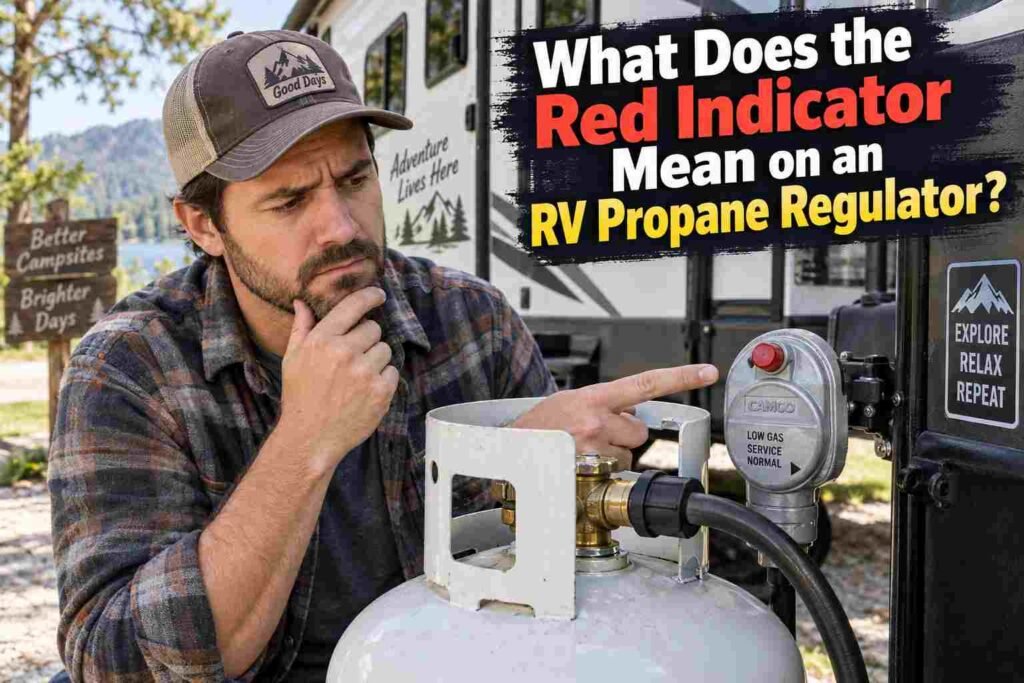
When I see a red indicator on an RV propane regulator, I do not immediately assume the regulator has failed. On a properly installed automatic-changeover system, red is usually doing exactly what it was designed to do: telling you that the cylinder you selected as the service or primary cylinder needs attention.
The important part is understanding what the indicator is actually monitoring. It reacts to gas pressure, not to the exact amount of liquid propane remaining in the bottle. That is why cold weather, high propane demand, a closed reserve-cylinder valve, or a restricted pigtail can sometimes make the indicator confusing.
RV Propane Regulator Red Indicator: Technical Details
| Item | Typical Meaning or Value | Why It Matters |
|---|---|---|
| Green indicator | Selected service cylinder has adequate pressure | Does not mean the bottle is completely full |
| Red indicator | Service cylinder pressure has fallen to the regulator’s changeover range | Usually means it is time to refill or replace the selected cylinder |
| Reserve cylinder | Normally begins supplying gas automatically | Both cylinder valves generally must be open for automatic backup operation |
| Typical RV outlet pressure | About 11 inches water column | Common low-pressure supply for RV propane appliances |
| 11 in. w.c. in psi | About 0.397 psi | Shows how low the regulated appliance pressure is |
| RegO 7525 example changeover indication | Indicator turns red when selected-side pressure falls below about 5 psig | Model-specific example, not a universal setting for every regulator |
What Does the Red Indicator Mean on an RV Propane Regulator?
On an automatic-changeover regulator, the red indicator normally means the cylinder selected by the lever or arrow can no longer maintain the pressure required to remain the active service cylinder.
RegO describes its 7525 Series this way: the indicator arrow points toward the service cylinder. When the indicator turns red, the service cylinder is considered empty and gas service is being supplied from the reserve cylinder. The red indication tells you it is time to replace or refill the service cylinder.
Marshall Excelsior describes the same basic operation on its MEGR-253 Series. The regulator automatically redirects LP-gas vapor flow from an empty service cylinder to a reserve cylinder without interrupting service, and the green indicator changes to red when the service cylinder needs to be refilled.
That is the first thing I want you to remember: red is primarily a cylinder-change signal, not automatically a regulator-failure signal.
Does Red Mean Both Propane Tanks Are Empty?
No. In a normal dual-cylinder automatic-changeover setup, red usually means the selected service cylinder has run down and the reserve cylinder has taken over.


This is one of the most common misunderstandings I see with RV propane systems. If both bottle valves are open, the regulator can continue feeding your furnace, refrigerator, water heater, or stove from the reserve cylinder even while the indicator is red.
However, if you ignore the red indicator long enough, the reserve cylinder can eventually run empty too. At that point you may suddenly lose propane service because there is no longer a full backup cylinder available.
Green vs. Red on an Automatic Changeover Regulator
| Indicator | What I Interpret It to Mean | What I Would Do |
|---|---|---|
| Green | Selected cylinder has enough pressure to serve the regulator | Continue normal use and monitor propane supply |
| Red | Selected service cylinder has dropped below the changeover point | Rotate selector to the cylinder now supplying gas, close/remove the depleted cylinder as instructed by the regulator manufacturer, and refill it |
| Partial red/green | Some models show a transitional or mixed indication during changeover | Follow the exact regulator instructions rather than relying only on color |
One subtle point is that green is not a tank gauge. A cylinder can be partly used and still show green because it has enough vapor pressure to keep the selected side active.
Likewise, red does not tell you exactly how many pounds or gallons of propane are left. The indicator is pressure-operated.
How the Automatic Changeover Actually Works
An automatic-changeover regulator combines two jobs. First, it decides which cylinder should supply propane. Second, it reduces the incoming cylinder pressure to the low pressure your RV appliances need.
I think of it as a primary-and-backup system. You point the selector lever toward the cylinder you want to use first. That cylinder becomes the service or primary cylinder. The other cylinder becomes the reserve. Both cylinder valves are then opened slowly so the regulator has access to both supplies.
As long as the primary cylinder can maintain enough pressure, the regulator continues drawing from it. When the primary side drops below the regulator’s changeover point, the reserve side begins supplying gas automatically. On many models, the indicator changes from green to red at this point.
The appliance side still sees low regulated pressure. The changeover mechanism does not send raw cylinder pressure directly to your RV. A two-stage automatic regulator continues reducing the propane to the required outlet setting, commonly around 11 inches water column.
Typical Changeover Sequence
| Stage | What Happens | Indicator |
|---|---|---|
| 1. Both cylinders available | Selected cylinder supplies propane | Usually green |
| 2. Service cylinder pressure falls | Reserve side begins supplementing or takes over | May transition to red or partial red/green |
| 3. Service cylinder depleted | Reserve cylinder supplies the RV | Red |
| 4. Selector moved to reserve side | Reserve becomes the new service cylinder | Returns to green if pressure is adequate |
| 5. Empty cylinder refilled | Refilled bottle becomes the new reserve | Green remains while new service cylinder is healthy |
What Should I Do When the Indicator Turns Red?
I would not simply disconnect the cylinder the moment I see red. First I would identify which cylinder the selector arrow or lever is pointing toward and confirm the other cylinder is actually supplying the RV.
Manufacturer instructions matter here. RegO tells users to close the valve on the depleted service cylinder, rotate the indicator or selector toward the reserve cylinder, remove and replace or refill the empty cylinder, reconnect it, then open its valve and check the connection for leaks with a suitable leak-detection solution.
Marshall Excelsior gives an especially important warning: before disconnecting the empty cylinder, the black changeover lever must be rotated fully toward the cylinder that is now supplying the regulator. Their instructions warn that disconnecting a hose while the indicator is red without correctly positioning the lever can result in a propane leak.
Can the Indicator Turn Red While There Is Still Propane in the Cylinder?
Yes. This is where the pressure-operated nature of the indicator matters.
A cylinder may still contain liquid propane but temporarily fail to provide enough vapor pressure to stay above the regulator’s changeover threshold. That can happen in very cold weather, under unusually high appliance demand, or when the cylinder has a restricted valve or pigtail connection.
For example, imagine your furnace, water heater, and refrigerator are all running on propane on a cold morning. The total vapor demand can be much higher than when only the refrigerator is operating. As the cylinder cools while propane vaporizes, its available vapor pressure and vaporization rate can fall. The regulator may then interpret the primary side as depleted and switch to the reserve even though some liquid propane remains.
Conditions That Can Cause an Early Red Indication
| Condition | What Happens | What I Would Check |
|---|---|---|
| Cold weather | Cylinder vapor pressure and vaporization rate fall | Cylinder level, temperature, load, and both bottle valves |
| High BTU demand | Service cylinder pressure can sag under load | Whether red appears only with furnace/water heater running |
| Kinked or restricted pigtail | Pressure reaching the regulator is reduced | Hose routing, damage, excess-flow activation, fittings |
| Cylinder valve not fully open | Available flow may be limited | Valve position and proper opening procedure |
| Regulator problem | Indicator may not respond correctly to pressure | Loaded outlet pressure and regulator condition |
How Much Pressure Does an RV Propane Regulator Deliver?
The indicator side works at cylinder pressure, but the outlet side of a typical RV automatic-changeover regulator is much lower. Many RV appliances are designed to receive around 11 inches water column.
| Pressure | Equivalent | Typical Role |
|---|---|---|
| 11 in. w.c. | About 0.397 psi | Common RV regulator outlet setting |
| 11 in. w.c. | About 2.74 kPa | Same outlet pressure in metric units |
| 100 psig | About 689 kPa | Published test inlet pressure used for some Marshall Excelsior capacity ratings, not normal RV appliance pressure |
This large pressure reduction is why a two-stage regulator is so important. The changeover mechanism decides which cylinder supplies propane, while the regulating stages control the pressure delivered downstream.
Does the Reserve Side Have the Same Capacity as the Primary Side?
Not always. This is a detail I think RV owners should know because an automatic changeover regulator may have a lower published capacity while operating from the reserve side.
For example, Marshall Excelsior publishes different primary and reserve capacities for its current MEGR-253 family. These are model-specific ratings, but they show why a system can sometimes behave differently after it has automatically switched cylinders.
| Marshall Excelsior Model | Primary Capacity | Reserve Capacity | Published Outlet Setting |
|---|---|---|---|
| MEGR-253 | 225,000 BTU/hr | 150,000 BTU/hr | 11 in. w.c. |
| MEGR-253H | 350,000 BTU/hr | 200,000 BTU/hr | 11 in. w.c. |
Marshall lists those capacities at specific test conditions, including 20% droop. I would never assume every RV automatic-changeover regulator has the same capacity. The correct regulator must be sized for the combined BTU demand of the appliances it serves.
If your furnace and other appliances become weak only after the regulator switches to reserve, capacity, cold-weather vaporization, or a restriction deserves attention. A red indicator by itself is normal; a red indicator combined with low flames or repeated appliance shutdowns may point to a supply problem that needs diagnosis.
For a deeper explanation of load-related pressure loss, see why propane pressure drops when another appliance turns on.
Why Is My RV Propane Regulator Still Red After I Refilled the Tank?
If the service cylinder has been refilled but the indicator remains red, I work through the simple causes before assuming the regulator is defective.
1. The Selector Is Still Pointing to the Wrong Cylinder
After an automatic changeover, the reserve cylinder may be supplying gas while the selector still points toward the depleted side. The normal service procedure is to rotate the selector toward the cylinder that is now supplying gas before removing the empty cylinder. Once properly positioned and supplied with adequate pressure, many regulators return to green.
2. The Refilled Cylinder Valve Is Closed
A newly connected cylinder cannot become a usable reserve if its valve remains closed. Automatic changeover only works when the regulator can access both cylinders.
3. The Cylinder Valve Was Opened Too Quickly
Modern cylinder connections can include excess-flow protection. A sudden rush of gas can cause the excess-flow device to restrict flow, which may leave you with weak propane service or confusing indicator behavior. I prefer to make sure appliances are off and open cylinder valves slowly, following the RV and regulator manufacturer instructions.
4. A Pigtail Is Restricted, Kinked, or Damaged
The pigtail is part of the pressure path between the cylinder and regulator. A restriction can make a full cylinder look like a low-pressure cylinder to the changeover mechanism.
5. The Regulator or Indicator Mechanism Has a Problem
If both cylinders are known full, both valves are open, the pigtails are in good condition, and the selector is correctly positioned but the indicator stays red, then I would have the regulator tested. Age, contamination, internal wear, corrosion, or a sticking changeover mechanism can prevent normal operation.
Do not compensate by turning adjustment screws unless the regulator manufacturer specifically calls for qualified adjustment. If outlet pressure needs to be checked, it should be measured with a suitable manometer and compared with the regulator and RV specifications. My guide on checking propane regulator pressure explains why static and flowing pressure both matter.
What If the Indicator Is Red and No Propane Appliances Work?
Red plus no propane service is different from red while the reserve cylinder is successfully supplying the RV.
| Red Indicator + Symptom | Possible Cause | Next Check |
|---|---|---|
| Red, appliances still normal | Normal automatic changeover | Refill the depleted service cylinder |
| Red, no gas flow | Reserve valve closed, reserve empty, excess-flow restriction, blocked pigtail, regulator problem | Confirm cylinder supply and proper valve/selector position |
| Red, weak flames | Low inlet pressure, high demand, cold weather, restriction, insufficient reserve capacity | Check pressure under load |
| Red, propane smell or hissing | Possible leak | Shut off propane if safe, avoid ignition sources, obtain qualified service |
If the regulator will not restore normal flow after the supply problem is corrected, see my article on a propane regulator that will not reset.
Is the Red Indicator a Reliable Propane Level Gauge?
No. I would not use it as one.
The changeover indicator tells you whether the selected cylinder can maintain enough pressure for the regulator. It does not measure liquid propane percentage the way a float gauge does, and it does not weigh the cylinder.
This means a regulator can remain green for most of a cylinder’s usable range and then turn red fairly quickly as pressure can no longer be maintained. It also means an unusually cold or heavily loaded cylinder may change over earlier than you expect.
If I need a better idea of how much propane is physically left in a removable cylinder, I use weight, an appropriate cylinder-level device, or another method intended to estimate contents. I do not interpret green as “full” or red as “completely bone dry.”
When Does a Red Indicator Suggest a Regulator Problem?
A red indicator is normal when the selected cylinder is depleted. I become more suspicious of the regulator when the color no longer matches the actual supply conditions or when pressure problems affect several appliances at once.
Examples include an indicator that stays red with two known-full cylinders, repeatedly flips red under modest load, never changes color when the selected cylinder empties, or is accompanied by unstable outlet pressure. Physical damage, corrosion, persistent gas odor, vent leakage, or a regulator that will not maintain its specified outlet pressure are stronger reasons to stop using the system and have it inspected.
If you are trying to decide whether the regulator itself has failed, my guide on how to know if a propane regulator is working properly covers the broader warning signs.
Can I Keep Using My RV When the Regulator Indicator Is Red?
If the red indication simply means the regulator has automatically switched to a healthy reserve cylinder, the RV may continue receiving propane normally. That uninterrupted service is the reason automatic-changeover regulators exist.
But I would not ignore the red indicator. The reserve is no longer a reserve once it becomes the active supply. If you keep using propane without refilling the depleted cylinder, you can eventually empty the second cylinder and lose service completely—often at the worst possible time, such as overnight when the furnace is running.
I treat red as an action signal: identify the depleted side, make the correct cylinder swap according to the regulator instructions, restore a full reserve cylinder, and leak-check the reconnected fitting with an approved leak-detection solution.
How I Prevent Confusion With an Automatic Changeover Regulator
I find a simple routine prevents most surprises. I keep both cylinders connected and their valves open when using automatic changeover. I point the selector clearly toward the cylinder I want to use first. I check the indicator periodically instead of waiting for appliances to stop. When it turns red, I move the selector toward the cylinder now supplying gas before removing the depleted bottle, then refill that bottle promptly so I once again have a true reserve.
I also inspect the pigtails and regulator area. Cracked hoses, tight bends, oily contamination, corrosion, loose fittings, or a blocked vent are reasons for service. The regulator vent should remain positioned as required by the manufacturer—commonly downward on RV installations—to help prevent water and debris from entering.
Frequently Asked Questions
Does a red RV propane regulator mean the tank is completely empty?
Not necessarily. It means the selected service side has fallen below the regulator’s changeover pressure. In normal conditions that usually happens when the cylinder is effectively depleted, but cold weather, high demand, or a restriction can sometimes cause changeover while some liquid propane remains.
Will my propane keep working when the indicator turns red?
Yes, if you have an automatic-changeover regulator, the reserve cylinder contains propane, both cylinder valves are open, and the regulator is functioning correctly. The reserve side should take over without interrupting service.
Why did my regulator turn red even though I just filled both tanks?
I would check selector position, cylinder valves, pigtails, excess-flow restrictions, and whether the regulator is actually receiving adequate inlet pressure. If both cylinders are full and correctly connected but the regulator remains red, qualified testing is appropriate.
What does green mean on an RV propane regulator?
Green generally means the selected service cylinder is providing adequate pressure. It does not mean the cylinder is 100% full.
Can cold weather make an RV regulator show red early?
Yes. Propane vapor pressure and vaporization capacity decrease as temperature falls. Heavy furnace use can further cool the cylinder. A pressure-operated changeover regulator may switch earlier in severe cold or high-demand conditions even though some propane remains.
Should both propane tank valves be open with an automatic changeover regulator?
Normally, yes. Automatic changeover requires the regulator to have access to the reserve cylinder. Always follow the instructions for your specific RV and regulator model.
Can I disconnect the empty cylinder while the indicator is red?
Not until you follow the regulator manufacturer’s changeover procedure. On Marshall Excelsior automatic-changeover regulators, the selector lever must first be rotated fully toward the alternate cylinder that is supplying the system, and the empty-cylinder valve is closed before removal. Disconnecting the wrong side while the regulator is in changeover can create a propane leak.
What if I smell propane while changing the cylinder?
Stop. Do not continue troubleshooting around an active leak. Avoid flames, sparks, and other ignition sources. Shut off the propane supply if it is safe to do so, leave the area if necessary, and have the RV propane system inspected by qualified service personnel. For related causes, see why a propane regulator may leak.
Bottom Line
When the indicator on an RV automatic-changeover propane regulator turns red, I read it first as a message that the selected service cylinder can no longer maintain the regulator’s required changeover pressure. If the reserve cylinder is connected, open, and healthy, the regulator should already be supplying the RV from that reserve cylinder.
Red does not automatically mean both bottles are empty, and it does not automatically mean the regulator is bad. It means you should identify the depleted service side, correctly move the selector to the cylinder now supplying gas, refill or replace the depleted cylinder, reconnect it safely, and restore it as your new reserve.
If the indicator stays red with full cylinders, if propane pressure is weak, if appliances repeatedly shut down, or if you smell gas, I would move beyond simple cylinder replacement and have the system tested. The indicator is useful, but the actual condition of the cylinders, pigtails, regulator, and outlet pressure tells the full story.
Technical Sources
I based the technical details in this article on current or manufacturer-published guidance, including:

Mike is an experienced propane technician with over 15 years of professional experience in the field. He has dedicated his career to helping customers with their propane needs, from installation to maintenance and repair. Together with Jeremy, he co-founded this website to provide useful information and guidance to customers seeking reliable propane services.


