
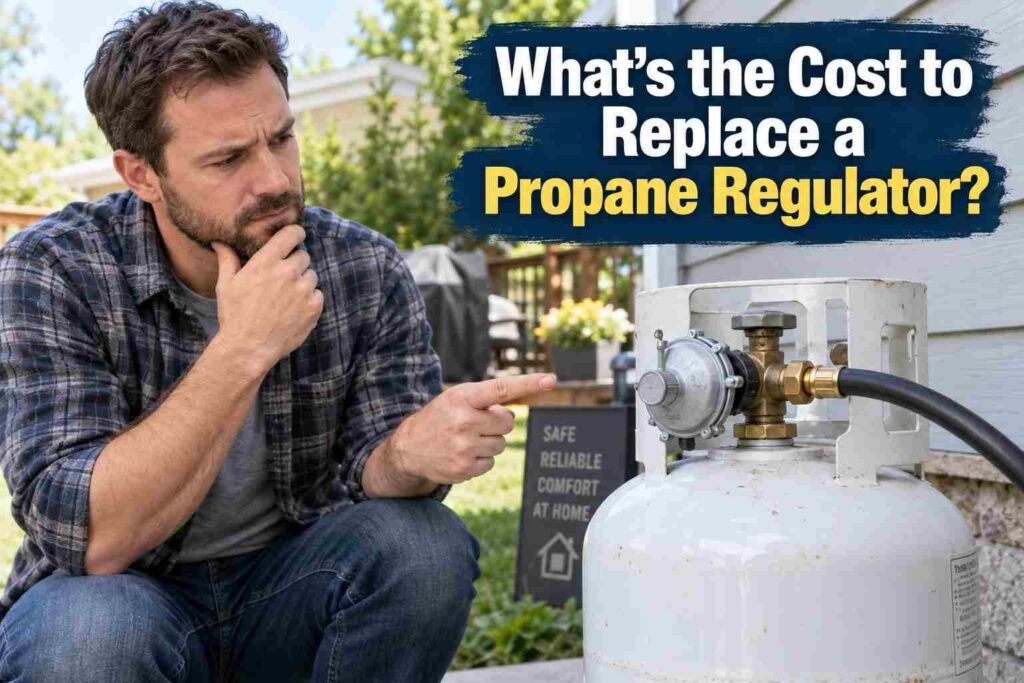
When someone asks me, “What’s the cost to replace a propane regulator?” I first ask what kind of regulator we are talking about. A $25 grill regulator, a $70 RV automatic-changeover regulator, a $110 residential second-stage regulator, and a high-capacity commercial regulator all do different jobs.
I also separate parts-only cost from installed cost. Online prices can make regulator replacement look inexpensive, but professional propane work usually includes shutting down the system, replacing fittings if needed, checking regulator outlet pressure, leak-testing the connections, and confirming the system operates correctly before it goes back into service.
The estimates in this article are planning ranges based on current 2026 retail listings and published service pricing. They are not a universal national rate. Your actual cost depends heavily on your location, propane supplier, regulator type, access, system size, and whether the technician finds additional problems.

2026 Propane Regulator Replacement Cost at a Glance
| Regulator Type | Typical Parts-Only Range | Planning Range Installed | Typical Application |
|---|---|---|---|
| Portable grill/small single-stage | $20–$50 | $75–$175 if professionally serviced | Grills, small outdoor appliances |
| RV two-stage regulator | $25–$80 | $150–$300 | Single-tank or fixed RV systems |
| RV automatic-changeover two-stage | $60–$150 | $245–$450 | Dual-cylinder travel trailers/fifth wheels |
| Residential integral two-stage | $75–$130 | $225–$500 | 100-lb cylinders, small domestic systems |
| Residential first-stage | $120–$175+ | $250–$550+ | Bulk tank to intermediate pressure |
| Residential second-stage | $90–$130 | $250–$600 | House-side low-pressure regulator |
| High-capacity second-stage/commercial | $140–$220+ | $350–$800+ | Large homes, generators, commercial loads |
| First + second stage replacement | $200–$350+ | $400–$900+ | Complete two-stage residential upgrade/replacement |
These installed figures are the budgeting ranges I would use—not guaranteed quotes. Published 2026 RV service pricing ranges from roughly $165–$285 for a standard two-stage regulator replacement to around $245–$385 for an automatic-changeover replacement at one mobile service provider, while another provider quotes $280–$450 for regulator replacement depending on the unit, labor, and fittings. That spread shows how much labor model and service-call structure can change the bill.
How Much Does the Regulator Itself Cost?
For many jobs, the actual regulator is surprisingly affordable compared with the total service invoice.
Current 2026 retail examples include basic grill regulators around $20–$50, RV two-stage regulators around the $20s to $80 range, Marshall Excelsior automatic-changeover RV regulators around $60–$80 without hoses, and complete regulator/pigtail kits that can approach $130–$150.
On residential systems, current second-stage regulator prices commonly fall around $90–$130 for standard domestic models. RegO LV4403B second-stage regulators are currently listed by specialty propane retailers around $100–$120, while some compact alternatives from Marshall Excelsior and Cavagna are around $65–$95.


Integral two-stage regulators commonly sell around $75–$130 depending on capacity and connections. Current examples include RegO compact twin-stage models in roughly that range and Fisher R632-series integral two-stage regulators around $125 at some distributors.
High-capacity regulators cost more. A 2.3-million-BTU/hr second-stage model is currently listed around $220 by one propane equipment retailer.
Current Parts Price Examples
| 2026 Example | Approx. Retail Price | Published Specification |
|---|---|---|
| Flame King RV 2-stage regulator | About $22 | RV low-pressure two-stage |
| Universal dual-stage regulator | About $45 | General two-stage application |
| Marshall Excelsior MEGR-253 auto changeover | About $68 | 225,000 BTU/hr class |
| RegO LV4403B residential second stage | About $100–$120 | About 935,000 BTU/hr, 11 in. w.c. |
| RegO/Fisher integral two-stage | About $75–$130 | Container pressure to low-pressure service |
| RegO first-stage regulator | About $120+ | Up to ~2.5 million BTU/hr on selected models |
| High-capacity second-stage | About $140–$220+ | Large residential/commercial loads |
Why Installed Cost Is Much Higher Than the Part Price
The regulator itself may cost only $70 or $110, but the technician still has to travel to the site, shut the system down, remove the old regulator, install the correct replacement, reconnect piping or hoses, leak-test the joints, and verify delivery pressure.
Some propane companies publish service labor rates around $150 per hour and dispatch fees up to about $150. That means a straightforward job can easily add $150–$300 in labor and service charges before extra fittings or piping are added.
For RV work, mobile service calls can be even more noticeable because travel is part of the price. Current 2026 mobile RV pricing shows regulator replacement commonly falling in the $165–$385 range, while some mobile providers start with a service-call charge near $299 before additional labor or parts.

Typical Cost Breakdown for a Residential Propane Regulator Replacement
| Cost Item | Typical Planning Range | Notes |
|---|---|---|
| Replacement regulator | $75–$220+ | Depends on stage, capacity, brand, connections |
| Service/dispatch fee | $50–$150+ | May be included in total or billed separately |
| Labor | $100–$300+ | Often one to two hours; emergency/mobile work costs more |
| Fittings/pigtails | $20–$100+ | Needed if old fittings or hoses are corroded/damaged |
| Leak/pressure test | Included or $50–$185 | Varies by company; some include it in installation |
| Vent piping/relocation | $50–$250+ | Only when installation needs modification |
How Much Does It Cost to Replace an RV Propane Regulator?
For an RV, I would budget roughly $150–$300 for a straightforward two-stage replacement and about $245–$450 for an automatic-changeover replacement when done by a shop or mobile technician.
Current service providers publish two-stage regulator replacement around $165–$285 and automatic-changeover replacement around $245–$385. Another current provider gives a broader $280–$450 range depending on the regulator, labor, and whether new fittings or line sections are needed.
Parts-only pricing can be far lower. Basic two-stage RV regulators are currently around $22–$50 at large retailers, while common Marshall Excelsior automatic-changeover regulators are listed around $60–$80 without new hoses.
| RV Replacement | Parts Only | Typical Installed Planning Range |
|---|---|---|
| Basic 2-stage | $25–$80 | $150–$300 |
| Automatic changeover | $60–$100 | $245–$450 |
| Auto-changeover with new pigtails | $120–$160+ | $300–$500+ |
If your RV regulator is leaking, freezing, stuck on red, or causing weak flames, I would have the outlet pressure and leak integrity checked before buying a replacement. My guide on how to know when an RV propane regulator is bad explains the symptoms that actually point to regulator failure.


How Much Does a Residential Second-Stage Regulator Cost to Replace?
A standard second-stage residential regulator often costs around $90–$130 for the part. Current RegO LV4403B models are listed around $100–$120 by propane specialty retailers, while some Marshall Excelsior and Cavagna second-stage regulators are in the $65–$95 range.
For a straightforward installed replacement, I would budget around $250–$600. That assumes the piping is accessible, the replacement matches the existing connections, and no major line work is needed.
The total can climb if the regulator is behind landscaping, buried piping has to be exposed, the vent needs to be rerouted, a dielectric connection is required, or the technician finds leaking fittings.
How Much Does a First-Stage Regulator Cost to Replace?
Current first-stage RegO models are listed around $120 and up, depending on inlet connection, outlet size, and pressure range. A first-stage regulator commonly reduces tank pressure to roughly 5–10 psig before the second-stage regulator reduces it again for appliances.
For a normal accessible first-stage replacement, I would budget roughly $250–$550+. Again, the part may be only $120–$175, while the rest is service, labor, testing, and fittings.
If the first-stage regulator belongs to the propane supplier rather than the homeowner, your cost may be different. Some companies own and maintain tank-side equipment, while other agreements make the customer responsible. I always check the supply agreement before buying a regulator that may not actually belong to me.
How Much Does an Integral Two-Stage Regulator Cost?
Integral two-stage regulators combine the first and second pressure reductions into one regulator body. They are common on 100-lb cylinder systems, smaller domestic installations, and some mobile applications.
Current retail examples generally run about $75–$130 for common RegO, Fisher, and Marshall Excelsior models. If professionally installed on an accessible cylinder or small tank system, a reasonable 2026 planning range is around $225–$500.
If you are replacing a regulator on a 100-lb cylinder setup, make sure the new regulator matches the total BTU load, connections, and required outlet pressure. My article on how to choose the propane regulator you need explains that sizing process.
What If Both First-Stage and Second-Stage Regulators Need Replacement?
If both regulators are old, damaged, or part of a system upgrade, the part cost may be around $200–$350 or more before labor.
Once two regulators, fittings, pressure testing, and possibly new pigtails or vent components are involved, I would budget roughly $400–$900+. Large-capacity or complicated systems can go beyond that.
I would not automatically replace both stages simply because one failed. A technician can test inlet pressure, outlet pressure, lock-up, and full-load performance to determine which component is actually faulty.
What Makes Propane Regulator Replacement More Expensive?
I see the biggest cost increases when the job stops being a simple regulator swap and turns into a system repair.
1. Corroded or leaking fittings
If the old regulator has been outside for years, the fittings around it may be rusty, seized, or leaking. Replacing flare fittings, pigtails, nipples, unions, or short pipe sections can add $20–$100 or more in materials plus labor.
2. Difficult access
A regulator mounted behind skirting, inside a crowded RV compartment, under a deck, or behind landscaping takes longer to service. Labor cost usually rises with access time.
3. Vent relocation or vent piping
Regulator vents have to be positioned correctly and kept away from openings or ignition sources as required by the regulator instructions and applicable codes. If the replacement regulator’s vent orientation differs from the old one, the technician may have to add or reroute vent piping.
4. Pigtail replacement
On RVs and cylinder systems, old pigtails are often replaced at the same time as the regulator. Current RV pigtails commonly cost about $15–$30 each, while specialty stainless or high-flow hoses can cost much more.
5. Pressure and leak testing
I consider testing part of the job, not an optional extra. A replacement regulator should be checked for leak tightness and correct outlet pressure before appliances are returned to service.
Some service companies include manometer testing in their flat-rate price. Others charge separately. Current RV service pricing shows stand-alone pressure testing around $145–$185 at some providers.
6. Emergency or after-hours service
If the regulator fails on a freezing night and the furnace will not run, an emergency call can cost substantially more than a scheduled daytime appointment. Dispatch premiums, after-hours labor, and travel can push a small regulator job well above the normal range.
How Much Does Emergency Propane Regulator Replacement Cost?
I would budget at least $300–$600 for an emergency residential or RV call, with complicated or remote jobs potentially going to $800–$1,000+.
The part may still be only $80–$150. What changes is the service charge. A technician may have to travel after hours, diagnose the system, locate the correct part, perform a pressure test, and restore heat or appliance service safely.
If you smell propane or the regulator is venting continuously, I would not delay service simply to avoid the emergency charge. Gas leakage is a safety issue, not a pricing issue.
Does the Propane Company Replace the Regulator for Free?
Sometimes—but I never assume it.
Who pays depends on who owns the regulator and the terms of your propane service agreement. Some propane suppliers own the tank-side regulator and maintain it as part of their equipment. Other customers own the tank, regulator, and piping and are responsible for repairs.
Some agreements explicitly list tank and regulator ownership as either company-owned or customer-owned. That is why my first call is often to the propane supplier. If the regulator belongs to them, buying one yourself may be unnecessary.
A regulator may also be covered by a manufacturer warranty if it failed unusually early, although labor and service-call charges may still apply.
Should I Replace the Regulator Myself to Save Money?
For a simple portable grill regulator, replacing a manufacturer-approved hose/regulator assembly can be straightforward. But once I am dealing with a fixed residential regulator, RV main-line regulator, bulk tank, hard piping, or a regulator that requires pressure adjustment, I treat it as professional propane work.
The risk is not just making a connection tight. The replacement has to be the correct pressure class and capacity, the vent has to be oriented correctly, and the downstream pressure must be tested.
PERC recommends that propane system installation, service, and repair be handled by qualified professionals. I agree with that approach because a regulator failure can create either low pressure that shuts appliances down or excessive pressure that causes overfiring and unsafe combustion.
Can I Save Money by Buying the Regulator Myself?
Possibly, but I check with the installer before ordering.
Some technicians will install customer-supplied parts, while others will not because they need to verify the regulator’s listing, pressure range, capacity, fittings, and warranty. If the wrong regulator is purchased, any savings disappear quickly.
I would confirm the exact model or specification with the technician first. A second-stage regulator, first-stage regulator, integral two-stage regulator, RV automatic-changeover regulator, and 2-PSI regulator are not interchangeable.
How Do I Know Whether the Regulator Really Needs Replacement?
I do not replace a regulator simply because one appliance will not light. If several appliances show the same pressure problem, the regulator becomes more suspicious.
Warning signs include:
- weak flames across multiple appliances;
- pressure dropping badly under load;
- yellow or unusually large flames across several appliances;
- gas leaking from the regulator vent or body;
- pressure that continues creeping upward after flow stops;
- repeated freezing or contamination;
- severe corrosion or physical damage;
- a regulator that cannot be adjusted into its proper range;
- an automatic-changeover regulator that will not switch correctly after other causes are ruled out.
If the regulator only needs a legitimate pressure adjustment and is otherwise sound, replacement may not be necessary. See my guide on how to know if your propane regulator needs adjustment.
How Much Does It Cost If the Regulator Is Not the Real Problem?
This is where diagnosis can actually save money.
A technician may discover that the regulator is fine and the problem is a kinked pigtail, tripped excess-flow device, undersized line, low tank pressure in cold weather, dirty burner, or appliance gas valve.
A basic service call or diagnostic visit might cost $75–$150 or more depending on location and provider. That can still be cheaper than replacing a good regulator and then paying again when the original problem remains.
For low-flow symptoms after changing a cylinder, I also check whether the excess-flow device simply needs to reset. My article on how to unstick or reset a propane regulator explains that situation.
How Long Does Propane Regulator Replacement Take?
A straightforward accessible regulator replacement often takes around one hour, although I would allow one to two hours when testing and fittings are included.
| Job Type | Typical On-Site Time | What Can Add Time |
|---|---|---|
| Simple RV two-stage regulator | 45–90 minutes | Bad pigtails, tight compartment, pressure-test issues |
| RV auto-changeover regulator | 60–90 minutes | Pigtails, brackets, fittings, selector issues |
| Residential second-stage | 1–2 hours | Corroded piping, vent changes, difficult access |
| First + second stage | 2–4+ hours | System modifications, piping, testing |
How I Budget for a Propane Regulator Replacement
If I want a realistic budget before calling anyone, I use this simple formula:
For example, a residential second-stage replacement might look like this:
| Example Cost | Amount |
|---|---|
| Second-stage regulator | $110 |
| Service/dispatch | $100 |
| 1.5 hours labor | $180 |
| Fittings | $30 |
| Pressure/leak test | Included |
| Example total | $420 |
That is not a quote—it simply shows why a $110 regulator can become a $400 installed repair.
Frequently Asked Questions
How much is a propane regulator replacement on average?
There is no single reliable national average because the regulator type and service model vary so much. For 2026 budgeting, I would expect about $150–$450 for many RV jobs and about $250–$600 for many straightforward residential regulator replacements.
How much does an RV propane regulator cost?
Parts commonly run about $25–$100 for the regulator itself, with automatic-changeover models and kits costing more. Professional replacement commonly lands around $150–$450 depending on whether pigtails, fittings, mobile service, and pressure testing are included.
How much does a house propane regulator cost?
A standard residential second-stage regulator often costs around $90–$130 for the part. A first-stage regulator may be around $120–$175+, while integral two-stage regulators commonly fall around $75–$130.
Is regulator replacement covered by my propane supplier?
It may be if the supplier owns the regulator or the equipment is covered by your service agreement. Check ownership before paying for a replacement yourself.
Why is labor more expensive than the regulator?
You are paying for safe shutdown, removal, correct installation, travel, fittings, leak testing, pressure verification, and the technician’s propane-system expertise. The regulator is often one of the least expensive parts of the job.
Should I replace the first-stage and second-stage regulators together?
Not automatically. I would replace both only when testing, age, condition, system design, or a planned upgrade justifies it. A qualified technician can determine whether one or both stages are actually failing.
Can I use a cheaper universal regulator?
I would not choose by price alone. The regulator must match inlet pressure, outlet pressure, BTU capacity, stage, vent orientation, connections, and the intended application. A cheap regulator with the wrong specifications is not a bargain.
How much more does emergency service cost?
After-hours and mobile work can add $100–$300 or more to a normal job, depending on distance and timing. In difficult cases, emergency regulator replacement can reach $500–$1,000+.
Bottom Line: What’s the Cost to Replace a Propane Regulator?
For 2026, I would budget about $20–$80 for many basic parts-only regulators, around $150–$450 for many RV regulator replacements, and about $250–$600 for a straightforward residential regulator replacement.
A high-capacity regulator, complete first- and second-stage replacement, emergency service, difficult access, new pigtails, corroded fittings, vent changes, or piping repairs can push the total to $500–$1,000 or more.
The best way to control the cost is to identify the correct regulator before ordering, confirm who owns the regulator, and make sure the quote includes leak testing and pressure verification. I would rather pay for one correctly diagnosed, correctly tested repair than replace a cheap regulator twice.
Technical and Pricing Sources
- Home Depot – Current Regulator Retail Pricing
- Propane-Regulators.com – Current Second-Stage Regulator Pricing
- PropaneGear – High-Capacity Second-Stage Pricing
- Tweetys – RV Automatic-Changeover Regulator Pricing
- A1 RV Repair – 2026 RV LP-Gas Service Pricing
- Pinnacle Propane – Published Service/Dispatch Rates
- RegO – LV4403B Residential Second-Stage Specifications

Mike is an experienced propane technician with over 15 years of professional experience in the field. He has dedicated his career to helping customers with their propane needs, from installation to maintenance and repair. Together with Jeremy, he co-founded this website to provide useful information and guidance to customers seeking reliable propane services.


