
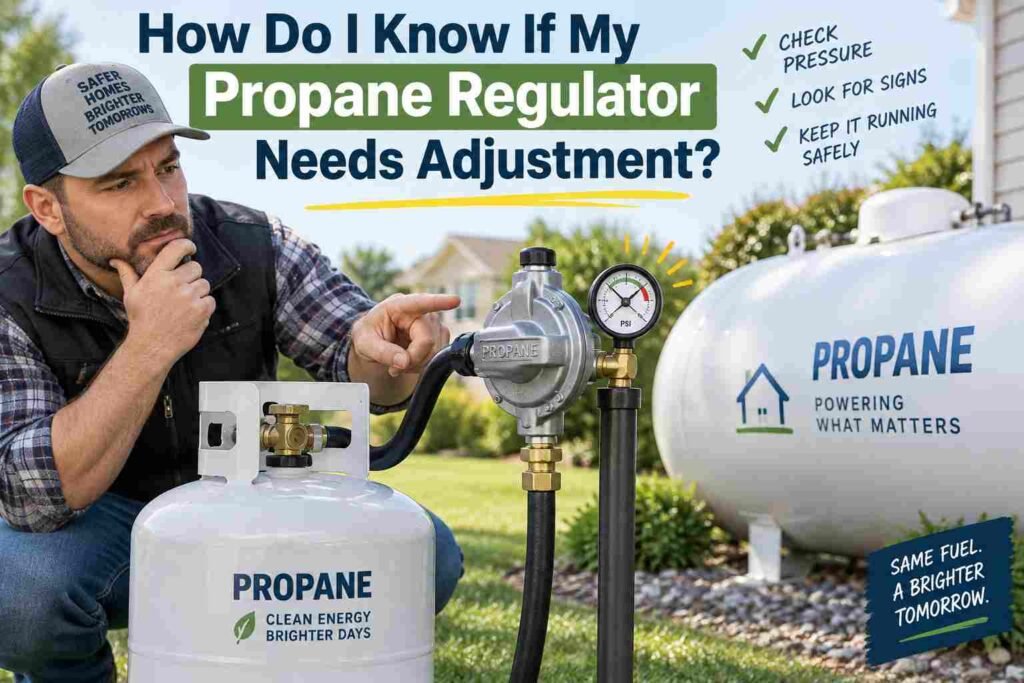
When someone asks me, “How do I know if my propane regulator needs adjustment?” I start with one rule: pressure should be measured, not guessed.
A weak flame does not automatically mean the regulator is set too low. A yellow flame does not automatically mean the regulator is set too high. The same symptoms can come from an empty or cold cylinder, a kinked pigtail, undersized piping, a dirty burner, blocked air shutter, failing appliance regulator, excessive system demand, or a propane regulator that is too small for the connected load.
That is why I look at inlet pressure, outlet pressure, appliance demand, and how the pressure behaves under load before I touch the regulator setting.


Propane Regulator Adjustment: Technical Details
| Check | Typical Example | What It Tells Me |
|---|---|---|
| Final low-pressure delivery | About 11 in. w.c. on many LP-gas systems | Whether the regulator is delivering the intended service pressure |
| 11 in. w.c. in PSI | About 0.397 psi | Shows how low appliance-service pressure really is |
| First-stage outlet | Often around 5–10 psig; many systems use ~10 psig | Feeds the second-stage regulator |
| Flow-pressure check | RegO: check around half connected load, then full load | Shows whether pressure holds while gas is actually flowing |
| Lock-up pressure | RegO guidance: no more than 130% of set delivery pressure | Checks regulator seat and shutoff behavior |
| Creep test | Observe for 5 minutes or longer | A continued pressure rise points to seat leakage, not a simple setting issue |
How Do I Know If My Propane Regulator Needs Adjustment?
The strongest sign is a measured outlet pressure that is consistently outside the correct range for the regulator and appliance system, even after I confirm that everything upstream and downstream is working properly.
For many low-pressure propane systems, RegO’s current service guidance uses about 11 inches water column at the appliance as the flow-pressure target. RegO recommends checking the regulator delivery pressure with roughly half the total appliance load operating, then turning on all appliances to make sure pressure is maintained at full load.
If the pressure is a little off and the regulator is designed to be field-adjustable, adjustment may be part of the solution. But if the pressure collapses only at full load, I first look for an undersized regulator, low inlet pressure, restricted piping, kinked lines, low tank vaporization, or excessive demand.
What Symptoms Can Suggest the Regulator Is Set Too Low?
I may investigate low regulator pressure if several propane appliances show the same symptoms at the same time.


- weak burner flames;
- furnace or water-heater burners that fail under load;
- multiple appliances losing flame strength when another appliance starts;
- an RV furnace that cycles off when the stove or water heater is also running;
- pressure that tests below the regulator or appliance manufacturer’s required inlet range.
But I do not adjust immediately. If pressure is normal with one appliance running and drops only when more load is added, that can be regulator droop, undersized piping, insufficient inlet pressure, or inadequate regulator capacity.
What Symptoms Can Suggest the Regulator Is Set Too High?
High pressure can produce more obvious combustion symptoms, but again, I verify pressure rather than relying on appearance alone.
Possible signs include unusually large flames, roaring burners, yellow flames, soot, pilot instability, or several appliances behaving abnormally at once. A bad appliance air mixture can also create yellow flames or soot, so I do not blame the service regulator without testing.
If outlet pressure remains high after I confirm the correct test point and load condition, the regulator may be misadjusted. But if pressure keeps climbing after appliances shut off, the more serious possibility is regulator seat leakage or “creep.”
That is not something I correct by turning the adjustment screw farther in or out. I treat creep as a regulator condition that requires service or replacement.

How Should Propane Regulator Pressure Be Tested?
I separate three measurements: inlet pressure, flow pressure, and lock-up pressure.
Inlet pressure is the pressure entering the regulator. Flow pressure is the outlet pressure while gas is being used. Lock-up pressure is the slight pressure rise that occurs after downstream flow stops and the regulator closes.
| Measurement | When It Is Taken | Why I Need It |
|---|---|---|
| Inlet pressure | Before regulator, ideally under load | Confirms regulator has enough upstream pressure to work properly |
| Flow pressure | With appliances operating | Shows real delivery pressure |
| Full-load pressure | With maximum expected appliance load | Reveals droop, undersizing, or line restrictions |
| Lock-up pressure | After appliance valves close | Checks regulator closing behavior |
| Creep observation | Several minutes after flow stops | Continued pressure rise suggests seat leakage |
For a detailed explanation of where these pressures are measured, see my article on inlet pressure vs. outlet pressure on a propane regulator.
What Does RegO Recommend for Flow-Pressure Testing?
RegO’s LP-Gas Serviceman’s Manual gives a practical field sequence. It says to check regulator delivery pressure with approximately half of the total appliance load in use. For the low-pressure system described in that procedure, the gauge should read 11 inches water column at the appliance. The regulator can then be adjusted if necessary.


After that, RegO says to turn on all appliances and verify that pressure is maintained at full load. If there is an excessive pressure drop, it recommends checking for restrictions such as kinks or flattened piping.
That is exactly why I do not adjust a regulator simply because the pressure falls when demand rises. If the regulator is already correctly set at moderate load, turning up the adjustment to hide an undersized pipe can create excessive lock-up pressure when demand stops.
When Adjustment Is Appropriate—and When It Is Not
I consider adjustment only when all of the following are true:
- the regulator model is designed to be field-adjustable;
- the correct test point is being used;
- the inlet pressure is within the regulator’s required range;
- the connected BTU load is within the regulator’s capacity;
- the piping and pigtails are not restricted;
- the regulator is not leaking, damaged, badly corroded, or frozen;
- the outlet pressure is measurably outside the required range under the specified test condition.
If those conditions are met, a qualified technician may adjust the outlet pressure while watching a gauge or manometer. Emerson’s current Fisher instruction manuals are explicit that outlet pressure should be monitored during adjustment and that the control spring must never be adjusted beyond its specified pressure range.
That matters because not every regulator can be adjusted indefinitely. A spring is designed for a specific range. If the desired pressure is outside that range, the correct regulator or spring must be used rather than forcing the adjustment mechanism.
When the Regulator Needs Service or Replacement Instead of Adjustment
There are several situations where I would not treat the problem as “just an adjustment.”
1. Pressure creeps upward after flow stops
RegO recommends shutting off all appliance valves after the flow-pressure test and watching the outlet pressure. A small lock-up rise is normal. But if the pressure continues creeping upward over several minutes, the regulator seat may not be closing properly.
RegO says a creeping rise can indicate dirt, scratches, dents, or seat-disc wear. Turning the adjustment screw does not repair a leaking seat.
2. Lock-up pressure is excessive
RegO’s service guidance says lock-up pressure should not exceed 130% of the set delivery pressure. For an 11-inch-w.c. regulator, 130% is about 14.3 inches w.c.
| Set Delivery Pressure | 130% Example Limit | Interpretation |
|---|---|---|
| 10 in. w.c. | 13.0 in. w.c. | General RegO lock-up criterion |
| 11 in. w.c. | 14.3 in. w.c. | General RegO lock-up criterion |
| 12 in. w.c. | 15.6 in. w.c. | General RegO lock-up criterion |
The exact manufacturer specification always controls, but the point is simple: an excessive no-flow rise can be a regulator-condition problem, not a reason to keep adjusting the set screw.
For more detail, see my article on lock-up pressure on a propane regulator.
3. The regulator vents or leaks gas
If propane is escaping continuously from the regulator vent or body, I do not adjust it. I treat it as a safety issue. The diaphragm, seat, relief mechanism, or another internal component may have failed.
4. The regulator is physically damaged or badly corroded
A damaged regulator housing, bent vent, severe corrosion, water intrusion, insect contamination, or impact damage can affect pressure control. I do not try to compensate for mechanical damage with an adjustment.
5. The regulator only fails at high load
If outlet pressure is correct at moderate flow but falls too far at full demand, I investigate sizing and supply conditions first. The regulator may be too small, the first-stage pressure may be low, the tank may not be vaporizing enough propane, or the piping may have excessive pressure drop.
This is also where BTU capacity calculations matter. A regulator set to 11 inches w.c. cannot maintain 11 inches w.c. at a flow rate beyond its useful capacity.
Can Low Inlet Pressure Make a Correctly Adjusted Regulator Look Bad?
Yes. A regulator can only reduce pressure; it cannot create pressure that is not available at its inlet.
Imagine a second-stage regulator designed to receive around 10 psig from a first-stage regulator. If the inlet pressure falls well below the expected range under load, the second-stage outlet may also fall. Turning up the second-stage adjustment screw does not fix the upstream shortage.
I check inlet pressure under load because a no-flow reading may look normal while the upstream system collapses when appliances demand gas.
| Inlet Condition | Outlet Behavior | What I Suspect |
|---|---|---|
| Inlet normal, outlet low at all loads | Consistently low | Possible setting issue, regulator condition, or wrong regulator |
| Inlet normal at light load, low at heavy load | Outlet also drops | Upstream restriction, first-stage issue, tank vaporization, undersized piping |
| Inlet normal, outlet good at moderate load but low at full load | Excessive droop | Regulator sizing/capacity or downstream restriction |
| Inlet normal, outlet rises after flow stops | Creep | Seat leakage/internal regulator problem |
Can Undersized Piping Make Me Think the Regulator Needs Adjustment?
Yes, and RegO specifically warns about this. If there is too much pressure drop through undersized, kinked, or flattened piping, someone may be tempted to increase the regulator setting to compensate.
That can create a dangerous condition. Under load, the extra pressure may be consumed by line loss. But when appliances shut off and flow stops, the line loss disappears and downstream pressure may rise too high.
That is why I correct piping problems rather than using the regulator adjustment to mask them.
Can a Regulator Be Too Small Even If the Pressure Setting Is Correct?
Absolutely. A regulator can be adjusted to the correct no-load or moderate-load pressure and still be undersized for the total BTU demand.
If the connected load approaches or exceeds the regulator’s useful capacity, outlet pressure can droop excessively. This is especially noticeable when several appliances start at once.
For example, suppose a system has a 100,000-BTU furnace, 40,000-BTU water heater, 65,000-BTU range, and 22,000-BTU dryer. That is 227,000 BTU/hr of connected input load. I would verify that the regulator’s published capacity can carry at least that load at the actual minimum inlet pressure and required outlet pressure.
| Appliance | Example Input |
|---|---|
| Furnace | 100,000 BTU/hr |
| Water heater | 40,000 BTU/hr |
| Range/oven | 65,000 BTU/hr |
| Dryer | 22,000 BTU/hr |
| Total | 227,000 BTU/hr |
If the regulator is too small, adjusting it upward is not the correct solution. I select the correct regulator capacity instead.
How Much Should I Turn the Adjustment Screw?
I do not recommend adjusting a propane regulator by counting turns or copying a generic “quarter-turn” rule from the internet. Different regulator models use different springs, threads, ranges, and pressure responses.
Emerson’s current Fisher instructions say the outlet pressure should be monitored with a gauge during adjustment. They also warn never to adjust the control spring beyond its specified pressure range.
So the right approach is not “turn it clockwise two turns.” The right approach is to follow the exact regulator manufacturer’s procedure while continuously monitoring pressure with the correct instrument.
Does Clockwise Always Increase Propane Regulator Pressure?
On many spring-loaded regulators, turning the adjusting screw clockwise increases spring compression and therefore raises outlet pressure, while turning it counterclockwise lowers pressure. Fisher documents that behavior on many adjustable regulator families.
But I still do not treat that as permission to adjust an unknown regulator. Some regulators are fixed, tamper-resistant, non-field-adjustable, or use a different adjustment arrangement. The regulator model and manual come first.
Should I Adjust an RV Propane Regulator?
For most RV owners, I would not recommend adjusting the regulator yourself. RV propane systems are low-pressure systems, typically around 11 inches water column, and they depend on correct two-stage regulation, proper pigtails, correct changeover operation, and leak-tight fittings.
If an RV regulator is delivering low pressure, the problem may be a tripped excess-flow device, cold cylinder, partially closed valve, kinked pigtail, failing automatic-changeover mechanism, or a regulator that is worn out. Turning the adjustment screw without testing can hide the real problem.
If you are diagnosing an RV regulator specifically, my article on how to know when an RV propane regulator is bad gives the warning signs to look for.
What If the Regulator Pressure Is Correct but the Flame Is Still Wrong?
If the service regulator pressure checks correctly, I move downstream. A yellow, lazy, noisy, or uneven flame can come from the burner, appliance regulator, or air-fuel mixture.
Possible appliance-level causes include:
- blocked burner ports;
- incorrect air-shutter setting;
- dirty or damaged burner;
- wrong LP-gas orifice;
- appliance regulator failure;
- improper conversion from natural gas to propane;
- combustion-air or venting problems.
That is why a regulator pressure test is so useful: it tells me whether I should keep troubleshooting the supply system or move to the appliance.
How Do I Know If the Regulator Is Bad Instead of Misadjusted?
A misadjusted regulator can often still hold a stable pressure; it is simply holding the wrong pressure. A failing regulator is more likely to behave unpredictably.
| Observed Behavior | More Like Misadjustment? | More Like Regulator Failure? |
|---|---|---|
| Pressure consistently a little low but stable | Possibly | Possible, but other causes must be ruled out |
| Pressure consistently a little high but stable | Possibly | Possible |
| Pressure creeps upward after flow stops | No | Yes—seat leakage likely |
| Gas vents continuously | No | Yes |
| Pressure fluctuates or hunts | Less likely | More likely |
| Only fails when total demand is high | Usually not | May indicate undersizing, restriction, or supply issue |
| Works only after tapping or moving regulator | No | Yes |
If you suspect the regulator itself is failing, do not keep compensating with the adjustment screw. Replace or service the correct component instead.
What Tools Are Used to Check Propane Regulator Pressure?
Low-pressure propane systems are usually checked with a manometer or other instrument capable of accurately reading inches of water column. A standard high-pressure tire-type gauge is not accurate enough for an 11-inch-w.c. system.
On the other hand, first-stage pressure in the 5–10 psig range requires a gauge designed for that higher pressure. I match the instrument to the pressure range being tested.
| Pressure Range | Typical Instrument | Example Use |
|---|---|---|
| Around 7–14 in. w.c. | Water-column manometer / digital manometer | Second-stage or appliance supply pressure |
| Around 5–10 psig | PSI-rated gas pressure gauge | First-stage pressure |
| Tank/container pressure | High-pressure propane-rated gauge | Container-side diagnostics |
For step-by-step background on test points and pressure ranges, see how to check propane regulator pressure.
Can Cold Weather Make It Look Like the Regulator Needs Adjustment?
Yes. Cold weather lowers propane vapor pressure and reduces how quickly a cylinder or tank can vaporize liquid propane. Under heavy demand, inlet pressure can fall even more.
If a regulator delivers normal pressure in mild weather but struggles only during very cold conditions, I look at tank size, fill level, vaporization capacity, regulator icing, and total BTU demand before adjusting anything.
A regulator cannot compensate for a storage container that cannot supply enough vapor.
Can a Dirty Regulator Need Adjustment?
Dirt can cause pressure problems, but adjustment is not necessarily the fix. Debris on the regulator seat can prevent proper lock-up and cause creep. Dirt in the inlet screen can restrict flow and create low outlet pressure under load.
In those cases, adjusting the spring may temporarily change the reading but does not remove the contamination. RegO specifically identifies inlet-nozzle damage, dirt, scratches, dents, and seat-disc wear as causes to inspect when creep is observed.
Can I Adjust the Regulator to Compensate for Long Propane Piping?
I would not use regulator adjustment as a substitute for correct pipe sizing. Long piping creates pressure drop, especially at high flow. The right solution is to size the piping and regulator system correctly.
Some systems intentionally use a higher intermediate distribution pressure, such as a 2-PSI system, followed by line regulators closer to the appliances. That is an engineered design—not the same as simply turning up a standard low-pressure regulator.
Frequently Asked Questions
How often should a propane regulator need adjustment?
A properly selected and installed regulator should not need routine homeowner adjustment. If the pressure repeatedly drifts out of specification, I suspect a regulator condition, contamination, sizing issue, or changing supply condition rather than assuming the regulator simply needs to be “tuned” again.
What is the normal propane regulator pressure?
It depends on the regulator stage and system. Many low-pressure residential and RV systems operate around 11 inches water column. A conventional first-stage regulator may deliver around 10 psig to a second-stage regulator. Always use the regulator and appliance specifications for the actual system.
Can I adjust propane pressure by watching the flame?
I do not recommend it. Flame appearance can be affected by burner condition, air mixture, orifice size, and appliance-specific issues. Pressure should be measured with the appropriate gauge or manometer.
What happens if I adjust a propane regulator too high?
Excessive outlet pressure can overfire appliances and contribute to oversized flames, soot, carbon monoxide, equipment damage, relief-valve operation, or unsafe gas conditions. Fisher warns not to adjust a regulator beyond the upper limit of the installed control spring.
What happens if regulator pressure is too low?
Appliances may have weak flames, fail to ignite reliably, shut down under load, or stop operating when multiple propane loads run together. Low pressure can be caused by misadjustment, but also by restricted piping, low inlet pressure, insufficient vaporization, an undersized regulator, or a damaged pigtail.
Can a propane regulator adjustment fix yellow flames?
Only if measured supply pressure is actually too high and the regulator is the cause. Yellow flames can also result from dirty burners, blocked combustion air, incorrect orifices, or appliance-level problems. I test pressure before adjusting.
Should I adjust a regulator that keeps freezing?
No. Freeze-ups usually point toward moisture, cold-weather vaporization, vent icing, restriction, or excessive load. Adjustment does not remove moisture or correct a frozen vent.
How do I know whether to adjust or replace the regulator?
If pressure is stable but slightly outside the required range and the regulator is field-adjustable, a qualified adjustment may be appropriate. If pressure creeps, vents gas, fluctuates, will not hold under load despite adequate supply, is physically damaged, or repeatedly malfunctions, I lean toward service or replacement.
My Diagnostic Checklist Before Any Adjustment
| Step | What I Confirm | Why |
|---|---|---|
| 1 | Correct regulator model and pressure class | Wrong regulator cannot be fixed by adjustment |
| 2 | Adequate inlet pressure under load | Regulator cannot boost low inlet pressure |
| 3 | Piping/pigtails not restricted | Line loss can mimic low regulator setting |
| 4 | Regulator has enough BTU capacity | Undersizing causes excessive droop |
| 5 | Flow pressure measured at correct test condition | Shows real delivery performance |
| 6 | Lock-up and creep acceptable | Rules out seat leakage/internal failure |
| 7 | No leak, venting, corrosion, or damage | Damaged regulator needs service/replacement |
Bottom Line: How Do I Know If My Regulator Needs Adjustment?
I know a propane regulator may need adjustment when a proper pressure test shows that its outlet pressure is consistently outside the required range, while the inlet pressure, piping, regulator capacity, appliance load, and regulator condition are all otherwise correct.
I do not adjust based on flame appearance alone. I check pressure under load, then check full-load performance, lock-up, and creep. If pressure is simply a little high or low and the regulator is designed for field adjustment, a qualified technician can set it to the manufacturer’s specified pressure while monitoring a gauge.
If pressure creeps after shutdown, the regulator leaks or vents gas, has physical damage, repeatedly freezes, fluctuates, or cannot maintain pressure because it is undersized or starved for inlet pressure, adjustment is not the real fix.
Technical Sources

Mike is an experienced propane technician with over 15 years of professional experience in the field. He has dedicated his career to helping customers with their propane needs, from installation to maintenance and repair. Together with Jeremy, he co-founded this website to provide useful information and guidance to customers seeking reliable propane services.


