
Quick Answer
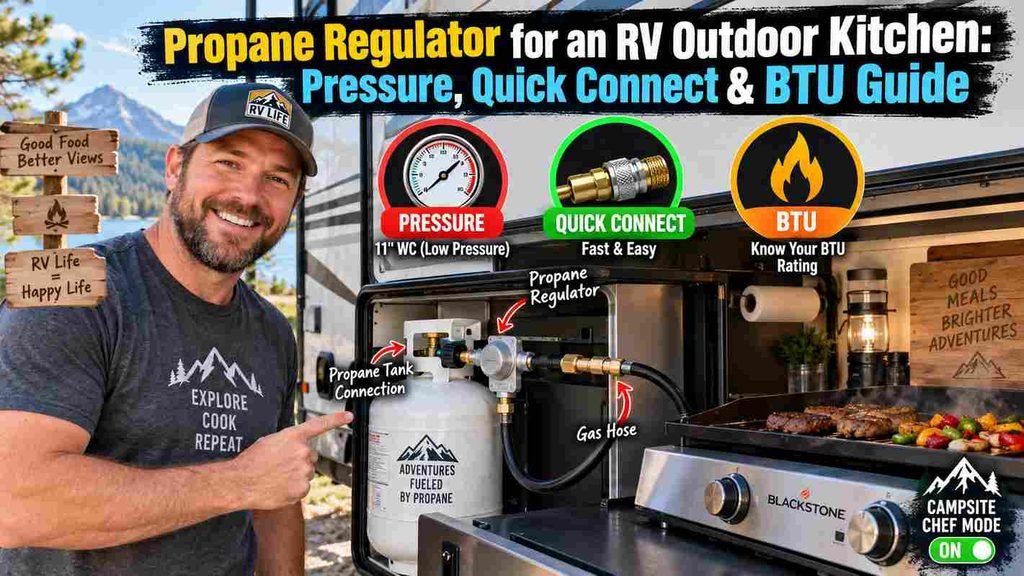
For most RV outdoor kitchens, I use the RV’s existing two-stage propane regulator, which typically supplies about 11 inches of water column (11″ WC)—roughly 0.4 PSI—to the coach and exterior quick-connect. If the outdoor grill, griddle, or stove connects to that low-pressure quick-connect, it usually must be designed for low-pressure RV propane or connected with the manufacturer-approved adapter that bypasses the appliance’s own regulator. Otherwise, two regulators in series can cause a weak flame. I also make sure the RV regulator has enough BTU capacity for the outdoor kitchen plus the furnace, water heater, refrigerator, range, and any other propane appliances that may run at the same time.
An RV outdoor kitchen can make camping a lot more convenient, but the propane system is easy to misunderstand because the same coach may have a furnace, water heater, refrigerator, indoor range, outdoor griddle, and quick-connect all sharing one regulator.
The most common mistake I see is treating the exterior quick-connect like a direct connection to the propane cylinder. It usually is not. On many RVs, the quick-connect is downstream of the main two-stage regulator, so the gas arriving there is already reduced to low appliance pressure.


That changes how I connect a grill or griddle. If the appliance already has its own low-pressure regulator and I leave that regulator in place, the propane gets regulated twice. The result can be a tiny flame, slow cooking, poor burner performance, or an appliance that will not stay lit.
In this guide, I’ll show you how I match the regulator to an RV outdoor kitchen, how 11″ WC quick-connect pressure works, when a regulator should be bypassed, how I size for BTU load, and what I check before adding another propane appliance to the RV.
What Pressure Does an RV Outdoor Kitchen Use?
Most RV propane systems are designed around a final appliance pressure of about 11 inches of water column, or approximately 0.4 PSI.
The RV’s two-stage regulator reduces cylinder pressure in two steps. The first stage drops tank pressure to an intermediate range, and the second stage reduces it again to the low pressure used by appliances.


| Pressure Point | Typical Value | Approx. PSI | What It Serves |
|---|---|---|---|
| Propane cylinder | Varies with temperature | Often well above 100 PSI | Raw tank pressure |
| First-stage outlet | About 10–13 PSI on many RV regulators | 10–13 PSI | Intermediate regulation |
| Second-stage outlet | About 11″ WC | 0.4 PSI | RV appliances and low-pressure quick-connect |
| Quick-connect outlet | Usually about 11″ WC | 0.4 PSI | Compatible outdoor grills, griddles, stoves |
Grand Design and Fleetwood RV documentation both describe RV two-stage regulation in this basic way: high cylinder pressure is first reduced to roughly 10–13 PSI, then reduced again to about 11″ WC for the appliances.
If you want the broader background, see what type of propane regulator an RV needs.
Why the RV Quick-Connect Is Usually Low Pressure
The exterior propane quick-connect is commonly installed after the RV’s main regulator. That means the gas has already been reduced to appliance pressure before it reaches the fitting.
Weber’s RV connection guidance, for example, specifies an RV LP system with a compatible quick-connect and a regulator set to 11″ WC. Fleetwood likewise describes the accessory quick disconnect as part of the regulated RV propane system.
That is why I do not connect a standard tank-regulated grill assembly to an RV quick-connect unless the grill manufacturer specifically says it is compatible.

| Connection Point | Pressure Condition | Typical Use |
|---|---|---|
| At propane cylinder before RV regulator | High pressure | Pigtails and main RV regulator |
| After RV regulator | Low pressure, about 11″ WC | Coach appliance manifold |
| Exterior RV quick-connect | Usually low pressure | RV-ready outdoor appliances |
| Portable grill with tank regulator | Designed for tank pressure at regulator inlet | Direct cylinder connection unless converted |
What Is Double Regulation?
Double regulation happens when already-regulated propane is sent through another low-pressure regulator.
Imagine the RV regulator has already reduced the gas to 11″ WC. Then you connect that low-pressure gas to a portable griddle that still has its factory regulator attached. That second regulator was designed to receive much higher propane pressure from a cylinder, not just 11″ WC.
The second regulator may not have enough inlet pressure to operate correctly. The griddle may light, but the flame can be very small.
This is why Blackstone’s current RV quick-connect instructions for compatible 17-inch and 22-inch tabletop griddles specifically say to remove the griddle regulator before connecting to the RV quick-connect.


| Setup | Result |
|---|---|
| RV quick-connect → low-pressure RV-ready grill | Correct when appliance is designed for 11″ WC |
| RV quick-connect → griddle with regulator still installed | Possible double regulation and weak flame |
| RV quick-connect → manufacturer-approved regulator-bypass adapter | Correct for compatible converted appliance |
| Propane cylinder → appliance regulator → grill | Normal portable-tank setup |
Do I Remove the Regulator From My RV Grill or Griddle?
Only when the appliance manufacturer provides or approves a low-pressure RV conversion method.
I do not remove a regulator just because someone online says it worked on a similar grill. Burner orifice size, valve design, connector type, and required inlet pressure all matter.
For Blackstone, the company now offers an RV quick-connect specifically for standard 17-inch and 22-inch tabletop griddles, and it instructs the user to remove the griddle’s regulator so the RV regulator supplies the low-pressure gas.
Weber also has RV-specific connection instructions for certain models. I follow the manual for the exact appliance rather than assuming every grill can be converted.
If the appliance cannot be approved for a low-pressure quick-connect, I use it from its intended propane source instead of improvising a regulator bypass.
What Regulator Does the RV Itself Need?
Most towable RVs with propane cylinders use a two-stage regulator. Dual-cylinder trailers often use an automatic-changeover two-stage regulator so one cylinder can take over when the other empties.
Current Flame King RV regulators provide a useful real-world example. Its compact two-stage RV regulator is set to 11″ WC and rated around 150,000 BTU/hr. Its automatic-changeover RV regulator is also set to 11″ WC and is rated much higher—about 345,200 BTU/hr.
| RV Regulator Example | Outlet Pressure | Published Capacity | Typical Application |
|---|---|---|---|
| Compact two-stage regulator | 11″ WC | 150,000 BTU/hr | Smaller RV propane systems |
| Automatic changeover two-stage regulator | 11″ WC | 345,200 BTU/hr | Dual-cylinder RV with multiple appliances |
| Outdoor appliance regulator | Model-specific | Model-specific | Direct cylinder appliance, not necessarily RV quick-connect |
If your RV uses two cylinders, see how an automatic changeover propane regulator works.
How Much BTU Capacity Does an RV Outdoor Kitchen Need?
The outdoor kitchen is only part of the total propane load. I size the main RV regulator for every appliance that may operate at the same time.
A tabletop griddle may use 20,000–40,000 BTU/hr. A furnace can use 20,000–40,000 BTU/hr. A water heater may add another 10,000–12,000 BTU/hr, and the range, refrigerator, or outdoor stove add more.
| RV Appliance | Illustrative Propane Input |
|---|---|
| Outdoor griddle | 20,000–40,000 BTU/hr |
| RV furnace | 20,000–40,000 BTU/hr |
| Water heater | 10,000–12,000 BTU/hr |
| Indoor cooktop/oven | 20,000–35,000 BTU/hr |
| Refrigerator on propane | 1,500–2,500 BTU/hr |
| Outdoor side burner | 8,000–15,000 BTU/hr |
As an example, a 35,000-BTU furnace, 12,000-BTU water heater, 25,000-BTU indoor range, and 30,000-BTU outdoor griddle add up to roughly 102,000 BTU/hr.
A 150,000-BTU regulator may handle that example comfortably if all other sizing conditions are met. But if the RV has larger appliances or additional propane accessories, I recalculate the load.
For the full sizing method, see how to calculate the BTU capacity needed for a propane regulator.
Why My Outdoor Kitchen Works Until the Furnace Turns On
If the griddle has a good flame until another appliance starts, I suspect a supply-capacity or pressure-drop issue.
| Symptom | Possible Cause | What I Check |
|---|---|---|
| Griddle weak when furnace starts | Main regulator near capacity | Total simultaneous BTU load |
| All appliances weaken together | Regulator, pigtail, or cylinder flow issue | Upstream supply system |
| Only outdoor kitchen is weak | Quick-connect hose or appliance adapter restriction | Hose length, fittings, regulator bypass |
| Pressure good with appliances off | Regulator droop under load | Flowing pressure test |
| Problem worse in cold weather | Cylinder vaporization reduced | Tank level, temperature, total demand |
The key test is pressure under load. An RV can show acceptable pressure when everything is off but drop below the required level when the furnace, water heater, and outdoor griddle all fire.
This is the same reason regulator capacity matters even though the outlet pressure is only 11″ WC.
How Hose Length Affects an RV Outdoor Kitchen
A longer quick-connect hose is convenient, but every hose and fitting adds resistance to propane flow.
For a small grill, the pressure drop may be minor. For a large griddle drawing 30,000–40,000 BTU/hr, a long narrow hose can become noticeable.
I use an LP-gas hose rated for the service pressure and flow, and I keep it only as long as I reasonably need. I also make sure the quick-connect coupler is fully engaged because some fittings will not pass gas until the sleeve and plug are completely locked.
I do not substitute compressed-air quick-connect fittings. Propane quick-connects need to be specifically listed and compatible with the RV system.
What Quick-Connect Size Does an RV Use?
Many RV exterior propane ports use a low-pressure quick-disconnect style commonly referred to as a Type II or Model 250-type connection, but I do not assume the fitting size by appearance.
The safest approach is to identify the RV fitting and match it to an approved hose or adapter intended for LP gas.
Weber specifically references a compatible Type II quick-connect for its RV connection. Fleetwood also instructs owners to use approved propane quick-disconnect fittings and flexible hose for external accessories.
If you are trying to identify an NPT, flare, or regulator connection, see how I match regulator inlet and outlet thread sizes.
Can I Use the RV Quick-Connect With a Blackstone?
For certain Blackstone models, yes. Blackstone’s current support page says its RV quick-connect is designed for standard 17-inch and 22-inch tabletop griddles.
The important instruction is that the griddle regulator must be removed so the appliance uses the RV’s existing low-pressure regulator.
I would not automatically apply the same conversion to a larger Blackstone or another brand. Larger griddles can require more gas flow, and the manufacturer may use a different valve or regulator arrangement.
If the appliance is not listed by the manufacturer for RV quick-connect use, I verify compatibility before modifying the fuel path.
Can I Use a Weber Grill With the RV Propane System?
Some Weber models have manufacturer guidance for RV propane connections. Weber’s documentation for compatible Q-series use specifies a low-pressure RV gas system regulated to 11″ WC and a compatible Type II quick-connect.
This is exactly the kind of setup I prefer: manufacturer documentation tells me the required pressure and connection rather than forcing me to guess.
If your grill does not have RV-specific instructions, I keep the original fuel system intact until compatibility is confirmed.
Can I Add a Second Regulator at the Outdoor Kitchen?
Usually not if the quick-connect is already supplied at 11″ WC and the appliance is designed to receive 11″ WC directly.
Adding another low-pressure regulator can cause double regulation. However, there are RV systems and special appliances with different pressure arrangements, so I do not remove or add regulators without tracing where the quick-connect is located relative to the main regulator.
If I am unsure, I follow the propane line from the cylinders, identify the regulator location, and verify the pressure at the exterior port with the RV documentation or a qualified technician.
What If the Outdoor Kitchen Is Factory-Built Into the RV?
A factory outdoor kitchen is usually engineered as part of the coach’s propane system. The stove, grill, or cooktop is supplied from the regulated manifold, and the manufacturer has already selected the required valve, orifice, hose, and appliance pressure.
I do not add another regulator just because the outdoor appliance looks like a portable grill.
If a factory appliance is replaced, I match the replacement to the RV’s low-pressure LP system. A direct-cylinder appliance with its own regulator is not automatically a drop-in replacement for a built-in RV cooktop.
Automatic Changeover Regulators and Outdoor Kitchens
Dual-cylinder RVs often use an automatic changeover regulator. This lets one cylinder act as the service tank and the other as reserve.
When the first cylinder empties, the regulator changes to the reserve side while still maintaining approximately 11″ WC downstream.
That convenience is valuable when cooking outside because you are less likely to lose flame in the middle of a meal. But the changeover feature does not increase BTU capacity unless the regulator itself is rated for the required load.
If you see a red indicator on an automatic regulator, it usually signals that the selected service cylinder is empty or that the regulator has switched to the reserve side. I replace or refill the empty cylinder rather than turning up pressure.
Why My RV Outdoor Grill Has a Tiny Flame
The most common causes I check are double regulation, an incompletely seated quick-connect, a kinked hose, low cylinder level, a tripped excess-flow device, or an undersized regulator.
| Problem | Likely Cause | What I Do |
|---|---|---|
| Tiny flame immediately after hookup | Second regulator still installed | Verify manufacturer-approved low-pressure conversion |
| No gas at appliance | Quick-connect not fully engaged | Reconnect and lock fitting |
| Flame weak only on long hose | Pressure drop / flow restriction | Use correctly sized approved hose |
| Flame weak when several appliances run | Regulator or cylinder capacity limit | Check total BTU load |
| Weak after cylinder change | Excess-flow restriction or valve opened too fast | Reset system per RV instructions |
If the main regulator itself seems unreliable, see how to know when an RV propane regulator is bad.
RV Outdoor Kitchen Propane Safety
I treat the outdoor quick-connect as part of the RV’s permanent propane system. I use only LP-gas-rated hoses, approved quick-connect fittings, and manufacturer-compatible appliance adapters.
Before cooking, I inspect the hose for abrasion, cracking, heat damage, or crushed sections. I keep the hose away from tires, hot exhaust, campfire embers, sharp edges, and areas where people can trip over it.
I shut the quick-connect valve before disconnecting an appliance. Many RV fittings also use a locking sleeve that must be fully engaged before gas can flow.
I leak-check new connections with an approved leak-detection solution or the method specified by the RV or appliance manufacturer. I never use a flame to look for leaks.
RV regulators also need the correct mounting orientation and an unobstructed vent. If the regulator is replaced or adjusted, I verify the outlet with a properly calibrated manometer rather than guessing.
For broader LP safety guidance, see my propane regulator safety requirements article.
Frequently Asked Questions
What pressure is an RV outdoor kitchen propane line?
Most RV low-pressure systems supply about 11″ WC, which is approximately 0.4 PSI. The exterior quick-connect is commonly downstream of the main RV regulator.
Do I need a regulator on an RV outdoor grill?
If the grill connects to an already-regulated RV quick-connect and the grill is designed for that connection, you generally do not add another low-pressure regulator. Follow the grill manufacturer’s RV conversion instructions.
Why does my Blackstone have a weak flame on the RV quick-connect?
A common cause is leaving the Blackstone regulator installed. On compatible 17-inch and 22-inch tabletop models, Blackstone instructs users to remove the griddle regulator when using its RV quick-connect adapter.
Can one RV regulator run the furnace, water heater, and outdoor griddle?
Yes, if the regulator and cylinders have enough capacity for the combined simultaneous BTU load. I total all appliances that may run at once.
What size regulator does an RV need?
The regulator should deliver about 11″ WC and have enough BTU capacity for the entire RV propane system. Current two-stage RV regulators are available from around 150,000 BTU/hr to well over 300,000 BTU/hr.
Can I connect a portable grill directly to the RV quick-connect?
Only if the grill is designed for low-pressure RV propane or has an approved conversion that bypasses its tank regulator. Otherwise, double regulation can cause poor performance.
Bottom Line
For most RV outdoor kitchens, I rely on the RV’s main two-stage regulator to provide about 11 inches WC to the exterior quick-connect. The outdoor appliance then needs to be compatible with that already-regulated low-pressure supply.
If a portable griddle or grill has its own tank regulator, I do not leave that regulator in series with the RV regulator unless the manufacturer specifically designed it that way. On approved conversions, the appliance regulator is bypassed and the RV regulator becomes the pressure-control device.
Finally, I size the RV regulator for the whole coach—not just the outdoor kitchen. Furnace, water heater, range, refrigerator, and outdoor cooking appliances can all draw propane at the same time, so BTU capacity is just as important as the 11″ WC pressure setting.

Mike is an experienced propane technician with over 15 years of professional experience in the field. He has dedicated his career to helping customers with their propane needs, from installation to maintenance and repair. Together with Jeremy, he co-founded this website to provide useful information and guidance to customers seeking reliable propane services.


