
Quick Answer
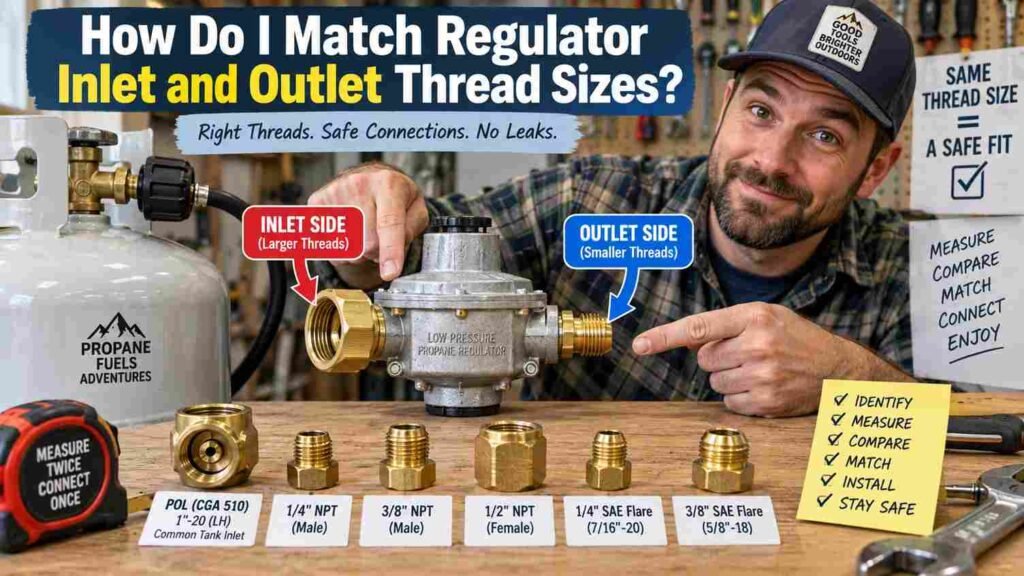
To match a propane regulator’s inlet and outlet thread sizes, I identify four things separately: the connection type, the nominal size, whether it is male or female, and what component it must connect to. A 1/2-inch female NPT outlet needs a compatible 1/2-inch male NPT fitting; a POL inlet needs a matching POL/CGA 510 connection; and a flare fitting must match the correct flare standard and tube size. I never match fittings by appearance or outside diameter alone because nominal pipe sizes do not equal the actual thread diameter.
If you have ever looked at a propane regulator and wondered why the inlet says one size while the outlet says another, you are not alone. Regulators often use different connections on each side because the inlet connects to a tank, cylinder, pigtail, or upstream regulator, while the outlet connects to downstream piping or tubing.
The safest way to approach the job is to treat the inlet and outlet as two separate connection problems. I identify exactly what each port is, then I match each one to the component on that side. I also verify the regulator’s pressure rating and BTU capacity, because a fitting can screw together correctly while the regulator itself is still wrong for the system.


If you are choosing the regulator itself rather than only identifying the threads, see my guide on what kind of regulator you need for a propane tank.
The Four Things I Check Before Matching Regulator Threads
| What I Check | Example | Why It Matters |
|---|---|---|
| Connection standard | NPT, POL/CGA 510, SAE 45° flare | Different standards use different thread forms and sealing methods |
| Nominal size | 1/4, 3/8, 1/2, 3/4 inch | The labeled size may not equal the diameter you measure |
| Male or female | Male NPT vs. female NPT | The mating component must be compatible |
| Application | Tank, pigtail, pipe, copper tube | The component on each side determines the correct connection |
I do not skip any of these. A 3/8-inch flare connection is not the same as 3/8-inch NPT, and a POL connection is not the same as a small pipe thread. The numbers may look familiar, but they describe different fitting systems.
What Does NPT Mean on a Propane Regulator?
NPT means National Pipe Taper. It is one of the most common connection types on U.S. propane regulators and gas piping. The threads are tapered, so they tighten progressively as the male and female fittings are assembled.
You may see markings such as 1/4 F.NPT, 1/2 F.NPT, 3/4 F.NPT, or 1/2 M.NPT. F means female and M means male.


The confusing part is that NPT sizes are nominal. A nominal 1/2-inch NPT thread does not measure 1/2 inch across the outside of the male threads. Swagelok’s current thread-identification guide lists the following approximate male diameters and pitches.
| Nominal NPT Size | Typical Male Thread Diameter | Threads per Inch |
|---|---|---|
| 1/8 inch | About 0.401 in. | 27 |
| 1/4 inch | About 0.533 in. | 18 |
| 3/8 inch | About 0.668 in. | 18 |
| 1/2 inch | About 0.832 in. | 14 |
| 3/4 inch | About 1.043 in. | 14 |
| 1 inch | About 1.305 in. | 11.5 |
I use those dimensions as identification references, not as inspection limits. Thread tolerances, coatings, wear, and where the calipers touch can change the reading. The model number and manufacturer data sheet are usually more reliable than measuring alone.
I also do not assume every tapered thread is NPT. BSPT can look very similar. For example, 1/4-inch NPT commonly uses 18 threads per inch, while 1/4-inch BSPT typically uses 19. Mixing thread systems is not a shortcut I recommend.
How I Identify an Unknown NPT Port
If the regulator label or model number is readable, I start there. Manufacturer documentation normally lists the inlet and outlet connection exactly.
If I have to identify a male thread, I measure the outside diameter with calipers and check the pitch with a thread gauge. For a female port, I prefer the data sheet or a known reference fitting rather than trying to judge the size by eye.

I never force a fitting that becomes unusually tight after only a turn or two. That can indicate the wrong nominal size, a different thread form, or cross-threading. Regulator bodies made from zinc or aluminum can be damaged surprisingly easily.
Common Propane Regulator Inlet and Outlet Combinations
A regulator does not need to have the same size or connection type on both ends. In fact, different inlet and outlet connections are normal.
| Example Combination | Inlet | Outlet | Typical Use |
|---|---|---|---|
| POL × 1/2 F.NPT | Female POL / CGA 510 | 1/2-inch female NPT | Residential or first-stage regulator service |
| POL × 3/4 F.NPT | Female POL / CGA 510 | 3/4-inch female NPT | Higher-flow residential piping |
| 1/4 F.NPT × 1/2 F.NPT | 1/4-inch female NPT | 1/2-inch female NPT | Regulator fed by a separate connector or pigtail |
| 1/4 F.NPT × 3/8 F.NPT | 1/4-inch female NPT | 3/8-inch female NPT | Smaller appliance or portable systems |
| Flare × NPT | SAE flare inlet | Female NPT outlet | Some RV, cylinder, and specialty assemblies |
RegO’s regulator catalog currently includes combinations such as female POL inlets with 1/2-inch or 3/4-inch female NPT outlets, as well as 1/4-inch female NPT inlets with 1/2-inch female NPT outlets. That is why I never assume the inlet and outlet should match each other.
What Is a POL Connection?
A POL connection is a propane-cylinder connection commonly identified as CGA 510. It is not NPT. Many first-stage and residential regulators use a POL-style inlet to connect to a propane container valve or a compatible POL fitting.


Some modern cylinder valves also have an external Type 1/QCC1 connection while retaining an internal POL connection. That does not make the fittings interchangeable. The regulator may use a POL nut and nipple, a female POL port, a Type 1 connector, or an NPT inlet designed for a separate pigtail.
I match POL fittings by the manufacturer’s stated connection type. I do not substitute a pipe-thread fitting simply because the diameter appears close.
What Is the Difference Between NPT and Flare Threads?
A flare fitting has threads, but the threads are not the sealing surface. The seal occurs where the flared tube or fitting seat meets the matching cone. That is fundamentally different from a tapered NPT joint.
SAE 45-degree flare fittings are common in fuel-gas and propane applications. Their size is usually tied to the tubing outside diameter, not to the outside diameter of the fitting’s threads.
| Tube Outside Diameter | Typical SAE 45° Flare Thread | Match It To |
|---|---|---|
| 1/4 inch | 7/16-20 | 1/4-inch tube / 45° flare fitting |
| 5/16 inch | 1/2-20 | 5/16-inch tube / 45° flare fitting |
| 3/8 inch | 5/8-18 | 3/8-inch tube / 45° flare fitting |
| 1/2 inch | 3/4-16 | 1/2-inch tube / 45° flare fitting |
This is why 3/8-inch flare and 3/8-inch NPT are not interchangeable. The flare designation describes a tubing/fitting system, while 3/8-inch NPT is a tapered pipe-thread size.
Parker’s current 45-degree flare documentation, for example, pairs a 5/16-inch tube outside diameter with a 1/2-20 flare thread. I identify the fitting family first and the size second.
Can I Put Thread Sealant on Every Propane Fitting?
No. I use sealant only where the connection design and manufacturer call for it.
For NPT connections, the tapered threads form part of the pressure seal. Emerson’s regulator installation guidance instructs installers to apply pipe compound to external NPT threads. I use only a sealant approved for fuel gas and compatible with propane, and I keep excess compound out of the gas passage.
Flare fittings seal at the flare seat, not at the threads. POL-type connections also rely on their designed sealing surface. I do not put pipe-thread sealant on flare seats or use sealant to compensate for damaged or mismatched fittings.
How Do I Match a Female Regulator Outlet to House Piping?
If the regulator outlet is listed as 1/2-inch female NPT, the direct mating end is a compatible 1/2-inch male NPT fitting. If the outlet is 3/4-inch female NPT, the mating end is 3/4-inch male NPT.
I do not automatically reduce a larger outlet to smaller piping simply because the smaller pipe is easier to install. Pipe diameter must support the required gas flow over the actual run length and allowable pressure drop.
A high-capacity regulator can still be starved by undersized downstream piping. If you are sizing the regulator at the same time, see how I calculate propane regulator BTU capacity and my guide to inlet versus outlet pressure.
Can I Use an Adapter if the Regulator Threads Do Not Match?
Sometimes, but an adapter should solve a legitimate connection transition—not make the wrong regulator fit.
A properly rated fitting can transition from one NPT pipe size to another where the design permits it. A manufacturer-specified pigtail can also transition from a cylinder connection to the regulator inlet. What I avoid is stacking several adapters because the regulator was purchased with the wrong connections.
Every additional joint is another potential leak point and can add mechanical stress to the regulator body. I also never use an adapter to force together standards that merely appear similar, such as NPT and BSPT or pipe threads and flare threads.
Before adapting anything, I verify that the regulator itself has the correct pressure stage, capacity, inlet-pressure rating, outlet pressure, vent orientation, and approved application.
How I Read a Regulator Data Sheet
When I am matching a replacement regulator, the data sheet is usually the fastest path to the correct answer. I look for the inlet connection, outlet connection, pressure settings, capacity, and vent position.
| Data-Sheet Item | Example | What It Tells Me |
|---|---|---|
| Inlet connection | F. POL | The upstream connection must match a female POL inlet |
| Outlet connection | 1/2 in. F.NPT | The downstream fitting normally needs a 1/2-inch male NPT end |
| Factory delivery pressure | 10 PSIG | Typical first-stage/intermediate pressure, not direct appliance pressure |
| Factory delivery pressure | 11 in. w.c. | Typical low-pressure propane delivery for many appliances |
| Capacity | 600,000 BTU/hr | Published flow capability under specified conditions |
| Vent position | Over outlet / 9 o’clock | Required mounting orientation information |
I do not buy from a product photo alone. Two regulators can look almost identical but have different ports, pressure settings, capacities, or vent positions. My article on what BTU capacity means on a propane regulator explains why the flow rating matters just as much as the connection size.
Common Thread-Matching Mistakes I Avoid
Assuming the measured diameter is the nominal NPT size
A nominal 1/2-inch NPT thread measures much larger than 1/2 inch across the male threads. I use a thread chart, not the raw diameter alone.
Calling every threaded gas fitting NPT
Flare, BSP, POL, Type 1, and other gas connections all use threads in some form. The presence of threads does not make the fitting NPT.
Matching the inlet but ignoring the outlet
A regulator can fit the tank perfectly and still be wrong for the downstream piping. I verify both sides before ordering.
Forcing a fitting that almost fits
If the thread form or pitch is wrong, forcing the connection can damage the regulator body and create an unsafe joint.
Using sealant on a flare seat
Flare joints seal at the flare surface. Thread sealant belongs only where the fitting design calls for it.
Ignoring the regulator’s pressure function
Correct threads do not tell me whether the regulator is first-stage, second-stage, integral two-stage, 2-PSI, or low-pressure. The pressure function must match the propane system.
When I Would Have a Propane Professional Verify the Connection
For a permanent residential propane system, I recommend professional verification when the regulator is being replaced, the piping configuration is changing, or the connection type is uncertain.
A regulator controls pressure for every appliance downstream. Emerson’s installation guidance states that qualified personnel should install or service regulators and that regulator and piping ratings must not be exceeded. It also instructs installers to keep the regulator vent unobstructed.
After regulator or piping work, the system may need leak testing and pressure verification before it is returned to service. If you are deciding whether to do the work yourself, see whether you should install a propane regulator yourself and my guide to propane regulator safety requirements.
Frequently Asked Questions
How do I know if my regulator outlet is 1/2 inch or 3/4 inch NPT?
I check the model number and data sheet first. For a male thread, nominal 1/2-inch NPT is about 0.832 inch in thread diameter and uses 14 threads per inch; nominal 3/4-inch NPT is about 1.043 inches and also uses 14 threads per inch. Female ports are best identified from manufacturer documentation.
Why does my 1/2-inch NPT fitting measure more than 1/2 inch?
Because NPT uses nominal pipe sizes. The nominal number is not the outside diameter of the male thread.
Can I connect 3/8-inch flare to 3/8-inch NPT?
Not directly. A 3/8-inch SAE 45-degree flare connection typically uses a 5/8-18 thread and seals at the flare seat, while 3/8-inch NPT is a tapered pipe thread. Use a fitting specifically designed for the transition if the system design permits it.
Is POL the same as 1/4-inch NPT?
No. POL/CGA 510 is a propane-cylinder connection standard. A 1/4-inch NPT connection is a tapered pipe thread.
Can the regulator inlet be smaller than the outlet?
Yes. A regulator may have a 1/4-inch NPT inlet and a 1/2-inch NPT outlet, or a POL inlet and a 3/4-inch NPT outlet. The two ports do not need to be the same size.
What if my replacement regulator has different connections from the old one?
I first confirm the replacement regulator is correct for the pressure stage, capacity, application, and venting. If it is correct, I then use the connection method specified by the manufacturer or a properly rated adapter where permitted. I do not assume an adapter makes two otherwise different regulators equivalent.
Bottom Line
To match propane regulator inlet and outlet thread sizes, identify the connection standard first, then the nominal size, then whether the connection is male or female. Do not use outside diameter alone, and do not assume two fittings are compatible simply because both are labeled 3/8 inch or 1/2 inch.
For NPT, I use the regulator data sheet plus a thread-size and pitch reference. For flare fittings, I match the flare standard and tubing outside diameter. For POL and cylinder connections, I use the exact connection specified by the regulator and container manufacturer.
Finally, I remember that correct threads are only one part of regulator selection. The regulator must also have the right inlet-pressure rating, outlet pressure, capacity, vent arrangement, and approved application. When those factors and the connection sizes all match, you have the right regulator for the system—not merely one that happens to screw into the pipe.

Mike is an experienced propane technician with over 15 years of professional experience in the field. He has dedicated his career to helping customers with their propane needs, from installation to maintenance and repair. Together with Jeremy, he co-founded this website to provide useful information and guidance to customers seeking reliable propane services.


