
Quick Answer
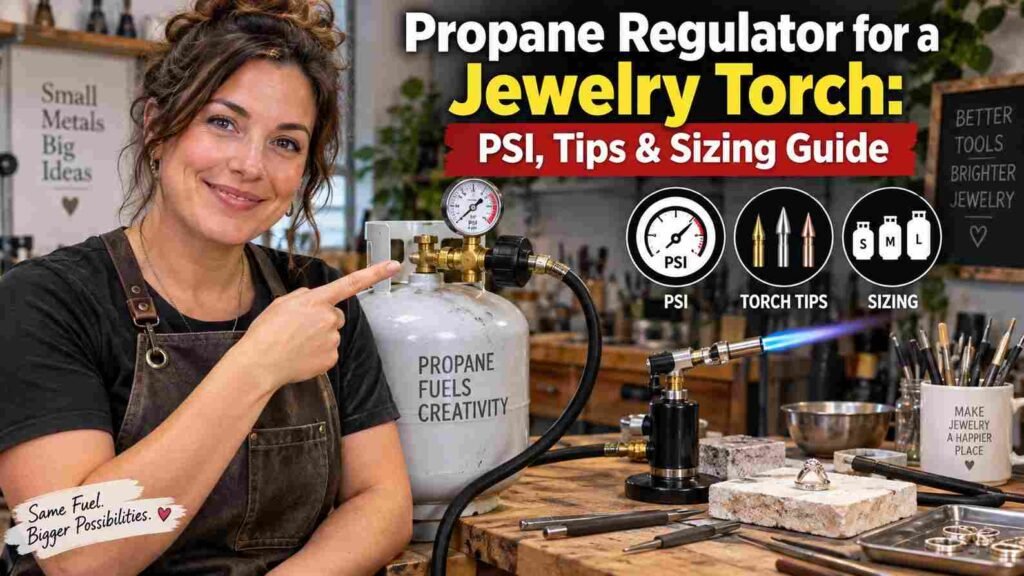
For most oxy-propane jewelry torches, I use a low-pressure adjustable propane regulator that gives fine control in roughly the 2–10 PSI working range. Small torch tips often run around 3–8 PSI, while some larger casting or multi-jet tips may need around 10 PSI propane. The exact setting depends on the torch and tip, so I always start with the manufacturer’s pressure chart. I also use a separate oxygen regulator, match the correct fuel-gas fittings and hose, and choose a regulator whose gauge is easy to read at low pressure instead of buying an oversized regulator designed for much higher PSI.
A jewelry torch needs a very different propane regulator than a blacksmith forge, BBQ grill, or whole-house propane system. Most jewelry torches work with relatively low fuel pressure, but they need smooth, repeatable adjustment because tiny changes in pressure can change the flame size and how easy the torch is to control.
That is why I do not choose a regulator by maximum PSI alone. A regulator that can reach 60 PSI may technically be able to supply 4 PSI, but if the gauge and adjustment are coarse, it can be frustrating to use on a small jewelry torch.


In this guide, I’ll show you how I match the regulator to common jewelry torch types, tip sizes, propane pressure, oxygen pressure, hoses, fittings, and the kind of work you are doing—whether that is soldering jump rings, annealing, brazing, or melting small amounts of metal.
What Type of Propane Regulator Does a Jewelry Torch Need?
For a typical oxy-propane jewelry torch, I look for an adjustable regulator designed specifically for propane or LP gas. I want a regulator that can hold low outlet pressures steadily and that has a gauge scaled closely enough for me to read settings such as 3, 4, 5, 6, or 8 PSI without guessing.
Smith Little Torch-style systems are a good example. Common straight, curved, and twin-flame tips use fuel and oxygen pressures in roughly the 3–8 PSI range depending on tip size. Optional multi-jet casting tips can require more pressure, around 10 PSI fuel and 14 PSI oxygen.
| Jewelry Torch Setup | Typical Propane Pressure | Typical Oxygen Pressure | Regulator Choice |
|---|---|---|---|
| Very small tip | About 3 PSI | About 3 PSI | Low-range adjustable propane regulator |
| Small/medium tip | 3–5 PSI | 3–5 PSI | Fine-control fuel regulator |
| Larger jewelry tip | 6–8 PSI | 6–8 PSI | Regulator stable through the upper single-digit range |
| Multi-jet / casting tip | About 10 PSI | About 14 PSI | Regulator with enough range and flow for heavier work |
| Meco-type small torch | Often under 10 PSI | Often under 10 PSI | Follow tip and torch manufacturer guidance |
I treat those numbers as manufacturer examples, not universal settings. Different torches, tips, fuel gases, and aftermarket nozzles can use different pressures.


If you want a broader explanation of propane regulator pressure, see my article on how many PSI a propane regulator supplies.
Why a Jewelry Torch Needs Fine Pressure Control
A jewelry torch may be used for work that ranges from a tiny solder seam to heating a large silver cuff. The flame has to be controllable enough to avoid overheating delicate parts while still having enough heat when you move to a larger piece.
Fine pressure control matters because the torch valves can only do so much. If I feed the torch from a regulator set much higher than necessary, I may end up running the torch valves barely cracked open. That makes the flame more sensitive and harder to adjust.
A lower, appropriate regulator setting lets me use more of the torch valve’s adjustment range. That usually makes the flame easier to tune.
This is one reason many jewelers prefer regulators that can hold a steady pressure in the 2–10 PSI area rather than general-purpose high-pressure regulators intended for heavier industrial work.

How Much PSI Does a Smith Little Torch Need?
The Smith Little Torch is one of the most common jewelry torches, so it gives us a useful reference point.
Pressure depends on the tip. Current jewelry-supply references for Smith/Gentec-compatible tips show approximately 3 PSI for smaller tips, 4 PSI for a No. 5 tip, 6 PSI for a No. 6, and around 7 PSI for a No. 7. Other setup guidance notes that standard Little Torch tips generally use about 2–8 PSI for both oxygen and fuel, while multi-jet tips may need around 10 PSI propane and 14 PSI oxygen.
| Tip Example | Approx. Recommended Pressure | Typical Use |
|---|---|---|
| No. 3 | About 3 PSI | Fine soldering and small parts |
| No. 4 | About 3 PSI | Small jewelry work |
| No. 5 | About 4 PSI | General jewelry soldering |
| No. 6 | About 6 PSI | Larger pieces and heavier heating |
| No. 7 | About 7–8 PSI | Larger flame and higher heat |
| Multi-jet casting tip | About 10 PSI propane | Melting/casting applications |
This is why I like a gauge that is easy to read below 10 PSI. If most of my work happens between 3 and 7 PSI, I gain very little from a fuel-pressure gauge that jumps from 0 to 60 PSI in large increments.
The tip chart should always override a generic recommendation. If your torch manual specifies a different value, use that value.


Can I Use a BBQ Propane Regulator for a Jewelry Torch?
Usually not if the torch is designed for several PSI of propane pressure.
A typical fixed low-pressure BBQ regulator supplies about 11 inches of water column, which is only around 0.4 PSI. A jewelry torch tip that needs 3–8 PSI requires much more pressure than that.
| Pressure | Approximate Equivalent | Typical Application |
|---|---|---|
| 11 in. WC | About 0.4 PSI | BBQ grills and low-pressure appliances |
| 3 PSI | About 83 in. WC | Small jewelry torch tips |
| 5 PSI | About 139 in. WC | Common jewelry-torch operating region |
| 8 PSI | About 222 in. WC | Larger jewelry torch tips |
| 10 PSI | About 277 in. WC | Some multi-jet/casting tips |
A fixed BBQ regulator may produce a weak flame or make it impossible to reach the output the torch was designed for.
That does not mean I choose a very high-pressure regulator instead. I choose an adjustable propane regulator that covers the required working range with good control.
What Regulator Range Should I Buy?
For most jewelry torches, I want the regulator’s useful range centered around the actual torch pressure, not far above it.
| Regulator Outlet Range | Best Use | What I Think About It |
|---|---|---|
| 0–10 PSI | Fine jewelry torches | Excellent low-pressure resolution |
| 0–15 PSI | Most jewelry work | Good balance for standard and larger tips |
| 0–30 PSI | Jewelry plus some heavier torch work | More versatile but may be coarser at low settings |
| 0–60 PSI | Industrial/general-purpose use | Usually more range than a jewelry torch needs |
A 0–15 PSI propane regulator is often a practical choice because it covers common jewelry tip pressures and still provides some headroom. A 0–30 PSI regulator can also work well if it has a sensitive adjustment mechanism and a low-pressure delivery gauge that is easy to read.
I do not judge a regulator by the inlet gauge. The high-pressure gauge shows tank pressure. The delivery gauge—the one that shows outlet pressure—is the important gauge for setting the torch.
My guide on regulator inlet pressure versus outlet pressure explains the difference.
Do I Need a Separate Oxygen Regulator?
Yes, if you are using an oxygen cylinder. The propane regulator controls fuel gas, while the oxygen regulator controls oxygen. They are separate devices and are not interchangeable.
For many small jewelry torch tips, fuel and oxygen pressures may be similar. For example, Smith Little Torch setup guidance often uses approximately the same PSI number as the tip number for both fuel and oxygen on standard tips. Larger specialty tips can use a higher oxygen setting.
The two regulators still have different gas-service requirements. Oxygen regulators must be designed for oxygen service and kept completely free of oil and grease.
If you use an oxygen concentrator instead of an oxygen cylinder, your oxygen pressure and flow will be limited by the concentrator. Some jewelry torches work well from concentrators, but larger tips may not reach full performance if the concentrator cannot deliver enough oxygen.
Propane vs. Acetylene for Jewelry Torches
Many jewelry torches can run on more than one fuel gas, but the regulator must match the gas you are actually using.
Propane and acetylene have different storage, pressure, flame, and regulator requirements. I never use an acetylene regulator as a casual substitute for a propane regulator unless the manufacturer specifically approves that regulator for LP gas service.
Propane is popular in jewelry studios because it is readily available, stores well in cylinders, and works effectively with oxygen for soldering, brazing, annealing, and many small melting tasks.
The torch tip can also matter. Some tiny tips may be intended for acetylene only, while larger compatible tips can use propane. Contenti’s Gentec/Smith-compatible tip listings, for example, identify the smallest No. 2 tip as acetylene-only while larger tips can use propane.
How Much Propane Flow Does a Jewelry Torch Need?
Jewelry torches usually do not demand the huge fuel flow of a forge or large glassblowing torch, but the regulator still has to maintain pressure while gas is flowing.
This matters when you use a larger tip or a multi-jet melting tip. A regulator that holds 5 PSI with the torch closed may drop badly when the torch is opened if the regulator, hose, or cylinder connection is too restrictive.
I do not size a jewelry regulator from PSI alone. I also check the regulator’s rated capacity and make sure the hose and fittings do not create an unnecessary restriction.
| Torch Demand | Typical Situation | What I Look For |
|---|---|---|
| Low | Tiny soldering tip | Stable pressure and very fine control |
| Medium | General jewelry tip | Steady 3–6 PSI under load |
| Higher | Large tip for annealing/heating | Adequate regulator and hose flow |
| High for jewelry work | Multi-jet melting/casting tip | Regulator must hold around 10 PSI at required flow |
If you want more detail on this principle, see what BTU capacity means on a propane regulator.
What Hose and Fittings Should I Use?
I use fuel-gas hose and fittings intended for propane/oxy-fuel service. I do not substitute general-purpose air tubing or unknown hose simply because the diameter fits.
Jewelry torch systems typically use clearly identified fuel and oxygen hoses. Fuel-gas connections commonly use left-hand threads, while oxygen connections use right-hand threads. The different thread direction helps prevent accidental interchange.
Some compact jewelry torches also use hose-barb connections or specialized torch fittings. I match the connection shown in the torch and regulator documentation rather than building a chain of adapters.
If you are unsure about POL, NPT, or flare connections on the regulator side, see how I match regulator inlet and outlet thread sizes.
Can I Use a 20-Lb Propane Cylinder?
A 20-pound propane cylinder has far more fuel capacity than most individual jewelry-torch sessions require, and it can easily supply the fuel flow needed by many small torches.
The bigger issue is where the cylinder may legally and safely be located. Local fire codes, building rules, insurer requirements, and studio policies may restrict indoor propane-cylinder use or storage.
In professional workshops, the propane cylinder may be stored outdoors with approved piping brought into the workspace. I follow the rules that apply to the specific building rather than assuming that because a cylinder is small enough to carry, it is acceptable beside the jewelry bench.
If you use a smaller cylinder, I still make sure the regulator connection is correct and that the cylinder can remain upright and protected from heat and physical damage.
Do I Need Flashback Arrestors or Check Valves?
I follow the torch manufacturer’s instructions and local oxy-fuel safety requirements. Backflow and flashback protection can be important in oxygen-fuel systems because you do not want one gas feeding backward into the other line.
The correct device depends on the torch, regulator, hose, and gas source. I use equipment specifically rated for oxygen-fuel service rather than substituting ordinary plumbing check valves.
Protective devices also create some pressure drop, so I make sure the torch still receives the pressure it needs after they are installed. If a very small torch suddenly becomes weak after adding an arrestor, I verify that the device is appropriate for low-flow jewelry service.
How I Set the Regulator for Jewelry Work
I start with the pressure recommended for the exact tip. I do not simply set every tip to the same number.
For a small torch, I open the cylinder according to the regulator and gas-supplier instructions, set the delivery pressure while gas is flowing as directed by the equipment manual, and then make the final flame adjustment at the torch valves.
The flame should respond smoothly when I adjust the torch. If the valves feel extremely sensitive and a tiny movement creates a huge flame change, the delivery pressure may be unnecessarily high.
If the torch blows out, pops, burns back, or will not produce the expected flame, I stop and check the correct tip, gas pressure, hose, regulator, and manufacturer instructions instead of continuing to raise pressure.
Common Jewelry Torch Regulator Problems
| Symptom | Possible Cause | What I Check |
|---|---|---|
| Flame too small | Pressure too low or supply restriction | Delivery gauge, hose, tip, valves |
| Flame blows off tip | Pressure too high or incorrect tip setting | Manufacturer pressure chart |
| Pressure falls when torch opens | Regulator or hose flow issue | Regulator capacity and restrictions |
| Gauge creeps upward | Regulator malfunction | Remove regulator from service |
| Torch is hard to fine-tune | Regulator range too broad/high | Use lower-range delivery control |
| Propane smell at bench | Leak or unburned gas | Shut down and leak-test before reuse |
Jewelry Torch Regulator Safety
A jewelry torch looks small compared with a welding torch, but it still uses pressurized fuel gas and oxygen around an open flame. I treat the regulator, hoses, valves, and cylinder connections as safety-critical equipment.
Before lighting, I inspect hoses for cracks, burns, abrasion, and loose fittings. I leak-check propane connections with an approved leak-detection solution or the method specified by the manufacturer. I never check for leaks with a flame.
I keep oxygen equipment free of oil and grease. OSHA specifically requires oxygen and fuel-gas equipment to be used for the gases and pressures for which it is intended, and oxygen equipment must not be contaminated with petroleum products.
I also use adequate ventilation. Jewelry soldering can create fumes from flux, solder, coatings, metals, and combustion products. A small flame does not eliminate the need for local exhaust ventilation.
For general LP-regulator considerations, see my propane regulator safety requirements guide.
Frequently Asked Questions
What PSI should I use for a jewelry torch?
It depends on the torch tip. Smith Little Torch-style standard tips commonly use about 3–8 PSI, while larger multi-jet tips may use about 10 PSI propane. Always follow the chart for your exact tip.
Is a 0–15 PSI propane regulator good for jewelry work?
Yes, it is a very useful range for many jewelry torches because it gives fine control in the low single-digit and upper single-digit PSI area.
Can I use a 0–30 PSI regulator?
Yes, if it adjusts smoothly at low pressure and the delivery gauge is readable where your torch operates. For very fine work, a lower-range regulator may be easier to tune.
Can I use a grill regulator?
Usually not for an oxy-propane jewelry torch that needs several PSI. A typical grill regulator supplies only around 0.4 PSI.
Do propane and oxygen use the same regulator?
No. Each gas needs its own regulator designed and connected for that gas.
Can I use one propane regulator for more than one jewelry torch?
Only if the regulator, manifold, hoses, protective devices, and cylinder supply are designed for the combined simultaneous flow. I size the system for all torches that may be used at once.
Bottom Line
For a jewelry torch, I want a propane regulator that gives stable, fine control in the torch’s actual working range—not simply the highest PSI available. Standard jewelry tips often operate around 3–8 PSI, while some specialty melting or casting tips may need around 10 PSI propane.
A low-range adjustable propane regulator, such as 0–10 or 0–15 PSI, is often ideal for fine jewelry work. A 0–30 PSI model can also be practical if it controls low pressure well. I pair it with a separate oxygen regulator, proper oxy-fuel hose, compatible fittings, and the pressure chart for the exact torch tip.
Most importantly, I use the torch manufacturer’s published settings as the final authority. Tip size, torch design, fuel gas, oxygen source, and the kind of work you are doing all affect the correct pressure.

Mike is an experienced propane technician with over 15 years of professional experience in the field. He has dedicated his career to helping customers with their propane needs, from installation to maintenance and repair. Together with Jeremy, he co-founded this website to provide useful information and guidance to customers seeking reliable propane services.


