
Quick Answer
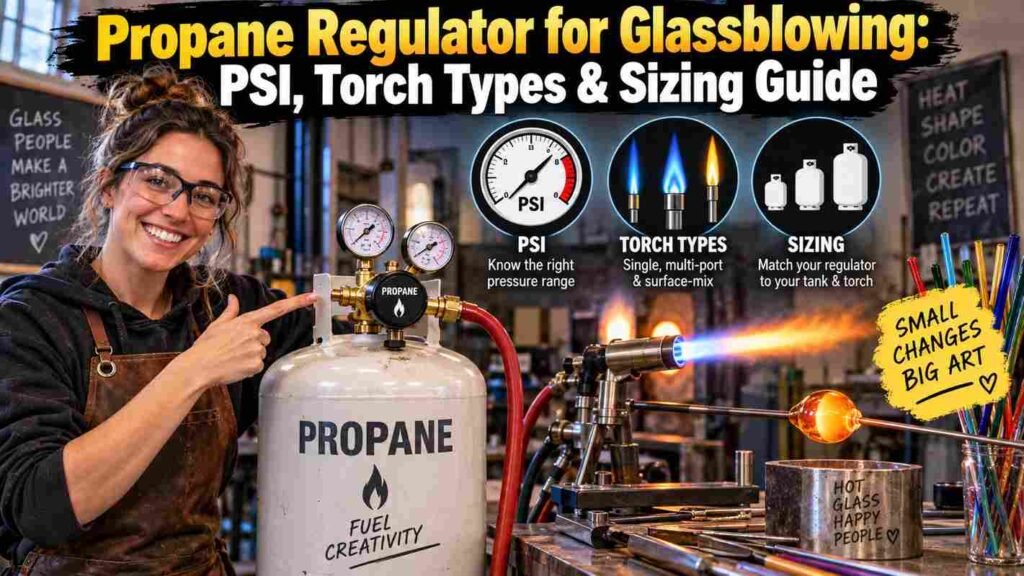
For most propane-fueled glassblowing torches, I use an adjustable regulator made specifically for propane/LP gas, with an outlet range that comfortably covers the torch manufacturer’s required fuel pressure. Small surface-mix torches may run around 2–5 PSI propane, many medium bench torches use about 5–8 PSI, and larger torches may call for roughly 10 PSI or more. I do not choose the regulator by PSI alone: it also needs enough flow capacity for the torch, the correct cylinder connection, compatible hose fittings, and a pressure gauge that is easy to read in the torch’s normal operating range.
Glassblowing puts very different demands on a propane regulator than a grill, RV, furnace, or blacksmith forge. The torch may need only a few PSI of fuel pressure, but it also needs stable flow and fine adjustment because flame chemistry changes when the propane-to-oxygen ratio changes.
That is why I start with the exact torch model. A Carlisle Mini CC, GTT Bobcat, GTT Lynx, and a large 30- to 60-jet torch do not all want the same propane pressure. If I know the torch, I can select the correct regulator range instead of buying a generic high-pressure regulator and hoping it works.


In this guide, I’ll show you how I match propane pressure, regulator range, torch type, gas flow, fittings, hose, and oxygen supply for a glassblowing bench.
What Type of Propane Regulator Does a Glassblowing Torch Need?
For cylinder-fed propane, I generally look for an adjustable fuel-gas regulator specifically rated for propane/LP gas. The outlet pressure range should include the torch manufacturer’s recommended fuel pressure without forcing me to operate near the very bottom or very top of the regulator’s scale.
A regulator with a 0–15 PSI or 0–30 PSI outlet range can cover many lampworking and glassblowing torches, but the best range depends on the torch. A small torch that normally runs at 2 PSI is easier to tune with a lower-range regulator than with a coarse regulator intended for much higher pressure.
I do not use an oxygen regulator for propane or a propane regulator for oxygen. Regulators are designed for specific gases, pressures, materials, and inlet connections. OSHA likewise requires pressure-reducing regulators to be used only for the gases and pressures for which they are intended.


| Torch / Application | Example Propane Pressure | Example Oxygen Pressure | Regulator Implication |
|---|---|---|---|
| Small surface-mix hand torch | About 2 PSI | About 5 PSI | Fine low-pressure adjustment is valuable |
| Small bench torch | About 5 PSI | About 10 PSI | A low-to-moderate adjustable LP regulator works well |
| Medium multi-port torch | About 5–8 PSI | About 15–25 PSI | Choose a regulator that holds stable fuel pressure under higher flow |
| Large 30–60 jet torch | About 10 PSI | About 35 PSI | Higher flow capacity becomes as important as outlet pressure |
| Premix torch | Manufacturer-specific | Manufacturer-specific | Pressure and mixer/tip combination must match the torch design |
How Much Propane PSI Does a Glassblowing Torch Need?
There is no universal propane pressure for glassblowing. I use the torch manufacturer’s pressure recommendation as my starting point because the burner geometry determines how much propane and oxygen the torch can handle.
Carlisle currently specifies about 2 PSI fuel gas and 5 PSI oxygen for the Mini CC. GTT instructions specify 5 PSI propane and 10 PSI oxygen for the Bobcat. GTT’s Lynx instructions call for approximately 5–8 PSI propane and 15–25 PSI oxygen, while its larger Delta/Mirage/Phantom-family instructions specify about 10 PSI fuel and 35 PSI oxygen for maximum performance.
| Example Torch | Fuel Pressure | Oxygen Pressure | Notes |
|---|---|---|---|
| Carlisle Mini CC | 2 PSI | 5 PSI | Small surface-mix torch |
| GTT Bobcat | 5 PSI | 10 PSI | Compact bench torch |
| GTT Lynx | 5–8 PSI | 15–25 PSI | Broader flame-control range |
| GTT Cricket | 5 PSI from propane cylinder | Can operate from low-pressure oxygen sources | Manufacturer notes fuel can operate lower, but 5 PSI is the cylinder setup |
| GTT large 30–60 jet torches | 10 PSI | 35 PSI | Minimum operation possible lower, but reduced performance |
| Carlisle CC | 5 PSI propane | 25 PSI oxygen | Large production-capable torch |
Those are manufacturer examples, not a chart for setting every torch. If your torch manual says something different, I use the manual.
If you want a deeper explanation of regulator pressure terminology, see my guide on propane regulator inlet pressure versus outlet pressure.
Why a Standard BBQ Regulator Is Usually the Wrong Choice
A typical fixed low-pressure grill regulator delivers about 11 inches of water column, which is only around 0.4 PSI. That is far below the 2–10 PSI fuel pressures specified for many popular glassblowing torches.

| Pressure | Approximate Equivalent | How It Compares |
|---|---|---|
| 11 in. WC | About 0.4 PSI | Typical low-pressure propane appliance supply |
| 2 PSI | About 55 in. WC | Around five times typical low-pressure appliance pressure |
| 5 PSI | About 139 in. WC | Common setting for several glass torches |
| 8 PSI | About 222 in. WC | Upper part of the recommended range for some medium torches |
| 10 PSI | About 277 in. WC | Used by some large multi-port torches |
If the fuel pressure is too low, the torch may not achieve its intended flame size or heat output. You may find yourself opening the torch valve fully while still getting less flame than the torch is designed to produce.
That does not mean I automatically choose the highest-pressure regulator I can find. Glassblowing needs controllability. I would rather have a regulator whose useful adjustment range matches the torch than a 0–60 PSI regulator when the torch normally runs at 2–5 PSI.
Surface-Mix vs. Premix Torches: Why the Regulator Choice Can Differ
The two broad torch designs you will encounter are surface mix and premix. The distinction matters because the gases interact differently inside the torch.
In a surface-mix torch, propane and oxygen travel through separate internal passages and mix at or just beyond the torch face. Popular lampworking torches such as the Carlisle Mini CC are surface mix. These torches can offer a wide range of flame chemistry while reducing the amount of combustible gas mixture contained inside the torch body.


In a premix torch, fuel and oxygen or air mix before reaching the burner tip. Carlisle’s Universal Hand Torch, for example, is a premix design and can use propane with oxygen or air. The correct pressures depend on the carburetor, nozzle, tip, and intended flame.
| Torch Design | Where Gases Mix | Regulator Consideration | Typical Use |
|---|---|---|---|
| Surface mix | At or near torch face | Stable independent fuel and oxygen pressure | Lampworking, borosilicate, soft glass |
| Premix | Inside mixer before tip | Follow tip/mixer pressure specifications closely | Scientific glass, hand torches, lathe work |
| Multi-stage surface mix | Separate center and outer fires | Fuel supply must handle combined maximum demand | Large borosilicate work |
| Oxygen-concentrator setup | Fuel regulator plus low-pressure oxygen source | Fuel pressure still follows torch requirement | Small/medium lampworking benches |
I do not transfer pressure settings from a surface-mix torch to a premix torch just because both use propane. The burner manufacturer’s instructions control.
How Much Propane Flow Does a Glassblowing Regulator Need?
Pressure is only part of the regulator specification. The regulator must also flow enough propane while holding that pressure.
This becomes especially important when moving from a small beadmaking torch to a larger borosilicate torch. Carlisle lists approximate standard propane consumption of only about 1.5 liters per minute for the Mini CC, but the Carlisle CC can use up to approximately 60 cubic feet per hour of propane in its standard configuration. The CC Plus/RP can reach roughly 120 CFH.
| Torch Example | Published Propane Flow | Approx. Relative Demand | What I Want From the Regulator |
|---|---|---|---|
| Carlisle Mini CC | About 1.5 LPM | Low | Fine pressure control at modest flow |
| Small bench torch | Model-specific | Low to medium | Stable 5 PSI supply |
| Carlisle CC | Up to about 60 CFH | High | Regulator and hose sized for substantial continuous flow |
| Carlisle CC Plus / RP | Up to about 120 CFH | Very high | High-flow fuel regulator and properly sized supply system |
A regulator can show the correct static PSI with the torch closed and still sag when the torch is opened if its flow capacity is too small. I want stable pressure under actual torch demand.
The same principle applies to other propane equipment. My article on what BTU capacity means on a propane regulator explains why regulator flow matters in addition to PSI.
What Regulator Range Should I Buy?
For many lampworking torches, I prefer a regulator whose gauge and adjustment range make 2–10 PSI easy to set. A 0–15 PSI regulator can be excellent for small and medium torches. A 0–30 PSI regulator is more flexible if you may eventually move to a larger torch, as long as the adjustment is smooth enough at low pressure.
| Regulator Outlet Range | Best Fit | Tradeoff |
|---|---|---|
| 0–10 PSI | Small torches with low fuel-pressure requirements | Excellent fine control but little headroom |
| 0–15 PSI | Many lampworking bench torches | Good balance of fine control and capacity |
| 0–30 PSI | Small through larger glass torches | More versatile but gauge resolution may be coarser |
| Above 30 PSI | Specialty/high-pressure applications | Usually unnecessary for ordinary glass torch fuel settings |
The inlet side must also match the propane source. A regulator connected directly to a portable cylinder may use POL/CGA 510 or Type 1/QCC1 depending on the regulator and cylinder valve. Studio installations supplied from building propane piping can be completely different.
If you need help identifying regulator connections, read how I match regulator inlet and outlet thread sizes.
Do I Need a Separate Oxygen Regulator?
If you are using compressed oxygen cylinders, yes—the oxygen supply uses its own oxygen regulator. The propane regulator and oxygen regulator are not interchangeable.
The oxygen pressure is often substantially higher than the propane pressure. As the manufacturer examples above show, a small torch might use 5 PSI oxygen with 2 PSI fuel, while a larger torch may use 25–35 PSI oxygen with 5–10 PSI fuel.
If you use oxygen concentrators instead of cylinders, the setup is different. Concentrators deliver oxygen at their own flow and pressure limits. Some torches are designed to run well on one or more concentrators, while larger torches may not reach maximum output without bottled oxygen or a higher-capacity oxygen system.
I match the oxygen source to the torch rather than turning up propane to compensate for inadequate oxygen. Too much fuel relative to oxygen creates a reducing, fuel-rich flame and can change how certain glass colors behave.
What Hose and Fittings Should I Use?
I use hose and fittings intended for oxy-fuel gas service and compatible with propane. Fuel-gas and oxygen hoses should remain clearly distinguishable and should not be made interchangeable.
GTT instructions commonly use red fuel hose and green oxygen hose, with fuel fittings using left-hand threads and oxygen fittings using right-hand threads. On some small torches, hose-barb connections are also used according to the manufacturer’s instructions.
I do not improvise with general-purpose air hose or unknown tubing. OSHA requires fuel-gas and oxygen hose to be distinguishable, inspected for damage, and removed from service when defective. Hose connections also need to be secure for the service pressure.
I route hoses away from hot glass, torch flames, sharp bench edges, and walkways. GTT specifically advises keeping torch lines under the table edge so hot glass cannot fall onto them.
Do I Need Flashback Arrestors or Check Valves?
I follow the torch and regulator manufacturer’s guidance and applicable workplace requirements. In oxy-fuel installations, backflow and flashback protection can be important because oxygen must not flow backward into the fuel-gas system and flame must not travel back into the supply system.
OSHA’s oxygen-fuel gas requirements call for approved protective equipment in fuel-gas piping systems to prevent oxygen backflow, flashback, and excessive back pressure. Carlisle also sells flashback-protection equipment specifically rated for LPG and oxygen service.
The correct device and location depend on the torch, hose, regulator, and whether the setup uses cylinders, manifolds, or permanent shop piping. I do not remove manufacturer-installed protection or substitute an ordinary check valve for equipment designed for oxy-fuel service.
Common Regulator Problems at the Glassblowing Bench
| Symptom | Possible Regulator/Supply Cause | What I Check |
|---|---|---|
| Flame shrinks as torch is opened | Regulator or supply flow is undersized | Regulator flow rating, tank supply, hose restriction |
| Gauge pressure falls under load | Insufficient flow or cylinder vaporization | Regulator capacity and propane source |
| Flame changes during session | Pressure drift or supply issue | Regulator stability, cylinder condition, connections |
| Cannot reach recommended PSI | Wrong regulator range or supply restriction | Regulator model, valve, hose, fittings |
| Pressure creeps upward | Regulator malfunction or seat leakage | Take regulator out of service for inspection |
| Propane odor at bench | Leak | Shut down supply and locate/correct leak before reuse |
Glassblowing Regulator Safety
Glassblowing combines fuel gas, oxygen, open flame, very hot glass, and combustible materials, so I treat the regulator and hose system as safety-critical equipment.
Before lighting, I inspect hoses, regulator gauges, torch valves, and connections. I leak-check the fuel system with an approved leak-detection solution or another method specified by the equipment manufacturer. I do not search for gas leaks with a flame.
OSHA requires oxygen and fuel-gas regulators and their gauges to be in proper working order, and it requires oxygen equipment to remain free of oil and grease. Oxygen and hydrocarbon contamination are a serious hazard, so I never handle oxygen valves or regulators with oily hands or lubricate oxygen fittings.
Ventilation also matters. A torch produces combustion gases and can release fumes from glass colors, metals, enamels, and surface treatments. I use local exhaust ventilation designed for the torch and the work being done.
For general LP regulator installation considerations, see my propane regulator safety requirements guide.
Frequently Asked Questions
What PSI should propane be for glassblowing?
It depends on the torch. Manufacturer examples range from about 2 PSI for a Carlisle Mini CC, 5 PSI for a GTT Bobcat, 5–8 PSI for a GTT Lynx, and around 10 PSI for larger GTT multi-port torches. I use the specification for the exact torch.
Can I use a BBQ regulator for a glass torch?
Usually not. A typical BBQ regulator supplies about 0.4 PSI, while many popular glassblowing torches call for 2–10 PSI propane. Use a regulator designed for propane with the outlet range specified for the torch.
Is a 0–30 PSI propane regulator good for glassblowing?
It can be, especially if you use or plan to use medium or large torches. For a small torch that normally runs at 2 PSI, however, a lower-range regulator may offer easier fine adjustment.
Do propane and oxygen need the same pressure?
No. Oxygen pressure is commonly higher. A torch might use 5 PSI propane and 10, 25, or 35 PSI oxygen depending on the design.
Can I run more than one torch from one propane regulator?
Only if the regulator, manifold, protective devices, hoses, and propane supply are designed for the combined simultaneous flow. I add the maximum fuel demand of the torches and size the complete system accordingly.
Why does my propane pressure drop when I open the torch?
The regulator may be undersized for flow, the cylinder may not be vaporizing propane fast enough, or there may be a restriction in the valve, hose, fitting, or manifold. Static pressure with the torch closed does not prove that the system can deliver the required flow.
Bottom Line
The right propane regulator for glassblowing is the one that matches your exact torch’s fuel pressure and flow requirements. Small surface-mix torches may need only about 2–5 PSI propane, medium torches often operate around 5–8 PSI, and larger multi-port torches may call for about 10 PSI.
I choose a propane-specific adjustable regulator with a gauge that is easy to read in that operating range, enough flow capacity to prevent pressure drop, the correct cylinder or piping connection, and compatible oxy-fuel hose and fittings. I keep the oxygen supply on a separate oxygen regulator or approved concentrator system.
Most importantly, I use the torch manufacturer’s published pressure settings rather than treating a generic PSI chart as a substitute. Glass torches vary too much in burner design, port count, mixing method, and gas consumption for one regulator setting to fit every bench.

Mike is an experienced propane technician with over 15 years of professional experience in the field. He has dedicated his career to helping customers with their propane needs, from installation to maintenance and repair. Together with Jeremy, he co-founded this website to provide useful information and guidance to customers seeking reliable propane services.


