
Quick Answer
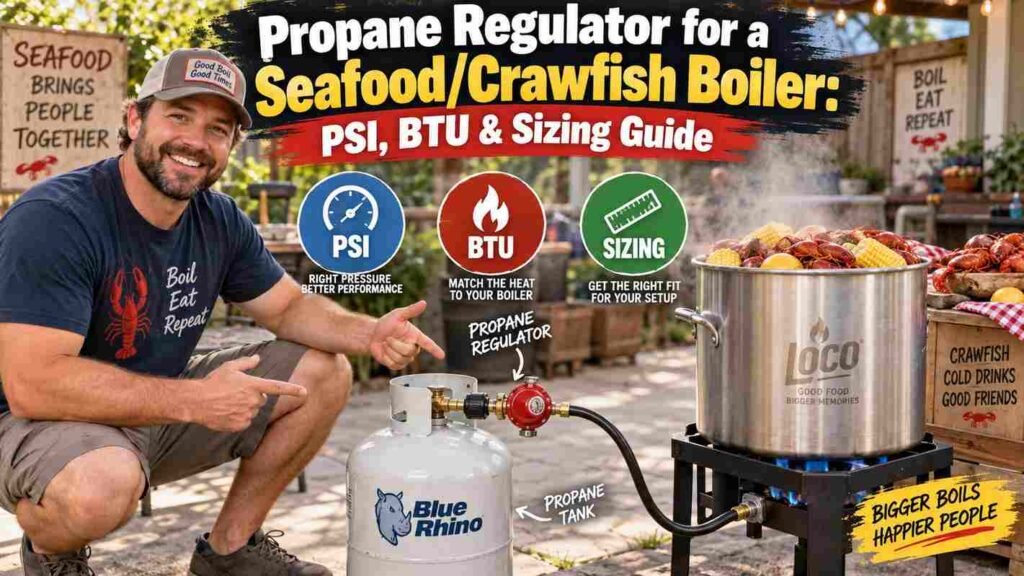
For most seafood and crawfish boilers, I use a high-pressure propane regulator matched to the burner—not a standard BBQ regulator. Smaller outdoor cookers may use a fixed or adjustable 5–10 PSI regulator, while high-output banjo and dual-jet burners often use 20–30 PSI regulators. Some large boiler systems are designed around regulators up to 40 PSI. The correct choice depends on the burner’s BTU rating, orifice, pot size, hose and fitting size, and the regulator specified by the cooker manufacturer. I never select the regulator by PSI alone; it must also have enough flow capacity to support the burner’s full BTU demand.
A seafood or crawfish boiler can use a tremendous amount of propane compared with a grill, RV appliance, or home stove. The whole point is to bring a large pot of water to a hard boil quickly, then recover that boil after adding crawfish, shrimp, crab, corn, potatoes, sausage, or other cold ingredients.
That means the regulator has to do two jobs well: deliver the correct pressure and provide enough propane flow for the burner at full fire. If either one is undersized, the boiler may take forever to heat, lose its boil after food is added, or never reach the output the burner was designed to produce.


In this guide, I’ll show you how I match regulator pressure, BTU capacity, burner type, stockpot size, tank size, hose, and fittings for seafood and crawfish boilers.
What Type of Propane Regulator Does a Crawfish Boiler Need?
Most crawfish boilers use a high-pressure propane regulator. The actual pressure depends on the burner design.
Bayou Classic, for example, currently pairs a 59,000 BTU outdoor cooker with a 10-PSI preset regulator, a 106,000 BTU seafood boiler with a 10-PSI regulator, a 180,000 BTU banjo burner with a 30-PSI adjustable regulator, and a 367,000 BTU dual-jet cooker with a 30-PSI adjustable regulator. GasOne sells high-output outdoor burners around 200,000–270,000 BTU with adjustable high-pressure regulator systems.
| Burner / Cooker Type | Example Output | Typical Regulator Range | Best Fit |
|---|---|---|---|
| Small high-pressure cooker | 41,000–59,000 BTU/hr | 5–10 PSI | Smaller pots and lighter outdoor cooking |
| Single-jet seafood boiler | Around 100,000 BTU/hr | About 10 PSI | Crawfish and seafood boils |
| Banjo burner | Around 180,000 BTU/hr | Up to 30 PSI adjustable | Large stockpots and fast recovery |
| High-output cast-iron burner | 200,000–270,000 BTU/hr | Often 0–20 PSI adjustable | Heavy outdoor boiling and brewing |
| Dual-jet cooker | Around 367,000 BTU/hr | Up to 30 PSI adjustable | Very large batch boiling |
| Large matched boiler system | Model-specific | Some systems use up to 40 PSI | Follow manufacturer specification |
Those figures show why I do not use one universal regulator for every seafood cooker. The regulator, burner, hose, and orifice are designed as a system.


If you want a broader explanation of regulator pressure ranges, see my article on how many PSI a propane regulator supplies.
Is a 10-PSI Regulator Enough for a Crawfish Boiler?
Sometimes, yes. A 10-PSI regulator is common on single-jet seafood boilers and medium-output outdoor cookers.
Bayou Classic’s 82-quart seafood/crawfish cooker, for example, uses a 106,000 BTU single-jet burner with a 10-PSI preset regulator. Its 59,000 BTU SP10 cooker also uses a 10-PSI preset regulator.
That tells me a 10-PSI regulator can absolutely be appropriate when the burner is designed around it. But I would not put that same regulator on a 180,000 BTU banjo burner if the manufacturer specifies a 30-PSI regulator for full output.
| Regulator Pressure | Typical Use | What I Expect |
|---|---|---|
| 5 PSI | Lower-output outdoor cooker | Good control for smaller pots and moderate heat |
| 10 PSI | Single-jet boiler / medium cooker | Common seafood-boil setup |
| 20 PSI | High-output cast-iron burner | More heat and faster recovery when burner is designed for it |
| 30 PSI | Large banjo / dual-jet burner | High heat for large stockpots |
| 40 PSI | Special high-output boiler systems | Use only when specifically matched to burner |
The number on the regulator is not a performance upgrade by itself. A 30-PSI regulator does not automatically make a burner better if the orifice and burner head were designed around 10 PSI.

Why a Standard BBQ Regulator Is Usually Too Weak
A typical grill regulator delivers around 11 inches of water column, which is only about 0.4 PSI. That is dramatically lower than the 5–30 PSI used by many outdoor seafood cookers.
| Pressure | Approximate Equivalent | Typical Application |
|---|---|---|
| 11 in. WC | About 0.4 PSI | Gas grills and low-pressure appliances |
| 5 PSI | About 139 in. WC | Lower-output outdoor cooker |
| 10 PSI | About 277 in. WC | Single-jet seafood boiler |
| 20 PSI | About 554 in. WC | High-output outdoor burner |
| 30 PSI | About 831 in. WC | Banjo and dual-jet burners |
If you put a low-pressure grill regulator on a high-pressure crawfish burner, you can end up with a small weak flame and painfully slow boil times.
That does not mean every boiler needs the highest-pressure regulator available. I use the regulator specified for the burner.
How Many BTUs Does a Crawfish Boiler Need?
BTU output affects how quickly the water heats and how quickly the pot returns to a boil after ingredients are added.


A 60,000 BTU cooker may be fine for a smaller pot. A 100,000-plus BTU single-jet boiler can handle a full crawfish pot more aggressively. A 180,000 to 200,000 BTU banjo-style burner gives faster recovery with large stockpots. Dual-jet systems can exceed 300,000 BTU/hr.
| Burner Output | Typical Pot / Use | Heating Character |
|---|---|---|
| 40,000–60,000 BTU/hr | Small to medium outdoor pots | Slower heat-up, moderate recovery |
| 80,000–110,000 BTU/hr | Medium to large seafood boils | Good all-around boiling performance |
| 150,000–200,000 BTU/hr | Large stockpots | Fast boil and strong recovery |
| 200,000–300,000 BTU/hr | Very large pots / heavy outdoor cooking | High heat, high propane demand |
| 300,000+ BTU/hr | Large commercial-style batch boiling | Very high fuel flow required |
I do not size the regulator only from the pressure printed on it. I also check whether it can flow enough propane at that pressure.
For example, Bayou Classic lists a 10-PSI regulator with a maximum rating of 142,800 BTU/hr and a 30-PSI adjustable regulator rated up to 180,000 BTU/hr. If your burner can consume more than the regulator can supply, the regulator can become the bottleneck even if the PSI range looks correct.
For more detail on this concept, see what BTU capacity means on a propane regulator.
How I Match Regulator Capacity to the Burner
I start with the burner’s published BTU input or the regulator specified by the cooker manufacturer. If the burner is rated at 180,000 BTU/hr, I want the complete regulator and hose assembly to support that demand at the required pressure.
I do not assume a regulator rated at 150,000 BTU/hr is close enough for a 200,000 BTU/hr burner. Under full load, the pressure can sag and the flame can weaken.
If the cooker has two burners or two jets supplied by one regulator, I size for the total simultaneous load unless the manufacturer has already engineered the assembly.
You can see the same principle in other propane systems. My guide on calculating the BTU capacity needed for a propane regulator explains the process in more detail.
10 PSI vs. 20 PSI vs. 30 PSI: Which Should I Buy?
I buy the regulator that matches the burner or replacement assembly—not the biggest one on the shelf.
| Regulator Range | When I Choose It | Main Advantage | Main Risk if Mismatched |
|---|---|---|---|
| 5–10 PSI | Cooker specifically designed for lower high-pressure operation | Good control and lower fuel rate | May not supply a large banjo burner |
| 0–20 PSI | High-output burner designed for adjustable pressure | Wide heat adjustment | Can overpower smaller burner/orifice |
| 0–30 PSI | Large banjo or dual-jet cooker | Fast heat-up and strong recovery | Wrong choice for burner rated only for lower pressure |
| 0–40 PSI | Large matched boiler system | Maximum high-output capability | Should never be substituted blindly |
Bayou Classic specifically labels its 30- and 40-PSI regulator assemblies for banjo burners and dual-jet cookers and states that they are not intended for gas grills. That is exactly how I think about regulator selection: application-specific rather than universal.
Does Pot Size Change the Regulator I Need?
The stockpot does not directly determine regulator PSI, but it changes how much burner output is useful.
A small 24-quart pot does not benefit much from a 367,000 BTU dual-jet burner and may be unsafe on a cooker frame designed for huge stockpots. On the other hand, a 100- to 160-quart seafood pot can be frustrating on a low-output burner because of the time required to bring that much water back to a boil.
| Pot Size | Typical Burner Range I Consider | Regulator Approach |
|---|---|---|
| 20–40 qt | 40,000–80,000 BTU/hr | 5–10 PSI if burner requires it |
| 60–80 qt | 60,000–110,000+ BTU/hr | Often 10 PSI single-jet setup |
| 80–120 qt | 100,000–200,000 BTU/hr | 10–30 PSI depending on burner |
| 120–160+ qt | 180,000–367,000+ BTU/hr | High-flow 20–30 PSI or matched system |
These are planning ranges, not replacement specifications. I always check the burner and cooker frame rating before increasing output.
What Hose and Fittings Should I Use?
I use an LPG hose assembly rated for the regulator’s maximum pressure and burner flow. High-output boilers often use braided stainless or reinforced thermoplastic LPG hose.
Current Bayou Classic high-pressure regulator assemblies commonly use a 3/8-inch flare swivel female outlet. GasOne’s 0–20 PSI regulator kits commonly use a QCC/ACME tank inlet and a 5/8-18 UNF outlet on the hose assembly.
Those connections are not interchangeable just because they look similar. I match the exact fitting called for by the burner or hose assembly.
If you are replacing a regulator and are unsure about POL, QCC1, NPT, or flare connections, see how I match propane regulator inlet and outlet thread sizes.
QCC1 vs. POL Tank Connections
Many modern high-pressure regulator assemblies connect to a standard 20-pound propane cylinder using a Type 1/QCC1 ACME connector. Other heavy-duty regulators use the internal POL/CGA 510 connection.
Bayou Classic’s 40-PSI assembly, for example, uses a soft-nose POL tank connection that fits inside the Type 1 propane-cylinder valve connection. GasOne’s high-pressure regulator kits commonly use a male QCC/ACME inlet.
I choose the regulator assembly that matches my cylinder valve and cooker system instead of adding unnecessary adapters.
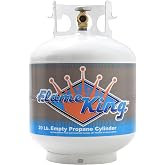
Can I Use a 20-Lb Propane Tank for a Crawfish Boiler?
Yes, many outdoor seafood boilers are designed for a standard 20-pound propane cylinder. GasOne’s 200,000 BTU B-5450, for example, is specified for a 20-pound tank.
But high-output burners can consume propane quickly. At full fire, a large burner can empty a cylinder much faster than a backyard grill.
Tank vaporization also matters. Pulling propane vapor at a high rate cools the cylinder. During long boils, cold weather, or low tank levels, the cylinder can frost and supply pressure can drop.
For large events or repeated batches, I prefer a full cylinder in good condition and may use a larger properly approved supply arrangement when the cooker manufacturer and local rules allow it.
Why My Crawfish Boiler Flame Gets Weak
| Symptom | Possible Cause | What I Check |
|---|---|---|
| Weak flame from the start | Wrong low-pressure regulator | Regulator PSI and model |
| Strong flame, then fading | Tank vaporization limit or icing | Tank level, temperature, runtime |
| Pressure drops under load | Regulator or hose undersized | BTU/flow rating and hose size |
| One jet weaker than another | Orifice or burner restriction | Jet/orifice condition |
| Yellow lazy flame | Poor air mix or obstruction | Air shutter and burner cleanliness |
| Flame cuts back after opening tank | Excess-flow device may have tripped | Shut down and reopen valve slowly per instructions |
If the system works well at low flame but falls apart at full output, I look at regulator flow capacity, hose restriction, tank supply, and the burner orifice before assuming the burner itself is defective.
Can I Turn Up the Regulator for a Faster Boil?
Only within the pressure range the burner is designed to use.
Increasing pressure can increase burner output, but only until the burner reaches its designed operating limit. Beyond that, you can create poor combustion, excessive flame, wasted propane, overheating of the cooker frame, or unsafe flame rollout around the stockpot.
I never replace a 10-PSI regulator with a 30-PSI model just to make the cooker hotter unless the burner manufacturer specifically approves that configuration.
If I need faster recovery, I choose a burner/cooker designed for higher output instead of over-driving an existing burner.
Outdoor Use and Safety
Seafood boilers are outdoor cooking appliances. I use them outside in an open, well-ventilated area on a stable noncombustible surface, away from structures, vehicles, dry grass, and other combustible materials.
I keep the propane cylinder upright and far enough from the burner and pot that it is not exposed to excessive radiant heat. I also keep the hose away from hot surfaces, pot edges, and areas where someone can trip over it.
Before every cook, I inspect the hose and regulator for cracking, abrasion, burns, loose fittings, or damage. I leak-check connections using an approved leak-detection solution or the method specified by the cooker manufacturer. I never use a flame to find a leak.
A large crawfish pot can weigh well over 100 pounds when filled with water and food. The cooker frame must be stable and rated for the pot size. I do not move the cooker while it is lit or while the pot contains boiling liquid.
For general regulator installation principles, see my propane regulator safety requirements guide.
Frequently Asked Questions
What PSI regulator do I need for a crawfish boiler?
It depends on the burner. Common outdoor seafood cookers use 10-PSI, 20-PSI, or 30-PSI regulators. Large matched boiler systems may use up to 40 PSI. Use the pressure specified for the exact burner.
Is a 10-PSI regulator enough for a seafood boil?
Yes, if the burner is designed for 10 PSI. Bayou Classic’s 106,000 BTU 82-quart seafood boiler uses a 10-PSI preset regulator.
Can I use a 30-PSI regulator on any crawfish burner?
No. A 30-PSI regulator should only be used on a burner designed for that pressure. It can over-fire a smaller burner or orifice.
Can I use a grill regulator?
Usually not on a high-pressure seafood cooker. A grill regulator commonly supplies only about 0.4 PSI, far below the 5–30 PSI used by many crawfish boilers.
Why does my boiler lose heat when I add crawfish?
The cold food absorbs a large amount of heat. If recovery is excessively slow, the burner may be undersized, the regulator may not supply enough flow, the hose may be restrictive, or the tank may not be vaporizing propane fast enough.
Can a 20-lb tank run a 200,000 BTU burner?
Many 200,000 BTU outdoor burners are sold for use with 20-pound cylinders, but the runtime is shorter and cylinder cooling can become noticeable at sustained high output. Follow the cooker manufacturer’s tank requirements.
Bottom Line
For a seafood or crawfish boiler, I match the propane regulator to the burner’s required pressure and full BTU demand. Smaller cookers may use 5–10 PSI, single-jet seafood boilers commonly use around 10 PSI, and large banjo or dual-jet burners often use adjustable 20–30 PSI regulators. Some large boiler systems use up to 40 PSI.
I also check regulator flow capacity, hose rating, orifice, tank connection, stockpot size, and the propane cylinder’s ability to keep up with sustained high demand.
Most importantly, I treat the burner and regulator as a matched system. A higher-pressure regulator is not automatically an upgrade. The correct regulator is the one the burner was engineered to use.

Mike is an experienced propane technician with over 15 years of professional experience in the field. He has dedicated his career to helping customers with their propane needs, from installation to maintenance and repair. Together with Jeremy, he co-founded this website to provide useful information and guidance to customers seeking reliable propane services.


