
Quick Answer
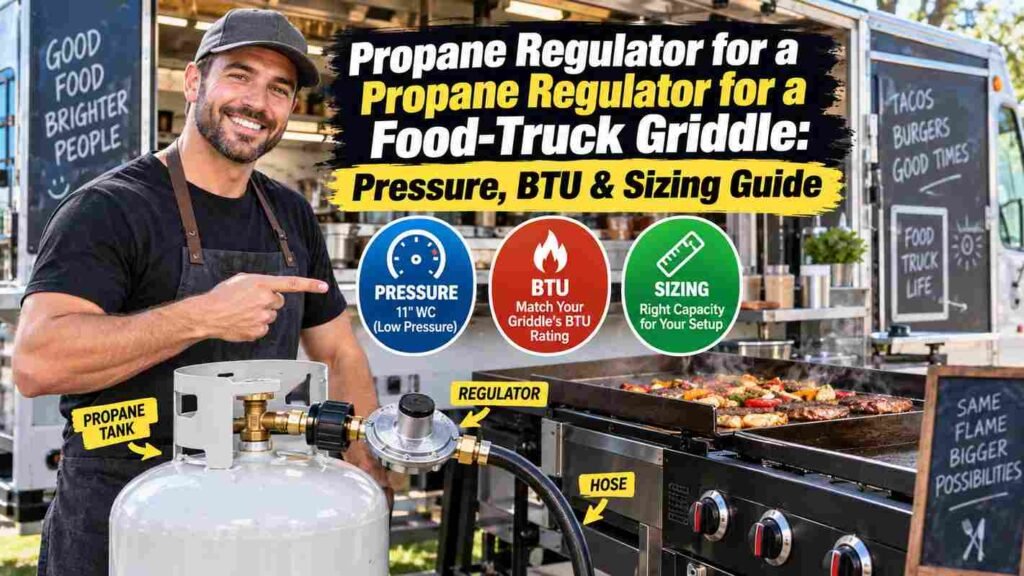
For most propane food-truck griddles, I use a properly sized low-pressure LP-gas system that delivers roughly 10–11 inches of water column to the appliance, not a high-pressure 10-, 20-, or 30-PSI cooker regulator. Commercial LP griddles commonly operate around 10″ WC, while portable outdoor griddles often use 11″ WC. The regulator must also have enough capacity for the griddle’s BTU load—and, if one truck regulator serves multiple appliances, for the combined load of every appliance that can run at the same time. I follow the griddle manufacturer’s inlet-pressure and regulator requirements first, then size the truck’s propane system around the total demand.
A food-truck griddle is one of those propane appliances where the pressure number can be misleading. You may have a 90,000- or 120,000-BTU commercial flat-top, yet the actual appliance pressure may still be only about 10 inches of water column. That is less than half a PSI.
The reason is simple: BTU capacity and pressure are not the same thing. A griddle can need a large volume of propane while still operating at low pressure. That is why I size the regulator for both delivery pressure and flow capacity.


In this guide, I’ll show you how I choose a propane regulator for a food-truck griddle, how I calculate BTU demand, when I use one or two stages of regulation, how I handle multiple appliances, and what I check on hoses, fittings, cylinders, and mobile-food safety requirements.
What Pressure Does a Propane Food-Truck Griddle Need?
For many commercial propane griddles, the answer is about 10 inches of water column. Portable outdoor griddles often use about 11 inches water column. Those values are very close, but I still use the exact number in the appliance manual.
Current Atosa commercial griddles are a good example. Its LP models are specified at 10″ WC, with each burner rated around 30,000 BTU/hr. Portable griddles from brands such as Pit Boss and Royal Gourmet commonly use regulators set around 11″ WC.
| Appliance Type | Typical LP Pressure | Approx. PSI | What I Use |
|---|---|---|---|
| Commercial countertop griddle | About 10″ WC | About 0.36 PSI | Commercial LP regulator/system sized to appliance |
| Portable outdoor griddle | About 11″ WC | About 0.40 PSI | Manufacturer-supplied low-pressure regulator |
| Food-truck branch line | System-specific | May be low-pressure or staged | Sized by truck LP design |
| High-pressure outdoor burner | 5–30 PSI | Much higher | Not the normal choice for a commercial griddle |
If you see a regulator rated in 10, 20, or 30 PSI, that does not mean it is better for a food-truck griddle. Those high-pressure regulators are commonly used for seafood boilers, turkey fryers, and some forge or burner systems—not for standard commercial flat-tops.


For a deeper explanation of pressure terminology, see my guide to regulator inlet pressure versus outlet pressure.
10 Inches WC vs. 11 Inches WC: Does the Difference Matter?
Yes, but I do not overthink it. The appliance manufacturer decides the required manifold or regulator pressure.
A commercial griddle specified for 10″ WC should be set up for 10″ WC. A portable griddle supplied with an 11″ WC regulator should use that matched regulator unless the manufacturer approves another setup.
| Pressure | Approx. PSI | Approx. mbar | Typical Use |
|---|---|---|---|
| 10″ WC | 0.36 PSI | 24.9 mbar | Many commercial LP griddles |
| 11″ WC | 0.40 PSI | 27.4 mbar | Many portable LP appliances |
| 2 PSI | 2.0 PSI | 138 mbar | Some distribution systems before final appliance regulation |
| 10 PSI | 10 PSI | 689 mbar | High-pressure outdoor burner systems |
The important point is that a food-truck griddle usually needs low pressure at the appliance even though the upstream tank pressure is much higher. The regulator system reduces that pressure in controlled stages.
How Many BTUs Does a Food-Truck Griddle Use?
Commercial griddle BTU ratings usually rise with width because each additional burner adds heat input.

A common commercial pattern is around 30,000 BTU/hr per 12 inches of griddle width. Current Atosa manual griddles follow that pattern, and similar heavy-duty models from other commercial suppliers do too.
| Griddle Width | Typical Burners | Example Input per Burner | Example Total Input |
|---|---|---|---|
| 24 inch | 2 | 30,000 BTU/hr | 60,000 BTU/hr |
| 36 inch | 3 | 30,000 BTU/hr | 90,000 BTU/hr |
| 48 inch | 4 | 30,000 BTU/hr | 120,000 BTU/hr |
| 60 inch | 5 | 30,000 BTU/hr | 150,000 BTU/hr |
I use the actual appliance nameplate, not the table above, when I size a real truck. Some griddles use 25,000-BTU burners, some use 30,000, and some thermostatic models differ.
If you are still getting familiar with regulator flow ratings, see what BTU capacity means on a propane regulator.
How I Size the Regulator for the Griddle
If the regulator serves only the griddle, I size it to supply at least the griddle’s full rated input at the required outlet pressure.


For example, if the griddle is rated at 90,000 BTU/hr and requires 10″ WC, the regulator must be capable of delivering at least 90,000 BTU/hr at that outlet pressure under the expected inlet conditions.
I also leave reasonable capacity margin instead of choosing a regulator that is operating right at its published maximum. The exact margin depends on the regulator manufacturer and system design.
| Griddle Load | Minimum Regulator Flow I Need | Practical Approach |
|---|---|---|
| 60,000 BTU/hr | At least 60,000 BTU/hr | Choose a low-pressure LP regulator comfortably above load |
| 90,000 BTU/hr | At least 90,000 BTU/hr | Allow margin for stable pressure under full fire |
| 120,000 BTU/hr | At least 120,000 BTU/hr | Verify regulator chart at actual inlet/outlet pressures |
| 150,000 BTU/hr | At least 150,000 BTU/hr | Use commercial-capacity regulator/system |
If I am sizing the whole truck rather than one appliance, I add every appliance that can operate at the same time. My article on how to calculate the BTU capacity needed for a propane regulator walks through that process.
What If the Food Truck Has More Than Just a Griddle?
Most food trucks do. A griddle may share the propane supply with fryers, a range, charbroiler, steam table, water heater, or other equipment.
That is where total connected load becomes more important than the griddle by itself.
| Appliance | Illustrative Input | Example |
|---|---|---|
| 36-inch griddle | 90,000 BTU/hr | 3 burners at 30,000 each |
| Two fryers | 80,000–160,000 BTU/hr total | Varies by fryer model |
| 2-burner range | 50,000–60,000 BTU/hr | Commercial open burners |
| Water heater | 30,000–80,000 BTU/hr | Model-dependent |
| Charbroiler | 60,000–120,000 BTU/hr | Width and burner design matter |
A truck with a 90,000-BTU griddle, 80,000-BTU fryer, and 40,000-BTU water heater already has a connected load of about 210,000 BTU/hr. If everything can run simultaneously, the upstream regulator and propane supply need to support that demand.
I do not size the truck regulator only to the largest appliance. I size the system to the simultaneous design load.
Does a Food Truck Need a Two-Stage Propane Regulator?
Many mobile propane systems use staged regulation because propane container pressure varies with temperature and can be very high. A first stage reduces container pressure to an intermediate level, and a second stage reduces it to the low pressure required by appliances.
Whether the regulators are separate or combined into an integral two-stage regulator depends on the vehicle design, tank type, piping layout, appliance requirements, and code-compliant installation.
For a small portable griddle connected directly to a 20-pound cylinder, the appliance may use a factory-supplied single assembly that performs the required regulation for that product. That is different from a commercial food truck with several permanently installed appliances.
I do not copy an RV regulator layout or backyard grill setup onto a food truck without verifying that the regulator is approved and sized for the mobile food application.
Can I Use the Griddle’s Factory Regulator in a Food Truck?
Sometimes, but it depends on how the griddle is listed and how the truck’s LP system is designed.
Portable outdoor griddles commonly come with a hose-and-regulator assembly intended to connect directly to a 20-pound cylinder. Manufacturers often instruct users to use only the supplied regulator.
A commercial countertop griddle may instead have an appliance regulator at the rear gas connection and expect the building or vehicle piping to deliver propane within a specified inlet-pressure range. Atosa commercial griddles, for example, commonly use a 3/4-inch NPT gas connection and an LP regulator setting around 10″ WC.
If the griddle is installed as part of a food-truck gas system, I follow the appliance manual and the truck gas-system design rather than removing or bypassing an appliance regulator because another regulator exists upstream.
What Size Gas Connection Does a Commercial Griddle Use?
Commercial griddles often use larger connections than portable backyard griddles. A 3/4-inch NPT rear gas connection is common on heavy-duty 24- to 60-inch commercial units.
That larger connection does not mean the griddle needs high pressure. It means the appliance needs enough gas volume at low pressure.
| Connection | Where I Commonly See It | Important Point |
|---|---|---|
| 3/4-inch NPT | Commercial countertop griddles | Supports substantial low-pressure gas flow |
| 1/2-inch NPT | Smaller commercial equipment | Still must be sized by BTU and run length |
| QCC1 / Type 1 | Portable cylinder-fed griddles | Typically part of factory hose/regulator assembly |
| POL / CGA 510 | Some heavy-duty cylinder/regulator systems | Must match approved LP system components |
If you need to identify the regulator and pipe connections, see my guide to matching regulator inlet and outlet thread sizes.
Can I Run a Commercial Griddle From a 20-Lb Propane Tank?
Physically, some griddles can consume fuel from a 20-pound cylinder if the regulator and fittings are compatible. But for a food truck, I look beyond whether the burner lights.
A 120,000- or 150,000-BTU griddle can draw propane quickly, especially when all burners are on. Add fryers, a water heater, or a range and the total demand can rise sharply.
A small cylinder can also experience vaporization limits. Propane must boil from liquid to vapor inside the container. As vapor is withdrawn, the tank cools. Cold weather, low liquid level, and high continuous demand reduce the amount of vapor the cylinder can supply.
That is why commercial mobile-food systems often use larger cylinders, multiple approved cylinders, or ASME tanks sized for the complete appliance load.
How Much Propane Can a Food Truck Carry?
For U.S. installations, NFPA 58 now includes a dedicated chapter for mobile food facilities. The allowable propane storage is tied in part to total appliance input and container type.
| Total Appliance Input | Maximum Aggregate Cylinder Water Capacity | Approx. Nominal Propane Capacity |
|---|---|---|
| Under 300,000 BTU/hr | 478 lb water capacity | About 200 lb propane |
| 300,000–700,000 BTU/hr | 717 lb water capacity | About 300 lb propane |
| Over 700,000 BTU/hr | 717 lb water capacity | About 300 lb propane |
NFPA 58 also limits individual cylinder water capacity and requires cylinders or ASME containers to be installed outside the vehicle or in an approved recess or vented cabinet. Local jurisdictions can adopt additional requirements, so I treat the code table as a starting point rather than the only rule.
This is one reason I want the complete appliance BTU list before designing a food-truck propane system.
Why the Griddle Flame Gets Weak When Other Appliances Turn On
If the griddle works normally by itself but the flame shrinks when a fryer or water heater starts, I suspect a supply-capacity problem.
| Symptom | Possible Cause | What I Check |
|---|---|---|
| Griddle weak only when fryer starts | Regulator undersized for combined load | Total BTU capacity |
| All appliances weak under peak demand | Tank vaporization or upstream restriction | Tank size, temperature, regulator and piping |
| One appliance weak all the time | Branch pipe or appliance regulator issue | Individual line and appliance pressure |
| Pressure good static, low under load | Regulator droop or restriction | Flowing pressure test |
| Problem worse in cold weather | Container vaporization limit | Propane storage size and tank temperature |
A static pressure reading can look normal with everything off. What matters is whether the system maintains the required pressure while the griddle and other appliances are firing.
My article on regulator droop in a propane system explains why outlet pressure can fall as flow increases.
Can I Use a High-Pressure Regulator to Get More Heat From the Griddle?
No. I do not raise supply pressure above the manufacturer’s specification to make the griddle hotter.
Commercial griddles are designed around specific orifices, manifold pressure, burners, pilots, and combustion-air settings. Feeding a 10″ WC griddle with several PSI of propane would be a major overpressure condition.
If the griddle does not heat properly at the correct pressure, I check burner condition, orifices, regulator function, gas supply capacity, airflow, thermostat or valve operation, and the appliance conversion setup.
A higher-pressure regulator is not an upgrade for a low-pressure commercial griddle.
Food-Truck Propane Regulator Safety
A food truck combines propane containers, gas piping, hot cooking appliances, electrical equipment, grease, and a confined workspace. I treat the LP system as part of the vehicle’s fire-safety system, not as a collection of separate appliance hoses.
I use listed regulators, hose, tubing, valves, fittings, and appliances appropriate for mobile LP-gas service. I secure cylinders and containers according to the applicable requirements and protect piping and regulators from vehicle movement, road debris, heat, and physical damage.
NFPA 58’s mobile-food provisions require the hose or tubing connecting the container to the vehicle piping not to extend outside the enclosure or touch the ground, and containers must be installed outside the vehicle or in an approved recess or vented cabinet.
I also leak-test the system after work is performed and verify appliance pressure under load. Food-truck installations should be inspected by the authority having jurisdiction and serviced by qualified LP-gas personnel where required.
For broader LP-regulator considerations, see my propane regulator safety requirements guide.
Frequently Asked Questions
What pressure regulator does a food-truck griddle need?
Many commercial LP griddles are designed for about 10″ WC, while portable griddles often use about 11″ WC. Use the exact pressure specified on the appliance data plate or manual.
Is 10 PSI the same as 10 inches WC?
No. Ten PSI is roughly 27 times higher than 10″ WC. A commercial griddle that needs 10″ WC should never be fed from a 10-PSI line without proper downstream regulation.
How many BTUs does a 36-inch commercial griddle use?
A common 36-inch commercial griddle uses around 90,000 BTU/hr, often three 30,000-BTU burners. The actual nameplate rating should be used for sizing.
Can one regulator run the griddle and fryer?
Yes, if the regulator and complete LP system are designed for the combined simultaneous BTU load and each appliance receives the correct pressure.
Can I use an RV regulator on a food truck?
I would not assume so. The regulator must be listed and sized for the mobile food application, total load, piping arrangement, and required pressure. A similar-looking two-stage regulator is not automatically interchangeable.
Why does my food-truck griddle lose heat during a rush?
If the burners weaken when several appliances are operating, the likely causes include insufficient regulator capacity, undersized piping, tank vaporization limits, or another upstream restriction.
Bottom Line
For most propane food-truck griddles, I want low-pressure LP gas at roughly 10–11 inches of water column, with enough regulator and piping capacity to support the griddle’s full BTU rating. A 24-inch commercial griddle may use around 60,000 BTU/hr, while a 60-inch unit can reach 150,000 BTU/hr.
If the same propane system also serves fryers, ranges, charbroilers, or a water heater, I size the upstream regulator and propane storage for the combined simultaneous load—not just the griddle.
Most importantly, I follow the griddle manufacturer’s gas-pressure specification and the food truck’s approved LP-system design. A high-pressure regulator will not make a low-pressure commercial griddle perform better; the right regulator is the one that delivers the correct pressure steadily at the required flow.

Mike is an experienced propane technician with over 15 years of professional experience in the field. He has dedicated his career to helping customers with their propane needs, from installation to maintenance and repair. Together with Jeremy, he co-founded this website to provide useful information and guidance to customers seeking reliable propane services.


