
Quick Answer
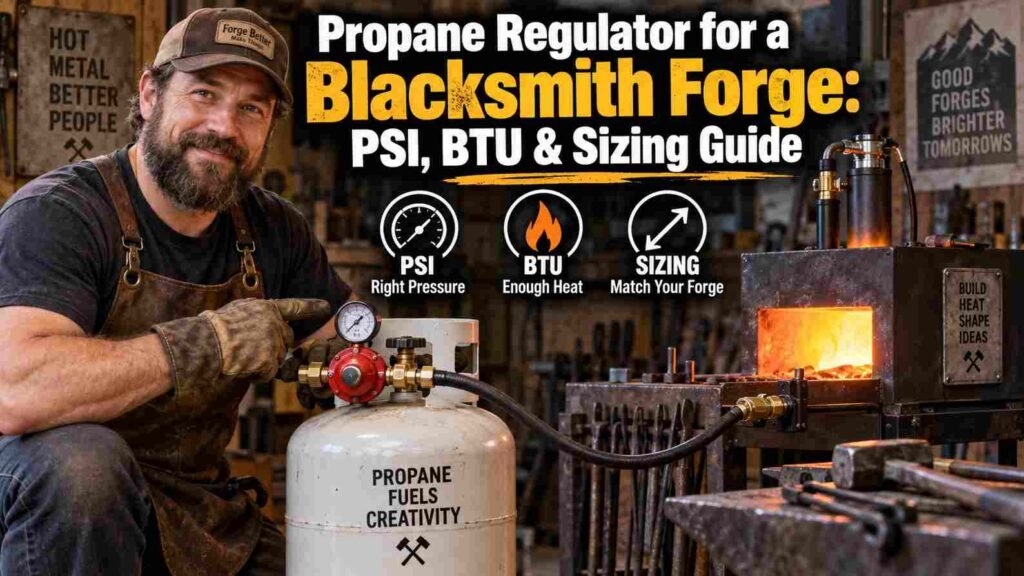
For most propane blacksmith forges, I use an adjustable high-pressure propane regulator rather than a fixed low-pressure BBQ regulator. A regulator with a working range around 0–20 PSI is suitable for many single- and dual-burner Venturi forges used for general forging, while a 0–30 PSI regulator gives extra adjustment range for burners that require higher pressure or for forge-welding heat. The exact setting depends on the burner design, orifice size, chamber volume, number of burners, and manufacturer instructions. I also match the regulator to the burner’s BTU demand, hose rating, tank connection, and fittings—not PSI alone.
A propane forge does not use the same kind of regulator as a typical gas grill. Most blacksmith forge burners—especially naturally aspirated Venturi burners—need substantially more gas pressure than the roughly 11 inches of water column supplied by a standard low-pressure household or barbecue regulator.
That is why I start by identifying the burner before I choose the regulator. A regulator can have the right tank connection and still be wrong because its pressure range is too low, its flow capacity is too small, or its outlet fitting does not match the forge gas train.


In this guide, I’ll walk you through the regulator pressure range, BTU capacity, burner count, tank size, fittings, hose, and safety factors I look at when setting up a propane blacksmith forge.
What Type of Propane Regulator Does a Blacksmith Forge Need?
For a typical propane forge, I look for an adjustable high-pressure LP-gas regulator. This is different from the fixed low-pressure regulator commonly used on grills, RV appliances, and household propane systems.
Many commercially sold blacksmith forge systems use regulators in the 0–20 PSI or 0–30 PSI range. For example, current forge-burner kits are commonly supplied with 0–30 PSI adjustable regulators, while some manufacturers recommend operating their burners in a much narrower range such as 4–10 PSI.
The important distinction is this: the regulator’s maximum range is not the pressure you must run all the time. A 0–30 PSI regulator simply gives you room to adjust. Your actual operating pressure should come from the burner or forge manufacturer and from how the flame behaves under load.


| Regulator Type | Typical Output | Suitable for Most Forges? | Typical Use |
|---|---|---|---|
| Fixed low-pressure regulator | About 11 in. WC / 0.4 PSI | Usually no | Grills, RV appliances, household low-pressure gas |
| Adjustable high-pressure regulator | 0–10 PSI | Sometimes | Low-pressure forge burners or forced-air systems |
| Adjustable high-pressure regulator | 0–20 PSI | Yes, for many setups | General forging with many Venturi burners |
| Adjustable high-pressure regulator | 0–30 PSI | Yes, very common | General forging plus higher-pressure headroom |
| Industrial adjustable regulator | Model-specific | Depends | Large multi-burner forges and specialty systems |
If you are comparing regulator pressure terminology, my guide on how many PSI a propane regulator supplies explains the difference between low-pressure and high-pressure regulator applications.
How Much PSI Does a Propane Forge Need?
There is no single PSI setting that works for every blacksmith forge. Burner design matters more than the forge label.
A naturally aspirated Venturi burner uses propane velocity to draw combustion air into the burner tube. If the gas pressure is too low, the burner may not entrain enough air or produce enough heat. If the pressure is too high, you can waste propane, push an excessively long flame out of the forge opening, or create unstable combustion.
Several current forge manufacturers and burner suppliers use adjustable 0–30 PSI regulators. One commercial single-burner forge, for example, specifies a 0–30.5 PSI regulator but recommends an operating pressure of roughly 4–10 PSI for its burner. Other forge references commonly describe general forging pressures in the 5–15 PSI range.
| Forge Operation | Illustrative Pressure Range | What I Watch For |
|---|---|---|
| Low idle / warm-up | 2–5 PSI | Stable flame without flameout |
| General forging | 5–10 PSI | Even chamber heat and neutral-to-slightly-rich flame |
| Heavy forging | 8–15 PSI | Adequate heat recovery when large stock enters |
| Forge welding | 10–20+ PSI on some burners | Only if the burner and forge manufacturer permit it |
| Forced-air burner | Often lower than Venturi | Blower supplies air, so pressure requirements differ |
These are reference ranges, not universal settings. I would never override a forge or burner manufacturer’s stated maximum pressure. A burner designed around 6 PSI is not automatically improved by feeding it 20 PSI.

If you want to understand why a pressure number can look so different from household propane systems, see my guide on regulator inlet pressure versus outlet pressure.
Why a BBQ Regulator Usually Does Not Work on a Blacksmith Forge
A common beginner mistake is connecting a blacksmith burner to a grill regulator because both run on propane. The connection may fit, but the operating pressure is usually completely different.
A standard low-pressure propane regulator supplies about 11 inches of water column, which is approximately 0.4 PSI. Many atmospheric forge burners need several PSI to operate properly. That means a grill regulator can be more than ten times lower in pressure than the forge burner expects.
| Pressure | Approximate Equivalent | Typical Application |
|---|---|---|
| 11 in. WC | About 0.4 PSI | Household appliances, RV appliances, grills |
| 5 PSI | About 139 in. WC | Lower-range forge operation |
| 10 PSI | About 277 in. WC | Common forge operating region |
| 20 PSI | About 554 in. WC | Higher-pressure forge operation on compatible burners |
| 30 PSI | About 831 in. WC | Upper regulator range on many forge kits |
The result of using a low-pressure regulator can be a weak flame, poor air entrainment, a forge that will not reach working temperature, or a burner that behaves unpredictably.


That does not mean every forge needs 20 or 30 PSI. It means you need the correct type of adjustable regulator so you can set the pressure the burner was actually designed to use.
How Much BTU Capacity Should the Regulator Have?
Pressure is only half of regulator sizing. The regulator also has to flow enough propane for all burners running at the same time.
Forge burner outputs vary widely. Some compact commercial forge burners are around 80,000 to 100,000 BTU/hr each. Larger burner systems can be considerably higher. Devil-Forge, for example, currently lists single-burner models around 80,000 BTU/hr and two-burner systems around 160,000 BTU/hr.
I add the burner ratings together and make sure the regulator and hose assembly can support the total gas demand at the required pressure.
| Burner Count | Example Rating per Burner | Example Total Load | Regulator Capacity I Would Target |
|---|---|---|---|
| 1 burner | 80,000 BTU/hr | 80,000 BTU/hr | At least 80,000 BTU/hr at required PSI, preferably with margin |
| 1 burner | 100,000 BTU/hr | 100,000 BTU/hr | At least 100,000 BTU/hr at required PSI |
| 2 burners | 80,000 BTU/hr | 160,000 BTU/hr | At least 160,000 BTU/hr at required PSI |
| 2 burners | 100,000 BTU/hr | 200,000 BTU/hr | At least 200,000 BTU/hr at required PSI |
| 3 burners | 80,000 BTU/hr | 240,000 BTU/hr | At least 240,000 BTU/hr at required PSI |
I do not rely on a regulator listing that says only “0–30 PSI.” I also want to know the regulator’s maximum flow or BTU capacity. Two regulators can have the same pressure range but very different flow capacity.
For more detail on this part of the calculation, see what BTU capacity means on a propane regulator and how I calculate regulator BTU capacity.
What Size Propane Tank Should I Use for a Forge?
The regulator cannot fix a tank that cannot vaporize propane fast enough.
As liquid propane boils into vapor, it absorbs heat from the cylinder. A high-output forge can draw vapor faster than a small cylinder can replace it, especially in cold weather or when the tank level is low. The cylinder surface may frost, regulator pressure may sag, and the forge may lose heat.
This is why a 20-pound cylinder can run a small forge successfully in one situation and struggle in another. Ambient temperature, burner BTU demand, tank fill level, and operating time all affect vaporization.
| Cylinder Situation | Typical Forge Effect | What I Consider |
|---|---|---|
| 20-lb cylinder, mild weather, single burner | Often workable | Watch for frost and pressure drop |
| 20-lb cylinder, cold weather, high-output burner | May struggle | Larger cylinder may provide better vaporization |
| 30- or 40-lb cylinder | More vaporization surface and fuel reserve | Useful for longer forge sessions |
| 100-lb cylinder | High reserve for stationary shop use | Check local storage and placement rules |
| Two-cylinder manifold | Can increase available vaporization | Use only a properly designed LP-gas manifold |
I do not apply external heat to a propane cylinder to stop frosting. If the tank cannot keep up, I reduce demand or move to a properly sized cylinder arrangement.
POL vs. QCC1: Which Tank Connection Should I Choose?
The regulator inlet has to match the propane cylinder valve.
Many U.S. portable cylinders use a Type 1/QCC1 external connection. Many forge regulator kits use QCC1 because it is hand-tightened and familiar to users of modern barbecue cylinders. Other heavy-duty forge regulators use the internal POL/CGA 510 connection.
Neither connection automatically makes the regulator better for forging. I choose based on the cylinder valve, regulator rating, and manufacturer-approved assembly.
| Connection | Common Description | Where I See It |
|---|---|---|
| Type 1 / QCC1 | Large external plastic handwheel connector | Modern 20-, 30-, and 40-lb cylinders |
| POL / CGA 510 | Internal left-hand propane connection | Heavy-duty regulators and many larger-cylinder setups |
| 1/4 in. NPT | Pipe-thread connection | Regulator outlet or gas-train fittings |
| SAE flare | Flare-seat connection | Some forge hose and burner assemblies |
If you are not sure what the regulator ports are, my guide on matching regulator inlet and outlet thread sizes explains NPT, POL, and flare connections in detail.
What Hose Should I Use for a Propane Forge?
I use a hose assembly specifically rated for LP gas and for the maximum pressure the regulator can deliver. I do not substitute a shop air hose, garden hose, or clear vinyl tubing.
The hose also needs enough flow capacity for the burner load and compatible fittings at both ends. Many forge kits are sold as matched regulator-and-hose assemblies, which reduces the chance of mismatched threads or inadequate pressure ratings.
I route the hose away from hot metal, forge openings, scale, sparks, sharp edges, and foot traffic. The cylinder should also be kept away from radiant forge heat.
Any hose that is cracked, hardened, abraded, burned, or leaking should be replaced rather than repaired with tape or clamps.
Venturi Burner vs. Forced-Air Burner Regulator Requirements
Most beginner propane forges use Venturi burners. They rely on propane velocity to pull combustion air into the mixing tube. Because of that, they often use a higher gas pressure than forced-air burners.
A forced-air burner has a blower supplying combustion air. That changes the pressure and control requirements, and some forced-air designs operate successfully at much lower propane pressure.
| Burner Type | How Air Enters | Common Regulator Approach | Important Note |
|---|---|---|---|
| Venturi / atmospheric | Gas jet entrains air | Adjustable high-pressure regulator | Pressure strongly affects air entrainment |
| Forced air | Electric blower supplies air | Often lower-pressure adjustable regulator | Fuel and blower airflow must be balanced |
| Ribbon burner | Depends on design | Manufacturer-specific | Do not assume Venturi pressure settings apply |
| Commercial packaged forge | Manufacturer-designed system | Use supplied or specified regulator | Follow the forge manual |
I never convert pressure settings from one burner type to another by guesswork. The burner manufacturer’s instructions should be the starting point.
Why My Forge Pressure Drops When I Open the Burner
If the regulator shows the desired pressure with the burner closed but the gauge drops dramatically when the burner opens, I look for a flow problem.
| Possible Cause | What Happens | What I Check |
|---|---|---|
| Regulator undersized | Pressure falls under demand | Regulator BTU/flow rating |
| Cylinder vaporization limit | Tank frosts and pressure falls | Tank size, temperature, fill level |
| Restricted hose or fitting | Flow is limited | Hose ID, fittings, valves, kinks |
| Excess-flow device activated | Very weak gas flow | Cylinder valve opening procedure and connector |
| Ice or contamination | Intermittent restriction | Regulator, hose, and valve condition |
| Multiple burners exceed capacity | Good with one burner, weak with two | Total connected BTU load |
This is why I size the entire gas train instead of focusing on regulator PSI alone.
Can I Use a Household Two-Stage Regulator on a Forge?
Usually not for a typical high-pressure Venturi forge. A residential two-stage regulator commonly delivers about 11 inches of water column, or roughly 0.4 PSI. That is excellent for a furnace, water heater, or range designed for low-pressure propane, but far below what many forge burners require.
Some specialty forced-air burners may be designed around lower gas pressures, so I do not make the decision from the word “forge” alone. I use the burner manufacturer’s specified inlet pressure.
If you are comparing regulator types, read what kind of propane regulator you need before selecting one.
Propane Forge Regulator Safety
A blacksmith forge combines pressurized fuel, open flame, extremely hot refractory surfaces, and carbon monoxide production. I treat the gas train as safety-critical equipment.
I use the forge outdoors or in a properly ventilated workspace designed for combustion equipment. I keep a carbon monoxide detector in occupied work areas, keep the propane cylinder upright, and keep it away from the forge’s radiant heat.
Before operation, I inspect the hose and fittings and perform a leak check using an approved leak-detection solution or soapy-water method where appropriate. I never test for leaks with a flame.
I also keep an accessible shutoff and know which valve stops the gas supply. If I smell propane, hear gas escaping, or find a damaged hose or regulator, I shut the system down and do not relight it until the problem is corrected.
For general propane-regulator safety considerations, see my propane regulator safety requirements guide. If you are changing a permanent propane system rather than using a packaged forge kit, I also recommend reading whether regulator installation should be handled by a professional.
Frequently Asked Questions
Is a 0–30 PSI regulator good for a propane forge?
Yes, a 0–30 PSI adjustable regulator is commonly used on propane forges and gives enough adjustment range for many Venturi burners. That does not mean you should run the forge at 30 PSI. Use the pressure recommended for your burner.
Can I use a 0–20 PSI regulator instead?
Often, yes. Many general forging applications operate well below 20 PSI. If the burner manufacturer requires more than 20 PSI for a specific operating condition, then a 0–20 PSI regulator would not provide enough range.
What PSI should I run my blacksmith forge at?
Many Venturi forges operate somewhere around 5–15 PSI during general forging, but the correct value is burner-specific. Some commercial burners recommend a narrower range such as 4–10 PSI. Start with the manufacturer’s instructions.
Do I need a regulator with a gauge?
A gauge is not always mandatory, but I consider it very useful. It lets you record working pressures, repeat successful settings, and see pressure drop under load.
Can I run two forge burners from one regulator?
Yes, if the regulator, hose, manifold, and cylinder can provide enough flow for both burners at the required pressure. Add the BTU rating of both burners and size the system for the total load.
Why does my propane tank freeze while forging?
The cylinder is likely vaporizing propane faster than it can absorb enough heat from the surroundings. High demand, cold weather, and a low fill level make this worse. A larger properly sized cylinder system can improve vaporization capacity.
Can I use a grill regulator on a forge?
Usually not. A grill regulator commonly supplies only about 0.4 PSI, while many atmospheric forge burners need several PSI. Use the regulator type specified by the forge or burner manufacturer.
Bottom Line
For most blacksmith forges, I choose an adjustable high-pressure propane regulator with enough pressure range and flow capacity for the burner system. A 0–20 PSI regulator works for many general-forging setups, while a 0–30 PSI model is extremely common because it provides additional adjustment range.
I then verify the total burner BTU load, tank connection, outlet fitting, hose pressure rating, cylinder vaporization capacity, and manufacturer-recommended operating pressure. Those details matter just as much as the number printed on the regulator gauge.
If you are running a packaged forge, the regulator supplied or specified by the manufacturer is usually the best reference. If you are assembling a custom gas train, use components rated for LP gas and the required pressure, leak-test every connection, and have an experienced gas professional verify anything you are unsure about.

Mike is an experienced propane technician with over 15 years of professional experience in the field. He has dedicated his career to helping customers with their propane needs, from installation to maintenance and repair. Together with Jeremy, he co-founded this website to provide useful information and guidance to customers seeking reliable propane services.


