
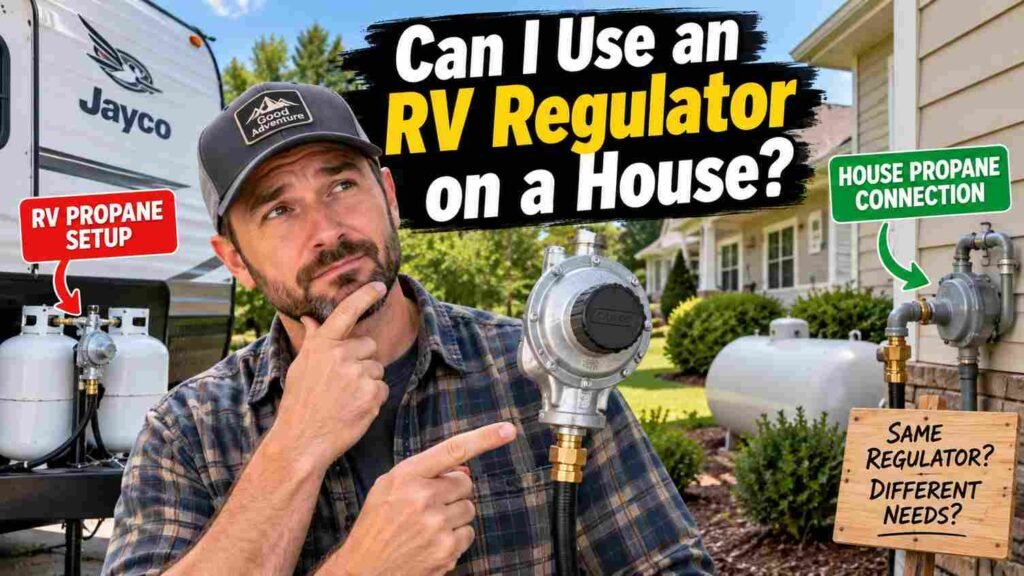
Quick Answer
You should not assume an RV regulator is suitable for a house just because both systems use propane and often supply appliances at about 11 inches of water column. Some two-stage regulators are approved for both RV and domestic applications, but many RV regulators are designed around smaller cylinder systems, different connections, different mounting arrangements, and lower total BTU loads. For a house, I size the regulator for the entire connected appliance load and verify the regulator’s listing, inlet and outlet pressures, capacity, venting, piping, and local code requirements. If the model is not specifically approved for the residential application, I would use a regulator designed and listed for home service instead.
An RV regulator can look almost identical to a residential propane regulator. That is what makes this question confusing. Both may be two-stage regulators. Both may reduce high propane container pressure to roughly 11″ WC. Both may even have enough BTU capacity to run several appliances. But matching outlet pressure does not automatically make the regulators interchangeable.
When I decide whether a propane regulator is appropriate, I do not start with the label “RV” or “house.” I start with the regulator’s approved application, pressure ratings, BTU capacity, connections, vent arrangement, installation instructions, and the gas system it will serve. Those details tell me whether the regulator belongs on that installation.


If you are trying to choose a regulator for a residential propane tank, my broader guide on what kind of propane regulator you need is a useful companion to this article.
Why an RV Regulator and a House Regulator Can Look So Similar
Propane is stored as a liquid under pressure. The vapor pressure in the container changes with temperature and operating conditions, and that pressure is far too high for a typical low-pressure furnace, water heater, range, or RV appliance. A regulator’s job is to reduce and stabilize that pressure before the gas reaches the appliance.
A common RV system uses an integral two-stage regulator. The first stage reduces container pressure to an intermediate pressure, commonly around 10 PSI. The second stage reduces it again to the appliance supply pressure, commonly around 11 inches of water column. M.B. Sturgis, for example, describes an RV two-stage regulator that reduces pressure to 10 PSI in the first stage and then to 11″ WC in the second stage. Cavagna likewise documents RV regulators with a 10 PSI intermediate stage and an 11″ WC outlet.
Residential systems may do essentially the same thing, but the regulator arrangement can be different. A small home supplied by cylinders may use a compact integral two-stage regulator at the container. A larger residential installation may use a first-stage regulator at the tank and a second-stage regulator closer to the house. Some homes use a 2 PSI distribution system and then reduce pressure again near the appliances.


| Pressure Point | Typical Example | Approximate Equivalent | What It Means |
|---|---|---|---|
| Propane container | Varies widely | Temperature-dependent | Unregulated tank or cylinder vapor pressure |
| First-stage outlet | About 10 PSI | About 277″ WC | Intermediate pressure used by many two-stage designs |
| Typical low-pressure appliance supply | 11″ WC | About 0.40 PSI / 27.4 mbar | Common propane appliance supply pressure |
| Residential elevated distribution | 2 PSI | About 55″ WC | Requires downstream reduction before typical low-pressure appliances |
The figures above are representative, not universal settings. Always use the pressure specified by the appliance manufacturer and regulator manufacturer. If you want a deeper explanation of the low-pressure number, see my guide to what 11 inches of water column means for propane.
What’s the Difference Between a Home and RV Two-Stage Regulator?
The biggest difference is usually not the basic physics of pressure reduction. It is the intended installation and the complete design around the regulator. An RV regulator is designed around a vehicle propane system. A home regulator is selected around a fixed-building fuel system and the appliances, piping distances, tank arrangement, and code requirements that go with it.
| Feature | RV Two-Stage Regulator | Home Two-Stage Regulator |
|---|---|---|
| Typical application | Motorhomes, travel trailers, fifth wheels, campers | Homes, cottages, cabins, mobile homes, fixed residential systems |
| Typical final outlet | Often 11″ WC | Often 11″ WC for low-pressure systems; some systems use 2 PSI upstream |
| First-stage intermediate pressure | Often about 10 PSI | Varies by regulator/system design |
| Typical capacity | Often roughly 100,000–500,000 BTU/hr depending on model | Common compact residential models can be 450,000–600,000+ BTU/hr depending on model |
| Connections | Often RV cylinder pigtails, inverted flare, 3/8″ outlets | Often POL/FNPT/container and larger NPT piping connections |
| Changeover feature | Common on dual-cylinder RV systems | Possible, but residential systems often use different tank/manifold arrangements |
| Mounting concern | Vehicle vibration, road spray, protected RV compartment, downward vent orientation | Outdoor tank/piping layout, regulator spacing, weather exposure, venting, building code |
| Listing/application | Often UL 144 for RV LP-gas use | Must be listed/approved for the actual residential LP-gas application |
| Main sizing basis | Total RV appliance input | Total connected residential load plus piping/system design |
That table explains why I do not judge interchangeability from outlet pressure alone. A regulator can deliver 11″ WC and still be wrong because its capacity is too small, its outlet fitting does not match the piping design, its vent cannot be installed correctly, or its listing does not cover the intended application.
There is also overlap. Some manufacturers make compact integral two-stage regulators that are marketed for RVs, cabins, seasonal homes, fireplaces, water heaters, ranges, and moderate domestic installations. RegO also makes compact twin-stage regulators specifically described for homes, mobile homes, cottages, small ASME tanks, and 100- to 420-pound DOT cylinders. So the real question is not, “Is it shaped like an RV regulator?” It is, “Is this exact regulator approved and properly sized for this exact installation?”
Can an RV Regulator Supply Enough BTUs for a House?
Sometimes it can. Sometimes it cannot. This is where I see one of the biggest practical problems with using an RV regulator on a house.

RV regulators are available in a surprisingly wide capacity range. Cavagna documentation shows RV two-stage models ranging roughly from 100,000 to 450,000 BTU per hour, depending on the model. M.B. Sturgis lists an RV two-stage regulator at 400,000 BTU/hr and an automatic-changeover RV model at 500,000 BTU/hr. By comparison, RegO lists common residential twin-stage models at 450,000 or 600,000 BTU/hr.
| Example Regulator/Application | Published Capacity | Typical Final Pressure | Why the Number Matters |
|---|---|---|---|
| Compact RV two-stage model | 160,000 BTU/hr | 11″ WC | May be enough for a modest RV but easily undersized for a multi-appliance house |
| High-capacity RV two-stage model | 400,000 BTU/hr | 11″ WC | Can support a larger load, but capacity alone does not make it residential-approved |
| RV automatic-changeover model | 500,000 BTU/hr | 11″ WC | High flow plus dual-cylinder convenience; still must match the installation |
| Compact residential twin-stage model | 450,000 BTU/hr | 11″ WC | Designed for average domestic/on-site container service |
| Larger residential twin-stage model | 600,000 BTU/hr | 11″ WC | Higher capacity for greater domestic demand |
Those figures illustrate the overlap, but they are not a recommendation to substitute one model for another. The exact regulator performance depends on inlet pressure, required outlet pressure, flow, temperature, and manufacturer test conditions.
To size a house regulator, I add the input ratings of the propane appliances that can operate at the same time. I use the appliance nameplates rather than guessing from the home’s square footage.
| Household Propane Appliance | Illustrative Input Range | Sizing Note |
|---|---|---|
| Forced-air furnace | 40,000–120,000 BTU/hr | Use the furnace nameplate input rating |
| Tankless water heater | 120,000–199,000 BTU/hr | Often one of the largest residential loads |
| Range / cooktop / oven | 40,000–80,000 BTU/hr | Add burner and oven loads according to manufacturer data |
| Gas fireplace | 20,000–60,000 BTU/hr | Varies substantially by model |
| Propane clothes dryer | 20,000–30,000 BTU/hr | Check appliance input rating |
| Storage water heater | 30,000–75,000 BTU/hr | Size and recovery rate affect input |
These are examples only. Imagine a house with an 80,000 BTU furnace, a 180,000 BTU tankless water heater, a 60,000 BTU range, and a 30,000 BTU fireplace. The connected load is already 350,000 BTU/hr. A 160,000 BTU RV regulator is clearly too small. A 400,000 BTU regulator looks closer on paper, but I still would not select it without confirming the manufacturer’s capacity data at the actual conditions and verifying that it is approved for the residential installation.


If you want to work through this calculation in detail, see how I calculate the BTU capacity needed for a propane regulator.
Why 11 Inches WC Does Not Automatically Mean the Regulator Will Work
A very common mistake is to compare only the outlet-pressure labels. If an RV regulator says 11″ WC and the furnace manual says 11″ WC supply, it is tempting to assume the regulator is correct.
But a regulator has to maintain the required pressure while gas is flowing. A unit that produces the right static pressure with one small burner operating may experience excessive pressure drop when a furnace and water heater fire together. This is why capacity, regulator droop, piping size, container vaporization, and inlet pressure matter.
I also check whether the appliance requires 11″ WC at the appliance inlet or whether the system is designed around a different delivery pressure upstream. Many modern residential propane systems use 2 PSI distribution because higher distribution pressure allows more capacity through smaller piping over longer distances. A line pressure regulator then reduces the pressure before the appliances. An 11″ WC RV regulator at the tank is not a substitute for a properly designed 2 PSI system.
RegO, for example, makes twin-stage regulators that deliver 2 PSI and specifically states that a downstream line pressure regulator is required to reduce that pressure to a nominal 11″ WC. That is a fundamentally different system arrangement from the typical RV setup.
Connections Are Another Important Difference
Even when pressure and BTU capacity look acceptable, the connections may tell you the regulator was designed for a different job.
An RV regulator often connects to removable DOT cylinders through pigtails. You may see inverted-flare inlets, 3/8-inch outlets, Type 1 cylinder connections, and an automatic-changeover body designed to switch between two cylinders.
A residential regulator may connect directly to a larger cylinder or ASME tank and feed permanent gas piping through 1/2-inch or 3/4-inch NPT connections. Those larger outlet sizes can be important when the house load and pipe length increase.
I do not recommend building a chain of adapters simply to force an RV regulator into residential piping. Every additional fitting introduces another potential leak point, and adapting threads does not change the regulator’s listing or performance. The regulator should be selected to fit the system rather than making the system fit an unsuitable regulator.
What About an RV Automatic-Changeover Regulator on a House?
An automatic-changeover regulator is useful when two propane cylinders are connected. The regulator draws from the service cylinder and automatically begins drawing from the reserve cylinder when the first cylinder can no longer maintain pressure. That is convenient in an RV because you can replace the empty cylinder without intentionally interrupting service.
You can read my full explanation of how an automatic-changeover propane regulator works.
A small cabin, tiny home, or seasonal building supplied by two portable cylinders may use a similar concept if the regulator and complete assembly are approved for that application. But a conventional house supplied by a 250-, 500-, or 1,000-gallon ASME tank generally has no need for an RV-style dual-cylinder changeover regulator. The tank and regulator system should be designed for stationary residential service.
Again, I would follow the regulator manufacturer’s application instructions rather than assuming that an automatic-changeover feature makes the unit universally usable.
Regulator Venting and Weather Protection Matter
A propane regulator breathes through a vent as the diaphragm moves. That vent also provides a path for the regulator to relieve or communicate pressure under certain fault conditions, depending on the design. Because of that, vent location and orientation are safety issues, not cosmetic details.
RV standards specifically address regulator mounting and weather protection. NFPA 1192 provisions require a two-stage regulator system or integral two-stage regulator to be listed to UL 144, sized for at least the total input of the RV appliances, and installed so the regulator relief vent opening points downward within the allowed orientation. Regulators located in vulnerable areas also need protection from weather and road spray.
Residential LP-gas installations have their own requirements. NFPA’s LP-gas guidance distinguishes the outdoor supply side, generally covered by NFPA 58, from building gas piping covered by NFPA 54 after the point of delivery. Local fuel-gas and mechanical codes can add requirements, and the authority having jurisdiction may enforce a particular adopted edition.
This is one reason I would not improvise venting or install a regulator inside an enclosed building simply because it physically fits. For more detail, see my article on propane regulator safety requirements.
Could an RV Regulator Work on a Tiny Home or Cabin?
This is the situation where the answer becomes more nuanced.
A tiny home or cabin may have a load that looks much more like an RV than a full-size house. For example, a small furnace, cooktop, and water heater might total well below 200,000 BTU/hr. If the home is supplied by one or two DOT cylinders, an integral two-stage regulator may be an appropriate design.
But I still would not choose a regulator merely because it is sold in the RV aisle. I would look for a model whose manufacturer specifically lists the type of domestic or stationary application you have. Some compact two-stage regulators are explicitly marketed for both portable/RV-type service and cabins or seasonal homes, while others are intended only for vehicle installations.
If the tiny home is permanently installed and treated by your jurisdiction as a dwelling, the propane system may be subject to residential building and fuel-gas requirements rather than RV rules. That distinction can affect the regulator, tank placement, piping, shutoffs, testing, and inspection.
How I Decide Whether a Regulator Is Suitable
When someone asks me whether a particular RV regulator can be used on a house, I work through the following questions instead of giving a blanket yes or no.
1. What application does the manufacturer approve?
The data sheet or label should identify the regulator’s intended service. If it says RV use only and gives no residential or domestic application, I would not treat it as a house regulator simply because the pressures match.
2. What is the required outlet pressure?
I verify the required supply pressure for the downstream system and appliances. Standard low-pressure propane commonly uses about 11″ WC, but not every system does.
3. What is the total BTU load?
The regulator must be able to supply the connected load under its rated conditions. I do not size from the average fuel use. I size from the input demand that can occur when appliances operate together.
4. What piping system is the house using?
A long residential run may be designed for 2 PSI distribution rather than 11″ WC from the tank. The regulator arrangement must match the pipe sizing calculation.
5. Are the inlet and outlet connections appropriate?
Connections should match the container, pigtail, regulator, and permanent piping arrangement specified for the installation. I avoid unnecessary adapter stacks.
6. Can the vent be installed correctly?
The regulator must be mounted in the orientation specified by the manufacturer and protected from rain, snow, debris, insects, and other conditions that could block the vent.
7. Is the container itself able to supply the load?
A correctly sized regulator cannot fix an undersized propane container. Small cylinders can struggle to vaporize enough propane during cold weather or high-demand operation. The available vaporization rate falls as temperature drops and as the liquid level decreases.
8. Does the installation comply with local requirements?
For a permanent residential system, I want the installation to comply with the regulator instructions, adopted fuel-gas/LP-gas codes, and local inspection requirements. If there is any doubt, I have a qualified propane technician or licensed gas fitter verify it.
What Can Happen If the Regulator Is Too Small?
An undersized regulator may seem fine when only one appliance is running. Problems often appear when demand increases.
| Symptom | Possible Regulator/System Issue | Why It Happens |
|---|---|---|
| Flames become smaller when another appliance starts | Insufficient regulator or piping capacity | Pressure drops as total flow demand rises |
| Furnace or water heater shuts down | Low inlet pressure at appliance | Safety controls may not allow normal operation |
| Yellow or unstable flame | Incorrect pressure or combustion problem | Burner may not receive the designed gas/air conditions |
| Works in warm weather but struggles in winter | Container vaporization or regulator icing/moisture issue | Cold temperatures reduce vaporization capacity |
| Pressure is correct with no load but low under load | Regulator droop, undersizing, piping restriction | Static pressure does not prove adequate flowing capacity |
Those symptoms are not proof that the regulator is the only problem. Pipe sizing, cylinder excess-flow devices, partially closed valves, debris, moisture, container size, and appliance faults can create similar behavior. That is why pressure testing under load is more useful than simply replacing parts.
Can I Install the RV Regulator Myself?
For a permanent house propane system, I recommend treating regulator work as gas-system work, not as a simple appliance accessory swap. Changing the regulator can affect outlet pressure, leak tightness, venting, and every appliance downstream.
After regulator work, the system may need a leak test, pressure verification, and appliance checks before it is returned to service. If the regulator is adjustable, an incorrect adjustment can create unsafe pressure. For a more detailed discussion, read whether you should install a propane regulator yourself.
If you smell propane, hear gas escaping, see damage to a regulator, or suspect a leak, do not keep experimenting with the system. Shut off the supply if it is safe to do so, avoid ignition sources, leave the area, and contact your propane supplier or emergency services as appropriate.
My Practical Recommendation
If you already have an RV regulator and are wondering whether you can put it on a house, I would not use it based only on the fact that it outputs 11″ WC. I would first find the exact model number and manufacturer data sheet.
If that documentation specifically permits the type of domestic installation you have, the BTU capacity exceeds the calculated load, the inlet and outlet pressures match the design, the connections and vent orientation are correct, and the installation complies with local requirements, then the regulator may be suitable.
If the manufacturer describes it only as an RV regulator, if the capacity is marginal, or if you have to improvise adapters and mounting to make it fit, I would choose a residential regulator designed for the house instead. Regulators are not expensive enough to justify creating uncertainty in the component controlling pressure for every propane appliance in the building.
If you are still deciding which style you need, my guide to what type of propane regulator an RV needs can help you compare the RV side of the decision.
Frequently Asked Questions
Is an RV propane regulator the same as a house regulator?
Not necessarily. Both can be two-stage regulators and both can deliver around 11″ WC, but they can differ in capacity, connections, vent arrangement, mounting, changeover features, and approved application. Some models overlap between RV and domestic service; others do not.
Can a 400,000 BTU RV regulator run a house?
A 400,000 BTU rating may be enough for some small residential loads, but the rating alone does not establish suitability. The exact regulator must also be approved for the installation and match the required inlet pressure, outlet pressure, connections, venting, and piping design.
Can I use an 11-inch WC regulator for my house?
Many low-pressure residential propane systems operate around 11″ WC, but you should not select a regulator from outlet pressure alone. Confirm the total BTU capacity and the complete system design. Some residential systems distribute propane at 2 PSI and reduce it again downstream.
Are RV automatic-changeover regulators only for RVs?
They are commonly used on RVs because RVs often have two removable cylinders. Similar changeover arrangements may be used in certain cabin or small-building systems when the equipment is approved for that application. Follow the manufacturer’s stated applications.
What’s the safest replacement for a house propane regulator?
I would use a listed regulator specifically intended for the residential system, sized for the total connected appliance load, correct pressure, piping configuration, and container. A propane professional can verify these factors and test the system after installation.
Bottom Line
Can you use an RV regulator on a house? Sometimes a particular regulator can serve both types of applications, but I would never assume that every RV regulator is interchangeable with a residential regulator. The final 11″ WC pressure may be the same while the capacity, connections, venting, listing, piping arrangement, and code requirements are different.
For a house, I select the regulator from the complete system: container, total BTU demand, required pressure, pipe length and diameter, regulator location, venting, and manufacturer approval. When those pieces match, you have a properly designed propane supply system rather than a regulator that merely happens to screw onto the connection.

Mike is an experienced propane technician with over 15 years of professional experience in the field. He has dedicated his career to helping customers with their propane needs, from installation to maintenance and repair. Together with Jeremy, he co-founded this website to provide useful information and guidance to customers seeking reliable propane services.


