
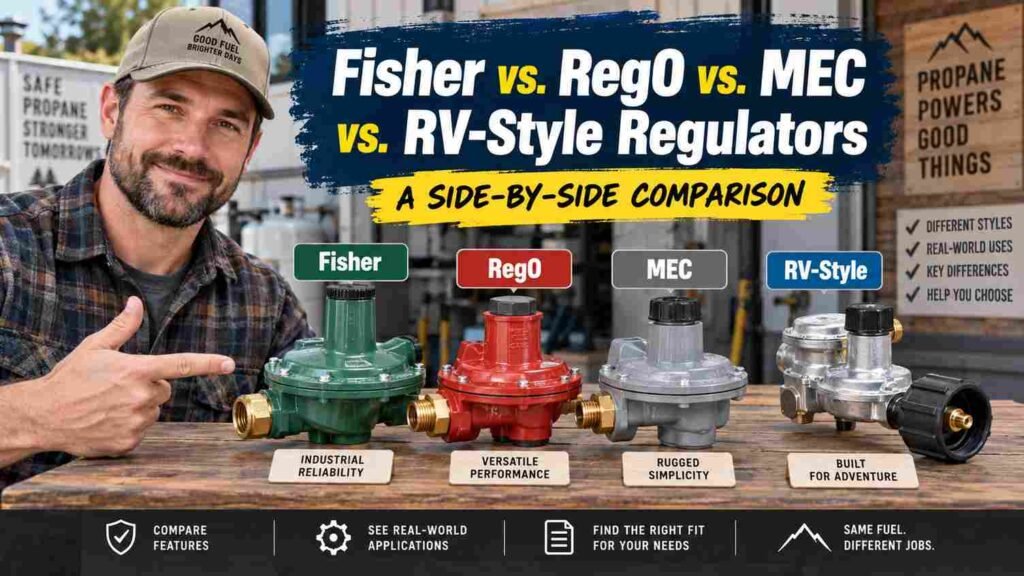
If you are comparing Fisher vs. RegO vs. MEC vs. RV-style propane regulators, I would not choose based only on brand reputation or price. I first ask what the regulator is being asked to do.
A regulator for a 30-foot travel trailer has a very different job from a second-stage regulator feeding a house with a furnace, tankless water heater, range, dryer, and standby generator. Both may deliver around 11 inches water column, but their flow capacities, inlet connections, venting, pressure taps, construction, and intended applications can be very different.
In this guide, I’ll compare the four categories in practical terms: where each one fits, typical capacity ranges, pressure arrangements, serviceability, advantages, limitations, and the situations where I would—or would not—use an RV-style regulator in place of a domestic propane regulator.


First: RV-Style Is a Category, Not a Brand
This is the most important distinction in the comparison.
Fisher, RegO, and Marshall Excelsior (MEC) are manufacturers with multiple propane regulator product families. Each company offers more than one regulator type, including first-stage, second-stage, integral two-stage, 2-PSI, and other specialized models.
By contrast, when people say RV-style regulator, they usually mean a compact regulator designed for portable or recreational LP-gas systems. It may be:
- an integral two-stage regulator;
- an automatic-changeover regulator for two cylinders;
- a regulator with 1/4-inch inverted-flare inlets;
- a 3/8-inch FNPT outlet;
- a compact 11″ w.c. outlet design; or
- a unit specifically marketed for RVs, trailers, cabins, or manufactured homes.
Marshall Excelsior itself makes RV-style regulators, so “MEC vs. RV-style” is not really a brand-versus-brand comparison. MEC is one of the companies that manufactures products in that category.


Fisher vs. RegO vs. MEC vs. RV-Style: Quick Comparison
| Category | Typical Use | Example Capacity | Typical Outlet |
|---|---|---|---|
| Fisher | Domestic, commercial, industrial, high-load systems | R622 up to about 1.4 million BTU/hr depending on configuration and conditions | Common residential models around 11″ w.c. |
| RegO | Domestic, commercial, cylinder, generator and multi-appliance systems | LV4403B example: 935,000 BTU/hr | 11″ w.c. factory setting on common domestic models |
| MEC | Domestic, commercial and recreational LP-gas systems | MEGR-1622-CFF example: 1.3 million BTU/hr | 11″ w.c. on common second-stage domestic models |
| RV-style | RVs, trailers, cabins, dual-cylinder systems | Often about 120,000–350,000 BTU/hr depending on model | Usually about 11″ w.c. |
Those figures are examples from specific current product families, not universal ratings. I always compare the exact model number because capacity varies with inlet pressure, outlet setting, connection size, and allowable droop.
Fisher Propane Regulators: What I Like About Them
Fisher is one of the best-known names in gas-pressure regulation, and its LP-gas product line covers everything from compact residential service to much larger commercial and industrial applications.
For residential second-stage use, the Fisher R600 family is a good example. The R622 is designed for domestic two-stage systems and can be configured for high flow. Emerson lists the R622 family up to around 1.4 million BTU/hr in applicable configurations.
Fisher also offers integral two-stage regulators such as the R632A, which reduces tank pressure directly to approximately 11″ w.c. in one assembly.
Example Fisher Technical Data
| Fisher Example | Application | Approx. Capacity | Outlet |
|---|---|---|---|
| R622 | Second stage | Up to about 1.4 million BTU/hr by configuration | Common 11″ w.c. setting |
| R632A | Integral two-stage | High residential capacity; exact rating depends on configuration | 11″ w.c. |
Fisher emphasizes features such as pressure test ports, internal relief protection on appropriate models, corrosion resistance, and positive drainage. Current Fisher literature also identifies a 20-year recommended replacement life for several domestic regulator families when properly installed and maintained.

If I am working on a conventional two-stage home system or a relatively high-BTU residential load, Fisher gives me a broad range of regulator configurations rather than forcing me into one compact size.
RegO Propane Regulators: Strong Domestic Range and Clear Capacity Classes
RegO also has a very broad LP-gas regulator line, and I find its product families easy to think about in terms of load classes.
For example, RegO’s selection literature shows second-stage regulator classes around 450,000, 935,000, 1.6 million, and 2.3 million BTU/hr. That makes it easy to see how quickly a whole-house system can move beyond the capacity of a small RV-style regulator.
The LV4403B family is a common full-size second-stage example. One current configuration is rated at 935,000 BTU/hr, with a factory delivery pressure of 11″ w.c. at 10 PSIG inlet and an adjustment range of about 9–13″ w.c.


Example RegO Technical Data
| RegO Example | Application | Capacity | Outlet |
|---|---|---|---|
| LV4403B46 | Full-size second stage | 935,000 BTU/hr | 11″ w.c. at 10 PSIG inlet |
| LV404B34 | Compact twin stage | 450,000 BTU/hr | 11″ w.c. |
| LV404B4 family | Integral twin stage | About 525,000 BTU/hr in current catalog data | 11″ w.c. |
RegO’s current catalog also highlights a 25-year Silver Service Life program on applicable domestic regulator families, along with a 10-year warranty on some current models. That is not a reason to ignore inspection or local replacement requirements, but it is useful when comparing manufacturer service-life guidance.
If you want to understand why I compare capacity rather than brand name alone, see What Does BTU Capacity Mean on a Propane Regulator?.
MEC Regulators: One Brand That Spans House Systems and RVs
Marshall Excelsior is interesting in this comparison because it operates in both worlds. MEC makes full-size domestic regulators and compact RV-style regulators.
For high-capacity residential service, MEC’s MEGR-1600-series regulators are comparable in purpose to full-size Fisher and RegO domestic regulators. The MEGR-1622-CFF second-stage model, for example, is listed at about 1.3 million BTU/hr and uses an 11″ w.c. outlet setting.
MEC also offers the MEGR-1632 full-size integral two-stage family. One current configuration is listed around 950,000 BTU/hr, again showing that MEC is not simply an “RV regulator brand.”
Example MEC Technical Data
| MEC Example | Application | Capacity | Outlet |
|---|---|---|---|
| MEGR-1622-CFF | Full-size second stage | 1,300,000 BTU/hr | 11″ w.c. |
| MEGR-1632-CFF | Full-size integral two-stage | 950,000 BTU/hr | 11″ w.c. |
| MEGR-253 | RV-style automatic changeover | 225,000 BTU/hr primary side | 11″ w.c. |
| MEGR-253H | High-capacity automatic changeover | 350,000 BTU/hr primary side | 11″ w.c. |
MEC’s domestic second-stage literature also gives a 25-year recommended replacement life on applicable domestic regulator families. Again, I follow the exact model instructions because service-life guidance can vary by product family and environment.
What I Mean by an RV-Style Regulator
RV-style regulators are designed around compact packaging and portable-cylinder systems.
Typical examples include MEC’s MEGR-291 compact integral two-stage regulators and MEGR-253 automatic-changeover regulators.
The current MEC RV catalog shows:
| RV-Style Example | Capacity at 30 PSI Inlet | Capacity at 100 PSI Inlet | Outlet |
|---|---|---|---|
| MEGR-291 | 175,000 BTU/hr | 195,000 BTU/hr | 11″ w.c. |
| MEGR-291H | 225,000 BTU/hr | 285,000 BTU/hr | 11″ w.c. |
| MEGR-253 automatic changeover | 225,000 BTU/hr primary / 150,000 BTU/hr reserve | 11″ w.c. | |
| MEGR-253H high capacity | 350,000 BTU/hr primary / 200,000 BTU/hr reserve | 11″ w.c. | |
These are very useful capacities for RVs, cabins, trailers, and smaller cylinder-fed systems. But compare those numbers with a 935,000 BTU/hr RegO second-stage regulator, a 1.3-million-BTU/hr MEC second-stage regulator, or a Fisher R622 configuration approaching 1.4 million BTU/hr. That is why I do not treat an RV regulator as automatically interchangeable with a residential house regulator just because both say 11″ w.c.
Can I Use an RV-Style Regulator on a House?
Sometimes a compact two-stage regulator is listed for mobile-home, cottage, cabin, or small domestic service. But I do not use the term “RV regulator” as proof that it is appropriate for a permanent house.
I verify:
- the manufacturer’s listed application;
- total connected BTU load;
- maximum inlet pressure;
- outlet-pressure range;
- connection sizes;
- vent orientation and vent-piping requirements;
- ambient-temperature rating;
- relief design; and
- local code requirements.
A small house with a range and water heater might have a load that falls within some compact two-stage regulator ratings. A large home with a furnace, tankless heater, generator, fireplaces, and dryer can exceed an RV-style regulator very quickly.
If you are specifically considering that swap, see Can I Use an RV Regulator on a House?.
Which Has the Highest Capacity?
There is no meaningful answer at the brand level because all three manufacturers offer multiple regulator sizes.
Instead, I compare model families.
| Example Model | Published Capacity | Type |
|---|---|---|
| MEC MEGR-253 | 225,000 BTU/hr primary | RV automatic changeover |
| RegO LV404B34 | 450,000 BTU/hr | Compact twin stage |
| Fisher R622-BCF example | 875,000 BTU/hr at specified conditions | Second stage |
| RegO LV4403B46 | 935,000 BTU/hr | Second stage |
| MEC MEGR-1622-CFF | 1,300,000 BTU/hr | Second stage |
| Fisher R622 selected configurations | Up to about 1,400,000 BTU/hr | Second stage |
I also remember that those published capacities may be based on different inlet pressures and droop assumptions. I do not compare raw BTU numbers without checking the footnotes and performance curves.
Fisher vs. RegO vs. MEC: Which Is Easier to Service?
All three manufacturers offer professional-grade models with features that make system checks easier, including pressure taps and replaceable or serviceable components on certain regulator families.
For me, the practical difference is usually not “Which brand can be serviced?” but rather:
- Which brand does the propane supplier stock locally?
- Which replacement parts are available?
- Which model has the right inlet and outlet orientation?
- Does the technician already know that regulator family?
- Does the local propane company standardize on one brand?
Standardizing around a commonly stocked regulator can make future replacement and troubleshooting easier.
What About Service Life?
Manufacturer service-life guidance is useful, but I do not treat it as a guarantee that a regulator will remain safe for that entire period under every condition.
| Manufacturer / Family | Current Published Guidance on Applicable Models |
|---|---|
| Fisher domestic R600 families | 20-year recommended replacement life on applicable models |
| RegO domestic regulator families | 25-year Silver Service Life on applicable current models |
| MEC domestic regulator families | 25-year recommended replacement life on applicable models |
| RV-style regulators | Varies by manufacturer and product family; follow the specific instructions |
Exposure to salt air, moisture, flooding, impact, contamination, corrosion, vent blockage, or abnormal operating conditions can justify earlier replacement.
Which Regulator Would I Use for a Standby Generator?
I size the regulator from the generator’s fuel demand and required inlet pressure, not the brand.
A 14-kW or 16-kW generator can consume roughly 265,000–275,000 BTU/hr in some manufacturer examples. That means a standard 175,000 or 225,000 BTU/hr RV-style regulator can be undersized before I even add other appliances.
A 450,000 BTU/hr-class integral two-stage regulator may fit some dedicated generator installations, while a shared whole-house system may require 900,000 BTU/hr or more.
For a detailed worked example, see What Size Propane Regulator Does a Standby Generator Need?.
Which Regulator Would I Use for a Furnace and Water Heater?
Again, I calculate the load first.
If a furnace is 100,000 BTU/hr and a storage water heater is 40,000 BTU/hr, the pair requires at least 140,000 BTU/hr before I add a range, dryer, fireplace, or generator.
That load can fit within many compact regulators, but I still prefer to size the entire house system rather than only those two appliances. If a tankless water heater is 199,000 BTU/hr, the combined load grows much faster.
You can see the full calculation in What Regulator Do I Need for a Furnace and Water Heater?.
Are Fisher, RegO, and MEC Regulators Interchangeable?
Not automatically.
I do not replace a Fisher with a RegO, a RegO with an MEC, or any of them with an RV regulator solely because the outlet pressure says 11″ w.c.
I match:
- regulator type;
- maximum inlet pressure;
- outlet setting and adjustment range;
- BTU capacity at the relevant conditions;
- connection sizes;
- body orientation;
- vent location;
- relief characteristics;
- listed application; and
- installation requirements.
That is also why I do not consider propane regulators universally interchangeable. For more detail, see Why Propane Regulators Are Not Universal.
My Practical Selection Guide
| If I Am Sizing… | What I Usually Compare First |
|---|---|
| RV with two cylinders | RV-listed automatic changeover, adequate BTU capacity, correct 11″ w.c. output |
| Small cabin | Total BTU load and whether compact integral two-stage use is listed |
| Typical house | Full-size or appropriately rated integral/second-stage domestic regulator |
| House with tankless water heater + generator | High-capacity domestic second-stage regulator and total connected load |
| Long underground run | Two-stage or 2-PSI system design, pressure drop and line sizing |
| Replacement regulator | Exact pressure, capacity, vent, connection and application match—not brand alone |
Frequently Asked Questions
Is RegO better than Fisher?
I would not make the decision that way. Both companies make professional LP-gas regulators in multiple pressure and capacity classes. I compare the exact model that fits the system, along with local availability and service support.
Is MEC only for RVs?
No. MEC makes RV automatic-changeover regulators, but it also makes high-capacity domestic second-stage and integral two-stage regulators with capacities around one million BTU/hr or more.
Can an RV regulator supply a whole house?
Only if the exact regulator is listed for the application and its capacity, pressure characteristics, connections, and venting meet the system requirements. Many RV-style regulators are far too small for a modern high-load house.
Why can two 11-inch WC regulators have very different capacities?
Outlet pressure is only one specification. Orifice size, diaphragm size, inlet pressure, body design, port size, and allowable droop all affect how much gas a regulator can deliver.
Should I buy the regulator with the highest BTU rating?
No. I choose a regulator that matches the system type and can maintain the correct pressure at the required load. Bigger is not automatically better if the regulator is the wrong stage, wrong pressure range, wrong vent configuration, or wrong application.
Bottom Line
When I compare Fisher vs. RegO vs. MEC vs. RV-style regulators, I see three established manufacturers plus one application category—not four equivalent brands.
Fisher, RegO, and MEC all offer legitimate high-capacity domestic regulator families. Depending on model and operating conditions, their second-stage regulators can range from several hundred thousand BTU/hr to well over one million BTU/hr.
RV-style regulators are often compact integral two-stage or automatic-changeover designs in roughly the 120,000–350,000 BTU/hr range. They are excellent when used for the application they were designed for, but they are not automatically suitable replacements for larger house regulators.
My rule is simple: I calculate the total propane load first, confirm the required inlet and outlet pressures, then choose the regulator model whose actual performance, connections, venting, and application listing fit the system. Brand comes after those requirements—not before them.
If the regulator serves a permanent house, generator, furnace, or other high-load equipment, I recommend having the final selection and installation verified by a qualified propane technician. For installation considerations, see Can I Install a Propane Regulator Myself, or Do I Need a Professional?.
Technical References

Mike is an experienced propane technician with over 15 years of professional experience in the field. He has dedicated his career to helping customers with their propane needs, from installation to maintenance and repair. Together with Jeremy, he co-founded this website to provide useful information and guidance to customers seeking reliable propane services.


