Is Butane Bad for the Environment? My Short Answer
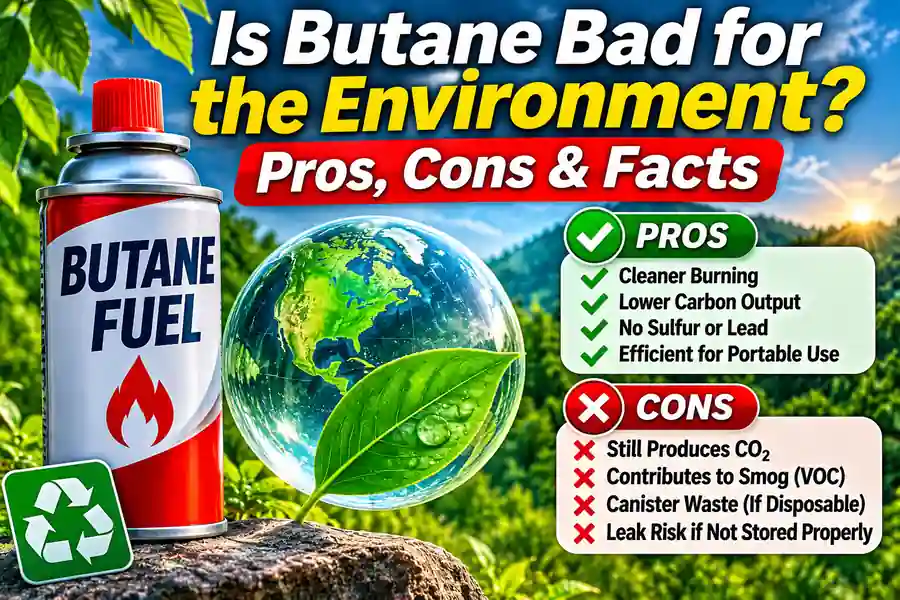
Yes, butane has environmental costs. It is a hydrocarbon used as a cooking fuel, lighter fuel, torch fuel and chemical feedstock. Most commercial butane comes from natural gas processing and petroleum refining. Those supply chains have extraction, processing, transport and refining impacts. Once butane is burned, its carbon becomes carbon dioxide. If released without burning, it can contribute to air-pollution chemistry.
At the same time, environmental harm cannot be judged solely by the name of a fuel. An efficiently used small butane stove that prepares one necessary meal may consume comparatively little fuel; a poorly maintained, continuously operating burner could consume far more. The competing energy source, electricity generation mix, equipment lifetime and packaging all affect the actual comparison.
I prefer to break the question into six separate parts: climate impact, local air quality, leaks, extraction and processing, container waste, and fuel efficiency. That approach helps prevent the common mistake of calling a fuel “green” because its flame looks blue, or labeling every use equally harmful without considering the work performed.


What Is Butane, and Where Does It Come From?
Butane is a combustible hydrocarbon with the molecular formula C₄H₁₀. Normal butane and isobutane have the same formula but different molecular structures. Normal butane boils near 31°F (−0.5°C) at standard atmospheric pressure, while isobutane boils near 11°F (−11.7°C). This matters to users of camping cartridges because it affects vapor pressure and performance in cold conditions.
Commercial supplies can be separated and processed from natural gas liquids or refinery streams. The environmental footprint begins before the retail can reaches the store: energy is required to operate facilities, transport fuel, manufacture metal packaging and deliver the finished product. A purchase that seems small and convenient may still have a chain of upstream emissions behind it.
| Property | Approximate value | Why it matters environmentally |
|---|---|---|
| Molecular formula | C₄H₁₀ | Contains fossil carbon that becomes CO₂ during combustion |
| Molecular mass | 58.12 g/mol | Used in carbon-emissions calculations |
| Normal butane boiling point | 31°F / −0.5°C | Affects stove output and fuel choice |
| Combustion energy (lower heating value) | About 45–46 MJ/kg | Useful for per-unit-energy comparisons |
| CO₂ from complete combustion | About 3.03 kg/kg | Direct fuel-use climate impact |
| Typical retail formats | Refill cans and disposable cartridges | Adds packaging and disposal impacts |
These values describe approximately pure butane. Retail “butane” products may contain isobutane, propane or other permitted components, so a specific fuel mix and manufacturer specification can alter performance and calculation assumptions. I would always distinguish net fuel mass from the total weight of the metal container.
How Much CO₂ Does Burning Butane Produce?
This is the most measurable part of the topic. Complete combustion of butane follows the idealized reaction 2 C₄H₁₀ + 13 O₂ → 8 CO₂ + 10 H₂O. Each mole of butane contains four carbon atoms; complete oxidation forms four moles of carbon dioxide. Dividing the mass of those four CO₂ molecules by the mass of one butane molecule gives roughly 176.04 ÷ 58.12 = 3.03.


In other words, burning one kilogram of pure butane produces around three kilograms of CO₂. The carbon combines with oxygen taken from the air, which explains why the mass of carbon dioxide exceeds the starting mass of fuel. This is a chemical mass-balance estimate, not a full life-cycle carbon footprint.
| Butane burned | Theoretical CO₂ released | Approximate direct combustion energy |
|---|---|---|
| 50 g | 0.152 kg | 2.3 MJ |
| 100 g | 0.303 kg | 4.6 MJ |
| 220 g | 0.667 kg | 10.1 MJ |
| 230 g | 0.697 kg | 10.6 MJ |
| 450 g | 1.364 kg | 20.7 MJ |
| 1 kg | 3.03 kg | 46 MJ |
| 5 kg | 15.15 kg | 230 MJ |
The energy column assumes a 46 MJ/kg lower heating value for easy comparison and is not the amount of heat a pot actually absorbs. Stove heat-transfer losses, wind, burner settings and cookware can change useful energy greatly. Government inventories also provide official butane emission factors on energy or volume bases; those may differ slightly because of fuel characteristics and reporting conventions.
What happens over a month or a year?
I would estimate usage from the actual net grams consumed rather than counting how many cans are purchased. A family using four 220 g cartridges in a month burns 880 g of butane, corresponding to about 2.67 kg of direct CO₂ emissions. Repeating that monthly would mean about 32 kg of direct CO₂ over twelve months, excluding extraction, packaging and transportation.
| Illustrative use pattern | Butane burned per month | Monthly direct CO₂ | Annual direct CO₂ |
|---|---|---|---|
| One 220 g cartridge | 0.22 kg | 0.67 kg | 8.0 kg |
| Four 220 g cartridges | 0.88 kg | 2.67 kg | 32.0 kg |
| Eight 220 g cartridges | 1.76 kg | 5.33 kg | 64.0 kg |
| Twelve 220 g cartridges | 2.64 kg | 8.00 kg | 96.0 kg |
These figures are examples for readers to customize, not typical household consumption estimates. A single cartridge can last different amounts of time depending on the stove and flame setting. The key point is that more fuel burned means more direct CO₂, irrespective of whether the flame produces visible smoke.
Does Butane Cause Global Warming?
Burning butane contributes to global warming primarily through CO₂ emissions. Carbon dioxide is a long-lived greenhouse gas, so even a stove that burns efficiently still produces climate-relevant emissions. Combustion can also produce smaller amounts of methane and nitrous oxide, depending on conditions, although those should be evaluated with suitable emission factors rather than guessed for a household burner.



Unburned butane is not equivalent to methane. Its atmospheric behavior, chemical reactivity and lifetime differ. I would not assign butane methane’s 100-year global-warming-potential number. Released butane can participate in atmospheric reactions that form ozone, which itself affects air quality and climate. Whether a specific release leads to substantial ozone depends on local sunlight, nitrogen oxides, weather and other pollutants.
The distinction matters because a misleading article might suggest that butane’s sole environmental impact is carbon dioxide after combustion. My practical advice is to prevent both unnecessary burning and leaks instead of treating venting the gas as an acceptable way to avoid CO₂.
Butane and Air Pollution: Is It a Clean-Burning Fuel?
Butane can burn with relatively little visible soot in properly designed equipment, especially compared with fuels or operating conditions that produce smoky combustion. This is a useful attribute for some portable appliances, but it does not make exhaust safe to breathe. A blue flame is not an emissions certificate, and incomplete combustion can still produce carbon monoxide or other pollutants.
Local air pollution depends on burner design, airflow, contaminants, maintenance and the location of use. A small camping stove burning cleanly outdoors is a very different exposure situation from the same stove operating in a small room. I would never recommend using an outdoor-rated portable butane stove indoors, even during a blackout or a storm.


| Potential emission | How it may arise | Why it matters |
|---|---|---|
| Carbon dioxide (CO₂) | Combustion of butane’s carbon | Contributes to climate change |
| Carbon monoxide (CO) | Incomplete combustion | Dangerous to people, especially in confined spaces |
| Nitrogen oxides (NOₓ) | High-temperature flame chemistry | Can contribute to local air pollution and ozone formation |
| Unburned hydrocarbons | Leaks, imperfect combustion, fuel handling | Can participate in atmospheric ozone formation |
| Particulate matter or soot | Poor combustion, contaminated flame, nearby materials | Can harm local air quality |
| Water vapor | Normal combustion product | Not evidence of a pollution-free fuel |
For generators, the indoor-combustion warning is especially important. My article Can You Run a Propane Generator Indoors? discusses a different machine with much larger exhaust output. The underlying lesson is consistent: equipment designed for outdoor combustion does not become safe indoors because the fuel is marketed as clean-burning.
Does Leaked Butane Damage the Environment?
A leaking cartridge has both immediate safety and environmental implications. Butane is highly flammable and heavier than air, so a release can accumulate in low-lying spaces and reach an ignition source. From an environmental perspective, releasing unburned hydrocarbons means fuel enters the atmosphere without providing any useful service. Butane and related reactive organic gases can contribute to ground-level ozone formation under favorable chemical conditions.
The U.S. Environmental Protection Agency classifies butane among very volatile organic compounds in an indoor-air context; terminology and regulatory VOC definitions vary by jurisdiction. I would not reduce the issue to a one-word label. What matters is the molecule’s rapid evaporation and its role in atmospheric chemistry, alongside the obvious fire and exposure risks.
If I suspect a leaking canister, my priority is not to calculate its climate impact. I would stop using the equipment, avoid flames and sparks, move people away from the affected area and follow the manufacturer’s emergency instructions. Do not deliberately release gas to ’empty’ a container for recycling, or try to repair a damaged valve.
Small leaks versus large releases
There is no universal safe amount of butane to leak. Even a modest release in an unsuitable enclosed space can be hazardous because of ignition risks. In open air, dispersion conditions vary with weather and terrain. Rather than present an invented acceptable leak rate, I would recommend checking seals, using approved connections and replacing damaged equipment.
Related fuel-leak prevention principles appear in Propane Generator Leaks: How to Detect and Prevent Them. That guide is about propane generator systems, not an instruction to apply generator fittings to butane cartridges.
Is Butane Worse for the Environment Than Propane?
Both are fossil-derived fuels and both emit CO₂ when burned. Propane’s chemical formula is C₃H₈ and butane’s is C₄H₁₀. Propane produces roughly 3.00 kg CO₂ per kilogram of pure fuel, while butane produces about 3.03 kg per kilogram. The difference by mass is small. What often matters more to the user is how many megajoules of useful heat the appliance transfers for a particular task.
| Metric | Butane (approx.) | Propane (approx.) | Comparison note |
|---|---|---|---|
| Formula | C₄H₁₀ | C₃H₈ | Both are hydrocarbons |
| Lower heating value | 45–46 MJ/kg | 46–46.5 MJ/kg | Similar energy per kilogram |
| Complete-combustion CO₂ | 3.03 kg/kg | 3.00 kg/kg | Small difference by mass |
| CO₂ per MJ of fuel LHV | 65.9 g/MJ at 46 MJ/kg | About 65 g/MJ at 46.2 MJ/kg | Assumptions and reporting basis matter |
| Typical container use | Refills and small cartridges | Small cylinders and bulk tanks | Packaging and handling differ |
| Cold-weather vaporization | Poor near 31°F boiling point | Much better at low temperatures | Use only approved fuel system |
A crucial caveat: regulatory emissions tables can give different factors per unit of energy because they use higher heating value rather than lower heating value, or assume different fuel characteristics. Never mix those accounting bases in the same comparison. The values above are simplified chemistry-and-LHV estimates, not certified emissions ratings for a specific burner.
If you are choosing between fuel systems for electricity rather than cooking, compare generator output and consumption, not only gas chemistry. My guide to propane generators versus natural gas shows how the equipment and fuel supply affect that decision.
What About Butane Versus Electric Cooking?
Electric cooking avoids combustion at the appliance, which can improve indoor air quality. But climate impact depends on where the electricity comes from, what technology cooks the food and how effectively the heat enters the cookware. A high-efficiency induction cooktop powered by low-carbon electricity may have a much smaller climate footprint for a meal than a butane burner. A resistance stove powered by a carbon-intensive grid requires more careful comparison.
I would evaluate energy delivered to food rather than compare a canister’s heating value directly with a household electricity bill. A butane stove may lose heat around the pot, while induction transfers energy directly into compatible cookware. The environmental answer becomes a whole-system calculation involving fuel production, generation losses, heat-transfer efficiency and appliance life.
A simple meal-energy example
Suppose a cooking task requires 1.0 MJ of useful heat at the pot. If a butane stove delivers 40% of the fuel energy into the pot, it needs 2.5 MJ of fuel, or about 54 g of butane at 46 MJ/kg. That fuel releases roughly 164 g of CO₂ directly. If an induction system uses 85% of its input energy for the same pot, it needs about 0.327 kWh of electricity. Its climate impact then depends on the grid’s emissions factor.
| Illustrative electricity source | Grid factor | 0.327 kWh electricity emissions | Compared with 164 g direct CO₂ from butane |
|---|---|---|---|
| Low-carbon grid example | 0.10 kg CO₂/kWh | 33 g | Lower operational CO₂ in this example |
| Mixed grid example | 0.40 kg CO₂/kWh | 131 g | Lower operational CO₂ in this example |
| Carbon-intensive grid example | 0.80 kg CO₂/kWh | 262 g | Higher operational CO₂ in this example |
Every number in this comparison is an assumption for teaching the method; it is not a measured claim about a specific city or stove. The butane calculation excludes upstream emissions, and the electricity calculation excludes infrastructure and upstream generation emissions beyond the chosen grid factor. My conclusion is not that one technology always wins, but that usable heat and local power mix determine the outcome.
What Is the Environmental Cost of Disposable Butane Canisters?
The fuel is only part of the story. Disposable cartridges require metal, valves, caps, printing, packaging and transportation. A small canister may use proportionally more packaging material per kilogram of fuel than bulk delivery systems. But I would avoid making sweeping claims without knowing the actual container’s materials, recycling recovery and transport distance.
Aerosol and fuel containers can remain hazardous even when they look empty. Rules differ by locality and container design. Some waste programs accept properly empty containers through designated channels, while others require hazardous-waste drop-off. I would never puncture, crush, burn or casually discard a canister containing residual gas.
| Canister life stage | Possible environmental impact | Practical improvement |
|---|---|---|
| Metal production | Energy use and raw-material extraction | Choose appropriate package sizes; avoid needless purchases |
| Fuel filling and sealing | Facility energy and potential losses | Buy reputable products with good quality control |
| Retail distribution | Transportation and packaging | Purchase reasonable quantities from suitable suppliers |
| Consumer use | CO₂ emissions and possible leaks | Avoid unnecessary burn time and maintain equipment |
| End of life | Waste and residual flammable contents | Follow manufacturer and local waste requirements |
I would not call a refill aerosol a zero-waste option either. It still becomes an empty pressurized supply can after use. What gets reused is the lighter, soldering iron or torch reservoir. The best comparison includes how long that device lasts and how much packaging it displaces over its actual service life.
Are Refillable Butane Devices More Eco-Friendly?
They can reduce the number of complete lighters or torches discarded, provided the device is truly designed for repeated refilling and lasts long enough. The environmental case is less clear if the refillable appliance fails quickly, develops a leaky valve or requires many small aerosols with substantial packaging. I would rather buy one durable, repairable tool and refill it responsibly than repeatedly replace a complete disposable product.
This does not mean single-use stove cartridges should be refilled at home. A disposable cartridge may have a self-sealing valve, but it is still not approved as a refillable pressure vessel. Never use aftermarket transfer adapters to top up a single-use container. The risks of overfilling, incompatible mixtures and damaged valves outweigh any claimed waste savings.
I look for three practical indicators: a device explicitly certified for the intended refill process, access to manufacturer-approved fuel and a realistic lifetime over which the equipment can serve its purpose. Those are more credible environmental indicators than a generic recycling symbol printed on a package.
Is Butane Biodegradable or Environmentally Persistent?
Butane is a volatile gas under ordinary conditions, so it behaves differently from plastic waste or spilled heavy oil. In the atmosphere, it participates in chemical reactions, principally with hydroxyl radicals, rather than remaining unchanged forever. That does not make emissions harmless: the reactions can contribute to atmospheric pollution, including ozone formation depending on conditions.
In environmental risk assessments, toxicity to organisms, environmental persistence, flammability, greenhouse-gas emissions and ozone chemistry are distinct questions. A substance may present relatively low direct ecosystem toxicity under assessed exposure conditions while still creating a carbon footprint when burned. I would keep those conclusions separate rather than call butane either ‘poison to the planet’ or ‘safe for nature.’
How Butane Extraction, Refining and Shipping Affect the Footprint
Upstream impacts depend on the source of the natural gas or crude oil, how hydrocarbons are separated, processing energy, methane management at production facilities and transportation. Refining and fractionation use industrial equipment and energy. I would not invent a fixed upstream percentage for every cartridge because supply chains vary across countries and producers.
The environmental balance can also change when butane is produced as a co-product alongside other petroleum and natural-gas products. Allocating shared upstream emissions among co-products requires a defensible life-cycle assessment method. Consumers rarely have enough information to calculate that accurately from the retail label alone.
What I can advise reliably is to reduce avoidable consumption and choose appropriately sized containers. A slightly cheaper imported multipack is not necessarily environmentally preferable to a suitable nearby product if it leads to excess unused fuel or unnecessary storage.
Seven Practical Ways I Would Reduce My Butane Footprint
1. Use only as much burner time as a task requires
A lid, suitable pan size and a protected outdoor cooking location—within the stove’s instructions—can reduce wasted heat. I would plan ingredients and cooking steps before lighting the burner so it does not sit burning while I prepare everything else. Never place an unsafe homemade windshield around a cassette stove’s cartridge compartment.
2. Prevent leaking valves and mismatched connections
I inspect for obvious damage, use only the specified cartridge and stop if I hear hissing or smell escaping gas. I would not attempt pressure-vessel repairs. Safe connections reduce both immediate fire hazards and avoidable unburned-gas emissions.
3. Choose a durable appliance
A long-lived torch or stove may reduce the frequency of replacing the entire device. I look for manufacturer support, replaceable components and proper safety approvals rather than buying by price alone. A cheap unit discarded every few months creates material waste that a product comparison should count.
4. Avoid inappropriate bulk purchasing
I buy a sensible amount that I can store under the manufacturer’s conditions. Buying too much pressurized gas increases storage complexity, and unused or damaged cartridges can eventually become waste. This is especially important where local disposal options are limited.
5. Consider electric alternatives when practical
For frequent indoor cooking, a suitable electric appliance can avoid fuel combustion in the room. I would compare local electricity generation, appliance efficiency and costs. During outages, I would prioritize no-cook foods, safe outdoor cooking or appropriate backup power rather than operating an outdoor stove inside.
6. Follow legitimate recycling and disposal rules
I check my local waste authority and the manufacturer’s guidance for the exact canister type. I do not vent residual fuel, puncture cans or assume curbside metal recycling accepts pressurized vessels. Disposal methods differ enough that one universal instruction would be misleading.
7. Compare the entire system, not just fuel chemistry
I ask how much useful heat or power the equipment provides per unit of consumed fuel. For larger backup-energy systems, generator refill frequency and runtime matter, as do installation and efficiency. Butane stoves should not be compared to generators as if both deliver the same service.
My Environmental Decision Matrix: What Matters Most?
I use a simple ranking system when advising readers about small portable fuels. It is not a standardized certification; it is my editorial framework for prioritizing meaningful actions. A fuel source earns fewer environmental advantages when it leaks, wastes heat, requires frequent replacement or cannot be disposed of responsibly.
| Decision factor | Lower-impact tendency | Higher-impact tendency | My priority |
|---|---|---|---|
| Fuel consumption | Efficient task completion | Long idle burn times | High |
| Combustion location | Approved outdoor use for outdoor equipment | Misuse inside enclosed spaces | Critical safety |
| Leak prevention | Sound valves and matched canisters | Damaged fittings and improvised adapters | High |
| Packaging | Appropriate size, responsibly managed waste | Excess small disposable packaging | Medium |
| Appliance lifetime | Durable and serviceable | Frequently replaced | Medium |
| Alternative energy | Low-carbon electricity when suitable | Inefficient high-carbon input | Context-dependent |
The most valuable part of this framework is avoiding false precision. I can calculate CO₂ from fuel mass with reasonable confidence, but I cannot determine a brand’s full environmental impact without life-cycle data. Consumers deserve to know which numbers are chemistry and which claims depend on manufacturing and end-of-life assumptions.
What About Using Butane During Power Outages?
A small butane stove may be useful for a short emergency when conditions allow safe outdoor cooking. That is not the same as saying it is the environmentally best way to supply a household’s energy. Butane stoves provide heat directly; they do not power refrigeration, lighting or medical equipment. For prolonged outages, an integrated plan with safe food storage, battery lighting, and appropriate backup power is more effective.
If your concern is keeping food cold, the article Can a Propane Generator Run a Refrigerator and Freezer? covers electrical backup requirements. In either case, I would choose the smallest sensible energy demand rather than oversizing fuel use out of habit.
Frequently Asked Questions
Is butane a greenhouse gas?
Unburned butane is a reactive atmospheric hydrocarbon, but it should not automatically be assigned the same greenhouse-gas factor as methane. Its most straightforward climate impact occurs when it burns and releases CO₂. Leaks also matter because of air-pollution chemistry.
How much CO₂ does a 220 g butane canister release?
If all 220 g consists of pure butane and burns completely, the direct carbon dioxide release is approximately 0.67 kg. The metal container’s manufacturing, distribution and disposal emissions are additional and are not included.
Is butane cleaner than charcoal?
For certain pollutants and stove conditions, butane combustion can generate less visible soot than charcoal cooking. But that does not settle the full climate or life-cycle comparison. Charcoal sourcing, stove efficiency, production methods, emissions and application all matter.
Does butane destroy the ozone layer?
Butane is not a classic ozone-depleting chlorofluorocarbon. However, released reactive hydrocarbons can help form harmful ground-level ozone under certain atmospheric conditions. Stratospheric ozone depletion and ground-level ozone pollution are different environmental issues.
Is butane renewable?
Most commercial butane is produced from fossil natural gas and petroleum streams, so ordinary retail butane is not a renewable fuel. A product would require credible feedstock and sustainability documentation before I would treat a claimed alternative origin differently.
Are butane canisters recyclable?
That depends on the canister, remaining fuel and local rules. Some programs accept properly empty metal cartridges while others direct them to specialized collection. Do not vent, puncture or crush a fuel canister to make it fit recycling guidance.
Is a blue butane flame pollution-free?
No. A blue flame generally suggests a particular combustion condition, not zero emissions. Burning hydrocarbon fuel still generates carbon dioxide, and poor combustion or equipment faults can create carbon monoxide or other pollutants.
Is it better to let unused butane escape rather than burn it?
No. Deliberate venting creates flammable-gas and air-pollution hazards. If you have an unwanted or damaged pressurized container, contact the manufacturer or local hazardous-waste service for appropriate handling.
Final Verdict: Is Butane Environmentally Friendly?
My answer is that butane is a useful but fossil-derived fuel with unavoidable environmental tradeoffs. It is not carbon neutral, and even complete combustion creates substantial CO₂ relative to the mass of fuel. Unburned releases, inefficient use, upstream production and disposable containers add other impacts that a ‘clean-burning’ label does not capture.
I do not think the best decision is automatically to ban every portable butane appliance or to assume it is greener than all alternatives. The better decision is to match the energy source to the job, use it efficiently, prioritize equipment safety and choose lower-carbon alternatives where they genuinely fit. For consumers, the clearest immediate actions are to reduce burn time, prevent leaks, store fuel correctly and dispose of containers through approved channels.
If you are comparing options for household or backup electricity, a butane canister is not a direct replacement for a generator. Our guide to the downsides of using a propane generator considers tradeoffs at a different energy scale. That distinction is the foundation of a sound environmental comparison: measure the useful service delivered, not just the fuel label.

Mike is an experienced propane technician with over 15 years of professional experience in the field. He has dedicated his career to helping customers with their propane needs, from installation to maintenance and repair. Together with Jeremy, he co-founded this website to provide useful information and guidance to customers seeking reliable propane services.