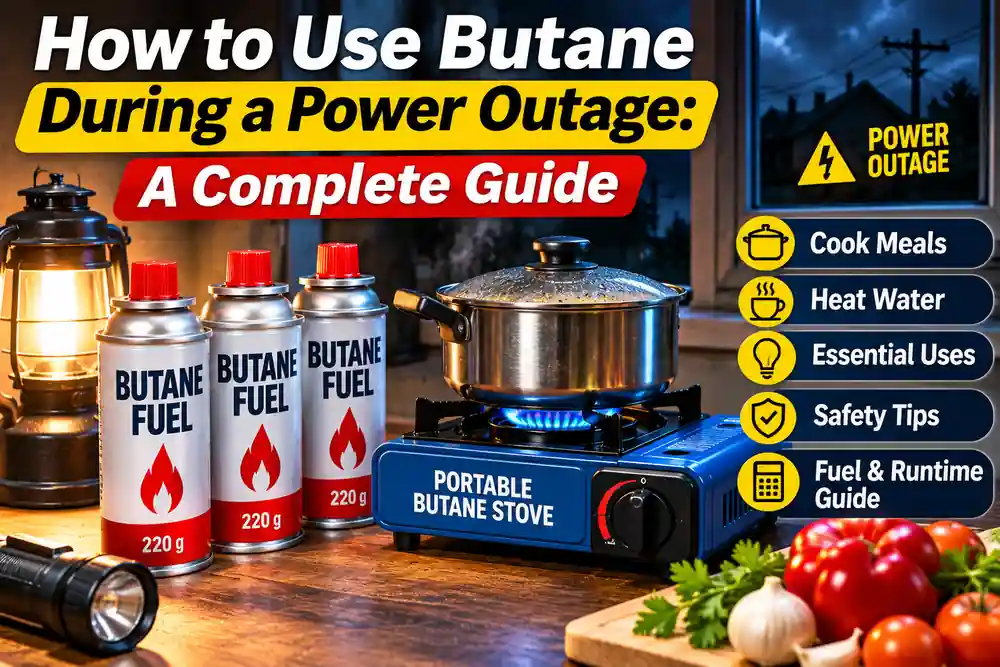
Can You Use Butane During a Power Outage?
Yes, but only for a limited set of practical tasks. In a blackout, I think of butane as a compact heat source, not a substitute for the electrical grid. A compatible portable stove can heat food or water where outdoor cooking is safe. A refillable butane torch might serve a specialist task, but a flame is not a light, refrigerator or phone charger.
The main advantage is independence from mains electricity. You do not need a live outlet for a manually ignited or self-igniting butane stove. The disadvantages are equally important: combustion produces exhaust gases, fuel supplies are finite and pressure declines in cold weather. Portable cooking devices also have strict limits on where and how you can operate them.
I would not make butane my only emergency cooking plan. If a storm makes the outdoors unsafe, you need ready-to-eat food that requires no flame. If the outage threatens critical medications or medical equipment, prioritize an appropriate emergency shelter or reliable medical-grade backup power; a stove does nothing for those loads.


What Butane Can—and Cannot—Do
| Outage need | Can butane help? | My recommended approach |
|---|---|---|
| Cooking a basic meal | Yes, with an approved outdoor stove | Use a matching canister and cook outdoors |
| Heating water | Yes, with an appropriate outdoor burner | Keep hot water away from children and combustibles |
| Charging a phone | No, not from a standard stove | Use charged power banks or a rated power station |
| Keeping refrigerated food cold | No | Use ice, coolers or an appropriate electrical backup |
| Room heating | Do not use a camping stove for this | Seek a safe heated location or certified heating solution |
| Lighting | A flame is technically light, but inappropriate as primary lighting | Use LED battery lanterns |
| Running household appliances | No | Consider a properly installed generator or power station |
When electricity is the actual problem, I prefer separating the tasks. My article on whether a portable propane generator can power a home during an outage covers electrical loads. A butane cooking stove and a propane generator solve different problems, and neither should be operated in an enclosed space.
The First Rule: Where Can You Safely Use a Butane Stove?
My default is straightforward: use a portable camping or cassette butane stove outdoors in a stable, well-ventilated location specifically permitted by the manufacturer’s directions, local fire restrictions and weather conditions. Health Canada advises that portable butane stoves should never be used indoors or in confined spaces; public-health guidance likewise warns against using portable camping stoves in homes, tents and campers because combustion can generate carbon monoxide.
I would not treat an open window, a kitchen exhaust fan or a carbon monoxide alarm as permission to use an outdoor-rated stove inside. A garage with its door open is not automatically a safe cooking location. Likewise, a covered porch can trap fumes or expose building materials to heat. Keep cooking well clear of doors, windows, vents and combustible structures, following the manufacturer’s location and clearance requirements.
If high winds, wildfire smoke, flooding or lightning make outdoor operation dangerous, put the stove away. A cold shelf-stable meal is safer than forcing an outdoor burner into a bedroom. If you or anyone nearby develops headache, dizziness, weakness, nausea or confusion while fuel equipment is operating, stop exposure immediately, move to fresh air and seek emergency medical advice.


How carbon monoxide changes the decision
Carbon monoxide has no reliable smell or color. It can form when combustion is incomplete, including when gas appliances are misused or poorly ventilated. A battery-operated carbon monoxide alarm is useful for household preparedness, but it is not a substitute for the rule against indoor camping-stove use. For related combustion risks, see Can You Run a Propane Generator Indoors?.
Choosing the Right Butane Stove and Canister
Before a blackout, I would match the stove to its fuel rather than shop by the cheapest available canister. One common option is a portable cassette stove accepting a specific approximately 220 g bayonet-style butane cartridge. Another is a backpacking burner designed for a matching threaded cartridge, sometimes containing an isobutane–propane blend. Their connectors and pressure characteristics are not interchangeable.
Read the appliance’s model-specific fuel list and look for approval markings. I would reject generic adapters and improvised refilling schemes outright. A cartridge may have a valve that closes when disconnected, yet still be manufactured as a single-use container. Do not refill that cartridge from another fuel vessel, even if a retailer sells a transfer nozzle.
| System | Typical fuel package | Why people choose it | Main limitation |
|---|---|---|---|
| Cassette-type portable butane stove | About 220 g cartridge, model-dependent | Compact, straightforward cooking platform | Cartridge positioning and pan clearance are critical |
| Threaded backpacking stove | Often 110 g, 230 g or 450 g fuel cartridge | Compact outdoor travel setup | Thread and fuel blend must be approved |
| Refillable butane microtorch | Approved lighter-grade refill aerosol | Useful for specialized small heating tasks | Not an appropriate general cooking burner |
| Battery power station plus electric kettle | Battery energy in Wh, not fuel grams | No combustion at point of use | High heating power drains batteries rapidly |
I pay particular attention to cookware size. Portable cassette stoves can overheat their own fuel compartment if a large pan reflects heat over the cartridge area. Health Canada recommends only pans that fit the grate, correct grate orientation, ample airflow, and never placing multiple stoves beside each other. I would never surround the stove with a homemade wind screen unless its instructions specifically allow that arrangement.
How Long Will One 220 g Butane Canister Last?
Runtime is best estimated from fuel mass and actual consumption, not only from the number of people eating. The simple calculation is runtime in hours = usable grams of fuel ÷ consumption in grams per hour. Different flame settings, winds, temperatures, cookware and simmering times change how fast fuel is burned.



For example, if a stove hypothetically burns 100 g/hour at a given setting, a 220 g cartridge gives 220 ÷ 100 = 2.2 hours of burner time. At 60 g/hour it would last about 3.7 hours; at 120 g/hour, about 1.8 hours. Those examples are not guaranteed runtimes for any particular model. Some gas may also become difficult to use as a cartridge cools or nears depletion.
| Hypothetical burn rate | 220 g cartridge | Two cartridges (440 g) | Four cartridges (880 g) |
|---|---|---|---|
| 40 g/hour | 5.5 h | 11.0 h | 22.0 h |
| 60 g/hour | 3.7 h | 7.3 h | 14.7 h |
| 80 g/hour | 2.8 h | 5.5 h | 11.0 h |
| 100 g/hour | 2.2 h | 4.4 h | 8.8 h |
| 120 g/hour | 1.8 h | 3.7 h | 7.3 h |
I would use the model’s stated fuel consumption when available, then add a modest contingency. Keep the numbers honest: the table describes burner hours, not hours of electrical backup and not the total number of meals. For wider fuel-planning principles, our guide on how often a propane generator needs refilling applies consumption-based planning to a different appliance.
How Many Butane Canisters Do You Need for a Three-Day Outage?
I plan meals first and cartridges second. Rather than assume every breakfast, lunch and dinner needs a burner, I build a menu around shelf-stable items. This cuts fuel demand and reduces the time a flame must be supervised. For a household with no safe outdoor cooking space, the correct answer is not ‘buy more canisters’—it is to plan no-cook food and alternative safe cooking access.
Here is an illustrative calculation for a household using a compatible 220 g cartridge stove outdoors. Assume 20 minutes of actual burner operation daily at 100 g/hour. Daily consumption is 100 × (20 ÷ 60), or 33.3 g. Over three days, that is about 100 g, so one full cartridge may appear sufficient on paper. I would still account for start-up, variable output, unexpected delays and a potential unusable remainder.


| Illustrative daily burner use | Rate assumed | Fuel for 3 days | 220 g cartridges theoretically required |
|---|---|---|---|
| 20 min/day | 100 g/h | 100 g | 1 |
| 40 min/day | 100 g/h | 200 g | 1 |
| 60 min/day | 100 g/h | 300 g | 2 |
| 90 min/day | 100 g/h | 450 g | 3 |
| 60 min/day | 120 g/h | 360 g | 2 |
The cartridge quantities are mathematical ceilings rounded upward, not storage recommendations. They omit fuel-transfer losses, weather and manufacturer restrictions. I would purchase only a quantity I can store safely, and I would test my real meal preparation time under ordinary outdoor conditions before an emergency—not during the blackout when everything else is already stressful.
A practical three-day meal rotation
For day one, I would use shelf-stable breakfast foods and reserve the burner for one hot meal if conditions permit. On day two, I would make a one-pot dish using ingredients that do not require refrigeration, keeping cooking time short. On day three, I would plan a no-cook alternative in case rain or wind rules out operating the stove. This rotation is a planning example, not a nutritional prescription.
Can Butane Boil Water When the Electricity Goes Out?
Yes, a suitable outdoor butane stove can heat a pot of water. But do not confuse boiling water for a hot drink with making contaminated water safe. If the local water authority issues a boil-water advisory, follow that advisory’s exact treatment instructions and use safe equipment. If flooding has contaminated the supply with chemicals or fuel, boiling does not make that contamination disappear.
I would set aside potable stored water before any storm rather than depend on fuel to treat all drinking water. Heat also requires time and a safe vessel. Trying to boil a large pot on a small burner can be inefficient, and oversized cookware may dangerously overheat some cassette stove cartridges.
Why water heating consumes fuel quickly
Heating water takes a substantial amount of energy. To raise one liter of water from 20°C to 100°C, the ideal sensible-heat requirement is approximately 334 kilojoules. With butane’s approximate lower heating value of 45–46 MJ/kg, that would correspond to roughly 7.3 g of butane at perfect heat transfer. Real burners waste heat, so actual consumption will be higher.
| Water quantity | Ideal heat for 20°C to 100°C | Theoretical butane at 100% efficiency | Illustrative fuel at 40% overall efficiency |
|---|---|---|---|
| 0.5 L | 167 kJ | 3.7 g | 9.2 g |
| 1.0 L | 334 kJ | 7.3 g | 18.4 g |
| 2.0 L | 668 kJ | 14.6 g | 36.7 g |
| 3.0 L | 1,002 kJ | 21.9 g | 55.1 g |
The 40% efficiency value is only a transparent example, not a laboratory rating of your stove. Heat absorbed by the pot, wind, lid usage, flame setting and fuel blend change results. My practical conclusion is to avoid heating more water than you need, without compromising food safety or official water treatment instructions.
Food Safety During an Outage: Butane Is Not a Refrigerator
This is the part of emergency cooking advice I consider most easily overlooked. If the power fails, keep refrigerator and freezer doors closed. U.S. public-health guidance states that an unopened refrigerator generally maintains safe cold conditions for about four hours; a full closed freezer about 48 hours, and a half-full freezer roughly 24 hours. These are planning windows, not guarantees when temperatures were already high or doors have been opened.
| Appliance or situation | Typical food-safety planning window | What I would do |
|---|---|---|
| Closed refrigerator | About 4 hours | Keep shut; check temperatures |
| Closed, full freezer | About 48 hours | Keep shut; evaluate food temperature when access is necessary |
| Closed, half-full freezer | About 24 hours | Prepare cooler and ice options |
| Refrigerated perishable food without safe cooling beyond 4 hours | May be unsafe | Discard as directed by food-safety guidance |
| Food still frozen with ice crystals or at ≤40°F | May be safe to refreeze or cook | Check official food-specific instructions |
A butane stove cannot rescue food that has already spent too long at unsafe temperatures. Reheating is not a universal fix because some organisms produce toxins that heat may not eliminate. I would use an appliance thermometer, ice packs and a cooler, and throw out unsafe perishable food rather than take the chance. For a separate electricity-based approach, see Can a Propane Generator Run a Refrigerator and Freezer?.
Butane in Cold Weather: Why the Flame May Weaken
Normal butane boils at approximately 31°F (−0.5°C) at atmospheric pressure. Near freezing, its ability to supply vapor can deteriorate, particularly when a cartridge cools further during operation. Isobutane boils near 11°F (−11.7°C), which is one reason some approved backpacking stove blends perform differently in the cold. Neither temperature is a guarantee that an appliance will work at that ambient reading.
I would never heat a butane cartridge with hot water, a flame, a heater or direct proximity to another burner to improve output. That can create an uncontrolled pressure hazard. If the stove is outside its approved temperature range, use a different manufacturer-approved cooking solution or a no-cook meal.
| Approximate outdoor temperature | Expected concern for normal butane | Decision I would make |
|---|---|---|
| 60°F / 16°C | Typically sufficient vaporization in an approved system | Operate per manufacturer instructions |
| 40°F / 4°C | Output can decline as cartridge cools | Monitor performance; avoid demanding heavy continuous output |
| 32°F / 0°C | Normal-butane vapor delivery can be poor | Have a no-cook or approved alternative |
| 20°F / −7°C | Normal-butane cartridge may be ineffective | Do not force or heat the container |
| 10°F / −12°C | Ordinary butane is unsuitable for many applications | Use an approved cold-weather alternative if safe |
The table gives broad qualitative context, not absolute cutoffs. Appliance geometry, blend and draw rate change the outcome. The same seasonal planning mindset appears in our propane generator winterization guide, although generator fuel systems are much larger and governed by different specifications.
Step-by-Step: My Safe Outdoor Cooking Routine
Step 1 — Decide whether outdoor cooking is safe at all
Before unpacking any stove, check for lightning, extreme wind, wildfire restrictions, flooding, nearby combustible debris and a suitable clear surface. If I cannot find an outdoor location meeting the stove’s instructions and local rules, I do not light it. The priority is safe shelter, not a hot meal.
Step 2 — Verify appliance and cartridge compatibility
I read the stove’s fuel designation and compare it with the cartridge label. I look for damage, rust, abnormal swelling and valve problems. A canister with evidence of leakage or physical damage is not an emergency spare worth using. Never alter the connector to make it fit.
Step 3 — Set up and protect the cooking area
I place the stove on a stable, noncombustible, level surface, with clear space around the burner and gas compartment. I follow the manual on grate orientation and cookware maximum diameter. I keep children and pets away and make sure there is no adjacent flame or portable heater warming the fuel cartridge.
Step 4 — Use the manufacturer’s ignition instructions
I engage the cartridge only as the model directs. If ignition fails or I detect leaking gas, I shut the controls off, avoid sparks and do not repeatedly try to ignite accumulating vapor. I let the area become safe and follow the model’s troubleshooting procedure.
Step 5 — Cook simply, supervise continuously
I favor dishes that need brief heating rather than long simmering, when that also satisfies food-safety requirements. I never leave a lit stove unattended. I keep towels, paper packaging, aerosols and loose clothing clear of the flame and put a lid on a pot only when appropriate for that food and cookware.
Step 6 — Shut down, cool and store correctly
After cooking I turn off the stove and let it cool fully before handling its cartridge or packing equipment. If instructed, I remove the cartridge for storage. I place fuel in a cool, approved location away from heat, sparks and children. I do not transport warm cartridges loose with metal tools.
How to Store Butane Canisters for Emergency Preparedness
My storage principle is to buy enough approved fuel for a realistic plan, not the largest possible stockpile. Canisters are pressurized flammable products. They belong in conditions meeting their label, manufacturer guidance and local fire code. That means avoiding hot vehicles, direct sun, furnaces, pilot lights and enclosed spaces that could accumulate leaking gas.
I also inspect the packaging before storms arrive. If a cartridge is severely corroded, crushed or leaking, I would remove it from service and seek local hazardous-waste guidance instead of trying to consume the last bit of fuel. Never puncture or burn an apparently empty fuel canister.
I keep a written inventory with the stove model, compatible cartridge type, quantity and purchase month. The inventory is not evidence that fuel has expired, but it helps identify damaged or forgotten stock. For broader fuel equipment handling, see how to transport and store a propane generator safely.
How Much Does Emergency Butane Cooking Cost?
Prices fluctuate by country, retailer, brand and package size. I compare cost per usable gram for compatible cartridges and then convert that into a meal budget. The following dollar amounts are hypothetical examples, not verified offers or current retail quotes.
| Example purchase | Assumed price | Net fuel | Cost per 100 g |
|---|---|---|---|
| One cassette cartridge | $3.50 | 220 g | $1.59 |
| Four-pack cassette cartridges | $12.00 | 880 g | $1.36 |
| One threaded cartridge | $7.00 | 110 g | $6.36 |
| One larger threaded cartridge | $12.00 | 230 g | $5.22 |
If I use 200 g over three days and buy one $3.50 compatible 220 g cartridge, the fuel consumed represents about $3.18 of its labeled contents. That is only fuel cost; it does not include the stove, cooking vessel, transportation or any remaining gas that cannot be used. The apparent savings of using an incompatible canister are meaningless because it would be unsafe.
Butane vs. Propane Generator vs. Battery Power Station
During outages I ask what function must keep operating. If the task is simply heating a meal outside, a compatible butane stove can be efficient and compact. If the task is keeping food refrigerated, powering a ventilator or running water pumps, butane cooking equipment is not a solution. Those electrical needs require an engineered backup arrangement appropriate to the device and installation.
| Emergency option | Suitable purpose | Can make electricity? | Main constraint |
|---|---|---|---|
| Portable butane stove | Outdoor cooking | No | Outdoor-only operation and finite cartridge supply |
| Propane generator | Selected electrical loads | Yes | Exhaust, fuel supply and safe electrical connection |
| Battery power station | Lights, electronics, selected appliances | Yes, stored electricity | Watt-hour capacity and inverter rating |
| No-cook emergency food | Eating when outdoor cooking is unsafe | Not applicable | Water, shelf life and nutritional suitability |
If you need to operate several appliances, our propane generator appliance wattage guide addresses load calculations and starting power. I would not attempt to attach a stove burner to a homemade generator or use indoor combustion as a substitute for an appropriately installed system.
My 72-Hour Blackout Plan: Priorities Before Fuel
I organize a short outage plan into three layers. First is safety: shelter, weather alerts, water, medicines and battery lighting. Second is food: ready-to-eat meals, food-temperature monitoring and a cooler. Third is optional outdoor hot cooking with a properly maintained stove and compatible fuel. This order matters because food preparation should never pressure you into using combustion equipment unsafely.
| Time after outage | Top priority | Butane decision |
|---|---|---|
| 0–4 hours | Keep refrigerator closed; confirm everyone is safe | No need to light a stove immediately |
| 4–24 hours | Protect perishables using cooler and ice as appropriate | Cook outdoors only if conditions permit |
| 24–48 hours | Reassess freezer, water and local emergency information | Preserve remaining cartridges for necessary meals |
| 48–72 hours | Check shelter, resupply and safe food options | Switch to no-cook foods if weather or fuel is unfavorable |
For an urban apartment without an approved outdoor cooking area, I would make the no-cook layer large enough to cover the whole emergency. For someone with a detached, safe outdoor cooking space, I would test the stove well before an emergency and record how much fuel a normal meal actually uses. That simple measurement is more valuable than claims about a universal ‘one canister per day’ rule.
Common Power-Outage Mistakes I Would Avoid
Using an outdoor stove in the kitchen
This is the biggest mistake. Never move an outdoor-rated butane stove into the home because the weather is unpleasant. Open windows and fans do not make that an approved indoor installation. Carbon monoxide can kill without warning.
Oversized pans and homemade wind guards
A large frying pan extending over the cartridge compartment can direct dangerous heat toward pressurized fuel. Multiple stoves placed side by side may create the same problem. Use only cookware within the limits stated in the stove manual.
Refilling a disposable cartridge
A bayonet cassette or ordinary threaded camping cartridge marked non-refillable is not meant to be refilled. I reject transfer adapters and any instruction that suggests topping it up from household LPG. The container and mixture must remain within the manufacturer’s approved system.
Assuming cooked food is automatically safe
Cooking does not reliably rescue food spoiled by unsafe storage. Keep a thermometer and follow official food-discard guidance rather than trusting odor, taste or a quick reheating.
Using butane for room heating
A camping stove is for its designated cooking task, not for heating a tent, closed room or sleeping area. If temperatures threaten your safety, seek a properly heated shelter or approved heating solution.
Frequently Asked Questions
Can I cook with butane inside when the power is out?
Do not use outdoor-rated portable butane stoves inside. Public-health authorities warn against indoor or confined-space use because of carbon monoxide and fire hazards. Follow the specific appliance’s certified application and location requirements.
How many meals can I make with a 220 g butane cartridge?
There is no universal meal count. If a meal uses the burner for 20 minutes at 100 g/hour, the theoretical fuel use is about 33 g, corresponding to roughly six such sessions per 220 g cartridge. Actual stove performance and fuel availability vary.
Can a butane stove charge a phone?
A normal butane stove produces heat, not usable electrical output. Use a power bank or rated backup system instead. Do not improvise electrical generation using flames and household parts.
Can I use a portable stove on my balcony?
Only when the stove manufacturer, building rules, local fire code and site conditions explicitly permit the location. An enclosed or poorly ventilated balcony may be unsafe. If approval is uncertain, choose no-cook food instead.
Does butane work in winter outages?
Ordinary butane often struggles near freezing because vapor pressure drops. Use only equipment and fuel blends explicitly approved for the expected temperature. Never warm a cartridge with a flame or heater.
What should I do if the stove smells of gas?
Stop operating it, avoid sparks and ignition sources, and move people away. Follow the product’s leak instructions and seek emergency assistance when warranted. Do not try to repair a damaged pressurized container during a blackout.
How long will refrigerated food last without electricity?
With doors kept shut, public-health guidance gives roughly four hours for a refrigerator, 48 hours for a full freezer and 24 hours for a half-full freezer. Verify actual temperatures and discard unsafe perishables.
Final Verdict: When Butane Belongs in Your Emergency Kit
I consider butane a useful optional outdoor cooking fuel, not an all-purpose backup-energy solution. It can help when you have a properly matched stove, a safe outdoor place to operate it and a simple meal plan. It cannot keep a refrigerator running, protect a medical device that needs electricity or safely warm a closed room.
My strongest recommendation is to plan a blackout around what you can do without flame first. Add butane only after checking the stove’s approval, the cartridge type, storage conditions and realistic consumption. Keep the arithmetic conservative and the safety rules firm: outdoor-rated camping stoves stay outdoors, single-use cartridges are never refilled, and food safety does not become optional because the lights went out.

Mike is an experienced propane technician with over 15 years of professional experience in the field. He has dedicated his career to helping customers with their propane needs, from installation to maintenance and repair. Together with Jeremy, he co-founded this website to provide useful information and guidance to customers seeking reliable propane services.