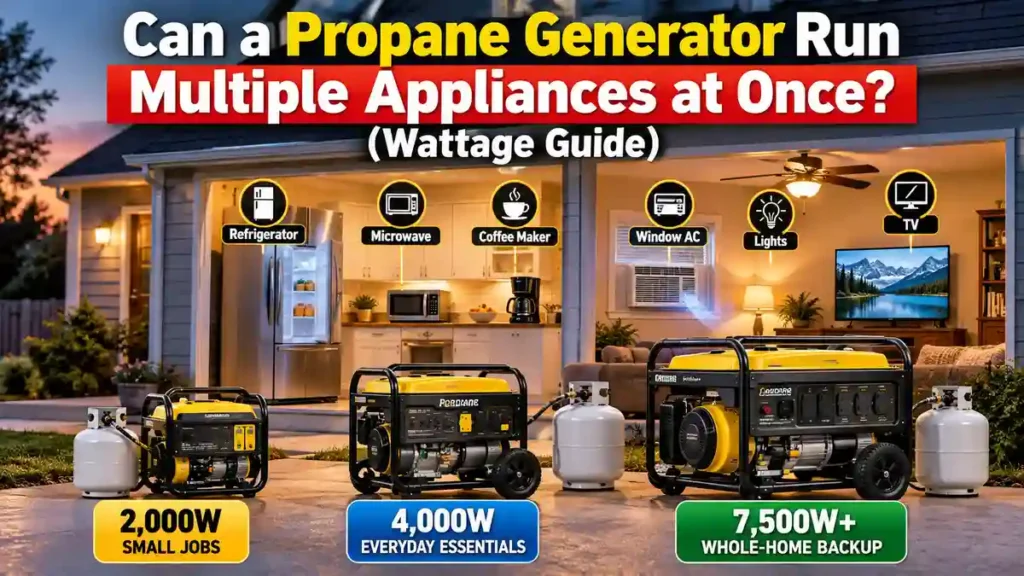
TL;DR — Can a propane generator run multiple appliances at once?
Yes. You can run several appliances at the same time if their combined running watts stay below your generator’s continuous propane (LPG) rating, their motor-starting demands fit its actual surge capability, and the receptacles, breakers and wiring are suitable. A 5,000-running-watt LPG generator may comfortably power a refrigerator, TV, internet router, fans, LED lights and a microwave in an illustrative outage setup. One large air conditioner, electric range or water heater may consume more capacity than all those small devices combined. Starting motors separately and shedding optional loads can help, but no wattage chart replaces the exact appliance nameplates and generator manual.
If you ask me how many appliances a propane generator can power, I won’t answer with a fixed number. Eight low-wattage devices can be easier to supply than two large appliances. What matters is which loads operate together and when their motors start. A refrigerator might run quietly for hours, then draw extra current when the compressor cycles on at the same moment you’re using a microwave.


I’ll show you how to make that calculation without confusing watts with kilowatt-hours, starting power with running power, or a gasoline rating with propane output. The tables are practical estimates for U.S. 120V/240V equipment—not claims that every appliance or generator consumes the same power.
1. How Many Appliances Can a Propane Generator Run at Once?
A generator sees electrical demand, not the number of power cords. If I add a router using 15 watts, a television using 120 watts and six LED lights totaling 60 watts, that group draws only 195 watts. An electric water heater may draw 4,500 watts by itself. This is why I build a simultaneous-load list instead of guessing from the number of connected outlets.
| Illustrative appliance group | Combined running watts | What changes the result |
|---|---|---|
| Router + TV + 6 LED bulbs | 195 W | Small steady demand |
| Refrigerator + freezer + router + lights + TV | ~650 W | Both compressors may restart |
| Microwave + electric kettle | ~2,900 W | Heavy resistance/electronic loads |
| Electric water heater + electric space heater | ~6,000 W | High sustained demand |
| Central A/C + well pump | ~5,500 W running | Motor starts may demand much more |
I always distinguish what is plugged in from what is switched on. The refrigerator compressor cycles; a microwave runs for minutes; an electric heater can operate for hours. Their peak coincidence determines whether you overload the generator. For a separate guide on selecting generator capacity for a house, see what size propane generator a house needs.
2. Running Watts vs. Starting Watts: The Crucial Difference
Running watts are electrical power consumed while a device operates normally. Starting watts describe a short demand when some motors and compressors first turn. That surge may last fractions of a second or longer and may be several times the steady draw. A generator’s advertised peak/starting watts are not its continuous power rating.


Here is my calculation rule for a simplified scenario: add the running watts of everything active, then replace the running demand of the single motor being started with its starting demand. Do that for every credible start event. If two motors may restart together, model both or use proper start-sequencing controls. Real starting kVA, power factor, voltage sag and waveform also matter, especially with central A/C and wells.
| Appliance | Illustrative running watts | Illustrative start/peak watts | What I verify |
|---|---|---|---|
| Refrigerator | 150–500 | 600–1,500 | Compressor label |
| Freezer | 100–400 | 500–1,200 | Compressor startup |
| Television | 60–200 | Near running draw | Power supply |
| Wi-Fi router | 10–30 | Near running draw | Power adapter |
| LED lights, group | 40–250 | Usually modest | Count and wattage |
| Microwave, input | 1,100–1,800 | Varies; sometimes little extra | Input not cooking watts |
| Electric fan | 40–150 | 80–350 | Motor and speed |
| 5,000-BTU window A/C | 400–800 | 900–2,000+ | Actual compressor specification |
| 8,000-BTU window A/C | 500–1,100 | 1,100–2,800+ | Energy efficiency varies |
| 12,000-BTU window A/C | 800–1,600 | 1,600–4,000+ | Verify nameplate |
| Central A/C system | 2,500–6,000+ | Can exceed 10,000 | LRA and generator motor-start kVA |
| Sump pump | 500–1,500 | 1,500–4,000+ | HP and startup |
| Well pump | 700–2,500+ | 2,000–7,000+ | Voltage, depth and motor |
| Electric water heater | 3,500–5,500 | Usually near running draw | Resistance element |
| Electric range / oven | 2,000–8,000+ | Element combinations | Burners and oven on together |
| Electric clothes dryer | 4,000–6,000 | Motor plus heater | Voltage and heating input |
| Phone/laptop chargers | 10–150 each | Usually modest | Power adapters |
| Level-2 EV charging | 3,800–11,500+ | Controlled load, not a simple motor start | Should it be disabled? |
Every wattage range above is illustrative. A modern inverter window air conditioner can start differently from an old fixed-speed compressor. I use actual input-watt or amp nameplates; if amps and volts are provided, volts × amps estimates apparent power (VA), and real power in watts may be lower for loads with power factor below one. Don’t treat cooling BTU/hour as electric input watts.
3. Propane Generator Wattage Chart: Examples by Size
For this comparison, every generator size is treated as a hypothetical continuous LPG running rating. A box labeled “9,500 watts” may refer to peak gasoline watts instead. Many portable dual-fuel generators have a lower propane rating; I verify that number before I select an appliance combination.
| LPG running rating | Illustrative compatible running loads | Combined run watts | Major limitation |
|---|---|---|---|
| 2,000 W | Fridge, 100W lights, TV, router | ~470 W | Refrigerator surge and outlet capacity |
| 3,500 W | Above plus 1,300W microwave and fan | ~1,860 W | Stagger compressor start |
| 5,000 W | Fridge, microwave, TV, lights, router, fan, small A/C | ~2,800 W | Possible A/C + fridge surges |
| 6,500 W | Above plus freezer and some pump use | ~4,250 W | Pump motor-start needs |
| 7,500 W | Fridge, freezer, well pump, microwave, lights, TV | ~3,620 W | Pump surge; 120V/240V limits |
| 9,500 W | Above plus selected A/C | ~6,500 W | Start sequencing and current limits |
| 10,000 W | Two fridges, larger A/C, pump, lights, kitchen loads | ~7,300 W | Outlets and overlapping motor starts |
| 12,000 W | Selected cooling, pump, kitchen and laundry loads | ~9,000 W | EV/heat loads can overload |
| 20,000 W | Whole-home circuits with some larger loads | ~14,000 W | HVAC inrush and load shedding |
| 26,000 W | More simultaneous home loads and HVAC zones | ~19,000 W | Still limited by total demand and starts |
I intentionally leave headroom in these examples because loads vary. A portable generator cannot magically send its full running watts through one small receptacle. Generac explicitly warns that individual outlets have separate limits, even if the entire generator can produce more power. A nominal 120V, 20A receptacle corresponds to 2,400 VA before other continuous-load and device rules; breaker, wiring and cable ratings still apply.
As a verified example, Champion’s dual-fuel 201507 provides 8,500 running watts on gasoline but 7,650 running watts on propane, with 9,565 propane starting watts. Its outlets include 120V 20A receptacles and a 120/240V 30A twist-lock receptacle. I would never treat its 8,500W gasoline rating as its LPG continuous rating. Those are published manufacturer specifications, not my test results.



4. How I Calculate the Total Appliance Wattage
Here is my repeatable worksheet method. First list what you truly need powered. Record each nameplate’s running input and starting requirements. Mark what can operate together; add those running loads, then test likely starting events. Finally check continuous LPG watts, surge capability, voltage, receptacles and appropriate operating margin.
| Sample six-appliance outage load | Illustrative running watts | Illustrative motor starting |
|---|---|---|
| Refrigerator | 200 | 900 W when compressor starts |
| Television | 120 | No significant motor start |
| LED lighting | 80 | No significant motor start |
| Microwave input | 1,400 | Depends on model |
| Electric fan | 90 | 180 W startup |
| Wi-Fi router | 15 | No significant motor start |
| Combined running | 1,905 W | 2,605 W with fridge starting |
My refrigerator-start arithmetic is 1,905 − 200 + 900 = 2,605 watts. On a hypothetical generator genuinely rated for 5,000 LPG running watts, the six appliances have a comfortable running margin in this example. But I would still check the actual microwave input, refrigerator surge and surge-duration performance. Don’t simply add all appliance starting ratings unless simultaneous starts are plausible.
5. What Can a 5,000-Watt Propane Generator Run Together?
Imagine a small household with a refrigerator, some lights, a router, TV and fan. Adding the microwave briefly may be reasonable. A window air conditioner adds comfort but also a compressor-start event. I would test the proposed schedule against the real generator specifications rather than tell you that every combination is automatically safe.
| 5,000W LPG example | Running demand | Potential peak event | My judgment |
|---|---|---|---|
| Refrigerator + TV + router + lights + fan | 505 W | ~1,205 W when refrigerator starts | Comfortably within watts; check outlet distribution |
| Above plus 1,400W microwave | 1,905 W | ~2,605 W | Plausible on suitable unit |
| Above plus 900W window A/C | 2,805 W | ~4,105 W when A/C starts at 2,200W | May fit; check overlapping motor starts |
| Above plus 4,500W water heater instead | 6,405 W | More if compressor starts | Exceeds 5,000W running |
| Microwave + A/C + 1,500W heater + 1,200W pump + 500W base | 5,700 W | Higher when pump starts | Exceeds rating |
The realistic surprise is that an electric resistance heater can use more steady power than several essential appliances together. If you’re using extension cords, the total rating doesn’t eliminate the limits of each receptacle, plug and cord. I never daisy-chain power strips or try to power house circuits through an ordinary wall outlet.


6. What Can a 7,500-Watt Propane Generator Run?
Now imagine a mid-size portable generator supplying a refrigerator, freezer, well pump, lights, TV and microwave. My illustrative running total is 3,620 watts. If the 1,500W running pump briefly needs 5,000W to start while all other devices remain active, total demand jumps to 7,120 watts. That’s below the cited Champion 201507’s 9,565W advertised LPG starting rating, but whether it works depends on actual transient response, voltage, phase and pump compatibility.
A second scenario is much harder: the pump and a large air-conditioning compressor attempt to start together. Even if steady demand is only 5,500W, two overlapping starts could exceed surge capability or cause voltage sag. I would stagger those motors, use compatible start controls or have an electrician assess the full system. Never bypass the overload protection to “get it going.”
7. What About a 10,000-Watt Propane Generator?
A genuine 10kW LPG-rated portable generator may support more refrigerators, selected air conditioning, kitchen equipment, laundry or well-pump loads than a 5kW unit. But I would not call it a universal whole-house solution: a 4.5kW water heater plus a 5kW dryer already approaches 10kW before you add anything else.
Some larger portable machines provide 120/240V output; others may have different receptacle combinations. I look at the generator’s output breakers and neutral/ground configuration, the current at each leg, and the planned connection method. An approved transfer switch or interlock and inlet must be designed and installed for household circuits by a qualified electrician.
8. Can 20kW or 26kW Run an Entire House?
A permanently installed 20kW or 26kW propane standby generator usually connects through an automatic transfer switch. It can power many home circuits, but that doesn’t prove every electric appliance may run at once. High-demand heat pumps, electric water heaters, cooking, dryers and EV charging can overlap. Smart load-shedding modules postpone nonessential equipment when necessary.
| Illustrative whole-home situation | Running watts | 20kW LP unit | 26kW LP unit |
|---|---|---|---|
| Refrigeration, lights, office, one A/C, well pump | ~8,500 W | Usually within rated running power | Within rated running power |
| Two A/C systems, cooking, essentials | ~16,000 W | Within nominal run; check starts | Within nominal run; check starts |
| Above plus electric water heater | ~20,500 W | Exceeds 20kW running | Within 26kW running; check motor starts |
| Above plus 7.2kW EV charging | ~27,700 W | Overload without shedding | Overload without shedding |
My advice is to calculate peak simultaneous demands and motor starts before choosing a standby size; square footage alone cannot settle it. I compare the tradeoff in my 20kW versus 26kW propane generator guide.
9. Can a Propane Generator Run a Refrigerator and A/C Together?
Yes, often—if the LPG rating and compressor starts are compatible. A refrigerator may consume a few hundred watts while a window A/C consumes several hundred to over a thousand. But the cooling capacity printed in BTU/hour is not its electrical wattage: an efficient 12,000-BTU inverter model can draw less electrical power than an older model with the same cooling rating.
| A/C example + 200W refrigerator | Illustrative A/C running watts | Combined running | Potential A/C start case |
|---|---|---|---|
| 5,000-BTU window A/C | 550 W | 750 W | If A/C starts at 1,300W: ~1,500W |
| 8,000-BTU window A/C | 800 W | 1,000 W | If starts at 2,000W: ~2,200W |
| 12,000-BTU window A/C | 1,200 W | 1,400 W | If starts at 3,200W: ~3,400W |
| Central air system | 3,500 W | 3,700 W | Could exceed 10kW transient; verify LRA |
Those numbers are scenarios, not ratings derived from cooling BTUs. If the refrigerator starts at the same time, demand can rise further. For compatible compressors, manufacturer-approved soft starters or staggered starts may help, but neither guarantees every generator can start every A/C.
10. What Happens If You Overload a Propane Generator?
An overload can trip a breaker, illuminate an inverter overload lamp, cause voltage to sag, bog the engine, trigger shutdown or disrupt the connected appliances. Some motors overheat if they repeatedly fail to start under low voltage. Continued abusive operation may damage the generator or equipment.
| Symptom | Possible cause | Safer response |
|---|---|---|
| Output breaker trips | Overcurrent or incompatible connected load | Stop and reduce load; inspect ratings |
| Overload indicator/shutdown | Generator capacity exceeded | Follow manual reset and reconnect fewer devices |
| Engine bogs when pump starts | Starting demand, fuel starvation, or both | Stop; check loads and arrange qualified fuel diagnosis |
| Voltage or frequency unstable | Large load step, fault or poor engine control | Unplug sensitive loads and follow service procedure |
| Gas odor or hissing | Possible LPG leak | Leave area; call propane supplier/emergency services |
| Outlets hot or cord damaged | Overloaded/undersized connection | Stop use and replace with properly rated equipment |
Not every rough-running generator is electrically overloaded. An undersized regulator, hose or cold cylinder may limit propane vapor delivery and cause engine speed to fall under demand. If you see a fuel-gas warning, treat it as an emergency rather than troubleshooting near the generator. For normal load-related performance failures after leak hazards are excluded, read why a propane generator loses power under load.
11. Do More Appliances Increase Propane Consumption?
Usually yes, because the engine must supply more mechanical work to generate additional electrical energy. But gallons/hour rarely increase in an exact straight line with load. The generator uses some fuel simply to keep running, and its efficiency changes as the load rises. Inverter units may reduce engine speed at low demand; conventional 60-Hz generators often maintain governed speed.
For a reference point, Champion’s 201507 is advertised to run up to five hours from a nominal full 20-lb cylinder at half of its 7,650W propane rating, implying approximately 4.7 ÷ 5 = 0.94 gallon/hour. The other load points below are hypothetical, not published Champion test data.
| LPG load share (7,650W example) | Electrical output | Assumed propane use | Fuel cost at $3.00/gal |
|---|---|---|---|
| 25% | 1.91 kW | 0.55 gal/h* | $1.65/h |
| 50% | 3.83 kW | 0.94 gal/h (derived) | $2.82/h |
| 75% | 5.74 kW | 1.23 gal/h* | $3.69/h |
| 100% | 7.65 kW | 1.52 gal/h* | $4.56/h |
*The 25%, 75% and 100% rates are illustrative planning assumptions. The 50% rate is derived from advertised runtime and nominal cylinder fill, so it’s still not an independent measured result. $3/gallon is a hypothetical price.
Suppose three small appliances draw about 1.0kW and six appliances draw 3.8kW. To model a rough difference, I might assume 0.45 gal/h versus 0.94 gal/h, respectively, for a representative conventional dual-fuel unit. At $3/gallon, the fuel-only cost rises from $1.35 to $2.82 per hour. That is a hypothetical comparison, not a conversion rule you can apply to every machine.
12. How Long Can Multiple Appliances Run on a Propane Tank?
A nominally full 20-lb cylinder holds approximately 4.7 U.S. gallons, 30 lb around 7.05, 40 lb around 9.4 and 100 lb around 23.5. Stationary tanks have different fill rules: if I plan from 80% full down to a 20% reserve, a 250-gallon tank offers approximately 150 budgeted gallons and a 500-gallon tank offers 300. These are gallons of fuel, not electricity.
| Fuel supply | Nominal/budgeted liquid propane | At 0.55 gal/h | At 0.94 gal/h | At 1.52 gal/h |
|---|---|---|---|---|
| 20-lb cylinder | 4.70 gal | 8.5 h | 5.0 h | 3.1 h |
| 30-lb cylinder | 7.05 gal | 12.8 h | 7.5 h | 4.6 h |
| 40-lb cylinder | 9.40 gal | 17.1 h | 10.0 h | 6.2 h |
| 100-lb cylinder | 23.50 gal | 42.7 h | 25.0 h | 15.5 h |
| 250-gal stationary tank (reserve) | 150 gal | 272.7 h | 159.6 h | 98.7 h |
| 500-gal stationary tank (reserve) | 300 gal | 545.5 h | 319.1 h | 197.4 h |
The formula is runtime = budgeted fuel gallons ÷ actual gallons per hour. Those figures do not account for the refrigerator cycling, generator idling, unexpected loads, or partial cylinder exchange fills. Most importantly, an undersized cylinder can be unable to vaporize fuel quickly enough in cold weather even if the arithmetic says gallons remain.
The engine’s fuel heat budget is also not its electricity: propane contains approximately 91,500 BTU per gallon of chemical energy, only a portion of which becomes useful electrical output. For longer-duration planning, see my propane tank-size chart for generators.
13. How I Prevent Overload When Several Appliances Are Running
My first tactic is priority. Refrigeration, necessary lighting, communication and essential medical equipment take precedence over a dryer, EV charger or several space heaters. Then I stagger major motors so a well pump and A/C compressor aren’t commanded to start together.
I use proper nameplate data or a suitable wattmeter where safe and appropriate; I never clamp onto energized conductors or alter household wiring without qualified help. I keep the generator’s overload display in view, use correctly sized cords and approved power-distribution equipment, and leave a sensible margin instead of operating at the theoretical edge all day.
Automatic standby load management can shed electric water heating, HVAC zones or charging equipment during large starts. A smaller generator with good sequencing may be more reliable than an oversized generator with an undersized propane supply. For the underlying load-inventory process, see how to calculate your home’s generator power needs.
14. Ten Common Mistakes I Would Avoid
1. Adding only running watts and ignoring motor starts. 2. Treating starting watts as continuous watts. 3. Using the gasoline rating in LPG mode. 4. Assuming every outlet can carry the whole generator rating. 5. Ignoring 120V versus 240V compatibility.
6. Plugging high-draw appliances into undersized extension cords. 7. Starting several compressors simultaneously. 8. Ignoring cold-weather cylinder vaporization. 9. Assuming a larger generator will always cost less per kWh. 10. Connecting the generator to household wiring through unsafe backfeeding.
I prevent these problems by checking the exact generator model, the tool or appliance label, realistic simultaneous demand, rated receptacles and a professional connection plan. If an appliance trips the overload repeatedly, I stop using that combination instead of bypassing safeguards.
15. Generator Safety When Powering Several Appliances
Carbon monoxide is deadly. Even propane-burning generators produce CO. I never operate one inside a home, garage, enclosed porch, shed or partly enclosed work area. CPSC recommends outdoor operation at least 20 feet from the home with exhaust pointed away from doors, windows and vents when feasible, while following manufacturer and local instructions. I maintain functioning CO alarms inside the home.
For electrical safety, I follow the unit’s grounding/bonding requirements, use GFCI protection as applicable, approved weather-rated cords, suitable breakers and proper plugs. A household transfer switch or approved interlock and inlet must be installed correctly. I never connect the generator to a wall receptacle or use a double-male cord to backfeed the home.
I also maintain appropriate weather protection without enclosing the engine or obstructing cooling airflow. Propane cylinders, hoses and regulators must meet the generator manufacturer’s requirements. If gas odor or an active hiss is present, leave immediately and contact the supplier or emergency services from a safe place. My propane generator leak safety guide explains the distinction from ordinary electrical overload.
16. My Appliance-Priority Worksheet
Here is a completed example of the list I’d make before buying a generator. “Expected together” is more important than how many circuits exist in the breaker panel.
| Appliance | Running W | Example starting W | Priority | Together? |
|---|---|---|---|---|
| Refrigerator | 200 | 900 | Essential | Yes |
| Lights | 100 | 100 | Essential | Yes |
| Wi-Fi + phone chargers | 40 | 40 | Essential | Yes |
| Television | 120 | 120 | Optional | Yes |
| Microwave | 1,400 | Varies | Optional | Briefly |
| Window A/C | 900 | 2,200 | Comfort | Sometimes |
| Electric water heater | 4,500 | ~4,500 | High demand | Shed during outage |
My normal simultaneous set excluding the heater is 2,760W. If the A/C starts at 2,200W while everything else runs, that rises to 4,060W. If the refrigerator starts at 900W while A/C is already running, demand rises to 3,460W. But if both start at the same time, the peak could be 4,760W—before considering real power factor and transients. I’d examine the manufacturer’s surge data for a 5kW propane-rated unit before promising that simultaneous event will work.
17. Which Propane Generator Size Should You Buy?
| Backup goal | Illustrative LPG running size to evaluate | What must be checked |
|---|---|---|
| Phone/router, lights and one efficient refrigerator | 2–3.5 kW | Refrigerator surge |
| Refrigerator, TV, lights, fan and microwave | 3.5–5 kW | Microwave plus fridge restart |
| Refrigerator and small window A/C | 3.5–6.5 kW | Compressor-start scenarios |
| Selected circuits with a pump | 6.5–10 kW | Motor inrush, proper outlets |
| Multiple kitchen appliances and selected A/C | 9.5–12 kW | High-power overlap and 240V loads |
| Whole-home circuits with managed HVAC | ~14–20 kW standby class | Actual home load study |
| Larger all-electric home, multiple HVAC systems | 20–26 kW or more | Load-shedding and full-load LP supply |
These aren’t universal minimums and aren’t intended to replace the nameplate calculation. I choose the smallest generator that supports my actual essential continuous loads, credible starting scenario and reasonable expansion. If the only reason to buy a much bigger unit is to run an optional heater and dryer together, I would consider shedding those loads instead.
18. Frequently Asked Questions
Can a propane generator run multiple appliances at once?
Yes. Combined running watts must be within the generator’s continuous LPG rating, and motor starting demand must be supported. Each receptacle and connected cord also has limits. I compare the actual appliance labels with the exact generator specifications rather than count plugs.
How many appliances can a 5,000W propane generator run?
It depends on which appliances. In a hypothetical scenario, a refrigerator, television, router, LED lights, fan and microwave total about 1,905 running watts. A large electric heater or water heater can consume most or all of a 5,000W supply by itself.
Can I run two refrigerators?
Often yes on appropriately sized equipment. The steady draw of two efficient refrigerators may be modest, but both compressors can restart together. Check each unit’s starting requirements and leave room for other loads.
Can I run a refrigerator and microwave simultaneously?
Often. My illustrative pair draws about 1,600W when the fridge is running normally and the microwave draws 1,400W. When the refrigerator compressor starts, the transient may rise to around 2,300W. Actual labels take priority.
Can a 7,500W generator run an air conditioner?
Many window units are possible, but central A/C may have a very large start surge. I would verify the exact LPG continuous and starting ratings, A/C LRA and the rest of the household loads before relying on it.
What can a 10,000W propane generator power?
A model genuinely rated at 10,000 running watts on propane can cover a useful group of household appliances, selected pumps and cooling equipment. It still needs compatible receptacles, voltage and motor-start performance; it may not supply every whole-home circuit at once.
Can a propane generator power an electric stove?
Potentially, if the generator, transfer installation and available current are suited to the range. A range using several burners and the oven can draw many thousands of watts, so I would usually manage cooking loads during an outage.
Can it run a washer and dryer?
A washing machine’s draw may be modest compared with a conventional electric dryer, which can consume 4–6kW. A small portable generator may not support both plus essential appliances. Gas dryers and efficient models have different needs.
Will more appliances consume more propane?
Usually yes, because electrical power demand rises. However, engine consumption is nonlinear, and the result varies with the generator and load. I use gallons/hour from the correct model at realistic output rather than multiply the appliance count.
What happens if I exceed rated watts?
The circuit breaker or inverter protection may trip, engine speed may drop, or the generator may shut down. Continuing to overload can harm connected equipment. Remove load and follow the manufacturer’s reset procedure; do not bypass protection.
Can 20kW power an entire house?
Sometimes, with correctly planned loads and motor starts. A 200-amp whole-home transfer switch does not mean the 20kW generator can supply 200 amps at 240V. Load shedding may be necessary for water heating, HVAC or EV charging.
How do I calculate total appliance watts?
Add all appliances likely to operate together, then analyze each credible motor-start event by replacing that motor’s running draw with its starting draw. Compare these figures with LPG-rated continuous power, actual surge behavior and receptacle limits.
Can I use extension cords for multiple appliances?
Yes, only when the generator manufacturer permits the setup and every cord and plug is properly rated, grounded where required, weather-suitable and protected. Don’t use light-duty indoor cords, damaged connections or power-strip chains.
How can I keep startup surges from tripping the generator?
I stage large motor starts, switch off optional heavy loads, consider manufacturer-approved soft-start equipment, and have a qualified electrician design load shedding where appropriate. The precise remedy depends on whether the limit is generator surge power, an outlet, or propane fuel flow.
19. My Final Recommendation
I would size a propane generator for the worst realistic simultaneous operating demand, not the total number of appliances in the house. Then I’d examine one motor-start event at a time, check the unit’s actual LPG-rated running and surge performance, and ensure every cord, outlet and transfer component is correctly rated.
For a few emergency essentials, a smaller portable dual-fuel unit may be all you need. For large pumps, central A/C and automatic whole-home operation, a professionally installed standby generator with appropriate load management is usually a more coherent system. Either way, careful scheduling can sometimes save more money than buying extra watts you rarely need.
Technical basis: The Champion 201507 LPG output and half-load runtime are manufacturer-published. General guidance on continuous versus surge ratings and receptacle limits reflects manufacturer sizing materials; outdoor carbon-monoxide precautions follow federal safety guidance. All appliance wattages, load combinations and fuel curves not attributed to a specific model are explicitly illustrative, not results of independent testing. No outbound links are included.

Mike is an experienced propane technician with over 15 years of professional experience in the field. He has dedicated his career to helping customers with their propane needs, from installation to maintenance and repair. Together with Jeremy, he co-founded this website to provide useful information and guidance to customers seeking reliable propane services.