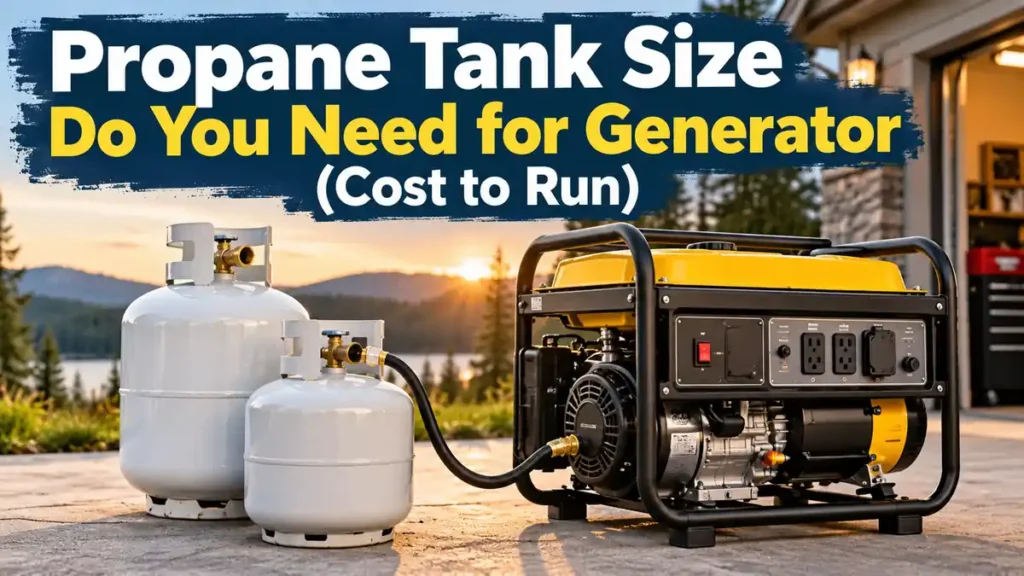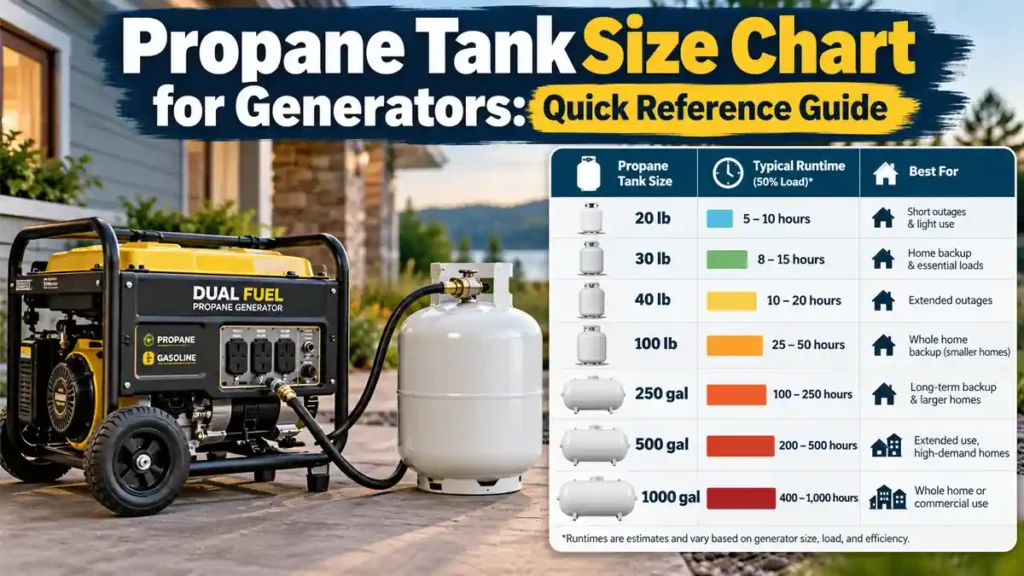
When someone asks me for a propane tank size chart for generators, I like to show the numbers before giving a long explanation. You may be planning a portable backup unit for a refrigerator and a few lights, or you may be comparing 250-, 500-, and 1,000-gallon storage for an automatic home standby generator. Those are two different jobs. What matters is how much usable liquid propane you start with, how quickly your generator burns it, and whether the fuel system can deliver vapor fast enough.
I built this page as a reference sheet you can actually use during a purchase or a fuel delivery discussion. Rather than treating generator kilowatts as an automatic tank-sizing formula, I separate storage, consumption, runtime and reserve. If your reserve runs dry unexpectedly, my propane generator out-of-fuel troubleshooting guide explains the shutdown and restart process. I also show you where the common arithmetic breaks down. If you want a full buying decision rather than a reference table, read my longer guide to choosing a propane tank size for a generator; here I keep the core numbers easy to scan.
Propane tank size chart for generators: gallons, capacity and uses
| Propane tank or cylinder | Approx. propane when full | Typical generator context | Critical note |
|---|---|---|---|
| 20-lb cylinder | 4.7 US gal | Portable generator, short runs | Cylinder fuel weight; vapor withdrawal |
| 30-lb cylinder | 7.1 US gal | Portable generator, longer runs | Verify cylinder valve and approved hose |
| 40-lb cylinder | 9.4 US gal | Portable generator with fewer swaps | Heavy when filled; compatible connection |
| 100-lb cylinder | 23.6 US gal | Extended portable backup | Vapor-delivery limits still apply |
| 120-gal ASME tank | 96.0 US gal | Smaller fixed LP systems | Not adequate for every standby model |
| 250-gal ASME tank | 200.0 US gal | Common starting point for standby installations | Check manufacturer’s tank minimum |
| 500-gal ASME tank | 400.0 US gal | Multi-day home backup | Popular balance of autonomy and space |
| 1,000-gal ASME tank | 800.0 US gal | Longer outages, larger simultaneous LP load | More siting and delivery planning |
The distinction is important. 20, 30, 40 and 100 lb describe how much propane a cylinder is designed to contain by weight. By contrast, 120, 250, 500 and 1,000 gallons describe the nominal water capacity of larger stationary tanks, not the liquid propane they can legally be filled with. The stationary tank normally needs expansion space, so I apply an approximate 80% fill to those gallon-rated vessels. I do not subtract another 20% from an already full 20-lb cylinder.


An important exception: a 33-lb forklift cylinder often supplies liquid propane, not the vapor that a typical residential or portable generator expects. I would not connect a forklift cylinder to a generator just because its pounds-to-gallons conversion looks attractive. Only use cylinder types, withdrawal modes, valves and hoses specifically approved by the generator and fuel-system manufacturer.
Propane generator runtime chart by tank size
Here is the table I would use first. I calculated each runtime from the full liquid gallons above, divided by one of four example consumption rates. They describe fuel consumption, not a fixed electrical generator size. That is deliberate: a 22-kW standby model and a portable dual-fuel model do not consume propane at the same rate, and newer engines can be more efficient than older machines.
| Tank size | 0.5 gal/hr | 1.0 gal/hr | 2.5 gal/hr | 3.7 gal/hr |
|---|---|---|---|---|
| 20-lb cylinder | 9.4 hr | 4.7 hr | 1.9 hr | 1.3 hr |
| 30-lb cylinder | 14.2 hr | 7.1 hr | 2.8 hr | 1.9 hr |
| 40-lb cylinder | 18.8 hr | 9.4 hr | 3.8 hr | 2.5 hr |
| 100-lb cylinder | 47.2 hr | 23.6 hr | 9.4 hr | 6.4 hr |
| 120-gal ASME tank | 192.0 hr | 96.0 hr | 38.4 hr | 25.9 hr |
| 250-gal ASME tank | 400.0 hr | 200.0 hr | 80.0 hr | 54.1 hr |
| 500-gal ASME tank | 800.0 hr | 400.0 hr | 160.0 hr | 108.1 hr |
| 1,000-gal ASME tank | 1600.0 hr | 800.0 hr | 320.0 hr | 216.2 hr |
Read the chart across your expected burn rate. For example, a tank with 400 gallons of propane can theoretically supply 160 hours at 2.5 gallons per hour, or roughly 6.7 days of continuous operation. At 3.7 gallons per hour, the same tank yields only about 108 hours. If the generator is periodically shut down, that changes calendar days but not the amount of fuel consumed while it is running.
For smaller equipment, a full 20-lb cylinder gives around 9.4 hours at 0.5 gal/hr. If your exchange bottle was filled with only 15 pounds instead of 20, it contains approximately 3.5 gallons and that estimate drops to about seven hours. That is why I always check the actual fuel weight or fill receipt, not simply the size stamped on a cylinder. See my separate 20-lb tank generator runtime breakdown for portable-use details.


The technical details behind the chart
I use U.S. liquid gallons and approximate properties of commercially supplied propane. Real density varies with temperature and composition, so these conversions are planning figures. Likewise, generator fuel-burn specifications are usually measured at particular loads and operating conditions. The manufacturer’s LP data always outranks a generic online estimate.
| Technical term | Planning value | Why I use it |
|---|---|---|
| Propane liquid weight | ~4.24 lb per US gallon | Convert full cylinder pounds into gallons |
| Propane energy content | ~91,500 BTU per gallon | Compare thermal fuel input, not electrical output |
| 20-lb cylinder volume | ~4.7 gallons | Portable runtime math |
| 100-lb cylinder volume | ~23.6 gallons | Longer portable-use estimates |
| ASME tank normal fill | About 80% of water capacity | Leaves liquid expansion space |
| Runtime equation | Liquid gallons ÷ LP gallons/hour | Gives a theoretical engine operating time |
| Reserve-aware equation | (Start gauge % − stop gauge %) × water capacity ÷ gal/hour | Estimates a practical refill planning window |
| Operating limit | Adequate vaporization and proper inlet pressure | A full tank can still fail to deliver enough fuel |
How much propane does a generator really consume per hour?
I would never size a tank solely from the number on a generator’s side cover. Rated electrical kilowatts tell you its potential output, but its propane burn depends on the engine design and operating load. Manufacturers publish separate LP consumption rates at approximately half load and full load. Those two points are useful for planning; real household demand moves constantly between them.
To give you realistic context, I reviewed current published air-cooled standby-generator information. The representative data below are model-family examples, not the rate for every unit with the same kW label. If your generator is a different model, I would use your unit’s serial-specific fuel sheet instead of copying these values.
| Example standby generator rating | LP at about 50% load | LP at full load | Equivalent daily use at 50% load |
|---|---|---|---|
| 14 kW | 1.76 gal/hr | 2.92 gal/hr | 42.2 gal/day |
| 18 kW | 1.65 gal/hr | 2.87 gal/hr | 39.6 gal/day |
| 22 kW | 2.45 gal/hr | 3.71 gal/hr | 58.8 gal/day |
| 26 kW | 2.05 gal/hr | 3.95 gal/hr | 49.2 gal/day |
Notice that the 26-kW example uses less fuel at half load than the 22-kW example. That is not an error in this chart. Engine and alternator efficiency differ, which is exactly why a simplified rule such as “every 20-kW generator burns three gallons per hour” can mislead you. If your unit will power only essential circuits during an outage, its consumption may be closer to a lower-load operating point than a full-load figure.
I still size the fuel piping and regulator for the generator’s required maximum gas input, not just the economical load you hope to run most often. That work belongs with a qualified LP-gas professional. If you also want to understand electrical demand, I explain the running-watt and starting-watt calculation in how to calculate your home’s power needs for a propane generator.

250 vs. 500 vs. 1,000-gallon propane tank for a generator
If you’re choosing between these common stationary sizes, I would use two charts. The first shows full-tank theoretical hours. The second deliberately leaves a reserve. In my experience as a way of thinking through the purchase, reserve planning matters more than chasing an impressive maximum number: refills can be delayed by storms, difficult access or unexpectedly high demand.
| Stationary tank | Propane at 80% fill | 2.5 gal/hr: full-to-empty | 3.7 gal/hr: full-to-empty |
|---|---|---|---|
| 250 gallons | 200 gallons | 80 hr / 3.3 days | 54 hr / 2.3 days |
| 500 gallons | 400 gallons | 160 hr / 6.7 days | 108 hr / 4.5 days |
| 1,000 gallons | 800 gallons | 320 hr / 13.3 days | 216 hr / 9.0 days |
The 250-gallon tank can be a practical starting point for some permanent standby setups, but it is not automatically enough for a household expecting uninterrupted operation through an extended storm. The 500-gallon tank often provides a useful compromise between available fuel and footprint. A 1,000-gallon tank may make sense when a long outage is plausible, propane also heats the house, or refilling access is unreliable.
One manufacturer-specific limit matters here: Generac’s published guidance identifies a 250-gallon minimum tank for its home standby installations, subject to a larger calculated requirement and any approved system exceptions. That is not a universal law covering every portable or stationary generator brand. I would check your precise model’s installation documentation and ask the propane supplier to verify the vaporization capacity at the design temperature.
My reserve-aware propane tank chart: when to schedule a refill
This is the second table I would put beside the fuel gauge. For a stationary tank, I assume delivery leaves the tank at 80% and I want to preserve a 20% gauge reading rather than plan to drain it completely. The amount between those points is 60% of nominal water capacity. The 20% stop level is my planning reserve, not an official universal minimum or a guarantee that the system can vaporize fuel down to that exact level.


| Tank | Gallons from 80% to 20% | At 1.0 gal/hr | At 2.5 gal/hr | At 3.7 gal/hr |
|---|---|---|---|---|
| 250 gallons | 150 | 150 hr / 6.3 days | 60 hr / 2.5 days | 40.5 hr / 1.7 days |
| 500 gallons | 300 | 300 hr / 12.5 days | 120 hr / 5.0 days | 81.1 hr / 3.4 days |
| 1,000 gallons | 600 | 600 hr / 25 days | 240 hr / 10 days | 162.2 hr / 6.8 days |
Here is my interpretation: if I expected a major storm and my 500-gallon tank was filled to 80%, I would not promise the household 6.7 days of 2.5-gallon-per-hour generator operation. I would plan around five days before hitting my 20% reserve and then decide whether I wanted an earlier refill. If other propane appliances are using fuel, that timeline would shrink further.
The calculation is also helpful for delivery scheduling. I explain automatic refills, will-call ordering, tank monitoring and emergency dispatch in my guide to getting propane delivered for your home generator. Set a minimum tank percentage that reflects your supplier’s refill lead time and the worst outage you reasonably want to tolerate. Do not wait for the gauge to reach the reserve before making a delivery plan, especially during winter. A propane professional can recommend a safer operating margin for your climate and supply arrangement.
Worked example: a 22-kW standby generator on a 500-gallon tank
Suppose you have a 22-kW propane standby generator with a published half-load fuel rate of 2.45 gal/hr. Your 500-gallon ASME tank starts at about 80% full, or 400 liquid gallons. The theoretical 400 ÷ 2.45 gives about 163 hours of running. Using my 20% reserve, you would instead budget 300 ÷ 2.45, or about 122 hours—just over five days. That is for the generator alone.
Now imagine a propane furnace, water heater or other equipment shares the same tank. I would not simply add those appliances’ electrical watts to the generator’s fuel consumption. They consume propane directly. I would estimate their own gallons per day from their nameplate inputs and actual expected operating cycles, then subtract that amount from the propane available for the generator. This keeps me from double-counting electricity while overlooking direct fuel demand.
| Planning line item | Worked example value | Meaning |
|---|---|---|
| Tank nominal water capacity | 500 gallons | Not the amount of liquid stored |
| Start at 80% full | 400 gallons | Approx. propane on hand |
| Stop / reserve at 20% | 100 gallons | My preferred cushion in this example |
| Available before reserve | 300 gallons | 400 minus 100 |
| Generator LP rate at ~50% load | 2.45 gal/hr | Illustrative model-specific specification |
| Hours before reserve, generator only | 122.4 hours | 300 ÷ 2.45 |
| Daily generator fuel demand | 58.8 gallons/day | 2.45 × 24; continuous running |
Cold weather: the reason a bigger tank may be needed
The runtime arithmetic above answers, “How many gallons do I have?” It does not answer, “Can those gallons reach my generator as vapor fast enough?” Liquid propane must absorb heat to become gas for a vapor-withdrawal generator. When the tank is cold, the liquid level is low or demand is very high, the tank may not vaporize enough fuel to maintain pressure. That can cause an engine to stumble or shut down even though the gauge shows propane remaining.
I view tank capacity and vaporization capacity as separate pass/fail tests. A 100-lb cylinder might mathematically contain many hours of fuel for a small generator, yet be unable to sustain the highest gas demand in cold conditions. The same concern can affect larger tanks as the temperature falls and the wetted tank surface decreases. Choosing larger storage sometimes solves two problems at once, but only an actual vaporization and pipe-sizing assessment can confirm it.
| Condition | What changes | What I would do |
|---|---|---|
| Warm outdoor temperature | Propane generally vaporizes more readily | Still verify maximum flow and approved regulator |
| Near-freezing weather | Fuel delivery capability can decline | Check the cold-weather design demand with supplier |
| Very cold temperatures | Vaporization can be a limiting factor | Evaluate larger tank or professionally designed system |
| Low tank level | Less liquid-wetted surface can reduce vapor supply | Use a higher refill threshold |
| Long or undersized gas line | Pressure drop can affect generator inlet pressure | Have qualified contractor size regulator and piping |
| Other propane appliances running | Shared gas load increases fuel demand | Calculate combined peak BTU/hr demand |
If you already see pressure-related symptoms, I cover the diagnostic side in why propane pressure drops when a generator starts. I would not try to fix a fuel-starved generator by modifying regulators or connecting cylinders in an improvised manifold. The manufacturer, propane dealer and licensed installer should agree on the fuel system design.
How I calculate the tank you need for a target outage duration
My quick method uses three inputs: expected gallons per hour, desired continuous runtime and a reserve. For an approximate ASME tank size when you plan to operate from 80% down to a 20% reserve, divide your required gallons by 0.60. This gives nominal water capacity, which you then round up to a commercially available tank size and confirm against the manufacturer’s minimum and local fuel requirements.
Example: You want 72 hours of generator operation at 2.5 gal/hr. That is 180 gallons for the generator. If you only want to consume the 60% band between 80% and 20% tank level, 180 ÷ 0.60 = 300 gallons of nominal tank water capacity. A 250-gallon tank is not enough for that exact goal; you would evaluate a larger standard size—commonly a 320- or 500-gallon installation—after verifying gas demand, other propane loads and delivery access.
| Your target runtime | At 1.0 gal/hr | At 2.5 gal/hr | At 3.7 gal/hr |
|---|---|---|---|
| 24 hours | 40 gal nominal capacity | 100 gal nominal capacity | 148 gal nominal capacity |
| 48 hours | 80 gal nominal capacity | 200 gal nominal capacity | 296 gal nominal capacity |
| 72 hours | 120 gal nominal capacity | 300 gal nominal capacity | 444 gal nominal capacity |
| 120 hours | 200 gal nominal capacity | 500 gal nominal capacity | 740 gal nominal capacity |
I intentionally call these mathematical minimums, not recommendations to install a tiny tank. For example, the 24-hour/1.0-gal-per-hour result says 40 gallons of nominal water capacity by arithmetic alone, but a particular permanent standby generator may require a 250-gallon minimum or more to meet vaporization requirements. Always apply the stricter manufacturer, code, fuel-system and actual-use limits.
Portable cylinder chart: 20 lb, 30 lb, 40 lb or 100 lb?
For a portable generator, I would start by reading its stated LP gallons per hour at the load you expect, then choose how many safe cylinder changes you are comfortable making. The smallest cylinders are easy to transport but need frequent exchanges. A 100-lb cylinder is much heavier, takes suitable equipment to handle and cannot be assumed to support high continuous vapor demand in freezing weather.
A 20-lb grill-size cylinder is best understood as a convenient short-duration fuel source, not a magic overnight guarantee. At a modest 0.5 gal/hr, it might last most of the night; at 1.0 gal/hr, it will run closer to five hours on a complete 20-lb fill. The distinction becomes important when you want a freezer, sump pump or medical appliance powered continuously. For longer small-cylinder calculations, see how long a 100-lb propane tank can run a generator.
What size propane tank do I prefer for different backup plans?
I avoid recommending one tank based only on home square footage. The right storage size depends on generator load, winter temperature, direct propane heating use, refilling frequency, physical space and local rules. I would first choose the electrical system from actual appliances, then size the fuel system separately. If you still need the electrical side, my guide to the propane generator size required for a house is the better starting point.
| Backup goal | Tank category I’d evaluate | Why |
|---|---|---|
| Occasional short portable use | 20–40 lb approved vapor cylinder | Simple handling and limited storage |
| Longer portable operation | 100 lb vapor cylinder or approved supplier-designed arrangement | Fewer swaps, subject to vaporization limits |
| Automatic standby backup | 250 gal or larger as model requires | Common minimum for some standby manufacturers |
| Multiple days of home backup | 500 gal class | More fuel buffer at moderate burn rates |
| Extended winter outages or large shared LP demand | 1,000 gal class or engineered alternative | Longer reserve and greater vaporization surface |
These aren’t endorsements of one tank as universally suitable. I might prefer a larger tank for a modest generator in an isolated cold area than for a bigger unit in a mild climate with prompt delivery service. I would ask whether the tank can be reached after snow, flooding or wind damage, and whether my propane supplier’s normal minimum-delivery policy fits my planned refill threshold.
The five mistakes that make generator tank charts misleading
- Mistake 1 — Confusing nominal tank gallons with liquid gallons: a 500-gallon ASME tank usually does not contain 500 gallons of propane.
- Mistake 2 — Treating full-to-empty as guaranteed runtime: leave a reserve and remember actual withdrawal may be limited.
- Mistake 3 — Ignoring other LP appliances: a furnace and water heater use the same stored propane even when their electricity use is small.
- Mistake 4 — Estimating fuel consumption from kW alone: use the exact LP gallons-per-hour chart for your engine and actual load.
- Mistake 5 — Overlooking vaporization and piping: stored gallons are worthless if your generator cannot receive enough gas at the required pressure.
My additional check is to ask whether the proposed tank size still makes sense during the last day of the desired outage, not just when the tank is freshly filled. That is why my refill-reserve chart and cold-weather assessment are separate. I would also ask a professional to confirm clearances, permanent pipework and permits before selecting the final location. See my 50-state guide to professional propane generator installation for that part of the project.
Frequently asked questions
How many gallons of propane are in a 100-lb tank?
A full 100-lb propane cylinder contains roughly 23.6 US gallons using about 4.24 pounds per gallon. Exact liquid volume varies with temperature and the fill. Do not assume it has enough vaporization capacity for every standby generator just because it contains that amount of fuel.
How many usable gallons are in a 500-gallon tank?
At a conventional 80% fill, a 500-gallon stationary tank holds about 400 gallons of liquid propane. If you stop planning at a 20% tank-gauge reserve, that leaves 300 gallons to use between the two levels. The fill and gauge readings are approximate; actual delivery and usage vary.
Is a 250-gallon tank enough for a 22-kW propane generator?
It may meet a particular manufacturer’s minimum tank size, but I would not call it enough without the full fuel-demand and cold-weather evaluation. At 2.45 gal/hr, 200 gallons nominally gives about 82 hours from a full 250-gallon tank; preserving a 20% gauge reserve reduces the planning window to around 61 hours, before direct propane appliances are counted. Review the exact installation manual.
How long will a 500-gallon propane tank run a generator?
At 2.5 gal/hr, about 160 theoretical hours when starting from an 80%-full tank. With my example 20% remaining reserve, plan around 120 hours instead. At full load, some large home standby machines burn substantially more fuel. Read the published LP consumption chart for your model before relying on these figures.
Is it better to use two small cylinders or one bigger tank?
I usually favor a properly specified larger fuel source when the equipment needs long uninterrupted operation, because it reduces cylinder changes. But connecting multiple cylinders requires an approved arrangement with the correct regulator, withdrawal mode and capacity; I would not jury-rig an assembly. Safety and vapor delivery matter more than the arithmetic sum of gallons.
Can I run a propane generator indoors if the tank is outside?
No. The fuel container being outside does not make indoor engine exhaust safe. Generators produce carbon monoxide and need the approved outdoor placement and clearances. I explain the risks in can you run a propane generator indoors?.
My final quick-reference recommendation
If you remember only one thing from this propane tank size chart, make it this: tank gallons tell me how much fuel is stored; fuel consumption tells me how long it may last; vaporization capacity tells me whether the generator can actually use it. I want all three answers before buying. For a portable unit I check the cylinder’s true fill, approved connections and expected hours. For a home standby system I compare 250-, 500-, and 1,000-gallon tanks using a realistic refill reserve, then confirm minimum tank size and winter fuel flow with the installer.
Finally, I keep a record of the actual gallons delivered and hours run after an outage. That simple feedback lets me replace generic table assumptions with my own household’s consumption history. An honest reference chart is the starting point, but your generator’s actual LP spec, your climate and your supplier’s delivery schedule determine whether a tank is truly right for you. If you’re planning years of ownership, see my propane generator maintenance guide after selecting the fuel system.

Mike is an experienced propane technician with over 15 years of professional experience in the field. He has dedicated his career to helping customers with their propane needs, from installation to maintenance and repair. Together with Jeremy, he co-founded this website to provide useful information and guidance to customers seeking reliable propane services.