Quick Answer
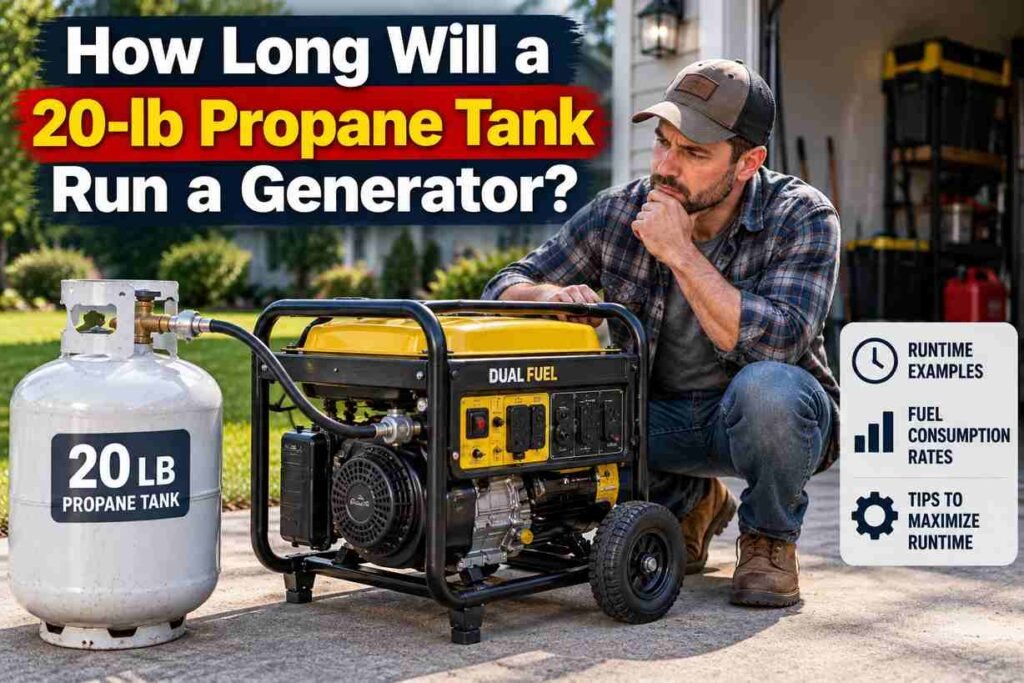
A full 20-lb propane tank will typically run a portable propane generator for roughly 5 to 25 hours, depending mainly on generator size and electrical load. Small inverter generators can run much longer because they burn fuel slowly at light loads, while large open-frame generators may use a 20-lb cylinder in about 5 hours at 50% load. For example, Champion currently lists up to 25 hours at 25% load for a 2,500-watt dual-fuel inverter, 10.5 hours at 50% load for a 3,650-watt model, and about 5 hours at 50% load for several 8,000–9,200-watt models. I always use the runtime published for your exact generator whenever possible.
If you are trying to plan for a blackout, camping trip, jobsite, or RV stay, I would not rely on a single “hours per tank” number. A 20-lb propane cylinder contains a fixed amount of fuel, but generators do not burn that fuel at a fixed rate. The engine consumes more propane when you connect more electrical load, and larger engines generally use more fuel than smaller engines.
In this guide, I’ll show you real manufacturer runtime examples, explain how much propane is actually in a 20-lb cylinder, give you a simple way to estimate runtime, and show you what changes the number in the real world.


How Much Propane Is Actually in a 20-lb Tank?
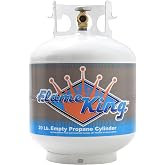
A standard 20-lb propane cylinder is the familiar grill-style tank that many portable dual-fuel generators are designed to use. The “20 lb” refers to the nominal weight of propane the cylinder can hold, not the total weight of the cylinder itself.
Propane suppliers commonly list a full 20-lb cylinder at about 4.6 to 4.7 gallons of propane. Using the U.S. Energy Information Administration’s current heat-content figure of about 91,452 BTU per gallon, that works out to roughly 421,000 to 430,000 BTU of fuel energy in a fully filled cylinder.
| 20-lb propane cylinder figure | Approximate value | Why it matters |
|---|---|---|
| Propane weight | 20 lb | The nominal fuel capacity |
| Liquid propane volume | About 4.6–4.7 gal | Useful for estimating gallons per hour |
| Energy per gallon | About 91,452 BTU | Current EIA heat-content figure |
| Total fuel energy | About 421,000–430,000 BTU | Shows how much chemical energy is stored in the cylinder |
| Common use | Portable grills and generators | 20-lb cylinders are widely used with portable equipment |
The generator cannot turn all of those BTUs into electricity because small engines and alternators lose energy as heat, exhaust, friction, and other inefficiencies. That is why I do not calculate generator runtime by simply dividing propane BTUs by electrical watt-hours unless I also have a realistic efficiency figure. The manufacturer’s tested runtime is usually the better starting point.
Real 20-lb Propane Tank Generator Runtime Examples
The most useful way to understand runtime is to look at actual generator specifications. Champion publishes runtime on a 20-lb propane cylinder for many of its current dual-fuel generators, and the numbers show how dramatically generator size and load change the result.


| Generator example | LP running watts | Test load | Published runtime on 20-lb tank |
|---|---|---|---|
| Champion 2,500W dual-fuel inverter | 1,665 W | 25% load | Up to 25 hours |
| Champion 3,650W dual-fuel generator | 3,285 W | 50% load | 10.5 hours |
| Champion 5,500W dual-fuel generator | 5,000 W | 50% load | 6.5 hours |
| Champion 6,250W dual-fuel generator | 5,600 W | 50% load | 10.5 hours |
| Champion 8,000W dual-fuel generator | 7,200 W | 50% load | 5 hours |
| Champion 8,500W dual-fuel generator | 7,650 W | 50% load | 5 hours |
| Champion 9,200W dual-fuel generator | 8,280 W | 50% load | 5 hours |
I would not use this table as a promise that every generator with the same wattage will run for the same number of hours. Different engines, carburetion systems, inverter controls, alternator efficiency, and load-management strategies can change fuel consumption significantly. The table is best used to understand the range you may see in real equipment.
The most important lesson is that a small generator carrying a light load can stretch one 20-lb tank through most of a day, while a large portable generator carrying a substantial load may use the same cylinder in a single afternoon or evening.
My Practical Rule of Thumb
If I do not have the exact manufacturer runtime in front of me, I use a broad planning range rather than pretending I can predict the exact hour. For many portable propane generators, I would think in roughly these terms:
| Generator/load situation | Planning estimate for a full 20-lb tank | Comments |
|---|---|---|
| Small inverter, very light load | 15–25+ hours | Best case for runtime |
| Small/medium portable, light to moderate load | 8–15 hours | Common backup/camping range |
| Medium portable, around 50% load | 6–11 hours | Varies greatly by engine and model |
| Large 7–9 kW-class portable, around 50% load | About 5–7 hours | High fuel demand |
| Near maximum continuous output | Usually less than the 50% load runtime | Fuel use rises as load rises |
I use these only for planning. If I need to know whether one cylinder will make it through the night, I look up the exact generator manual or product specification and add a safety margin.
How Generator Load Changes Propane Runtime
Electrical load is usually the biggest variable you can control. A generator producing only 500 watts does not need the same engine power as it does while producing 4,000 or 6,000 watts. As the electrical load rises, the governor opens the throttle, the engine produces more torque, and propane consumption increases.

That means shutting off unnecessary appliances can extend runtime. During an outage, I prioritize refrigerators, freezers, lights, communications, medical equipment, and other essential loads before I run large resistance heaters, electric water heaters, clothes dryers, or multiple high-wattage appliances.
Starting watts matter too
Motors and compressors can briefly require much more power when they start than when they are already running. A refrigerator, well pump, sump pump, or air conditioner may cause the generator to jump to a higher fuel demand for a few seconds. Those short surges usually do not change total runtime dramatically by themselves, but frequent cycling can increase fuel use and can expose a generator that is already operating near its limit.
A Simple Runtime Formula I Use
If the manufacturer gives you propane consumption in gallons per hour, estimating runtime is straightforward. I use:
Estimated runtime = usable gallons in the cylinder ÷ generator propane consumption in gallons per hour


For a fully filled 20-lb cylinder, using about 4.6 gallons is a reasonable planning figure. If a generator burns 0.5 gallon per hour at your operating load, the estimate is:
4.6 gal ÷ 0.5 gal/hr = about 9.2 hours
| Propane consumption | Estimated runtime from 4.6 gal | Approximate propane used in 10 hours |
|---|---|---|
| 0.20 gal/hr | 23.0 hr | 2.0 gal |
| 0.30 gal/hr | 15.3 hr | 3.0 gal |
| 0.40 gal/hr | 11.5 hr | 4.0 gal |
| 0.50 gal/hr | 9.2 hr | 5.0 gal |
| 0.70 gal/hr | 6.6 hr | 7.0 gal |
| 0.90 gal/hr | 5.1 hr | 9.0 gal |
The last column also shows why a 20-lb tank cannot physically support 10 hours at the higher consumption rates—it would require more propane than the cylinder holds. When I see a generator specification in gallons per hour, this quick calculation is usually the easiest way to plan fuel.
Why a 20-lb Tank May Not Deliver All Its Fuel at High Generator Demand
There is another issue besides total fuel quantity: vaporization capacity. Most portable propane generators consume propane vapor. Liquid propane inside the cylinder has to absorb heat and boil into vapor fast enough to feed the engine.
A 20-lb cylinder can contain plenty of propane but still struggle to vaporize it quickly enough if the generator is large, the load is high, the weather is cold, or the cylinder is nearly empty. When vaporization cannot keep up, cylinder pressure can fall and the generator may lose power, surge, or shut down before the cylinder is technically empty.
If that sounds familiar, see my guide on why propane pressure drops when a generator starts and my article on why a propane generator loses power under load.
Cold Weather Can Shorten Practical Runtime
Cold weather does not magically remove propane from the cylinder, but it can reduce how quickly the liquid propane vaporizes. As propane evaporates, the cylinder gets colder. If the outdoor temperature is already low and the generator is drawing fuel rapidly, the tank can frost and the available vapor pressure can fall.
That means the generator may stop or lose power even though propane remains in the tank. A larger approved cylinder has more surface area and can usually vaporize fuel more effectively. For long emergency operation in cold climates, I would not assume a single 20-lb cylinder is the right fuel supply for a high-output generator.
A Full Exchange Tank May Not Contain 20 Pounds of Propane
This is an easy detail to miss. A cylinder that is physically called a “20-lb tank” does not always arrive with 20 pounds of propane in it. Some exchange programs sell cylinders with a lower net propane fill. That means two cylinders that look identical can give you different runtime.
If I am comparing runtime precisely, I check the label for the net propane weight. A refill station that fills the cylinder to its proper allowable capacity may give you more fuel than an exchange cylinder that is sold with a lower net weight.
| Actual propane in cylinder | Compared with true 20-lb fill | Expected effect on runtime |
|---|---|---|
| 20 lb | 100% reference | Full expected runtime |
| 18 lb | 90% of reference | Roughly 10% less runtime |
| 15 lb | 75% of reference | Roughly 25% less runtime |
| 10 lb remaining | 50% of reference | Roughly half the full-tank runtime |
Those percentages are approximate because fuel consumption is not perfectly constant, but they are useful for planning. If your generator used to run 8 hours and now runs about 6 hours on exchange cylinders, the actual fill amount is one of the first things I would check.
Can I Use Two 20-lb Tanks to Double Runtime?
In principle, more propane capacity can extend operating time, but I do not connect multiple cylinders with improvised tees, homemade manifolds, or unapproved fittings. The regulator, hoses, excess-flow devices, and cylinder connections must be designed for the generator and for multi-cylinder service if you want to use more than one tank.
Some portable-generator manufacturers offer approved larger-cylinder setups or accessories. If I need substantially more runtime, I prefer a manufacturer-approved solution or a properly designed larger propane supply installed by a qualified propane professional.
For a deeper look at matching tank size to generator demand, see what propane tank size you need for a generator.
Is a 20-lb Tank Big Enough for a Whole-House Standby Generator?
Generally, I would not treat a 20-lb grill cylinder as the normal fuel supply for a whole-house standby generator. Standby units can consume propane at rates measured in gallons per hour, and they may need to run continuously for many hours or days. They also require enough vaporization capacity to support the engine at full load.
For example, current Generac standby specifications show propane consumption well above 1 gallon per hour on many home units. A 14 kW Generac model lists about 1.76 gallons per hour at 50% load and 2.92 gallons per hour at full load. A 20-lb cylinder only holds roughly 4.6 gallons, so even ignoring vaporization limits, the theoretical fuel quantity would be exhausted quickly. Standby systems are normally paired with much larger propane tanks sized by a professional.
This article is therefore mainly about portable generators specifically designed to operate from a 20-lb cylinder.
How Many 20-lb Tanks Would I Keep for an Outage?
I plan backward from expected runtime. If my generator runs 7 hours on one 20-lb tank at my normal load and I want 24 hours of coverage, I would need about 3.4 full tanks mathematically. In real life, I would round up because loads change, tanks may not be completely full, and I do not want to run out of fuel at the exact calculated minute.
| Runtime per tank | Tanks for about 24 hr | Tanks for about 48 hr | Tanks for about 72 hr |
|---|---|---|---|
| 5 hr | 5 tanks | 10 tanks | 15 tanks |
| 7 hr | 4 tanks | 7 tanks | 11 tanks |
| 10 hr | 3 tanks | 5 tanks | 8 tanks |
| 15 hr | 2 tanks | 4 tanks | 5 tanks |
| 20 hr | 2 tanks | 3 tanks | 4 tanks |
These are planning numbers, not storage recommendations. Propane-cylinder storage and quantity limits can depend on where you live and where the cylinders are stored, so I follow local fire code, supplier guidance, and cylinder-storage rules.
How I Make a 20-lb Tank Last Longer
- Run only the loads I actually need. Lower electrical load usually means lower fuel consumption.
- Avoid using electric resistance heat if another safe option is available. A 1,500-watt heater can consume a large share of a small generator’s capacity.
- Let refrigerators and freezers cycle. I do not need every appliance drawing power continuously.
- Use an inverter generator when the load is light. Inverter designs can reduce engine speed at low load on models designed to do so.
- Keep the generator maintained. A dirty air filter, worn spark plug, or poorly running engine can waste fuel.
- Use a properly filled cylinder. A partially filled or underfilled exchange tank starts with less available runtime.
- Keep the propane system correctly sized. A restricted hose or regulator can reduce performance even if fuel remains in the cylinder.
Portable Generator Safety Matters More Than Runtime
I never extend runtime by moving a generator closer to the house, into a garage, onto a porch, or into another enclosed area. Propane generators still produce carbon monoxide. The U.S. Consumer Product Safety Commission says portable generators should be operated outdoors only, at least 20 feet from the home, with the exhaust directed away from the building.
I also follow the generator manufacturer’s instructions for wet weather, electrical grounding or bonding, extension cords, refueling, and propane-cylinder placement. A few extra hours of runtime are never worth creating a carbon-monoxide, fire, or electrical hazard.
Frequently Asked Questions
Will a 20-lb propane tank run a generator all night?
Often, yes—but not always. A small or medium generator at a moderate load may run 8–15 hours, which can cover a typical night. A large generator at about 50% load may run only around 5–7 hours on the same cylinder. I check the exact model specification before relying on one tank overnight.
How long will a 20-lb propane tank run a 5,000-watt generator?
A current Champion model rated at 5,000 running watts on propane lists about 6.5 hours at 50% load from a 20-lb cylinder. Another brand or model can differ, so I use that only as a real-world example rather than a universal rule.
How long will a 20-lb propane tank run a 3,500-watt generator?
Many generators in this size range can run roughly 8–12 hours at moderate load. One current Champion 3,650-watt-class dual-fuel model lists 10.5 hours at 50% load on a 20-lb cylinder.
Does a generator use more propane at full load?
Yes. As electrical load increases, the engine must produce more power, so fuel consumption rises. That is why manufacturer runtime is usually stated at a specific load such as 25% or 50%.
Does a propane generator run longer than a gasoline generator?
It depends on the fuel tank sizes and the generator design. A comparison based only on hours can be misleading because the onboard gasoline tank and external propane cylinder may contain very different amounts of usable energy. I compare fuel consumption at the same electrical load instead.
Can I run a generator continuously until the propane tank is empty?
I follow the generator’s operating and maintenance instructions rather than assuming continuous operation is unlimited. Oil checks, maintenance intervals, weather conditions, cylinder vaporization, and safe shutdown procedures still apply even if fuel remains.
Bottom Line
For most portable-generator planning, I would say a full 20-lb propane tank can provide about 5 to 25 hours of runtime, with the wide range caused mainly by generator size and electrical load. Large 8–9 kW-class portable generators can use a cylinder in about 5 hours at 50% load, while a small inverter at light load can run much longer.
If I want the best estimate for my own generator, I use the exact manufacturer runtime or propane consumption figure, check how much propane is actually in the cylinder, and then adjust for my real electrical load and operating conditions. I also remember that cold weather and high fuel demand can limit vaporization before every last pound of propane is usable.
For long outages, I would rather calculate my fuel plan in advance than discover halfway through the night that my generator burns propane twice as fast as I expected.

Mike is an experienced propane technician with over 15 years of professional experience in the field. He has dedicated his career to helping customers with their propane needs, from installation to maintenance and repair. Together with Jeremy, he co-founded this website to provide useful information and guidance to customers seeking reliable propane services.