Quick Answer
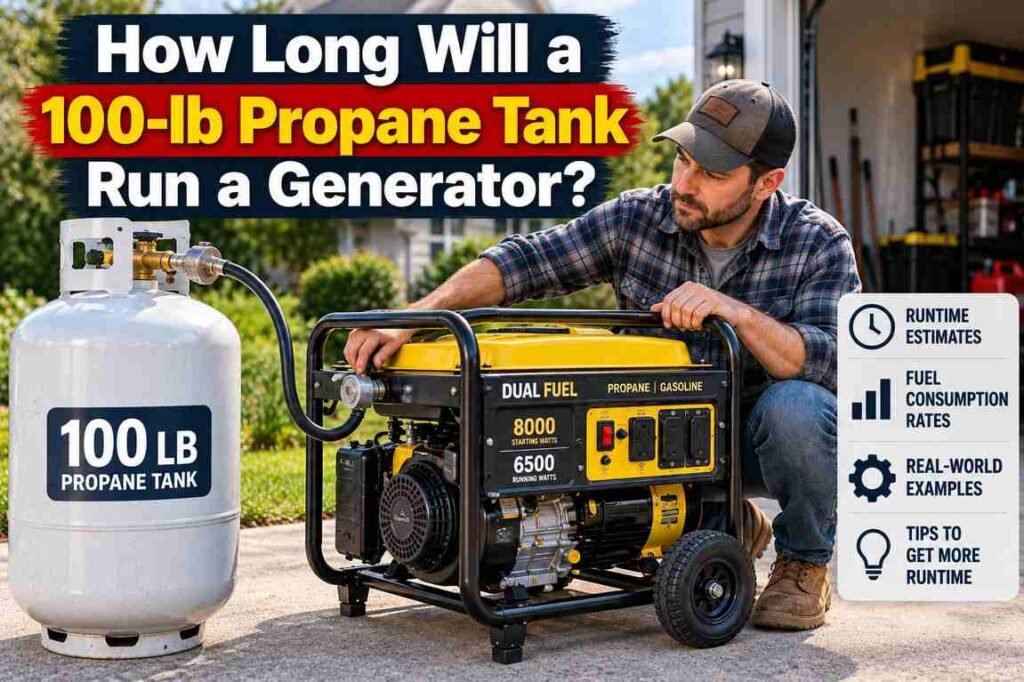
A full 100-lb propane tank can run many portable generators for roughly 20 to 50+ hours, depending mainly on generator size and electrical load. A 100-lb cylinder holds about 23 gallons of propane, which is about five times the fuel in a full 20-lb cylinder. Using current Champion runtime figures as examples, a 3,650-watt-class generator that runs 10.5 hours at 50% load on a 20-lb tank would theoretically run about 52.5 hours on 100 lb of propane, while an 8,000-watt-class generator that runs 5 hours on a 20-lb tank would be closer to 25 hours. I treat those as planning estimates, because temperature, load, regulator capacity, and the approved cylinder connection can change real runtime.
A 100-lb propane cylinder gives you much more useful runtime than a standard 20-lb grill tank, which is why many people consider one for extended outages, cabins, RV setups, workshops, and portable backup generators. But I would not tell you that a 100-lb tank always runs a generator for a fixed number of hours. Generator fuel use varies too much from one model and load level to another.
The most reliable way I estimate runtime is to start with the amount of propane in the cylinder, then compare that with the generator’s published propane consumption or runtime at a known load. In this guide, I’ll walk you through both methods and show real examples from current generator specifications.


How Much Propane Is in a 100-lb Tank?
A 100-lb propane cylinder holds about 100 pounds of propane when properly filled. AmeriGas lists a full 100-lb cylinder at approximately 23 gallons of propane. That is almost exactly five times the 4.6 gallons in a full 20-lb cylinder.
The U.S. Energy Information Administration currently lists propane at about 91,452 BTU per gallon. At 23 gallons, a full 100-lb cylinder contains about 2.1 million BTU of fuel energy before engine and generator losses.
| 100-lb propane cylinder figure | Approximate value | Why it matters |
|---|---|---|
| Propane weight | 100 lb | Nominal propane capacity |
| Liquid propane volume | About 23 gal | Main figure I use for runtime calculations |
| Energy per gallon | About 91,452 BTU | Current EIA heat-content value |
| Total fuel energy | About 2.10 million BTU | Chemical energy stored in a full cylinder |
| Compared with 20-lb tank | About 5× more propane | Useful for scaling known 20-lb runtimes |
Real-World 100-lb Runtime Estimates From Current Generator Data
Many portable-generator manufacturers publish runtime using a 20-lb cylinder because that is the most common portable propane tank. Since a 100-lb cylinder contains about five times as much propane, I can make a simple planning estimate by multiplying the 20-lb runtime by about five—provided the generator is approved to use the larger supply and fuel flow remains adequate.
| Current generator example | Published 20-lb runtime | Load used in test | 100-lb planning estimate |
|---|---|---|---|
| Champion 3,650W dual-fuel | 10.5 hr | 50% load | About 52.5 hr |
| Champion 5,500W dual-fuel | 6.5 hr | 50% load | About 32.5 hr |
| Champion 8,000W dual-fuel | 5 hr | 50% load | About 25 hr |
I emphasize that these are scaled estimates, not manufacturer-certified 100-lb runtime tests. Actual performance depends on the connection method, regulator capacity, temperature, load pattern, and whether the generator is designed for that cylinder setup. Still, the numbers are useful for understanding what a 100-lb tank can realistically do.


A Simple Formula for 100-lb Propane Tank Runtime
If your generator manual gives propane consumption in gallons per hour, the math is simple. I use:
Runtime in hours = usable propane gallons ÷ generator propane consumption in gallons per hour
For a 100-lb cylinder, I use about 23 gallons as the starting point. So if a generator consumes 0.5 gallon per hour at your typical load:
23 gal ÷ 0.5 gal/hr = about 46 hours
| Propane consumption | Estimated runtime from 23 gal | Approximate propane used in 24 hr |
|---|---|---|
| 0.30 gal/hr | 76.7 hr | 7.2 gal |
| 0.40 gal/hr | 57.5 hr | 9.6 gal |
| 0.50 gal/hr | 46.0 hr | 12.0 gal |
| 0.60 gal/hr | 38.3 hr | 14.4 gal |
| 0.80 gal/hr | 28.8 hr | 19.2 gal |
| 1.00 gal/hr | 23.0 hr | 23.0 gal |
| 1.20 gal/hr | 19.2 hr | 28.8 gal |
That last row is a good reminder that a generator burning more than about 1 gallon per hour will not make it through a full 24-hour day on one 100-lb cylinder.

My Practical Runtime Range by Generator Size
If I do not have the exact consumption figure, I use a broad planning range. These are not guarantees, but they are realistic starting points for many portable propane generators.
| Generator situation | Typical 100-lb planning range | What I expect |
|---|---|---|
| Small inverter, light load | 50–80+ hr | Longest runtime |
| Small/medium portable, moderate load | 35–55 hr | Common extended-backup range |
| Medium 5–6 kW portable, around 50% load | 30–40 hr | Higher fuel demand |
| Large 7–9 kW portable, around 50% load | 20–30 hr | High fuel consumption |
| Near maximum continuous load | Less than 50%-load runtime | Fuel use rises as output rises |
Why Electrical Load Changes Runtime So Much
A propane generator does not burn fuel at one fixed rate. As you connect more electrical load, the engine has to produce more torque. The governor opens the throttle, the engine consumes more propane, and runtime falls.
This is why I can often extend runtime significantly by managing loads. During an outage, I may power a refrigerator, freezer, lights, internet equipment, a few outlets, and a well pump only when needed. If I also run electric space heaters, an electric water heater, or large air-conditioning loads continuously, propane use rises quickly.
Motor starting loads are different from running loads
Refrigerators, pumps, compressors, and air conditioners can draw much more power for a few seconds when they start. Those short surges do not necessarily destroy your overall runtime, but they can increase fuel demand temporarily and make a marginal propane supply system show pressure-drop problems.


A 100-lb Tank Is Not the Same as a 100-Gallon Tank
This is an important distinction. A 100-lb propane cylinder holds about 23 gallons of propane. A 100-gallon propane tank is much larger and can hold roughly 80 gallons when filled to the normal 80% liquid level used for expansion space.
| Tank description | Approximate propane quantity | Relative fuel capacity |
|---|---|---|
| 20-lb cylinder | 4.6 gal | 1× reference |
| 100-lb cylinder | 23 gal | About 5× a 20-lb cylinder |
| 100-gallon tank | About 80 gal usable | About 17× a 20-lb cylinder |
I mention this because searches for “100 propane tank” often mix pounds and gallons. If you are planning a long outage, that difference completely changes runtime.
Can I Connect a 100-lb Tank Directly to Any Propane Generator?
No. I would not assume every portable generator can be connected directly to a 100-lb cylinder. Many dual-fuel generators are sold with a hose and regulator designed around a standard 20-lb or 30-lb cylinder. Champion, for example, specifically recommends contacting a qualified local installer when using cylinders larger than the standard portable sizes.
The correct connection depends on regulator type, inlet pressure, hose design, cylinder valve, generator fuel system, and manufacturer instructions. I do not use an improvised adapter simply because the threads fit.
If you are working out the regulator side of the setup, see my propane regulator guide for portable dual-fuel generators.
Why a 100-lb Cylinder Often Performs Better Than a 20-lb Cylinder in Cold Weather
A larger cylinder does more than hold more fuel. It also provides more surface area for liquid propane to absorb heat from the surroundings and vaporize. That can make a 100-lb cylinder more capable of supporting sustained generator demand, especially in cool weather.
A small 20-lb cylinder may begin frosting or losing vaporization capacity under high demand even though propane remains inside. A 100-lb cylinder generally has a better ability to vaporize fuel at the same withdrawal rate, although very cold conditions and high generator loads can still create limits.
If your generator loses pressure when it starts, see why propane pressure drops when a generator starts.
How Long Would a 100-lb Tank Run Common Generator Loads?
The generator’s rated wattage is only part of the story. What matters most is how much power you are actually using. A 7,000-watt generator powering 1,500 watts of load may use much less propane than the same generator operating near full output.
| Typical backup load pattern | Likely fuel-use effect | Expected runtime effect |
|---|---|---|
| Refrigerator + lights + internet | Low to moderate | Long runtime |
| Refrigerator + freezer + well pump cycling | Moderate | Good runtime with occasional spikes |
| Several kitchen appliances | Moderate to high | Runtime drops |
| Large window A/C or portable A/C | High while compressor runs | Noticeable fuel increase |
| Electric space heaters | High continuous load | Shorter runtime |
| Near generator maximum output | Very high | Shortest runtime |
How Many Days Can a 100-lb Propane Tank Run a Generator?
To convert hours into days, I simply divide runtime by 24. For example, 48 hours is two days of continuous operation, while 36 hours is one and a half days.
| Runtime | Equivalent continuous time | What it means for planning |
|---|---|---|
| 24 hr | 1 day | One full day without refilling |
| 36 hr | 1.5 days | Day plus overnight plus half a day |
| 48 hr | 2 days | Two continuous days |
| 60 hr | 2.5 days | Useful for light-load operation |
| 72 hr | 3 days | Possible mainly with efficient/light-load setups |
If I am planning for a multi-day outage, I do not run the generator continuously unless I truly need to. Load scheduling can stretch a 100-lb cylinder much farther.
Can a 100-lb Tank Run a Generator for a Whole Weekend?
Often, yes. A weekend is roughly 48 hours. A small or medium portable generator at light to moderate load may reach or exceed that on a full 100-lb cylinder. A large 8,000-watt-class generator at 50% load, however, may be closer to 25 hours based on current 20-lb runtime data scaled to 100 lb.
So if I needed guaranteed weekend coverage, I would calculate from the specific generator’s propane consumption rather than assume one cylinder is enough.
How a 100-lb Tank Compares With Five 20-lb Tanks
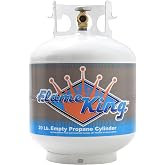
On paper, the propane quantity is nearly the same. Five full 20-lb cylinders hold about 23 gallons total, roughly equal to one full 100-lb cylinder. But the operating experience is different.
| One 100-lb cylinder | Five 20-lb cylinders |
|---|---|
| One large fuel source | Multiple smaller fuel sources |
| Fewer tank changes | More frequent cylinder changes |
| Better vaporization surface area for sustained draw | Each small cylinder can cool faster under heavy draw |
| Heavy and less portable | Easier to move one at a time |
| Connection may require approved larger-cylinder setup | Often matches included portable-generator hose |
I choose based on whether I value portability or long uninterrupted operation. For emergency home backup, fewer cylinder changes can be a major advantage. For camping or moving the generator frequently, 20-lb cylinders may be easier to handle.
How I Estimate My Own Runtime Before an Outage
- Find the generator’s propane consumption or 20-lb runtime. I use the manufacturer specification whenever possible.
- Identify the load used in the test. A runtime measured at 25% load cannot be compared directly with one measured at 50% load.
- Convert the fuel quantity. A 100-lb tank is about 23 gallons.
- Scale carefully. If I only have a 20-lb runtime, multiplying by about five gives a reasonable first estimate.
- Reduce the estimate for real-world planning. I leave a margin for cold weather, changing loads, and tanks that may not be perfectly full.
- Confirm the connection is approved. I do not attach a 100-lb tank to a generator unless the regulator and hose setup is appropriate.
What Can Make the Tank Seem to Run Out Early?
- A cylinder that was not filled to its expected weight
- Cold weather limiting propane vaporization
- High electrical load
- A regulator or hose restriction
- A leak in the propane system
- Generator maintenance problems causing inefficient operation
- Running heaters or other large continuous loads
- Incorrect assumptions based on gasoline watt ratings instead of propane ratings
If the generator is still running but power falls off as fuel demand increases, read why a propane generator loses power under load.
Safety: A Larger Tank Does Not Change Generator CO Rules
A propane generator still produces carbon monoxide. I never run one in a garage, shed, basement, carport, enclosed porch, or close to doors and windows just because it is fueled by propane. Portable generators belong outdoors and well away from occupied buildings, following the manufacturer’s placement instructions.
A full 100-lb cylinder is also heavy. I keep it upright and secured according to propane-cylinder handling requirements and avoid moving or transporting it casually once filled. I follow local propane rules and supplier guidance for storage and transport.
Frequently Asked Questions
How long will a 100-lb propane tank run a 5,000-watt generator?
A current Champion 5,500-watt model produces 5,000 running watts on propane and is rated for 6.5 hours at 50% load on a 20-lb cylinder. Scaling the fuel quantity by five gives a planning estimate of about 32.5 hours on 100 lb of propane at a similar load.
How long will a 100-lb propane tank run an 8,000-watt generator?
A current Champion 8,000-watt dual-fuel model is rated for about 5 hours at 50% load on a 20-lb propane cylinder. A simple five-times fuel scaling gives about 25 hours from a full 100-lb cylinder at a similar load, assuming the larger-cylinder setup is approved and can supply the required flow.
How long will a 100-lb propane tank run a 3,500-watt generator?
A current Champion 3,650-watt-class model runs 10.5 hours at 50% load on a 20-lb cylinder. Five times the fuel suggests roughly 52.5 hours from 100 lb of propane at the same test load.
Is a 100-lb propane tank good for emergency backup?
It can be very useful for a portable generator because it reduces cylinder changes and provides better vaporization capacity than a 20-lb tank. I still verify that the generator manufacturer allows or supports the connection and that the regulator and hose are correctly sized.
How many gallons are in a 100-lb propane tank?
AmeriGas lists a full 100-lb cylinder at approximately 23 gallons of propane.
Should I use a 100-lb tank or a larger stationary tank?
For occasional portable backup, a 100-lb cylinder can be convenient. For long outages, high-output generators, or whole-house standby systems, a larger stationary propane tank is usually more practical because it provides much more fuel and vaporization capacity.
Bottom Line
A full 100-lb propane cylinder holds about 23 gallons of propane and can run many portable generators for roughly 20 to 50+ hours, depending on generator size and electrical load. Small or moderately loaded generators can push beyond two days, while large 7–9 kW-class portable generators at around 50% load may be closer to one day.
For the best estimate, I use the generator manufacturer’s propane consumption or 20-lb runtime figure. If all I have is a 20-lb runtime, multiplying it by about five gives me a solid planning number because a 100-lb cylinder contains about five times as much propane. Then I reduce that estimate slightly for real-world conditions and make sure the larger-cylinder regulator and connection are approved.
If you are comparing sizes, my related guide on how long a 20-lb propane tank runs a generator makes the difference especially clear.

Mike is an experienced propane technician with over 15 years of professional experience in the field. He has dedicated his career to helping customers with their propane needs, from installation to maintenance and repair. Together with Jeremy, he co-founded this website to provide useful information and guidance to customers seeking reliable propane services.