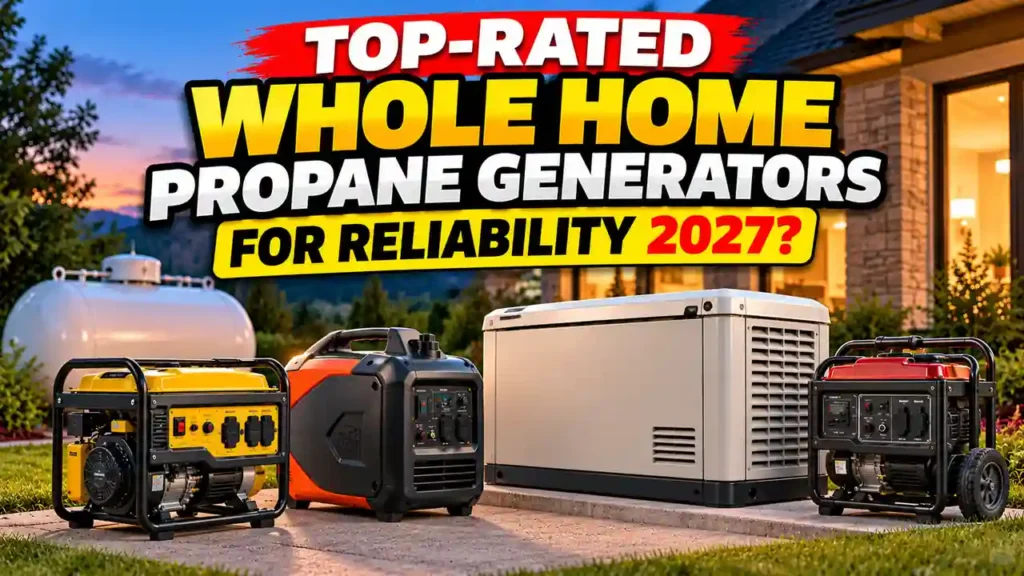
TL;DR — Top-rated whole-home propane generators for reliability in 2026
For most homeowners who prioritize local service, my first shortlist is the Generac Guardian Next Generation 22-kW. I would also compare the KOHLER 26RCA for motor-starting and premium installation, the Briggs & Stratton PowerProtect+ 26-kW for warranty coverage, the Generac Next Generation 26-kW for larger simultaneous loads, and the Cummins QuietConnect RS20A where strong local Cummins support is available. The Champion aXis 14-kW deserves a look for essential circuits with smart load management. These are editorial picks based on published specifications, design, warranty and service considerations—not independently measured failure-rate rankings. Before you buy, I would prioritize a qualified local dealer, an accurate electrical load calculation and a properly sized propane system.
What are the top-rated whole-home propane generators for reliability in 2026? I would start with Generac, KOHLER (now associated with the Rehlko power business), Briggs & Stratton, Cummins and Champion. But the most reliable generator for your home isn’t necessarily the one with the biggest engine or the longest advertised warranty. It’s the unit that can power your essential loads when the grid fails, has adequate propane available, and can be repaired promptly by someone near you.


I’ve written this buyer’s guide for U.S. residential 120/240-volt, 60-Hz propane standby systems. These are permanently installed generators that can work with an automatic transfer switch. I’m not ranking portable propane generators, and I am not treating a seller’s five-star review average as proof of lifetime reliability.
The models and public specifications were checked for the 2026 buying season. Model numbers, packages and warranties change, so I recommend confirming the exact SKU and written terms before placing an order. I don’t claim to have run a controlled endurance test of all six generators; instead, I explain the strengths, limitations and buying questions that matter.
Best Whole-Home Propane Generators of 2026: My Shortlist
| Editorial pick | Verified LP output | What stands out | Important limitation |
|---|---|---|---|
| Generac Guardian Next Gen 22 kW (7325) | 22 kW | Cellular status monitoring; transfer-switch bundle; broad service ecosystem | Dealer quality and site installation matter |
| KOHLER 26RCA | 26 kW | Large motor-starting capability; aluminum enclosure | Confirm local Rehlko/KOHLER service access |
| Briggs & Stratton PowerProtect+ 26 kW | 26 kW | 7-year limited warranty; 993-cc commercial-grade Vanguard engine | Warranty terms and package vary by SKU |
| Generac Guardian Next Gen 26 kW (7327/7328) | 26 kW | Large-output cellular Guardian option | More power does not always mean more reliability or lower cost |
| Cummins QuietConnect RS20A | 20 kW on LP | Sound-attenuated residential standby family; load management options | Dealer coverage and parts timing vary regionally |
| Champion aXis 14 kW (100837) | 14 kW | 200-A smart load-managing transfer switch; 10-year limited warranty | Not enough for every large home load at once |
This table is a practical editorial shortlist. I did not find a credible, public, apples-to-apples database of field failure rates for all these exact 2026 models. So I won’t invent reliability percentages or pretend that “number one” is proven by laboratory testing. I rank them according to likely owner priorities: service access, protection and controls, engine/generator specifications, warranty and fuel-system fit.
How I Judge Reliability Before Recommending a Standby Generator
When I’m choosing equipment intended to protect a household during a major outage, I don’t care only about a generator’s maximum advertised kilowatts. I want to know whether it will start automatically, accept the home’s motor-starting loads, maintain stable voltage, and remain supported years later. I also need the propane supplier and installer to prove the fuel system can keep up.


| Reliability factor | Why I weigh it heavily | What I would verify |
|---|---|---|
| Local dealer and repair access | A broken generator is useless if no technician can get parts | Distance, emergency service, parts stock, response policy |
| Actual LP rated watts | The generator must support loads on propane, not just natural gas | Model-specific LP output and starting capability |
| Automatic transfer switch | Safe, dependable transfer matters as much as engine starting | Switch rating, whole-home vs selected circuits, load management |
| Engine, alternator and enclosure | Weather resistance and sound power quality affect ownership | Corrosion control, service access, voltage specs |
| Monitoring and alerts | Early warnings can prevent surprise failures | Connectivity fees, notifications and service records |
| Warranty terms | Longer coverage may reduce ownership risk | Parts, labor, travel, exclusions, registration |
| Propane delivery design | Low pressure can shut down an otherwise healthy unit | Tank vaporization, minimum level, regulator, piping, cold weather |
I encourage you to read my full explanation of propane generator reliability, pros and cons before treating any brand as completely trouble-free. Fuel storage is one of propane’s benefits, but a properly designed system matters more than a marketing badge.
1. Generac Guardian Next Generation 22-kW — My All-Around Starting Point
If I were shopping for a typical home that wants automatic backup for several essential and comfort circuits, I would put the Generac Guardian Next Generation 22-kW package (model 7325) on the first quote request. The current published bundle pairs a 22-kW class generator with a transfer switch, built-in cellular connectivity, electronic fuel/ignition control and a Power Zone 200 controller.
Generac lists 22 kW on propane and 21 kW on natural gas for this newer model. That difference matters. I would not copy an older Guardian’s 19.5-kW natural-gas rating onto it, and I would not mix the new model’s propane fuel consumption with older 7043 specifications.
| Next Gen Guardian 22-kW specification | Published value |
|---|---|
| Example transfer-switch package | 7325 / G0073250 |
| Continuous output on LP | 22,000 W |
| Continuous output on natural gas | 21,000 W |
| Electrical output | 120/240 V, single phase |
| LP fuel consumption at 50% of rated output | 2.45 U.S. gal/hour |
| LP fuel consumption at full rated output | 3.71 U.S. gal/hour |
| Standard listed warranty | 5-year limited |
| Monitoring | Built-in cellular; some app features may require subscription |
I like the model’s monitoring and service-oriented features because a standby machine spends most of its life waiting. A low-oil alert, failed exercise cycle, weak battery, or maintenance reminder may matter more to a homeowner than a marginal difference in advertised output. If you have several authorized Generac technicians nearby, that also strengthens the argument.
My reservation: a widely available brand is not automatically the most dependable individual installation. I would ask who will commission the unit, how they conduct loaded testing, whether batteries and service parts are stocked locally, and what happens if the unit fails during a long storm.

2. KOHLER 26RCA — My Premium Motor-Starting Candidate
The KOHLER 26RCA deserves a top place when a home has multiple large motor loads and the owner values strong electrical performance and an established dealer relationship. The current Rehlko/KOHLER listing shows 26 kW on LP, 24 kW on natural gas and a 39-kVA peak motor-starting rating at 240 volts for the listed configuration.
I also like that the manufacturer publishes separate exercise and normal operating sound ratings. Exercise mode is not the same condition as supplying a house during an outage, so a low exercise number shouldn’t be advertised as the generator’s full-load noise.
| KOHLER 26RCA detail | Published specification |
|---|---|
| LP rated output | 26 kW |
| Natural-gas rated output | 24 kW |
| Peak motor-starting capability | 39 kVA at 240 V (listed configuration) |
| Engine displacement | 999 cc |
| Enclosure | Aluminum |
| Sound during weekly exercise | 56 dB(A) |
| Sound during full-speed operation | 67 dB(A) |
| Warranty | 5-year limited |
My reliability question for KOHLER isn’t simply “Is it a good generator?” The answer depends on whether your area has a competent authorized installer and a service route with dependable spare parts. I would verify the exact transfer-switch package, installation clearances and dealer-maintenance responsibilities in writing.
The KOHLER energy business uses the Rehlko corporate name, so don’t be surprised if you encounter both names on documentation. That branding change does not by itself prove a defect or improvement in the generator.


3. Briggs & Stratton PowerProtect+ 26-kW — A Warranty-Focused Pick
If I expected to own the generator for a long time, I would make the Briggs & Stratton PowerProtect+ 26-kW part of the bidding process. The manufacturer’s published specifications show a 26-kW LP / 24-kW natural-gas configuration using a 993-cc Vanguard commercial-grade engine, with a 7-year limited warranty on the PowerProtect+ model page.
Some PowerProtect-branded versions and SKUs are advertised with different warranties, so I would be very particular about that plus sign. If a dealer quotes a “26-kW Briggs generator,” I ask for the exact model number, warranty form and what it covers for labor, travel and accessories.
| PowerProtect+ 26-kW specification | Manufacturer-listed value |
|---|---|
| LP running output | 26 kW |
| Natural-gas running output | 24 kW |
| Engine | Briggs & Stratton Vanguard, 993 cc |
| Rated service voltage | 120/240 V |
| Normal operating sound | 67 dB(A) |
| Half-load LP fuel input | 235,000 BTU/hour |
| Manufacturer-listed warranty | 7 years, subject to written coverage terms |
| General system | Automatic standby; transfer equipment depends on package |
A specification that gives fuel use in BTU/hour isn’t directly interchangeable with gallons/hour, but I can convert it for budgeting. Using about 91,500 BTU per U.S. gallon of propane, the listed 235,000 BTU/hour corresponds to roughly 2.57 gal/hour at its reported 50% load. That’s an estimate based on heating-value conversion, not an independent consumption test.
The more useful question is whether an authorized Briggs service company near you can respond quickly after a storm, and what is actually included in the warranty. A generous warranty is worth less if service, travel time or parts fulfillment are uncertain.
4. Generac Guardian Next Generation 26-kW — More Headroom for Busy Homes
For a home with several air conditioners, pumps, high-draw appliances or significant simultaneous loads, I would compare the 26-kW Next Generation Guardian against the 22-kW unit rather than buy by square footage alone. The newer 7327 generator-only listing specifies 26 kW LP / 24 kW natural gas; the 7328 designation is a transfer-switch bundle in the same new series.
The manufacturer’s published new-series fuel figures are about 2.05 gal/hour at 50% load and 3.95 gal/hour at full load. It’s possible for newer designs to consume less fuel at a particular test point than older or smaller models. But remember that half-load on a 26-kW set is about 13 kW of output, while half-load on a 22-kW set is about 11 kW. Those are not equal-load fuel economy tests.
| Next Gen Guardian 26-kW detail | Manufacturer-listed value |
|---|---|
| Example model designations | 7327 generator-only / 7328 package |
| LP continuous power | 26 kW |
| Natural-gas continuous power | 24 kW |
| LP use at half of rated load | 2.05 gal/hour |
| LP use at full rated load | 3.95 gal/hour |
| Enclosure | Aluminum |
| Controls | Power Zone 200; cellular-equipped configuration |
| Warranty | 5-year limited |
If your calculated peak running and motor-starting loads fit the 22-kW machine comfortably, I would not assume the 26-kW model is a better investment just because it is larger. Both need a strong fuel supply and scheduled maintenance. If your household loads are close to the smaller unit’s limit, extra capacity can reduce the risk of overload trips.
5. Cummins QuietConnect RS20A — Worth Considering Where Cummins Service Is Strong
Cummins has a longstanding commercial power reputation, and its QuietConnect RS20A is an alternative to consider for residential backup. The air-cooled QuietConnect family includes the RS20A rated at 20 kW on LP (with an 18-kW natural-gas rating in the family documentation), plus sound-attenuated enclosures, monitoring options and load-management capabilities.
Cummins publishes noise-focused features for its QuietConnect air-cooled lineup, with a series-level description of 65 dB or lower under its stated test conditions. I would still request the exact current RS20A sound sheet and installation package instead of assuming that one family rating applies to every load condition.
| Cummins RS20A consideration | What I would verify |
|---|---|
| Residential LP capacity | 20 kW |
| Natural-gas rating | 18 kW per family data |
| Rated output configuration | 120/240 V, 60 Hz residential version |
| Enclosure | Weather-protective, sound attenuated |
| Warranty reference | 5 years / 2,000 hours in RS20A documentation; check current contract |
| Monitoring / load management | Availability by controller, accessories and package |
| Availability | Confirm exact SKU, parts and local authorized dealer |
I would not promote Cummins as the universal winner if I couldn’t find a nearby qualified technician. A smaller service presence in one region can turn a good machine into an inconvenient ownership experience. Conversely, if your local dealer knows Cummins well and stocks the parts, it may be an excellent long-term choice.
6. Champion aXis 14-kW — Practical Value With Smart Load Management
The Champion aXis 14-kW model 100837 is marketed as a whole-house standby system and includes a 200-amp automatic transfer switch with aXis load management. Champion lists 14,000 watts on propane and 12,500 watts on natural gas, as well as a 10-year limited warranty on the referenced model.
Here’s the important nuance: a whole-house transfer switch does not make a 14-kW generator capable of supplying every household appliance simultaneously. Smart controls can shed or stagger loads so that essential systems remain powered. I like that approach when a homeowner is comfortable prioritizing circuits, but I would not choose it for unlimited simultaneous heavy electrical loads.
| Champion aXis 100837 specification | Published value |
|---|---|
| LP standby output | 14 kW |
| Natural-gas standby output | 12.5 kW |
| Automatic transfer switch | 200 A with aXis load management |
| LP use at half of rated output | 1.6 gal/hour |
| LP use at full rated output | 2.6 gal/hour |
| Operational sound | 62 dB(A), per product listing |
| Automatic starting | 24 V starting system |
| Warranty | 10-year limited |
This model also gives a useful example of why I compare warranties carefully. A longer warranty on paper doesn’t automatically mean no-cost repairs for a decade under every condition. I would request the full documents, registration rules, mileage/travel restrictions and maintenance requirements.
2026 Technical Comparison: LP vs. Natural-Gas Running Watts
Most home standby products in this group can be configured for either natural gas or propane vapor, but the rated electrical output may differ by fuel. Because this article is about propane reliability, I use the manufacturer’s propane output rather than a higher or lower gas rating that doesn’t apply to your installation.
| Model | LP rated kW | Natural-gas rated kW | LP advantage over NG |
|---|---|---|---|
| Generac Next Gen 22 kW | 22 | 21 | 1 kW |
| KOHLER 26RCA | 26 | 24 | 2 kW |
| Briggs PowerProtect+ 26 kW | 26 | 24 | 2 kW |
| Generac Next Gen 26 kW | 26 | 24 | 2 kW |
| Cummins RS20A | 20 | 18 | 2 kW |
| Champion aXis 14 kW | 14 | 12.5 | 1.5 kW |
These are specific product configurations rather than universal brand ratings. Always check model year, serial-number documentation, altitude derating and the connected transfer equipment. For a permanently installed system, an electrician should calculate both steady loads and compressor/motor starting requirements.
How Much Generator Power Does Your Whole House Actually Need?
I don’t size a standby generator using the number of bedrooms alone. Two 2,500-square-foot houses can have completely different electrical demands. One might use a gas range and gas water heater; the other may have electric resistance heating, several HVAC compressors, an electric dryer and an EV charger. The difference can be many thousands of watts.
My starting point is a load inventory prepared from appliance nameplates and actual operating needs. The table below is an illustrative household example, not a ready-made engineering load calculation.
| Potential household circuit | Illustrative running demand | Why it matters |
|---|---|---|
| Refrigerator and freezer | 0.3–1.0 kW combined | Compressor startup surge |
| LED lights, router, electronics | 0.2–0.7 kW | Essential communications |
| Well or sump pump | 0.7–2.0 kW | Motor starting current |
| Central air conditioner | 2.5–6.0+ kW | Compressor inrush; motor-starting kVA |
| Electric water heater | 3.5–5.5 kW | Large resistance load |
| Electric dryer | 4.0–6.0 kW | Can dominate total load |
| EV charging | 3.8–11.5+ kW | Often reasonable to shed during outages |
Notice how much the answer changes when you turn on the water heater, dryer, HVAC and charging circuits. A 14-kW machine with good load shedding may serve the essential circuits of a substantial home; a 26-kW machine may still need load management in a highly electrified house. I would also check whether the generator can start your largest compressor rather than comparing running watts alone.
Propane Consumption: What These Standby Generators Cost to Run
To judge long-outage reliability, I calculate both how long the fuel lasts and what a 24-hour run costs. Here I’m using manufacturer fuel-use figures where available. The price example is $3.00 per gallon as a hypothetical calculation, not a verified nationwide October 2026 retail price.
| Model and operating point | Published/derived LP gallons/hour | Fuel cost/hour at $3/gal | Fuel cost/24 hours |
|---|---|---|---|
| Generac Next Gen 22 kW, half load | 2.45 | $7.35 | $176.40 |
| Generac Next Gen 22 kW, full load | 3.71 | $11.13 | $267.12 |
| Generac Next Gen 26 kW, half load | 2.05 | $6.15 | $147.60 |
| Generac Next Gen 26 kW, full load | 3.95 | $11.85 | $284.40 |
| Briggs PowerProtect+ 26 kW, half load | ~2.57 (BTU conversion) | ~$7.71 | ~$185.04 |
| Champion aXis 14 kW, half load | 1.60 | $4.80 | $115.20 |
| Champion aXis 14 kW, full load | 2.60 | $7.80 | $187.20 |
The Briggs gallon figure is an approximation derived from 235,000 BTU/hour ÷ approximately 91,500 BTU per gallon, and its price cells are rounded. The manufacturer-reported half-load tests occur at different electrical outputs, so I cannot honestly rank efficiency by simply choosing the smallest gallons/hour in that column. For fuel efficiency, I would compare measured gallons per generated kilowatt-hour at an equal electrical load.
Your actual cost also depends on refill versus exchange pricing, bulk deliveries, tank rental, service fees and other propane appliances drawing from the same storage tank. To separate consumption rates from fuel-to-electric conversion efficiency, see my propane vs. gasoline generator efficiency comparison. I explain the broader fuel economics in my comparison of generator operating costs on gasoline and propane.
How Large a Propane Tank Will You Need for Whole-Home Backup?
An impressive generator is not reliable if its propane supply empties on the second day of an outage. Nominal stationary propane tanks are usually filled to around 80% of water capacity, leaving space for liquid expansion. I also plan a refill reserve, often using 20% of tank capacity remaining as a simple planning boundary—not permission to run until the last drop.
| Stationary tank rating | Approximate liquid at 80% fill | Budgeted use from 80% down to 20% | Runtime at 2.5 gal/hour |
|---|---|---|---|
| 120-gallon tank | 96 gallons | 72 gallons | 28.8 hours |
| 250-gallon tank | 200 gallons | 150 gallons | 60 hours |
| 500-gallon tank | 400 gallons | 300 gallons | 120 hours |
| 1,000-gallon tank | 800 gallons | 600 gallons | 240 hours |
These are math examples, not installation recommendations for every generator. At colder temperatures, a tank may have enough liquid gallons but lack the vaporization capacity to support peak BTU/hour demand. An installer must verify the propane tank, regulator and piping at minimum expected temperature and minimum working fuel level.
For a proper approach to gallons and runtime, read what propane tank size you need for a generator and the standby-generator regulator sizing guide. Those articles also explain why fuel pressure at the generator inlet matters.
Why Service Network and Warranty May Matter More Than the Brand Ranking
A home standby generator typically spends most of the year idle, then has to start on the worst day of the year. The first service visit might be needed during a widespread storm when local contractors are overwhelmed. That is why I consider a trustworthy local installer and service company a major part of reliability, rather than a small extra factor.
Before signing, I would ask who performs annual service, what the emergency callout policy is, whether the dealer stocks batteries and control boards, and whether the manufacturer reimburses travel or labor throughout the warranty. I would also ask whether remote monitoring alerts go only to you or to a service provider.
| Question to ask a dealer | The answer I want |
|---|---|
| Do you service this exact model? | Yes, with trained technicians and parts access |
| Who handles warranty claims? | Clear written process and contact |
| Is emergency service available? | Practical response policy and expected limitations |
| Is a load test included? | Start-up, transfer and capacity checks documented |
| Will you check propane pressure under load? | Yes, according to the exact installation manual |
| Are transfer-switch and battery parts covered? | Written exclusions and term details |
| Is the equipment registered? | Registration completed where required |
A seven-year warranty with poor local service may be less attractive than a five-year plan backed by a nearby dealer who can diagnose and repair the generator quickly. Warranty length is one consideration, not a direct measurement of a machine’s failure rate.
Air-Cooled vs. Liquid-Cooled: Which Is More Reliable?
The generator models in my shortlist are primarily air-cooled residential standby machines. These are practical for many houses in roughly the 14–26-kW range. Liquid-cooled generator systems become more relevant when the electrical demand is substantially higher, longer duty cycles are expected, or the owner needs commercial-style capability.
| Design question | Air-cooled residential standby | Larger liquid-cooled standby |
|---|---|---|
| Typical role | Small and medium-to-large home backup | Larger homes and complex higher loads |
| Equipment complexity | Relatively compact and simpler cooling design | Additional coolant, radiator and fluid-service systems |
| Installation | Often less expensive and smaller footprint | Usually greater capital and installation cost |
| Fuel need | Model-specific; can still require hundreds of BTU-thousands/hour | Often materially greater at high output |
| Reliability deciding factor | Sizing, service and duty rating | Sizing, cooling maintenance, service and duty rating |
I would not assume that liquid cooling always makes a unit more reliable for every homeowner. It may be appropriate for a demanding site, but it increases system complexity and typically price. Let a load study—not a sales pitch—determine whether you need the larger class.
Common Reliability Problems That Have Nothing to Do With the Generator Brand
Even a premium standby generator can fail if its starting battery is weak, the transfer switch doesn’t operate, the fuel pressure drops during high demand or the home exceeds the available watts. Problems that appear after heavy loads start are often mistaken for a defective engine.
If your unit fires up but then shuts down, see why a propane generator starts and then dies. If it repeatedly hunts, use my guide to propane generator surging. If output drops under heavy demand, read why a propane generator loses power under load.
These guides matter when evaluating reliability because a poorly sized propane installation can make more than one generator brand appear unreliable. I want the installer to measure the actual issue before recommending an expensive replacement.
2026 Whole-Home Propane Generator Buying Checklist
- Define the circuits you must keep powered. I separate critical loads from conveniences and nonessential resistance loads.
- Calculate motor-starting requirements. HVAC and pumps need more consideration than a simple total running-watt sum.
- Shortlist two or three local serviceable models. I wouldn’t buy a niche model without nearby support just to win a specification-sheet contest.
- Confirm the exact LP output and model number. I avoid mixing 2026 Next Generation and older Guardian fuel ratings.
- Choose the transfer-switch strategy. Whole-house switching, selected circuits and automatic load shedding are different arrangements.
- Size propane for the full outage plan. I budget a refill reserve and have tank vaporization and pipe pressure checked.
- Compare total installed proposals. I include the tank, delivery, permitting, pad, wiring, gas piping and commissioning.
- Read the written warranty and service contract. Pay attention to labor, travel and required maintenance.
- Require a commissioning test. I want documented transfer operation, correct fuel pressure, alarm checks and stable output.
- Schedule regular exercise and service. A standby generator must remain ready between actual outages.
How Much Should You Budget for Installation in 2026?
I would not quote the price of the generator box as the installed price. The bill can include a transfer switch, electrical panel changes, trenching, propane tank purchase or lease, regulator stages, piping, concrete/pad work, permits, delivery and startup tests. Costs vary by utility setup and distance from the tank.
For early U.S. planning, some 2026 dealer and buying-guide estimates put many typical air-cooled residential standby projects around $10,000–$18,000 installed, with straightforward installations potentially below and complex sites substantially above that range. This is a broad published planning range, not an actual contractor quote or a promise for your location. The cost of a new bulk propane tank may be extra.
| Installation cost item | What changes the price |
|---|---|
| Generator and selected switch package | Output size, included ATS, controller and monitoring |
| Electrical labor | Panel configuration, circuit selection, cable length, permits |
| Propane system | Existing tank vs. new tank; vaporization and line size |
| Site work | Pad, trench, obstacles, setbacks and equipment access |
| Commissioning | Fuel pressure tests, ATS checks and loaded operation |
| Ongoing costs | Propane, maintenance, monitoring options and repairs |
The quote I trust most itemizes these costs and specifies who is responsible for propane work versus electrical work. Never size or install a propane line from generic internet charts alone.
Frequently Asked Questions
What is the most reliable propane whole-house generator in 2026?
I don’t have independent failure-rate data proving a universal winner. Generac Guardian Next Generation 22 kW is my practical starting point for many homeowners because of its current feature set and potentially accessible service network. KOHLER, Briggs & Stratton, Cummins and Champion may be a better fit depending on the loads, local support and your warranty priorities.
Is a 14-kW generator big enough for an entire house?
It can serve a whole-house transfer-switch installation with load management, but that does not mean it can run every high-demand appliance simultaneously. I would calculate the circuit loads before claiming 14 kW is sufficient.
Is a 22-kW or 26-kW propane generator better?
Neither number tells the full story. If the 22-kW unit comfortably meets the load, I wouldn’t automatically spend more for 26 kW. If you need more simultaneous HVAC or pump capacity, 26 kW may provide useful headroom. Both must be sized for starting surges and fuel delivery.
How long can a 500-gallon propane tank power a whole-home generator?
At 80% fill it stores about 400 gallons. If I plan to refill when the gauge approaches 20% of total tank capacity, about 300 gallons are budgeted. At an illustrative 2.5 gal/hour, that’s roughly 120 hours. Your actual runtime depends on the exact model and load, and the tank must still supply enough vapor.
Which standby generator has the longest warranty?
Among the particular models discussed, Champion’s aXis 14-kW advertises a 10-year limited warranty, while the cited Briggs PowerProtect+ 26-kW listing advertises seven years. A longer warranty does not mean every part, labor visit or excluded fault is paid for. Compare the detailed contract.
Are propane standby generators quieter than gasoline generators?
A permanently installed enclosed propane standby unit can have a favorable published dBA figure, but the fuel itself doesn’t guarantee quieter operation. Enclosure, engine speed, cooling and load are major factors. Read my generator noise comparison for practical dBA examples.
How long should a whole-house propane generator last?
Some properly maintained standby units can last 15–20 years or longer, but there is no universal expiration date. Annual hours, weather, maintenance and availability of replacement components matter. See my article on propane generator life expectancy and replacement signs.
My Final Recommendation for 2026
If I were narrowing this to three quotes, I would usually start with the Generac Next Gen 22-kW, KOHLER 26RCA and Briggs & Stratton PowerProtect+ 26-kW, then adjust the shortlist based on actual loads and who can service the equipment locally. For smaller essential-load systems, I would add Champion aXis 14-kW. If there’s an established Cummins dealer nearby, I would absolutely include QuietConnect RS20A.
I would rather own a correctly sized 20-kW system with a dependable local installer, sufficient propane, proper transfer controls and documented service than a bigger 26-kW unit with poor support or an undersized fuel line. The most reliable whole-home propane generator is the one installed, supplied, maintained and supported correctly for your specific home.
Research note: Specifications, model descriptions and warranty headings were cross-checked against publicly available 2026 manufacturer listings for Generac, KOHLER/Rehlko, Briggs & Stratton, Cummins and Champion. The recommendations are editorial comparisons, not hands-on laboratory durability testing. No paid placement or personal ownership claim is implied. Always obtain the current data sheet and written warranty for the exact SKU.

Mike is an experienced propane technician with over 15 years of professional experience in the field. He has dedicated his career to helping customers with their propane needs, from installation to maintenance and repair. Together with Jeremy, he co-founded this website to provide useful information and guidance to customers seeking reliable propane services.