
Quick Answer
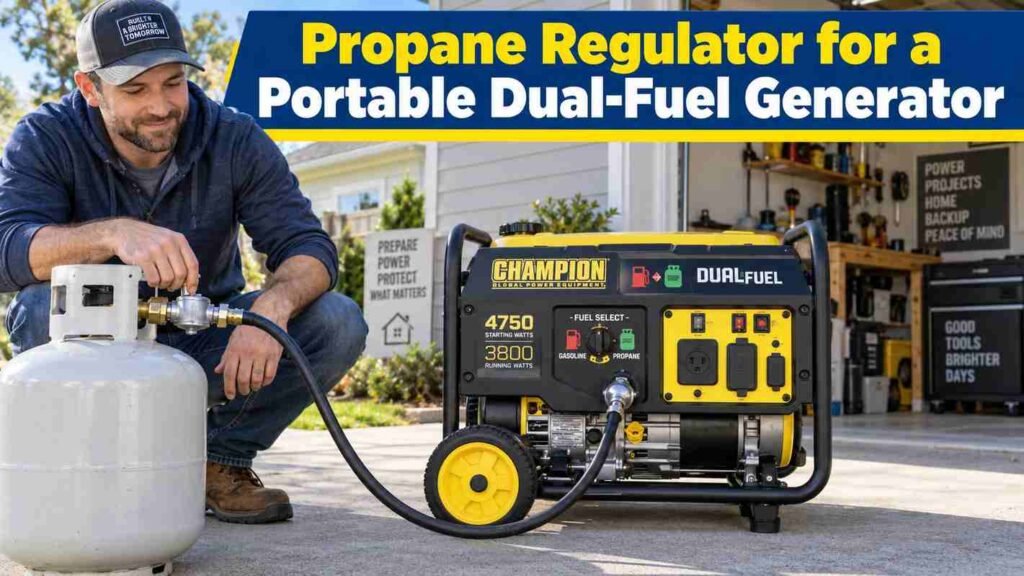
For a portable dual-fuel generator, I normally use the propane hose-and-regulator assembly supplied or specified by the generator manufacturer. These generators often use more than one stage of fuel control: a tank-side regulator in the hose assembly reduces cylinder pressure, while a secondary or demand regulator at the generator meters fuel to the engine. If I connect the generator to a large stationary propane tank that already supplies about 10–14 inches of water column, some manufacturers instruct me to remove the hose’s primary regulator and feed the generator’s secondary regulator directly. The exact setup is model-specific, and regulator capacity, hose size, tank vaporization, and generator load all matter.
Portable dual-fuel generators are different from grills, fire pits, and household appliances because the engine fuel system has to deliver propane in proportion to engine demand. The generator may idle lightly one moment and then pull a large propane flow when an air conditioner, well pump, refrigerator, or other motor load starts.
That is why I do not replace a generator regulator with a generic barbecue regulator just because the fittings look similar. The pressure, flow rate, hose, quick-connect, demand regulator, and carburetor or mixer are designed as a system.


In this guide, I’ll show you how I choose a propane regulator for a portable dual-fuel generator, how the regulator stages work, when 10–14″ WC matters, what size propane cylinder I consider, and what I check when a generator starts on propane but dies under load.
What Type of Propane Regulator Does a Dual-Fuel Generator Need?
My first choice is always the manufacturer-supplied LPG hose and regulator or an exact approved replacement for the generator model.
Current dual-fuel generators from Champion, FIRMAN, DuroMax, Westinghouse, and other major brands are sold with model-specific LPG connection hardware. DuroMax, for example, states that its dual-fuel generators include the propane regulator and hose needed for supported portable-tank operation. FIRMAN models also ship with an LPG regulator and hose.
| Generator Fuel Setup | Regulator Approach | What I Do |
|---|---|---|
| 20–40 lb portable propane cylinder | Manufacturer hose/regulator assembly | Use the original matched assembly |
| Generator with tank-side regulator + demand regulator | Two-part fuel-control system | Do not remove either component unless manual instructs it |
| Large stationary tank with low-pressure outlet | Model-specific direct low-pressure connection | Follow generator manual and qualified gas installer |
| Generic replacement regulator | Only if explicitly compatible | Match pressure, flow, connector and demand system |
If I do not have the original regulator, I identify the exact generator model before ordering a replacement. I do not select one only by engine size or generator wattage.


For a broader look at regulator categories, see what kind of regulator I need for a propane tank.
How the Propane Fuel System on a Portable Generator Works
A portable dual-fuel generator often uses a two-part propane fuel-control arrangement.
The first component reduces the high and variable pressure coming from the propane cylinder. The second component—often called a demand regulator, secondary regulator, zero governor, or fuel controller—meters propane according to engine vacuum and load.
| Component | Location | Job |
|---|---|---|
| Cylinder valve | Propane tank | Controls fuel leaving the cylinder |
| Primary regulator | Usually in hose/regulator assembly | Reduces tank pressure |
| Fuel hose / quick-connect | Between tank and generator | Carries regulated propane |
| Secondary / demand regulator | At or inside generator | Meters propane to engine as demand changes |
| Mixer / carburetor | Engine intake | Combines propane with combustion air |
This is why I am careful about removing or adding regulators. If I accidentally double-regulate the system, the generator may starve for fuel. If I remove a required regulator, I can overpressure downstream components.
My article on propane regulator inlet pressure versus outlet pressure explains the same principle in more detail.

What Propane Pressure Does a Portable Dual-Fuel Generator Need?
There is no one pressure that I can safely apply to every dual-fuel generator. The correct pressure depends on where I am measuring in the generator’s fuel train.
For portable cylinder operation, I generally do not adjust the pressure at all; I use the manufacturer’s complete regulator/hose assembly.
For a large stationary tank, some manufacturers provide a specific low-pressure requirement. Westinghouse, for example, has published instructions for certain dual-fuel models stating that the propane supply from a large tank should be about 10–14 inches WC, which is the normal residential low-pressure range.
| Supply Situation | Typical Pressure Approach | Important Note |
|---|---|---|
| Portable cylinder + factory hose | Manufacturer-controlled | Do not substitute a generic PSI setting |
| Large tank with regulated residential outlet | About 10–14″ WC on certain Westinghouse models | Verify exact generator manual |
| Demand regulator outlet | Engine-demand controlled | Not normally adjusted by owner |
| Generic 10–20 PSI adjustable regulator | High-pressure outdoor use | Not a universal generator substitute |
Ten to 14 inches WC is only about 0.36–0.51 PSI. That is very different from a 10-PSI or 20-PSI adjustable outdoor-burner regulator.


If you want to compare the numbers, see how many PSI a propane regulator supplies.
Can I Use a BBQ Regulator on a Dual-Fuel Generator?
I do not recommend it unless the generator manufacturer specifically lists that regulator as compatible.
A grill regulator may deliver a familiar low pressure such as 11″ WC, but that does not mean it has the correct flow capacity, hose connection, excess-flow characteristics, or relationship with the generator’s demand regulator.
A generator can also demand fuel much more abruptly than a grill. When a large electrical load starts, the engine throttle opens and propane demand can rise quickly.
If the regulator cannot respond, the engine may surge, bog down, lose frequency, or shut off.
Why Generator Wattage Matters to Propane Regulator Sizing
Electrical wattage is not the same as propane BTU input, but larger generators generally need larger engines and substantially more fuel flow.
Current portable dual-fuel products show the range. A FIRMAN H03651 produces about 3,300 running watts on propane, while a Champion 201281 produces about 6,750 propane running watts. DuroMax’s XP13000HX produces about 10,000 running watts on propane.
| Current Generator Example | Propane Running Watts | Propane Starting / Peak Watts | Fuel-System Implication |
|---|---|---|---|
| FIRMAN H03651 | 3,300 W | 4,100 W | Moderate propane demand |
| Champion 201281 | 6,750 W | 8,400 W | Higher flow required under load |
| FIRMAN H07553 | 6,750 W | 8,450 W | Large portable-generator demand |
| DuroMax XP13000HX | 10,000 W | 12,500 W | Very high portable propane demand |
I do not convert generator watts directly into regulator BTU capacity unless I also know the engine’s fuel-consumption data or manufacturer fuel requirement. Engine efficiency varies.
Instead, I use the generator manufacturer’s regulator and fuel-hose specification whenever possible.
How Much BTU Capacity Can a Large Generator Need?
Large portable engines can require a surprising amount of fuel. DuroMax publishes a natural-gas full-load requirement of 225,000 BTU/hr on its 13,000-watt tri-fuel platform. Propane fuel characteristics and model calibration differ, but the figure shows the scale of gas flow that a large portable generator can demand.
That is why I do not assume that a regulator rated for a small grill or a 60,000-BTU appliance is suitable for a 10,000-running-watt generator.
| Generator Size Class | Fuel-Demand Character | Regulator Concern |
|---|---|---|
| 2,000–4,000 running watts | Moderate | Factory small-cylinder system usually adequate |
| 5,000–7,500 running watts | High | Cylinder vaporization and hose flow become important |
| 8,000–10,000 running watts | Very high | Larger tank often needed for sustained output |
| 10,000+ running watts | Whole-home portable class | Treat regulator/tank sizing as a major fuel-system design issue |
For more background on regulator flow, see what BTU capacity means on a propane regulator.
20-Lb vs. 40-Lb vs. 100-Lb Propane Tank for a Generator
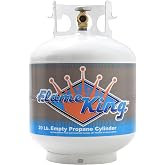
Small and medium dual-fuel generators are often demonstrated with a standard 20-pound grill cylinder. But as generator output rises, I become much more concerned about tank vaporization.
DuroMax currently recommends at least a 40-pound propane tank for its XP13000HX, a 10,000-running-watt propane generator. That recommendation makes sense because a larger cylinder has more liquid surface area and more thermal mass to support vaporization.
| Propane Cylinder | Where I Consider It | Main Limitation |
|---|---|---|
| 20 lb | Small/medium generator, moderate load | Can frost or lose vaporization at sustained high load |
| 30–40 lb | Medium/large portable generator | Better runtime and vaporization |
| 100 lb | Longer backup use / higher loads | Heavy and must be handled/stored correctly |
| Large stationary tank | Extended home backup | Requires properly designed low-pressure connection |
I do not choose the tank only for runtime. The cylinder also has to vaporize propane fast enough at the expected temperature and load.
Why a Propane Tank Freezes or Frosts While Running a Generator
As liquid propane changes into vapor, it absorbs heat from the cylinder. A generator pulling fuel quickly can cool the cylinder until frost forms on the outside.
Some frosting is a sign of high vaporization demand, but heavy icing accompanied by a weak or dying engine tells me the cylinder may be struggling to supply enough vapor.
| Condition | What Happens | What I Consider |
|---|---|---|
| Warm weather, full tank | Strongest vaporization | Normal operation |
| Cold weather | Lower vaporization rate | Use adequate tank size |
| Tank nearly empty | Less wetted surface area | Pressure can fall under load |
| Large generator at high load | Rapid fuel withdrawal | Move to larger approved cylinder/tank |
| Frosting + engine bogging | Fuel supply may be inadequate | Check tank size, regulator, hose and load |
For more on this issue, see what to do when a propane tank freezes or frosts.
Connecting a Portable Generator to a Large Propane Tank
This is where I stop treating the generator like a simple plug-and-play cylinder appliance.
A large stationary propane tank may already have first- and second-stage residential regulators. If that system supplies approximately 10–14″ WC, adding the portable generator’s original primary regulator can create too much pressure reduction.
Westinghouse has published model-specific instructions stating that when a large-tank outlet is already within the required 10–14″ WC range, the primary regulator in the generator fuel-line components should be removed and the low-pressure supply plumbed to the generator’s secondary regulator.
I do not generalize that procedure to every brand. Champion, DuroMax, FIRMAN, and other manufacturers may use different fuel-train arrangements.
For a permanent or large-tank connection, I follow the generator manual and use a qualified propane professional to verify pressure, shutoff valves, pipe size, regulator arrangement, and leak testing.
Why Double Regulation Can Make a Generator Run Poorly
Double regulation happens when propane is reduced to low pressure and then sent through another regulator that expected higher inlet pressure.
The generator may start with no electrical load because fuel demand is low. But when I add a refrigerator, pump, air conditioner, or transfer-switch load, the engine may bog because the fuel train cannot supply enough propane.
| Symptom | Possible Fuel Cause |
|---|---|
| Starts but dies when load is added | Low gas flow / double regulation |
| Surges under load | Regulator or hose restriction |
| Runs on gasoline but not propane | LPG hose, regulator, valve or demand system problem |
| Runs on propane at light load only | Cylinder vaporization or regulator capacity issue |
| Problem worse in cold weather | Tank vaporization limit |
Why I Do Not Use a Longer Hose Without Checking Flow
A long propane hose adds resistance. The effect becomes more important as fuel flow increases.
If I replace a short factory hose with a very long small-diameter hose, I can create enough pressure drop to affect a large generator at full load.
I use manufacturer-approved hose lengths and diameters whenever possible. For a permanently piped stationary-tank connection, I size the line based on gas load, supply pressure, material, and equivalent length rather than simply copying the factory hose diameter.
How I Troubleshoot Low Propane Pressure on a Dual-Fuel Generator
I troubleshoot from the tank toward the engine.
| Step | What I Check | Why |
|---|---|---|
| 1 | Tank valve fully open and cylinder has fuel | Eliminates basic supply problem |
| 2 | Correct manufacturer hose/regulator installed | Confirms fuel system compatibility |
| 3 | Hose not kinked, damaged or iced | Eliminates flow restriction |
| 4 | Tank large enough for load and weather | Checks vaporization capacity |
| 5 | Quick-connect fully seated | Confirms unobstructed fuel path |
| 6 | Generator demand regulator / mixer condition | Checks engine-side fuel control |
If pressure falls only after a large load is connected, I suspect fuel-flow capacity rather than a simple ignition problem.
PropaneHQ also has a related guide on why propane pressure drops when another load comes on.
Can I Adjust the Regulator to Get More Generator Power?
No. I do not turn up propane pressure beyond the generator manufacturer’s specification to increase electrical output.
Dual-fuel engines are calibrated around a specific fuel-delivery system. More propane pressure does not automatically produce more usable power. It can create an over-rich mixture, poor combustion, hard starting, regulator problems, or engine damage.
Propane power output is often slightly lower than gasoline output. That is normal. Champion’s current 7,500-watt model, for example, is rated 7,500 running watts on gasoline and 6,750 running watts on propane. DuroMax’s XP13000HX is rated 10,500 running watts on gasoline and 10,000 running watts on propane.
I plan electrical loads around the generator’s propane rating rather than trying to force gasoline-level output through regulator adjustment.
Portable Generator Propane Safety
I operate a portable generator outdoors only, far from doors, windows, vents, crawlspaces, and other openings where carbon monoxide can enter a building. A propane engine still produces carbon monoxide.
I never run the generator inside a garage, shed, carport enclosure, basement, or other occupied or partially enclosed space simply because propane burns cleanly.
I inspect the LPG hose before each use for cracking, abrasion, heat damage, or loose fittings. After connecting a cylinder, I follow the manufacturer’s leak-check procedure using soapy water or an approved leak-detection solution.
Champion specifically instructs users to fully open the LPG cylinder valve and leak-check LPG connections before operation. I also start and stop the generator according to the model manual rather than opening or closing fuel valves randomly under load.
For whole-home backup, I use an approved transfer switch or interlock and a qualified electrician so the generator cannot backfeed utility lines.
For general propane-system precautions, see my propane regulator safety requirements guide.
Frequently Asked Questions
What PSI regulator does a dual-fuel generator need?
There is no universal PSI setting. Portable operation normally uses the generator’s factory LPG regulator/hose assembly. Some large-tank connections use a low-pressure supply around 10–14″ WC, but that is model-specific.
Can I use a 20-lb propane tank on a dual-fuel generator?
Many small and medium generators can use a 20-lb cylinder, but large generators may need a larger tank for adequate vaporization. DuroMax recommends at least 40 lb for its XP13000HX.
Can I connect my generator to a 500-gallon propane tank?
Potentially, yes, but the regulator arrangement and supply pressure must match the generator. I follow the manufacturer’s large-tank instructions and use a qualified gas professional.
Why does my generator run on propane but die under load?
Common causes include an undersized cylinder, cold-weather vaporization limits, double regulation, a restrictive hose, an incompatible regulator, or a problem with the demand regulator.
Can I replace the generator regulator with a grill regulator?
I do not unless the generator manufacturer specifically approves that regulator. Correct pressure alone does not guarantee adequate flow or compatibility.
Why does my generator make fewer watts on propane?
Many dual-fuel generators are rated for somewhat lower running and starting wattage on propane than gasoline. I use the propane-specific watt rating when planning loads.
Bottom Line
For a portable dual-fuel generator, I use the exact LPG regulator and hose assembly supplied or specified by the generator manufacturer. The system may include both a tank-side pressure regulator and a generator-mounted demand regulator, so I do not add or remove components casually.
For portable cylinders, I size the propane tank for both runtime and vaporization. As generator output rises, larger cylinders become increasingly important; high-output models may specifically call for 40-pound or larger tanks.
If I connect the generator to a large stationary tank, I verify the tank outlet pressure and follow the model-specific instructions. Some generators can accept a regulated 10–14″ WC supply at their secondary regulator, while others use a different arrangement. The regulator, tank, hose, demand regulator, and engine all need to work as one matched fuel system.

Mike is an experienced propane technician with over 15 years of professional experience in the field. He has dedicated his career to helping customers with their propane needs, from installation to maintenance and repair. Together with Jeremy, he co-founded this website to provide useful information and guidance to customers seeking reliable propane services.


