
Quick Answer
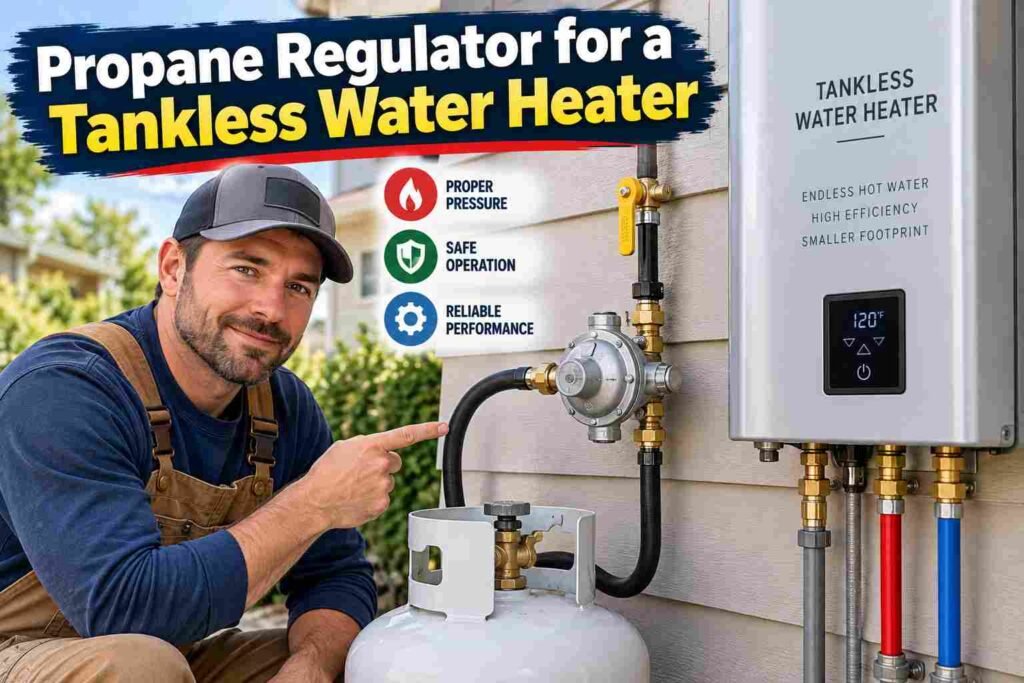
For a propane tankless water heater, I use a residential propane regulator system that delivers the heater’s required low-pressure LP inlet range while maintaining enough flow for the unit’s full BTU rating. Many tankless models fall roughly in the 120,000–199,000 BTU/hr class, so regulator capacity and gas-line size are critical. Depending on the model, LP inlet pressure may be around 8–13.5 inches of water column, with some manufacturers limiting maximum LP inlet pressure to about 13 inches WC. I never assume that “11 inches WC” is automatically correct for every tankless heater; I verify the exact rating plate and installation manual, then size the regulator, pipe, and propane tank together.
A tankless water heater is one of the hardest-working propane appliances in a house because it can go from zero gas flow to a very large burner demand almost instantly. A small range burner may use 10,000–18,000 BTU/hr, while a tankless water heater can demand 120,000, 160,000, 180,000, or nearly 200,000 BTU/hr as soon as someone opens a hot-water tap.
That sudden load is why a propane system can appear perfectly normal until the tankless heater starts. Static pressure may look fine, but the pressure can collapse under full fire if the regulator, gas line, tank, or fittings are undersized.


In this guide, I’ll show you how I choose a propane regulator for a tankless water heater, how I think about inlet pressure and BTU capacity, why gas-line size matters so much, and what I check when a heater shuts down or throws a low-gas error.
What Pressure Does a Propane Tankless Water Heater Need?
There is no single inlet pressure that applies to every propane tankless water heater. I use the exact minimum and maximum values printed on the appliance rating plate or in the installation manual.
Current manufacturer documentation shows why this matters. Rheem states that LP inlet pressure must not exceed about 13″ WC on the referenced tankless model and directs the installer to use the rating plate for the minimum inlet pressure under main-burner operation. Rinnai technical data for certain LP models shows a minimum/maximum range around 8″ WC to 13.5″ WC.
| Pressure Condition | Illustrative LP Value | What I Use It For |
|---|---|---|
| Minimum inlet pressure | Model-specific; some Rinnai examples around 8″ WC | Lowest acceptable pressure while burner is firing |
| Common residential supply target | Often around 11″ WC | Typical second-stage regulator setting |
| Maximum LP inlet pressure | Around 13–13.5″ WC on some current/legacy models | Do not exceed appliance limit |
| 2-PSI distribution | 2 PSI | Upstream distribution only unless appliance/system is specifically designed otherwise |
This is why I do not blindly set every system to exactly 11″ WC and call the job finished. Eleven inches WC is a common residential regulator setting, but the tankless heater must remain inside its own approved pressure range under full load.


For a deeper explanation of pressure terminology, see my guide to propane regulator inlet pressure versus outlet pressure.
Why Tankless Water Heaters Need So Much Gas Flow
A storage-tank water heater typically fires a moderate burner for a longer period. A tankless heater does the opposite: it produces a large amount of heat immediately as water flows through the heat exchanger.
That means the propane regulator must respond quickly and maintain outlet pressure while the appliance jumps to high fire.
| Tankless Heater Input | Typical Application Scale | Regulator/Gas-System Impact |
|---|---|---|
| 120,000 BTU/hr | Smaller household unit | Still a large residential gas load |
| 130,000–150,000 BTU/hr | Small-to-medium home | Requires substantial regulator and pipe capacity |
| 160,000–180,000 BTU/hr | Medium/high-demand home | Pressure drop becomes more critical |
| 199,000 BTU/hr | Large residential tankless unit | Often one of the biggest loads in the home |
Rinnai’s current gas-line sizing guidance lists propane tankless models from about 120,000 to 199,000 BTU/hr, which shows how large the load can be compared with many other residential appliances.
That is why I size the propane regulator by total BTU capacity as well as outlet pressure.

For the underlying concept, see what BTU capacity means on a propane regulator.
How I Size the Regulator for a Tankless Water Heater
If the tankless heater is the only propane appliance, I start with its maximum input rating and select a regulator with enough published capacity at the required inlet and outlet conditions.
If the home also has a furnace, range, dryer, fireplace, pool heater, or generator, I size the upstream propane system for the combined simultaneous load.
| Appliance | Illustrative Input |
|---|---|
| Tankless water heater | 199,000 BTU/hr |
| Furnace | 80,000 BTU/hr |
| Residential range | 70,000 BTU/hr |
| Fireplace | 30,000 BTU/hr |
| Gas dryer | 22,000 BTU/hr |
| Example connected total | 401,000 BTU/hr |
In that example, a 200,000-BTU regulator would be nowhere near large enough for the house. Even if the water heater works by itself, the system could lose pressure when the furnace and range fire at the same time.


My guide on how to calculate the BTU capacity needed for a propane regulator walks through this sizing method in more detail.
Does a Tankless Water Heater Need a Two-Stage Propane Regulator?
For most permanent residential propane systems, I prefer two-stage regulation because it produces a stable low-pressure supply despite changes in tank pressure and appliance load.
The first stage reduces tank pressure to an intermediate pressure. The second stage reduces that pressure again to the low-pressure range used by residential appliances.
An integral two-stage regulator can perform both reductions in one body, while larger residential systems may use separate first-stage and second-stage regulators.
The important point is not whether the two stages are inside one housing or separated. The important point is that the final pressure at the tankless heater stays inside the appliance’s specified range while the unit is at full fire.
Can I Use an 11-Inch-WC Regulator?
Often, yes, because 11″ WC is a common residential propane outlet setting. But I verify the heater’s minimum and maximum inlet pressure first.
If the water heater requires at least 8″ WC under full fire and allows up to around 13″ WC, an 11″ WC supply may work well—as long as pressure does not fall below the minimum when the burner ramps up.
The problem is that a regulator set to 11″ WC with no load may deliver less at the appliance after pipe pressure loss and regulator droop are added.
| Condition | Example Reading | Interpretation |
|---|---|---|
| Static pressure with heater off | 11.0″ WC | Looks normal |
| Heater at low fire | 10.5″ WC | Usually acceptable if within manual limits |
| Heater at high fire | 7.0″ WC | May be below required minimum |
| Pressure recovers when heater stops | 11.0″ WC | Points toward flow restriction or undersizing |
That is why I care more about flowing pressure than static pressure.
For more background, see what 11 inches water column means for propane.
Why Gas-Line Size Matters So Much
A tankless heater can have the correct regulator and still starve for gas if the pipe is too small or too long.
Rinnai’s current low-pressure propane sizing table makes this very clear. Under its stated assumptions, a 199,000-BTU tankless model may be limited to about 20 feet of equivalent length on 1/2-inch Schedule 40 metallic pipe, while 3/4-inch pipe may allow roughly 80 feet.
| Example Rinnai LP Model Load | 1/2-in. Pipe Max Equivalent Length | 3/4-in. Pipe Max Equivalent Length |
|---|---|---|
| 120,000 BTU/hr | About 50 ft | About 300 ft |
| 150,000 BTU/hr | About 30 ft | About 175 ft |
| 160,000 BTU/hr | About 30 ft | About 150 ft |
| 180,000 BTU/hr | About 20 ft | About 125 ft |
| 199,000 BTU/hr | About 20 ft | About 80 ft |
These are manufacturer examples under specific pressure-drop assumptions, not universal pipe-sizing rules. The correct pipe size depends on material, total equivalent length, supply pressure, fittings, and all connected appliances.
Rheem also states that the supply line should use properly sized piping and, on the referenced installation instructions, calls for at least a 3/4-inch black-steel gas supply line or other approved material.
I do not size the pipe by matching the threaded gas inlet on the heater. I size it by BTU load and equivalent length.
Can I Use a 2-PSI Propane System With a Tankless Water Heater?
Yes, as an upstream distribution strategy, but I do not feed a standard low-pressure tankless heater directly from 2 PSI unless the appliance manufacturer specifically permits that arrangement.
A 2-PSI house system can move large amounts of propane through smaller piping with lower pressure loss. Near the water heater, a properly sized line regulator reduces the 2-PSI gas to the appliance’s approved inlet range.
| System Section | Typical Pressure | Purpose |
|---|---|---|
| Tank / first stage | High-to-intermediate pressure | Initial reduction |
| House distribution line | 2 PSI | Carry high BTU load efficiently |
| Line regulator near water heater | Reduces 2 PSI to low pressure | Protect appliance and stabilize inlet |
| Tankless heater inlet | Model-specific low pressure | Feeds appliance gas valve |
I size the line regulator for the full BTU load downstream of it and verify outlet pressure while the water heater is running at maximum input.
Why the Water Heater Shuts Off When Another Appliance Starts
If a tankless heater runs normally until the furnace, range, or generator starts, I suspect the propane system is reaching its flow limit.
| Symptom | Possible Cause | What I Check |
|---|---|---|
| Water heater shuts down when furnace starts | Upstream regulator undersized | Combined BTU load |
| Hot water goes cold during high demand | Gas pressure falls below minimum | Flowing inlet pressure |
| Heater works at low flow but not high flow | Pipe or regulator restriction | High-fire gas demand |
| All appliances weaken together | Tank/regulator supply problem | Tank vaporization and regulator capacity |
| Problem appears only in winter | Tank cannot vaporize enough propane | Tank size, level, temperature |
PropaneHQ already has a related troubleshooting guide on why propane pressure drops when another appliance turns on. Tankless water heaters are especially good at exposing that problem because their load changes so quickly.
What Is Regulator Droop, and Why Does It Matter Here?
Regulator droop is the normal tendency for outlet pressure to decrease as gas flow increases.
A properly sized regulator controls droop within acceptable limits. An undersized regulator can show a much larger pressure drop when a 199,000-BTU tankless heater goes to full fire.
That is why I do not judge regulator performance from the no-load pressure alone.
For a full explanation, see what regulator droop means in a propane system.
What Size Propane Tank Does a Tankless Water Heater Need?
The tank must be large enough not only to store fuel but also to vaporize propane fast enough to supply the water heater at high fire.
A 199,000-BTU tankless heater can consume propane at a very high instantaneous rate. Add a furnace or range, and winter vaporization can become the limiting factor.
| Propane Supply | What I Consider |
|---|---|
| 20-lb cylinder | Generally too small for permanent whole-house tankless use |
| 100-lb cylinder | May support some smaller applications, but winter vaporization can be limiting |
| 250-gallon stationary tank | Better reserve and vaporization for residential use |
| 500-gallon stationary tank | Strong choice for homes with several high-BTU propane appliances |
Those are planning observations, not a universal tank-sizing table. Actual tank size depends on climate, total appliance load, refill access, and local propane-supplier recommendations.
If a high-BTU heater works when the tank is full but struggles when the tank level is low or the weather turns cold, I investigate vaporization capacity.
How Much Propane Does a 199,000-BTU Tankless Heater Use?
One gallon of propane contains roughly 91,500 BTU of energy. At 199,000 BTU/hr input, the theoretical propane consumption at continuous maximum fire is a little over 2 gallons per hour.
| Heater Input | Approx. Propane Use at Continuous Full Fire |
|---|---|
| 120,000 BTU/hr | About 1.31 gal/hr |
| 150,000 BTU/hr | About 1.64 gal/hr |
| 160,000 BTU/hr | About 1.75 gal/hr |
| 180,000 BTU/hr | About 1.97 gal/hr |
| 199,000 BTU/hr | About 2.17 gal/hr |
A tankless heater rarely stays at maximum fire for a full hour in ordinary residential use, but these numbers show why the propane system needs substantial short-term flow capacity.
Can a Bad Regulator Cause Tankless Water Heater Error Codes?
Yes. If inlet pressure falls below the water heater’s approved range, the unit may fail to ignite, shut down, or generate a combustion or gas-supply error.
Rinnai notes that undersized gas piping can reduce performance and that its tankless units are designed to stop operation when inadequate gas flow is detected.
Before replacing the heater itself, I check gas pressure under load, regulator capacity, pipe size, tank level, and whether another appliance causes the pressure to collapse.
I do not increase regulator pressure above the manufacturer’s maximum to clear an error code.
Can I Turn Up the Regulator to Make the Water Heater Work Better?
No. I only adjust a regulator to the specified system pressure using proper test instruments and qualified procedures.
If the heater has low gas pressure because the pipe is undersized, turning up the regulator can mask the real problem and overpressure other appliances when the load changes.
If the regulator is undersized, I replace it with the correct capacity rather than forcing a smaller regulator to operate outside its intended range.
If the tank is too small for winter vaporization, increasing outlet pressure will not solve the supply problem.
Tankless Water Heater Regulator Safety
A permanent tankless water heater installation involves gas piping, combustion, venting, condensate on condensing models, electricity, and water plumbing. I treat the gas side as qualified installation work.
I leak-test the gas piping after installation using an approved method and follow the appliance manufacturer’s instructions for pressure testing and isolation.
Rheem’s current instructions specify a manual gas shutoff valve, properly sized piping, and a sediment trap on the gas supply. Rinnai likewise emphasizes correct gas sizing and qualified installation.
The propane regulator vent must stay unobstructed and correctly oriented. If a line-pressure regulator is installed indoors or in an enclosure, its venting arrangement must meet the regulator manufacturer’s instructions and applicable code.
For broader regulator requirements, see my propane regulator safety requirements guide.
Frequently Asked Questions
What PSI regulator does a propane tankless water heater need?
Most residential propane tankless heaters operate at well under 1 PSI. Exact inlet pressure is model-specific and is usually stated in inches of water column. Some examples allow roughly 8–13.5″ WC.
Is 11 inches WC enough for a tankless water heater?
Often, yes, if the model’s approved inlet range includes 11″ WC and the pressure stays above the minimum while the heater is at full fire.
How many BTUs does a tankless water heater use?
Many residential models range from about 120,000 to 199,000 BTU/hr maximum input.
Can a 1/2-inch gas line run a 199,000-BTU tankless heater?
Sometimes over a short run, depending on pressure and system design. Rinnai’s current low-pressure propane table shows about 20 feet maximum equivalent length for certain 199,000-BTU models on 1/2-inch Schedule 40 pipe under its stated assumptions.
Can I use a 2-PSI propane line?
Yes as upstream distribution, but I normally reduce it through a properly sized downstream regulator before a standard low-pressure tankless heater unless the manufacturer specifies otherwise.
Why does my tankless heater work until the furnace turns on?
That often points to insufficient regulator capacity, undersized piping, or a propane supply that cannot support the combined BTU load.
Bottom Line
For a propane tankless water heater, I size the regulator for the heater’s exact inlet-pressure range and full BTU demand—not just a generic 11-inch-WC number. Many tankless models draw 120,000–199,000 BTU/hr, so regulator flow capacity and gas-line sizing are just as important as pressure.
I verify pressure while the heater is at high fire, because a system that looks fine at rest can fall below the heater’s minimum inlet pressure when demand spikes.
Most importantly, I treat the regulator, pipe size, propane tank, line length, and other household appliances as one system. If all of those pieces are sized together, the tankless water heater will receive stable propane pressure when it needs it most.

Mike is an experienced propane technician with over 15 years of professional experience in the field. He has dedicated his career to helping customers with their propane needs, from installation to maintenance and repair. Together with Jeremy, he co-founded this website to provide useful information and guidance to customers seeking reliable propane services.


