
Quick Answer
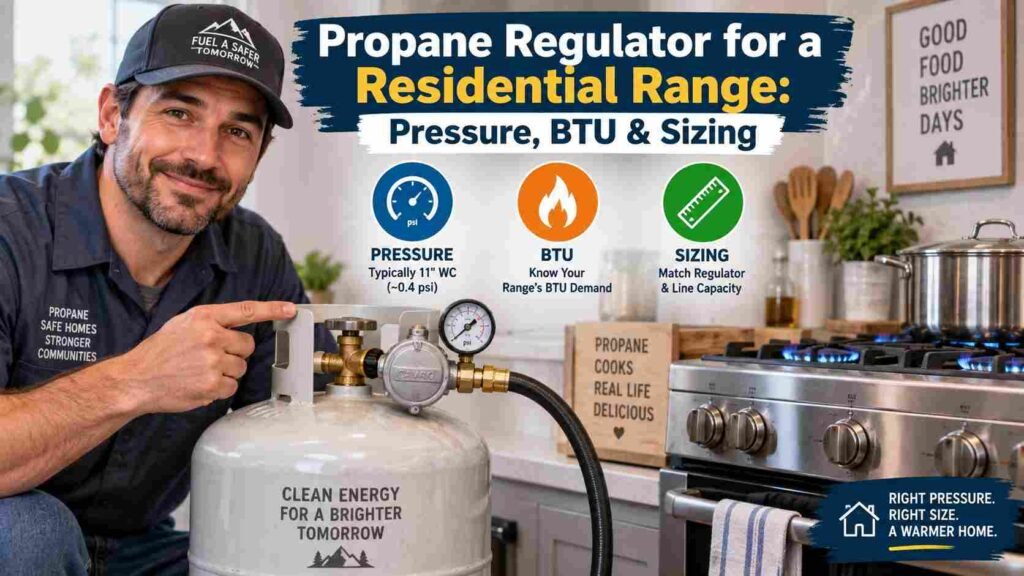
For most residential propane ranges, I want the house propane system to deliver roughly 11–14 inches of water column to the range, while the range’s own appliance regulator stays installed and reduces that pressure to the manufacturer’s manifold setting—commonly about 10 inches WC. I never remove the range regulator just because the house already has a propane regulator. I also verify that the range has been correctly converted for LP gas, including the regulator setting and burner orifices, and I make sure the upstream propane regulator and piping are sized for the total BTU load of the home.
A residential propane range usually uses two different levels of pressure regulation. The first happens at the propane tank or building system, where tank pressure is reduced to a low appliance-supply pressure. The second happens at the range itself, where the built-in appliance regulator controls the manifold pressure feeding the burners.
That distinction matters because many homeowners see a regulator on the propane tank and assume the regulator on the range is redundant. It is not. Major manufacturers such as GE and Whirlpool specify that the appliance regulator must remain in the gas supply path.


In this guide, I’ll show you what pressure a propane range needs, why the appliance regulator stays installed, how LP conversion works, how I think about BTU capacity, and what I check when a range has weak, yellow, or unusually large flames.
What Pressure Does a Residential Propane Range Need?
For many modern residential propane ranges, the gas supply entering the appliance regulator needs to be roughly 11–14 inches of water column. The exact range depends on the manufacturer and model.
Current GE guidance lists propane inlet pressure to the range regulator at about 11–13″ WC. Current Whirlpool installation instructions commonly specify 11–14″ WC for propane.
| Pressure Point | Typical Propane Value | Approx. PSI | Purpose |
|---|---|---|---|
| House / appliance inlet minimum | About 11″ WC | 0.40 PSI | Provides adequate pressure to range regulator |
| House / appliance inlet maximum | About 13–14″ WC | 0.47–0.51 PSI | Protects appliance regulator from overpressure |
| Range manifold pressure | Often about 10″ WC | 0.36 PSI | Feeds propane burner orifices |
| 2-PSI home distribution line | 2 PSI | 2.0 PSI | Must be reduced before range inlet |
I always use the installation instructions for the exact range as the final authority. Some ranges use a different manifold setting, and regional models can vary.


If you want a deeper explanation of these numbers, see what 11 inches water column means for propane.
Why the Range Still Needs Its Own Gas Pressure Regulator
The house propane regulator and the range regulator do different jobs.
The house regulator keeps the building’s propane supply in the normal low-pressure range. The appliance regulator then fine-tunes the pressure entering the range manifold so the burners operate at the pressure used during appliance design and certification.
GE specifically states that the pressure regulator supplied with the range must be used. Older and current installation instructions also state that the regulator located at the range manifold must remain in the LP supply line.
| Regulator | Where It Is Located | Main Job |
|---|---|---|
| Tank / first-stage regulator | At propane tank | Reduces tank pressure to intermediate pressure |
| Second-stage / house regulator | Near tank or building | Reduces pressure to appliance-supply range |
| Line regulator in 2-PSI system | Near appliance branch | Reduces 2 PSI to low pressure |
| Range appliance regulator | On the range | Maintains appliance manifold pressure |
I do not bypass or remove the appliance regulator because another regulator exists upstream.

My guide on inlet pressure versus outlet pressure explains why multiple stages of regulation can be necessary.
What Is the Manifold Pressure on a Propane Range?
Many residential ranges use approximately 10 inches WC manifold pressure when configured for propane.
For example, GE installation literature has long specified 10″ WC operating pressure for LP gas on many ranges and cooktops. That operating pressure is downstream of the appliance regulator.
The inlet pressure must be somewhat higher than the manifold setting so the regulator has enough pressure differential to work correctly. This is why manufacturers often want at least 11″ WC inlet pressure when the manifold setting is 10″ WC.


| Measurement | Typical Example |
|---|---|
| LP supply entering appliance regulator | 11–13 or 11–14″ WC |
| LP manifold operating pressure | About 10″ WC |
| Minimum pressure differential | Often at least 1″ WC above manifold |
| Pressure unit | Water column, not PSI |
11 Inches WC Is Not 11 PSI
This is one of the easiest mistakes to make when shopping for a replacement regulator.
Eleven inches water column is only about 0.4 PSI. Eleven PSI is dramatically higher and would be completely inappropriate for a standard residential range.
| Pressure | Approx. PSI | Appropriate for Standard Residential Range? |
|---|---|---|
| 10″ WC | 0.36 PSI | Typical manifold pressure |
| 11″ WC | 0.40 PSI | Common minimum inlet pressure |
| 14″ WC | 0.51 PSI | Common maximum inlet pressure |
| 2 PSI | 2.0 PSI | Only as upstream distribution pressure with downstream regulation |
| 10 PSI | 10 PSI | No — high-pressure burner applications |
If you are choosing a household regulator, do not confuse a 10-PSI adjustable outdoor-burner regulator with a 10″ WC appliance regulator. They are not remotely the same.
For more context, see how many PSI a propane regulator supplies.
Does the Range Need to Be Converted From Natural Gas to Propane?
Usually, yes, if the range was shipped configured for natural gas.
The conversion is not just a regulator adjustment. It typically includes changing or repositioning the appliance regulator for LP service and installing the correct propane burner orifices. Oven bake and broil burners may require separate LP orifices or adjustments as well.
GE currently says its gas cooking appliances are generally supplied ready for natural gas and include an LP conversion kit. The company recommends that conversion be performed by a qualified installer or service technician.
Whirlpool’s current range manuals likewise show model-specific propane orifice charts and instructions for changing the gas-pressure regulator from natural gas to propane.
| Conversion Item | Natural Gas Setup | Propane Setup |
|---|---|---|
| Appliance regulator | NAT position / setting | LP position / setting |
| Burner orifices | Larger natural-gas openings | Smaller LP-specific orifices |
| Bake burner | Natural-gas orifice | LP orifice / adjustment |
| Broil burner | Natural-gas orifice | LP orifice / adjustment |
| Pressure verification | Natural-gas values | LP inlet and manifold values |
Can I Just Change the Regulator and Leave the Orifices Alone?
No. A natural-gas range converted to propane normally needs the correct LP orifices as well as the regulator conversion.
Propane contains more energy per unit volume and is supplied at a different appliance pressure than natural gas. The burner openings are therefore sized differently.
If I run propane through natural-gas orifices, the appliance can be severely over-fired. That can create large yellow flames, soot, overheating, and unsafe combustion.
I use the conversion kit and instructions for the exact model rather than drilling or modifying orifices.
How Many BTUs Does a Residential Range Use?
A modern residential range can have a surprisingly high connected gas load when all burners and the oven are operating.
Whirlpool says residential range burners can span from low simmer outputs up to about 18,000 BTU/hr. Current GE and Whirlpool models commonly include burners around 5,000, 9,500–10,000, 15,000, and 18,000 BTU/hr.
| Burner Type | Typical Current Residential Output |
|---|---|
| Simmer burner | About 500–5,000 BTU/hr depending on model |
| Standard burner | About 8,000–10,000 BTU/hr |
| Power burner | About 12,000–15,000 BTU/hr |
| High-output burner | About 18,000 BTU/hr |
| Oval / center griddle burner | About 8,000–12,000 BTU/hr |
A current GE five-burner range, for example, uses cooktop burners rated at 18,000, 15,000, 10,000, 9,500, and 5,000 BTU/hr. That is 57,500 BTU/hr of cooktop burner input before the oven burner is added.
This is why I include the range in the home’s total propane load calculation instead of treating it as a small appliance.
How I Size the House Propane Regulator for a Range
If the range is the only propane appliance, almost any properly selected residential regulator with adequate capacity will have plenty of flow. But most propane homes also have a furnace, water heater, dryer, fireplace, or generator.
I add the input ratings of all appliances that may operate simultaneously and select the upstream regulator based on that combined load.
| Appliance | Illustrative Input |
|---|---|
| Residential range | 70,000 BTU/hr including oven and cooktop |
| Water heater | 40,000 BTU/hr |
| Furnace | 80,000 BTU/hr |
| Gas dryer | 22,000 BTU/hr |
| Fireplace | 30,000 BTU/hr |
| Example total | 242,000 BTU/hr |
If the calculated connected load is 242,000 BTU/hr, I do not install a regulator rated for only 200,000 BTU/hr. I move to a regulator with enough capacity at the specified inlet and outlet conditions.
For the full method, see how I calculate the BTU capacity needed for a propane regulator.
What Does Regulator BTU Capacity Mean for a Range?
Regulator BTU capacity tells me how much propane the regulator can pass while still maintaining acceptable outlet pressure.
A regulator may be set to 11″ WC and still be too small for a house if the furnace, water heater, and range all run together.
The symptoms can include weak range flames when the furnace starts, a water heater that drops out, or low pressure at distant appliances.
My article on what BTU capacity means on a propane regulator explains this in detail.
Can a Residential Range Be Supplied From a 2-PSI System?
Yes, but not directly.
Some homes use 2-PSI propane distribution because it allows a large amount of gas to move through smaller piping with less pressure drop.
Before the range, a listed line-pressure regulator reduces the 2-PSI gas to the low pressure required at the appliance—typically around 11–14″ WC inlet.
| System Section | Pressure |
|---|---|
| Tank / first-stage supply | System-specific intermediate pressure |
| House distribution line | 2 PSI |
| Line regulator near appliance manifold | Reduces 2 PSI |
| Range inlet | About 11–14″ WC |
| Range manifold | Often about 10″ WC |
I never connect a range designed for 11–14″ WC directly to a 2-PSI line.
The line regulator must also be sized for the BTU load downstream of it.
What Size Gas Line Does a Propane Range Need?
Gas-line size depends on the range input, run length, system pressure, pipe material, and other connected appliances.
Many residential ranges connect through a 1/2-inch flexible metal appliance connector, although the building supply may be 1/2 inch or 3/4 inch depending on the installation.
GE installation guidance commonly references a 1/2-inch inside-diameter flexible metal appliance connector and requires a manual shutoff valve in the supply line.
I do not assume 1/2-inch piping is always sufficient just because the range connection is 1/2 inch. A long low-pressure run with several appliances may require larger piping upstream.
Why My Propane Range Flame Is Too Small
If the range has weak flames on every burner, I look at the gas supply before assuming all burner valves are defective.
| Symptom | Possible Cause | What I Check |
|---|---|---|
| All burners weak | Low inlet pressure | Pressure at range under load |
| Flames weaken when furnace starts | Upstream regulator undersized | Total home BTU demand |
| One burner weak | Dirty or incorrect orifice | Burner cap and orifice |
| Range weak after conversion | Wrong LP conversion setup | Regulator position and orifice kit |
| Pressure fine static but low while cooking | Pipe/regulator flow restriction | Flowing pressure test |
A pressure reading with all appliances off can be misleading. I want to know whether pressure stays within the manufacturer’s range while the range and other major appliances are operating.
Why My Propane Range Has Large or Yellow Flames
Large yellow flames can point to overpressure, incorrect LP conversion, wrong orifices, burner-cap misalignment, or restricted combustion air.
If a newly converted range produces very large flames, I shut it down and verify the regulator conversion and orifice installation rather than trying to tune the flames with the knobs.
A range converted from natural gas to propane with the wrong burner orifices can be dangerously over-fired.
I also check that burner caps are seated correctly because a misaligned cap can distort the flame even when the gas pressure is correct.
Can I Adjust the House Regulator to Fix a Range Problem?
I do not adjust the house propane regulator just because one range burner seems weak.
Changing the house regulator affects every appliance in the building. A small pressure increase intended to help the range could overpressure a water heater, furnace, fireplace, or other appliance.
I first verify inlet pressure at the range, appliance manifold pressure, conversion setup, burner condition, and pipe sizing.
If the house regulator actually needs adjustment, that is a system-level service task and should be handled with proper pressure instruments and qualified service procedures.
Pressure Testing a Residential Range
Range manufacturers place limits on pressure testing because excessive test pressure can damage the appliance regulator and gas valve.
Current Whirlpool instructions state that if the building gas piping is pressure-tested above 1/2 PSI, the range and its shutoff valve must be disconnected from the piping system. At 1/2 PSI or lower, the range can be isolated by closing its manual shutoff valve.
That 1/2-PSI threshold is approximately 14″ WC—the same neighborhood as the maximum normal propane inlet pressure on many ranges.
I follow the installation manual exactly during pressure testing rather than exposing the appliance regulator to test pressure it was not designed to handle.
Residential Range Regulator Safety
Gas-range installation combines propane piping, combustion, electricity, cabinetry clearances, and anti-tip requirements. I treat it as a qualified installation task rather than a simple appliance swap.
I use a new listed flexible appliance connector when required, install an accessible shutoff valve, and leak-test the connection after installation using an approved leak-detection method. I never use an open flame to check for leaks.
I also make sure the anti-tip bracket is installed. That safety device prevents the range from tipping forward if weight is placed on an open oven door.
If the range is being converted from natural gas to propane, I have the regulator and burner orifices converted according to the exact manufacturer instructions and verify operation afterward.
For broader propane-system guidance, see my propane regulator safety requirements article. For permanent regulator work, see whether propane regulator installation should be handled by a professional.
Frequently Asked Questions
What PSI regulator does a residential propane range need?
Most residential propane ranges operate at less than 1 PSI. A common inlet range is about 11–14″ WC, or approximately 0.40–0.51 PSI.
What is the manifold pressure for a propane range?
Many ranges use about 10″ WC manifold pressure on propane. I verify the model’s rating plate or installation manual before testing or adjusting anything.
Does a propane range need its own regulator?
Yes. The appliance regulator supplied with the range normally remains installed even when the home already has propane regulators upstream.
Can I connect a propane range directly to a 2-PSI line?
No. A downstream line regulator must reduce the 2-PSI distribution pressure to the range’s required low inlet pressure.
Do I need different burner orifices for propane?
Yes, on a range originally configured for natural gas. The LP conversion kit normally includes smaller propane-specific burner orifices and instructions for converting the appliance regulator.
Why does my range flame get smaller when the furnace starts?
That can indicate an undersized upstream regulator, undersized piping, or insufficient pressure under combined load. I check the total home BTU demand and flowing pressure.
Bottom Line
For most residential propane ranges, I want approximately 11–14 inches WC entering the appliance regulator, with the range’s own regulator left in place to maintain the correct manifold pressure—often around 10 inches WC.
I also make sure the range is correctly converted for propane, including the regulator setting and burner orifices, and I include the range’s full BTU input when sizing the home propane regulator and gas piping.
Most importantly, I do not remove the appliance regulator, increase house pressure to solve a burner problem, or connect a low-pressure range directly to a 2-PSI system. The tank regulator, line regulator, appliance regulator, orifices, and piping all have to work together as one correctly sized propane system.

Mike is an experienced propane technician with over 15 years of professional experience in the field. He has dedicated his career to helping customers with their propane needs, from installation to maintenance and repair. Together with Jeremy, he co-founded this website to provide useful information and guidance to customers seeking reliable propane services.


