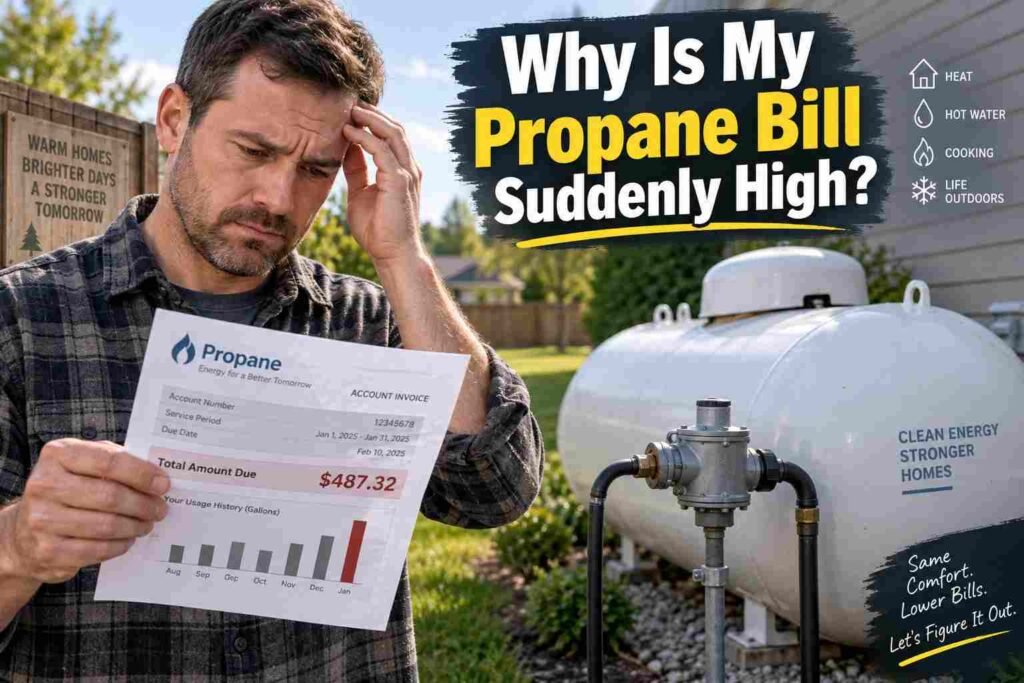
When someone tells me, “My propane bill suddenly doubled,” I do not immediately blame the regulator, the propane company, or the weather. I start with the bill itself.
The fastest way to find the cause is to answer four questions:
- Did I buy more gallons than usual?
- Did the price per gallon increase?
- Was this delivery covering a longer or colder period?
- Were extra charges added to the invoice?
Once I separate price from consumption, the problem usually becomes much easier to diagnose.


Why Is My Propane Bill Suddenly High? Technical Overview
| Possible Cause | What I Look For | Likely Effect |
|---|---|---|
| Colder weather | More furnace runtime / higher heating degree days | More gallons used |
| Higher propane price | Higher $/gal on invoice | Higher bill even at same usage |
| Larger delivery | More gallons delivered than prior invoice | Large one-time invoice |
| Thermostat change | Higher indoor temperature or longer heating schedule | Increased furnace runtime |
| New propane appliance | Generator, fireplace, garage heater, pool heater, range, dryer | Higher connected fuel use |
| More hot-water demand | Guests, longer showers, plumbing leak, higher set temperature | Water heater burns more propane |
| Furnace/appliance efficiency problem | Dirty filter, poor airflow, burner/combustion issue | Longer runtime or wasted fuel |
| Air leaks / poor insulation | Drafts, cold rooms, frequent cycling | Higher heating load |
| Propane leak | Unusual usage, odor, hissing, detector alarm | Fuel loss and immediate safety concern |
| High regulator pressure | Oversized flames, soot, abnormal pressure test | Possible overfiring and unsafe combustion |
Start With the Math: Gallons × Price per Gallon + Fees
This is the first calculation I make because it separates a consumption problem from a price problem.
A propane invoice is basically:
Imagine these two deliveries:
| Invoice | Gallons | Price/Gallon | Fuel Charge |
|---|---|---|---|
| Previous delivery | 150 gal | $2.50 | $375 |
| Current delivery | 200 gal | $2.75 | $550 |
The bill jumped by $175 before fees, but there are two causes: I bought 50 more gallons and each gallon cost 25 cents more.


That distinction matters. If gallons stayed the same but the price increased, I investigate market price and supplier pricing. If the price stayed similar but gallons jumped, I investigate usage.
1. Colder Weather Is Usually the First Place I Look
For homes that use propane for space heating, outdoor temperature has a huge effect on consumption.
EIA says propane consumption is closely correlated with winter temperatures because propane is widely used for space heating. In January 2025, a severe cold snap pushed U.S. propane consumption to about 1.48 million barrels per day, the highest January level in roughly two decades.
EIA also uses heating degree days (HDDs) to estimate how much heating demand weather creates. More heating degree days generally mean the furnace has to run more.
So if my propane usage suddenly rises, I compare the current billing period with the same dates last year. I do not compare a January invoice with an October invoice and expect the gallons to match.

2. Check Whether the Price Per Gallon Changed
Your household can use exactly the same amount of propane and still receive a higher bill if the unit price changes.
Propane prices are affected by wholesale propane values, crude oil and natural-gas markets, inventories, transportation costs, weather, regional demand, storage, and logistics. EIA notes that customers farther from major propane supply sources generally pay more because of transportation costs, and consumers receiving smaller deliveries often pay more per gallon than customers taking larger volumes.
The latest EIA residential heating-season data available before the 2026–27 heating season showed a U.S. residential average of about $2.674 per gallon on March 30, 2026. Regional prices varied substantially; actual supplier prices can be much higher or lower.
I therefore compare the exact price-per-gallon line on my invoices rather than relying on a national average.


3. A Bigger Bill May Simply Be a Bigger Delivery
Propane billing is different from monthly electric billing. Many homes are billed when a truck delivers propane rather than for exactly one calendar month of consumption.
If my supplier delivered 250 gallons this time and only 100 gallons last time, the new invoice will obviously be much larger—even if my daily propane usage did not change much.
This can happen when:
- the tank was allowed to get lower before the delivery;
- the previous delivery was small;
- delivery timing changed;
- the supplier filled the tank more completely;
- weather prevented an earlier delivery;
- I changed from will-call to automatic delivery;
- the billing period covered more days.
I compare gallons delivered and days since the previous delivery before deciding my “monthly bill” has doubled.
4. Your Thermostat Setting May Have Changed
A few degrees can make a meaningful difference over an entire heating season.
The U.S. Department of Energy says lowering a thermostat by about 7–10°F for eight hours per day can save as much as 10% per year on heating and cooling in suitable systems.
The reverse is also useful to understand: if I started keeping the house warmer all day, stopped using nighttime setbacks, or someone changed the thermostat schedule, propane consumption can rise without anything being mechanically wrong.
I check:
- daytime set temperature;
- nighttime temperature;
- vacation/away schedule;
- smart thermostat history;
- whether someone switched from “auto” to a constant hold.
5. More People in the House Can Raise Propane Use
If propane heats the water, cooks food, dries clothes, or heats living spaces, occupancy matters.
Guests or family members staying at home can mean:
- more showers;
- more laundry;
- more cooking;
- more hot-water use;
- more rooms heated;
- doors opening more frequently;
- higher thermostat settings for comfort.
A bill increase that begins exactly when household occupancy changes may be completely explainable.
6. A New Propane Appliance Can Consume More Than You Expect
I make a list of everything connected to propane. People often remember the furnace and water heater but forget outdoor or occasional-use equipment.
High-demand propane appliances can include:
- standby generators;
- tankless water heaters;
- pool or spa heaters;
- garage/shop heaters;
- fireplaces;
- patio heaters;
- large ranges or ovens;
- clothes dryers;
- greenhouse heaters.
A generator is a classic example. After a multi-day power outage, homeowners sometimes receive a surprisingly large propane bill because the generator ran continuously or near-continuously.
7. Estimate Appliance Consumption From BTU/hr
One gallon of propane contains roughly 91,500 BTU of energy according to PERC’s technical guide. EIA’s current conversion factor is about 91,452 BTU per gallon.
That lets me estimate the theoretical maximum gallons per hour for an appliance:
| Appliance Input | Approx. Propane at Continuous Full Input |
|---|---|
| 40,000 BTU/hr | 0.44 gal/hr |
| 80,000 BTU/hr | 0.87 gal/hr |
| 100,000 BTU/hr | 1.09 gal/hr |
| 150,000 BTU/hr | 1.64 gal/hr |
| 200,000 BTU/hr | 2.19 gal/hr |
These are simple full-input energy estimates, not guaranteed real-world consumption. Furnaces cycle, modulating equipment changes firing rate, and appliance efficiency affects how much useful heat you receive.
8. Check the Water Heater—Especially for Hidden Hot-Water Demand
A propane water heater can quietly become one of the biggest sources of unexplained consumption.
I look for:
- a dripping hot-water faucet;
- a leaking shower valve;
- a hot-water pipe leak;
- a recirculation pump running continuously;
- a higher thermostat setting;
- sediment or maintenance problems;
- more showers or laundry;
- a new large soaking tub or frequent dishwasher use.
A plumbing leak does not have to involve propane to raise the propane bill. If heated water is constantly escaping, the propane water heater keeps firing to replace that heat.
9. A Dirty Furnace Filter or Poor Maintenance Can Increase Fuel Use
ENERGY STAR recommends checking HVAC filters regularly and says a dirty filter makes the system work harder, wastes energy, and can contribute to equipment problems.
Its heating-maintenance checklist also recommends checking gas connections, gas pressure, burner combustion, and the heat exchanger because poor burner operation can reduce safety and efficiency.
If my furnace suddenly runs longer than it used to, I check maintenance history before blaming propane prices.
I also look for:
- dirty filters;
- blocked return-air grilles;
- closed supply registers;
- duct leakage;
- dirty burners;
- thermostat calibration problems;
- short cycling;
- blower problems.
10. Older or Lower-Efficiency Heating Equipment Uses More Fuel
Furnace efficiency is often expressed as AFUE—Annual Fuel Utilization Efficiency.
DOE’s current federal procurement comparison illustrates the difference: a 95% AFUE furnace converts more of the fuel into useful seasonal heat than an 80% AFUE furnace.
That does not mean an old furnace suddenly loses 15 percentage points of efficiency overnight, but a lower-efficiency appliance will generally require more fuel to deliver the same heat. Mechanical problems can also push actual performance below what I expect.
| AFUE | Approximate Seasonal Meaning |
|---|---|
| 80% | About 80% of fuel energy becomes useful seasonal heat under the rating method |
| 90% | About 90% becomes useful seasonal heat |
| 95% | About 95% becomes useful seasonal heat |
| 99% | About 99% becomes useful seasonal heat |
11. Air Leaks and Poor Insulation Can Make the Furnace Run Constantly
If cold air enters through doors, windows, attic penetrations, crawl spaces, or poorly sealed ductwork, the furnace has to replace that lost heat.
DOE recommends air sealing and insulation as core energy-efficiency measures because reducing unwanted air leakage lowers heating demand.
If my home suddenly feels draftier, I check whether:
- weatherstripping has failed;
- a storm window is missing;
- a crawl-space door is open;
- attic access is poorly sealed;
- a fireplace damper is left open;
- ductwork has separated;
- a renovation created new air leaks.
12. A Propane Leak Can Cause Unexplained High Usage
This is the possibility I take most seriously.
PERC explicitly lists unusual propane usage as a possible indicator of a gas leak. Other warning signs include the distinctive propane odor, hissing gas, or a propane-gas detector alarm.
If my tank level is dropping much faster than expected and I cannot explain the usage, I do not keep experimenting with appliances.
If I suspect a leak, PERC’s safety guidance is to get everyone away from the suspected leak area, avoid sparks and flames, stay away, and contact the propane retailer, 911, or the fire department from a safe location. The propane system should be checked by a qualified professional before appliances are used again.
If the regulator itself smells like gas, see why a propane regulator may smell like gas.
13. Could a Bad Propane Regulator Increase My Bill?
It is possible, but I do not make the regulator my first suspect.
A correctly operating regulator controls the pressure supplied to the appliances. If outlet pressure is too high, appliances may overfire or show abnormal flames depending on their own controls and regulators. That can create both a safety problem and potentially higher fuel use.
Warning signs can include unusually large flames, roaring burners, soot, unstable pilots, or several appliances behaving abnormally at the same time.
I do not adjust the regulator to reduce the bill. I have the pressure tested.
My guide on how to know if propane regulator pressure is too high explains what technicians look for.
14. Check Whether the Tank Gauge and Delivery Gallons Make Sense
A tank gauge shows an approximate percentage of liquid propane in the tank. It is not the same as the truck’s delivery meter.
If I think I received “too much propane,” I compare:
- tank size;
- approximate gauge percentage before delivery;
- approximate gauge percentage after delivery;
- gallons printed on the delivery ticket.
Remember that stationary propane tanks normally are not filled to 100% liquid capacity because room is needed for liquid expansion. A gauge reading and delivered-gallon number will therefore not translate into a perfect simple percentage calculation.
If I see a major inconsistency, I ask the propane supplier to explain the delivery ticket and meter reading rather than assuming the tank gauge is a precise billing instrument.
15. Look at Delivery Fees, Tank Rent, Minimum Charges, and Other Line Items
Sometimes the propane itself is not what changed.
Depending on the supplier and contract, an invoice can include charges such as:
- delivery fees;
- hazardous-material or regulatory fees;
- tank lease/rental;
- minimum annual usage fees;
- service or inspection charges;
- late-payment fees;
- emergency delivery fees;
- taxes;
- credit-card or payment-processing fees.
Not every propane company charges these, and names vary. I compare line items with the previous invoice to see whether a new fee appeared.
16. Automatic Delivery Can Make Bills Look Random
Automatic delivery is convenient, but it does not necessarily produce equal-sized monthly bills.
A supplier may estimate usage using weather data, tank size, household history, and delivery routing. The truck may arrive when the estimated tank level reaches a target rather than on the same day every month.
That can produce a $250 invoice one time and a $700 invoice another time even though average daily consumption did not triple.
If predictable cash flow matters more than individual delivery size, I ask whether the supplier offers a budget-payment or level-payment plan.
17. Compare Gallons Per Day, Not Just Bill Totals
This is one of the most useful ways I normalize usage.
Suppose I used 180 gallons over 60 days last year and 210 gallons over 70 days this year.
| Period | Gallons | Days | Gallons/Day |
|---|---|---|---|
| Last year | 180 | 60 | 3.00 |
| This year | 210 | 70 | 3.00 |
The invoice shows 30 more gallons, but daily usage is identical. The billing period was simply longer.
18. Compare Similar Weather Periods
Gallons per day are useful, but weather-normalized comparisons are even better for heating homes.
If this January was much colder than last January, higher propane usage may be completely normal. Heating degree days give me a better comparison than calendar days alone.
If propane gallons rose 20% but heating degree days rose by a similar amount, that points more toward weather than a hidden mechanical problem.
19. A Standby Generator Can Empty a Tank Faster Than Homeowners Expect
After storms or outages, this is one of the first questions I ask.
Standby generators can have large BTU inputs at high electrical loads. If a generator ran for 30, 50, or 100 hours, that fuel consumption can materially change the next propane delivery.
I check the generator hour meter or controller history. It gives me a much better explanation than trying to infer generator use from the tank gauge.
20. How I Troubleshoot a Sudden High Propane Bill
I work through the problem in this order:
| Step | What I Compare |
|---|---|
| 1 | Current gallons delivered vs. previous deliveries |
| 2 | Current price per gallon vs. previous price |
| 3 | Invoice fees and taxes |
| 4 | Days between deliveries |
| 5 | Weather / heating degree days |
| 6 | Thermostat settings and occupancy |
| 7 | New appliances, generator runtime, fireplace/pool/garage-heater use |
| 8 | Furnace filter and maintenance history |
| 9 | Hot-water leaks or unusual water-heater activity |
| 10 | Leak warning signs or unexplained tank-level loss |
Frequently Asked Questions
Why did my propane usage suddenly double?
The most common explanations are colder weather, a longer billing period, a thermostat change, more household occupancy, a new propane appliance, generator use, or an appliance operating inefficiently. If none of those explains the increase, I have the propane system checked for leakage or abnormal operation.
Can cold weather really increase propane use that much?
Yes. Space-heating demand rises sharply as outdoor temperatures fall. EIA data consistently show that colder winters and higher heating degree days increase propane demand.
Can a propane leak cause a high bill without a strong smell?
Yes, unusual propane usage itself is listed by PERC as a possible leak warning. Odor can also be difficult for some people to detect. If I cannot explain a rapid tank-level decline, I contact the propane supplier or a qualified professional rather than relying on smell alone.
Can a bad furnace increase my propane bill?
Yes. A furnace with airflow problems, dirty components, control issues, poor combustion, or declining performance may run longer than necessary. ENERGY STAR recommends annual heating-system maintenance and regular filter inspection.
Can a bad regulator cause high propane consumption?
Potentially. Excessive outlet pressure can overfire appliances or create abnormal combustion. But I do not diagnose the regulator from the bill alone. It requires a proper pressure test.
Why is my propane bill high when the tank still looks full?
You may be looking at the gauge after a recent delivery. The invoice charges for gallons delivered, not the percentage you used after the delivery. Compare the delivery ticket, gallons, and before/after tank gauge readings.
Why does my propane company charge more per gallon than the U.S. average?
Propane pricing is local. Transportation distance, delivery size, supplier costs, regional wholesale prices, contract type, tank ownership, and location all matter. EIA specifically notes that remote consumers and customers taking smaller delivery volumes often pay more per gallon.
How can I lower my propane heating bill?
I focus on thermostat scheduling, air sealing, insulation, furnace maintenance, clean filters, hot-water conservation, and checking for unnecessary propane loads. DOE says a suitable thermostat setback of 7–10°F for eight hours per day can save as much as 10% per year on heating and cooling.
Should I shut off appliances to see whether the tank gauge still drops?
I do not use improvised isolation tests as a substitute for professional leak testing. If propane loss is unexplained, especially if I smell gas or hear hissing, I follow PERC emergency guidance and have the system checked.
Bottom Line: Why Is My Propane Bill Suddenly High?
When my propane bill suddenly rises, I start with the invoice—not the equipment.
I compare gallons delivered, price per gallon, fees, and the number of days since the previous delivery. Then I look at colder weather, thermostat settings, occupancy, hot-water use, new appliances, generator runtime, furnace condition, air leaks, and home insulation.
If the price per gallon changed but gallons stayed similar, I have a pricing issue. If gallons increased but price stayed similar, I have a consumption issue. If both increased, the bill can jump very quickly.
I also take unexplained propane consumption seriously. PERC lists unusual usage as a possible sign of a leak. If the tank is dropping faster than expected and I cannot account for the fuel—or I smell propane, hear hissing, or receive a detector alarm—I stop treating it as a budgeting question and have the system checked immediately.
The most useful number for ongoing tracking is often gallons per day, compared with similar weather. That lets me see whether my household is truly burning propane faster or whether I simply received a bigger delivery at a higher price.
Technical and Consumer Sources
- Propane Education & Research Council – Safety Guide for Propane Users
- U.S. Energy Information Administration – Heating Oil and Propane Update
- EIA – Factors Affecting Propane Prices
- EIA – Cold Weather and U.S. Propane Consumption
- EIA – Propane Energy Content
- U.S. Department of Energy – Home Energy Savings and Thermostats
- ENERGY STAR – Heating and Cooling Maintenance Checklist

Mike is an experienced propane technician with over 15 years of professional experience in the field. He has dedicated his career to helping customers with their propane needs, from installation to maintenance and repair. Together with Jeremy, he co-founded this website to provide useful information and guidance to customers seeking reliable propane services.