
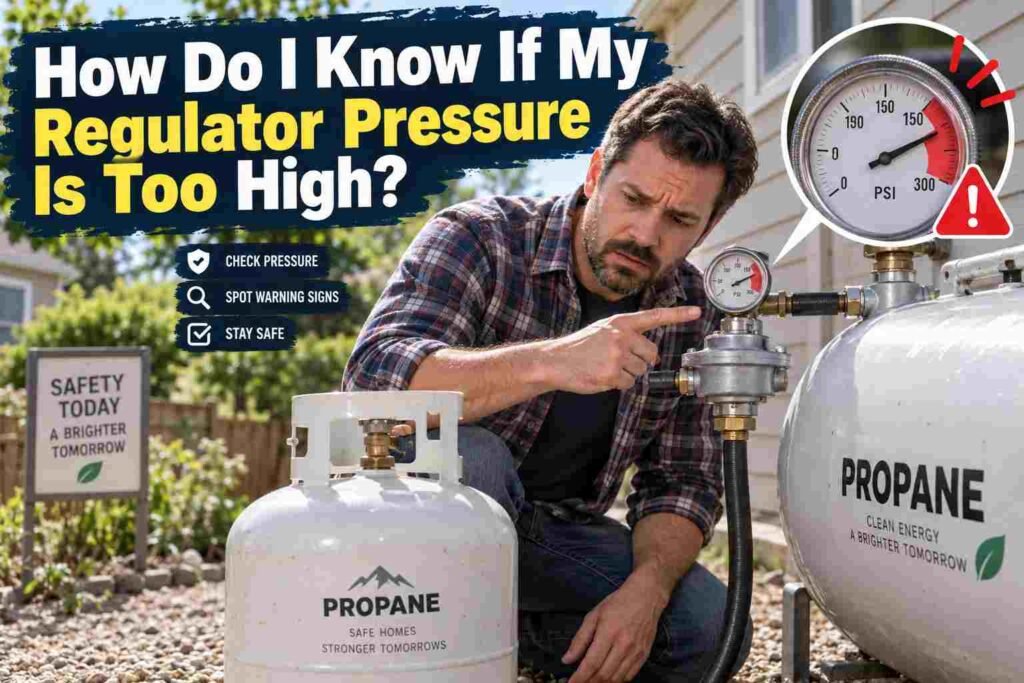
When someone asks me, “How do I know if my regulator pressure is too high?” I do not start by looking only at the flame. I start with a pressure measurement.
Flame appearance can give me clues, but it does not prove that the service regulator is overpressuring the system. Yellow flames, soot, roaring burners, pilot problems, and unusual heat output can also come from dirty burners, blocked combustion air, incorrect orifices, appliance-regulator problems, or a bad fuel conversion.
The strongest evidence is a measured outlet pressure that is higher than the value specified for the regulator and the downstream appliances.


Propane Regulator Pressure: Technical Details
| Pressure Point | Common Example | When I Would Suspect High Pressure |
|---|---|---|
| Final low-pressure residential/RV supply | About 11″ w.c. (0.397 psi) | Reading consistently above manufacturer range under correct test conditions |
| Lock-up pressure | Small rise after flow stops | RegO general criterion: above 130% of set pressure is excessive |
| 11″ w.c. regulator at lock-up | Up to about 14.3″ w.c. under RegO’s general criterion | Continued rise or much higher pressure points to a problem |
| First-stage outlet | Often around 5–10 psig; many systems use ~10 psig | Above regulator model’s intended first-stage setting |
| 2-PSI distribution | About 2 psig | Above the designed 2-PSI service range |
How Do I Know If My Propane Regulator Pressure Is Too High?
I compare the measured outlet pressure with the regulator’s actual specification. That sounds simple, but it is important because not every propane regulator is supposed to deliver 11 inches water column.
A normal residential second-stage regulator may deliver around 11″ w.c. A first-stage regulator may deliver around 10 psig. A 2-PSI service regulator may intentionally deliver around 2 psig. A commercial pounds-to-pounds regulator may be designed for 10, 20, 30, or more PSI.
So before I decide a reading is high, I identify the regulator type and where the pressure is being measured.
If you are not sure which side of the regulator you are reading, see my guide on inlet pressure vs. outlet pressure on a propane regulator.


What Are the Most Common Signs of Excessive Propane Pressure?
If several propane appliances begin acting abnormally at the same time, I become more suspicious of the common supply pressure.
Possible warning signs include:
- burner flames that are noticeably larger than normal;
- roaring or unusually forceful burner sound;
- yellow or unstable flames across multiple appliances;
- soot appearing on more than one appliance;
- pilot flames that lift, blow off, or become unstable;
- appliances that seem to overheat or cycle abnormally;
- regulator relief or vent activity;
- pressure readings above the manufacturer’s stated range.
PERC says properly operating propane appliances normally burn with a blue flame and warns that yellow flames or significant soot can indicate incomplete combustion. I treat those as reasons for inspection, but not as proof by themselves that the regulator pressure is high.
Soot is particularly important because incomplete combustion can increase carbon monoxide risk. If I see soot on an appliance, vent, or heating register, I stop treating the problem as a cosmetic issue and have the system checked.
Why Flame Appearance Alone Can Mislead You
I never set a propane regulator by “eyeballing” the flame.

A yellow flame may result from:
- too much propane pressure;
- too little combustion air;
- a dirty burner;
- a blocked burner port;
- an incorrect propane orifice;
- a blocked appliance vent;
- an appliance regulator problem;
- improper conversion from natural gas to propane.
If only one appliance shows a yellow flame while every other propane appliance operates normally, I am more suspicious of that appliance than the main service regulator.
If multiple appliances simultaneously show unusually large or unstable flames, that is a stronger reason to check common supply pressure.
What Pressure Should a Low-Pressure Propane Regulator Deliver?
For many residential and RV systems, the commonly used final supply pressure is around 11 inches water column.


RegO’s current LP-Gas Serviceman’s Manual uses 11″ w.c. as its example appliance delivery pressure during regulator flow testing. Fisher’s current second-stage regulator literature likewise describes domestic second-stage regulators reducing first-stage pressure to low-pressure service.
| Pressure | Approximate Equivalent | Typical Context |
|---|---|---|
| 11″ w.c. | 0.397 psi / 2.74 kPa | Many low-pressure residential/RV systems |
| 14.3″ w.c. | 0.517 psi | 130% of an 11″ w.c. set point |
| 2 psi | 55.4″ w.c. | 2-PSI distribution system |
| 10 psi | 276.8″ w.c. | Common first-stage outlet example |
This table shows why I pay close attention to units. If someone says “my propane pressure is 11,” I need to know whether they mean 11 psi or 11 inches water column. Those are radically different pressures.
How Do I Test Whether the Pressure Is Too High?
I separate flow pressure from lock-up pressure.
Flow pressure is the outlet pressure while gas is moving through the regulator. Lock-up pressure is the pressure that remains after downstream appliances stop drawing gas and the regulator closes.
RegO recommends checking delivery pressure with approximately half of the connected appliance load operating. After verifying the set pressure, it recommends turning on all appliances to make sure pressure remains acceptable at full load.
After that, the appliance valves are shut to observe lock-up.
This test sequence tells me much more than a single no-flow reading because it shows how the regulator behaves while supplying gas and how well it closes afterward.
What Is High Lock-Up Pressure?
A regulator does not instantly return to its flowing set point the moment gas demand stops. A slight rise is normal as the valve closes. That rise is called lock-up pressure.
RegO says lock-up pressure should not exceed 130% of the regulator’s set delivery pressure. If a low-pressure regulator is set to 11″ w.c., 130% is about 14.3″ w.c.
| Regulator Set Point | 130% Lock-Up Example | How I Interpret It |
|---|---|---|
| 10″ w.c. | 13.0″ w.c. | General RegO service criterion |
| 11″ w.c. | 14.3″ w.c. | General RegO service criterion |
| 12″ w.c. | 15.6″ w.c. | General RegO service criterion |
I treat those numbers as service guidance, not a universal substitute for the exact regulator manual. The actual regulator specification controls.
What If the Pressure Keeps Rising After Lock-Up?
This is where I distinguish lock-up from creep.
A normal regulator rises slightly and then stabilizes. A regulator with creep keeps increasing after the flow has stopped.
RegO recommends watching the pressure for five minutes or longer. If the pressure continues climbing, it says the regulator seat may not be closing properly. Dirt, scratches, dents, or wear on the seat disc or inlet nozzle can cause this.
Fisher’s LP-Gas handbook makes a similar point: worn regulator disks or foreign material trapped between the disk and orifice can cause higher-than-normal outlet pressure at lock-up or very low flow. Fisher says a pressure test is required to verify the condition and recommends regulator replacement if pressure is high.
This is important because creep is not a simple “turn the regulator down” problem. If the regulator cannot seal, changing the spring setting does not fix the leaking seat.
What Causes Propane Regulator Pressure to Be Too High?
I usually group the causes into six categories.
1. The regulator is adjusted above the correct set point
If someone has previously turned the adjustment screw too far, the flowing outlet pressure may simply be set too high.
That is one of the simpler possibilities, but I still confirm the pressure under the correct load condition before making any conclusion. I also verify that the installed spring is designed for the desired pressure range.
2. Dirt or debris is preventing the regulator seat from closing
Foreign material from piping, pigtails, or upstream components can become trapped between the regulator seat disc and inlet nozzle. That can allow gas to leak through after the regulator should be closed.
The result is often high lock-up pressure or pressure creep.
3. The regulator seat or disk is worn
Over time, sealing surfaces can wear. Fisher specifically warns that regulator disk wear—especially in older regulators—can cause high outlet pressure at lock-up or very low flow.
I do not try to compensate for worn internal parts by reducing the spring setting. I treat worn sealing components as a service or replacement issue.
4. The vent is blocked
A regulator diaphragm has to reference atmospheric pressure through the vent. Emerson warns that an obstructed spring-case vent can cause abnormally high outlet pressure on some regulator designs.
Snow, ice, insects, mud, paint, debris, or an improperly installed cover can all interfere with the vent.
I visually check the vent, but I do not poke tools, compressed air, or chemicals into it. If contamination has entered the regulator, the safer solution is professional inspection or replacement.
5. The wrong regulator is installed
A pounds-to-pounds regulator is not a substitute for a low-pressure residential regulator.
For example, Fisher explicitly warns never to use its 64 or 67C Series pounds-to-pounds regulators on low-pressure inch-water-column service. RegO sells high-pressure industrial regulators with ranges such as 20–45 psig. Those products are correct for specific industrial applications but completely inappropriate as the final regulator for ordinary low-pressure household appliances.
6. The regulator was turned up to hide another problem
RegO warns about regulators being set too high to compensate for line losses caused by undersized piping.
This can produce a dangerous pattern: pressure seems acceptable while gas is flowing because the undersized pipe consumes part of the pressure, but once the appliances shut off and line loss disappears, downstream pressure rises too high.
I fix the piping problem instead of using regulator pressure as a workaround.
High Regulator Pressure vs. High Tank Pressure
Tank pressure and regulator outlet pressure are not the same thing.
A propane tank can naturally be above 100 psi in warm weather. The regulator’s job is to reduce that variable tank pressure to the much lower pressure required by the system.
So if the tank is at 120 psi on a warm day, I do not consider that proof that the regulator outlet is too high. I measure the pressure after the regulator.
Likewise, a first-stage regulator may intentionally deliver about 10 psi. That would be dangerously high if it appeared on a normal low-pressure appliance manifold, but it can be perfectly normal between the first and second regulator stages.
How High Pressure Can Affect Propane Appliances
Appliances are designed to operate within a specific inlet-pressure range. If the pressure arriving at the appliance is too high, the gas valve and burner may receive more gas than intended.
Depending on the appliance, I may see oversized flames, noisy combustion, unstable pilots, overheating, incomplete combustion, soot, or nuisance shutdowns.
PERC warns that soot and yellow flames can indicate incomplete combustion and possible carbon monoxide concerns. Because those symptoms can also come from blocked vents or dirty burners, I do not assume the service regulator is the only possible cause.
| Symptom | Could High Supply Pressure Cause It? | Other Causes I Also Check |
|---|---|---|
| Oversized flame | Yes | Wrong orifice, appliance regulator fault |
| Yellow flame | Possible | Dirty burner, poor combustion air, blocked vent |
| Soot | Possible | Incomplete combustion, venting problem, burner issue |
| Roaring burner | Possible | Burner/orifice/air mixture problem |
| Pilot instability | Possible | Drafts, thermocouple, pilot assembly, appliance valve |
| Several appliances abnormal at once | More suspicious | Common upstream supply problem |
What If Only One Appliance Has High-Flame Symptoms?
If every other propane appliance is operating normally, I look at the affected appliance first.
The appliance may have its own pressure regulator, gas valve, manifold adjustment, orifice, burner-air setting, or conversion kit. A single-appliance problem is less convincing evidence that the main service regulator is overpressuring the entire system.
This is also why RegO cautions that appliance regulators may be preset below 11″ w.c. and recommends measuring service pressure at an appropriate system test point rather than assuming every appliance tap represents the main regulator setting.
Can a Regulator Relief Valve Tell Me the Pressure Is Too High?
Relief-valve operation can be a sign of an overpressure condition, but I do not use it as a normal pressure indicator.
Fisher’s R622 second-stage regulator, for example, includes overpressure protection designed to limit downstream pressure in an abnormal condition. That relief protection is a safety feature, not a substitute for correct regulator operation.
If a regulator is venting propane continuously, I treat it as a service problem. I do not block the vent, cap it, or assume the gas discharge is harmless.
How Do I Tell High Pressure From Regulator Creep?
I look at the timing of the pressure rise.
If pressure is already too high while gas is flowing, the regulator may be misadjusted, incorrectly selected, or malfunctioning. If flow pressure is normal but the pressure climbs after the appliances shut off, I suspect lock-up or seat leakage.
RegO says a small lock-up rise is normal. But if the pressure continues creeping upward for five minutes or more, the regulator seat is not closing properly.
| Pressure Pattern | What It Suggests | What I Do |
|---|---|---|
| High during normal flow | Wrong setting, wrong regulator, or control fault | Verify regulator model and set point professionally |
| Slight rise, then stable after shutdown | Normal lock-up may be occurring | Compare with manufacturer limit |
| Keeps rising after shutdown | Creep / seat leakage | Service or replace regulator |
| Normal at no flow, high only intermittently | Control instability, debris, wrong test condition | Full diagnostic test |
Could the Regulator Be Correct but the Gauge Be Wrong?
Yes. I always consider the test instrument.
A damaged gauge, wrong pressure range, incorrect zero, poor connection, or wrong test point can produce misleading readings. A 0–300-psi gauge is not useful for accurately checking an 11-inch-water-column system.
For low-pressure service, I use an instrument intended for inches of water column, such as a water-column or digital manometer. For first-stage pressure, I use a PSI-rated gauge that is appropriate for the expected range.
If you want help interpreting the instrument itself, see how to read a propane regulator gauge.
Can I Turn the Regulator Down If the Pressure Is Too High?
I do not recommend trial-and-error adjustment.
A regulator should only be adjusted if it is designed to be field-adjustable, the correct pressure is known, the inlet pressure is normal, the regulator is correctly sized, and the technician is monitoring outlet pressure with the proper instrument.
If the pressure is high because the seat is leaking, the vent is obstructed, the wrong regulator is installed, or internal parts are worn, turning the adjustment screw does not fix the actual problem.
My article on how to know if a propane regulator needs adjustment explains when adjustment is appropriate and when replacement or service is the better answer.
What If Someone Turned Up the Regulator to Compensate for Low Pressure?
This is a situation RegO specifically warns about.
If piping is undersized, kinked, or restricted, the system may lose too much pressure while gas is flowing. Someone may try to “fix” the low reading by increasing the regulator setting.
That can create excessive pressure when gas demand falls. The regulator may then have too high a lock-up pressure because the line loss that existed at full flow disappears.
I correct the restriction or pipe-sizing problem rather than using a higher regulator setting to hide it.
Can High First-Stage Pressure Damage the Second-Stage Regulator?
It can if the second-stage inlet pressure exceeds the regulator’s rated range.
Every second-stage regulator has an allowed inlet-pressure range. In many traditional residential systems, the first stage delivers around 10 psig. If a first-stage regulator is set substantially above the second-stage regulator’s inlet rating, the downstream regulator may not control pressure as intended and could be exposed to excessive stress.
I verify both stages as a system rather than adjusting one regulator in isolation.
Can Cold Weather Cause High Regulator Pressure?
Cold weather usually lowers propane tank vapor pressure rather than increasing it. However, winter conditions can still create unusual regulator behavior if the vent freezes or becomes blocked.
Emerson warns that an obstructed spring-case vent can cause abnormally high outlet pressure on some regulator designs. That is why I keep vents pointed correctly and free of snow, ice, mud, and debris.
If you are preparing for cold weather, see how to winterize a propane regulator.
Can High Regulator Pressure Cause Soot?
Yes, excessive gas flow can contribute to poor combustion and soot, but soot is not specific to high regulator pressure.
PERC says soot may indicate that propane is not burning completely. That can also happen when air intakes or vents are blocked, burners are dirty, or the appliance is defective or improperly adjusted.
I treat soot as a reason for professional inspection because incomplete combustion can increase carbon monoxide production.
Can High Pressure Make a Propane Appliance Dangerous?
Yes. Appliances are designed around a specific fuel pressure and orifice size. If the inlet pressure exceeds the allowed range, the burner may receive more fuel than it was designed to handle.
Potential consequences can include overfiring, overheating, unstable combustion, soot, carbon monoxide, nuisance shutdowns, appliance damage, or relief-system operation.
This is why I do not leave a suspected high-pressure condition in service while I “watch it for a few days.”
My Diagnostic Checklist for Suspected High Regulator Pressure
| Step | What I Check | Why It Matters |
|---|---|---|
| 1 | Correct regulator model and pressure class | Wrong regulator can create fundamentally wrong outlet pressure |
| 2 | Correct gauge/manometer and test point | Prevents false diagnosis |
| 3 | Flow pressure at expected appliance load | Shows actual operating set point |
| 4 | Lock-up pressure after flow stops | Shows closing behavior |
| 5 | Pressure for 5 minutes or longer | Reveals creep from seat leakage |
| 6 | Vent clear and correctly oriented | Blocked vent can upset regulation |
| 7 | Several appliances or only one affected | Helps separate common-supply from appliance-specific problems |
Frequently Asked Questions
What pressure is too high for a propane regulator?
It depends on the regulator type. For many low-pressure residential systems, around 11″ w.c. is a common flowing set point. RegO’s general lock-up criterion says pressure should not exceed 130% of the set delivery pressure. For an 11″ w.c. regulator, that works out to about 14.3″ w.c. The exact regulator specification always controls.
Is 14″ w.c. too high for propane?
It can be, depending on whether you are looking at flowing pressure or brief lock-up pressure. If a system is supposed to flow at 11″ w.c., a steady 14″ w.c. while appliances are operating would be above that target. Around 14.3″ w.c. is RegO’s general 130% lock-up example for an 11″ w.c. set point—not a normal flowing set point.
Is 10 psi too high for propane appliances?
For ordinary low-pressure household appliances, yes. But 10 psi can be normal between the first-stage and second-stage regulators in a conventional two-stage system. Location matters.
Can a blocked regulator vent cause high pressure?
Yes. Emerson warns that an obstructed spring-case vent can cause abnormally high outlet pressure on some regulator designs.
Can a bad regulator cause yellow flames?
Yes, excessive regulator pressure can contribute to abnormal flame behavior, but yellow flames can also result from dirty burners, inadequate combustion air, wrong orifices, blocked vents, or appliance-level problems. I confirm pressure before blaming the regulator.
Can regulator pressure be too high only when no appliances are running?
Yes. That is often where high lock-up or creep shows up. If flow pressure is normal but the no-flow pressure rises excessively or keeps climbing, I suspect seat leakage or an internal regulator problem.
Should I replace a regulator that has high lock-up pressure?
If testing confirms excessive lock-up or creep caused by seat wear, debris, or internal damage, replacement or manufacturer-approved service is usually more appropriate than adjustment alone. Fisher specifically recommends replacing regulators when high outlet pressure is verified from disk wear or internal contamination.
Can I lower propane pressure myself?
I do not recommend trial-and-error adjustment. Propane pressure affects combustion and safety. A qualified technician should verify the regulator type, inlet pressure, outlet pressure, load, lock-up, and leak tightness before changing the setting.
Bottom Line: How Do I Know If My Regulator Pressure Is Too High?
I know regulator pressure is too high when a proper pressure test shows the outlet is above the regulator or appliance manufacturer’s specified range under the correct test condition.
On many low-pressure propane systems, around 11″ w.c. is a common flowing pressure. A small rise after flow stops can be normal, but RegO’s general service guidance says lock-up should stay below 130% of the set pressure—about 14.3″ w.c. for an 11″ w.c. setting. If pressure continues to creep upward for five minutes or more, I suspect that the regulator seat is not sealing correctly.
I also pay attention to system-wide symptoms such as oversized flames, soot, roaring burners, unstable pilots, or several appliances behaving abnormally at the same time. But I never rely on flame appearance alone because appliance problems can create similar symptoms.
If high pressure is confirmed, I do not simply turn the regulator down. I check for the wrong regulator, obstructed vent, debris, worn seats, bad piping practices, and other causes. If the regulator leaks, vents continuously, creeps, or cannot control pressure, I take it out of service and have it professionally repaired or replaced.
Technical Sources

Mike is an experienced propane technician with over 15 years of professional experience in the field. He has dedicated his career to helping customers with their propane needs, from installation to maintenance and repair. Together with Jeremy, he co-founded this website to provide useful information and guidance to customers seeking reliable propane services.


