
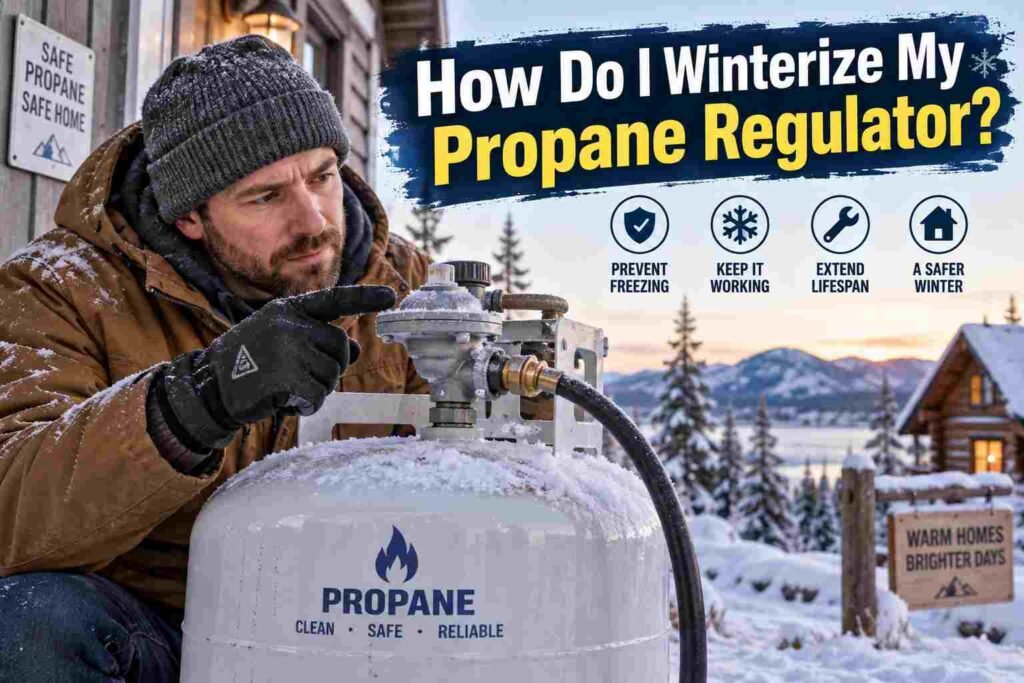
When I winterize a propane system, I do not treat the regulator like an outdoor faucet that simply needs insulation. A propane regulator has to “breathe” through its vent. If I cover it too tightly, plug the vent with insulation, or let snow and ice pack around it, I can create a pressure-control problem instead of preventing one.
My goal is to keep the regulator dry, unobstructed, correctly oriented, protected from falling snow and ice, and supplied with enough propane vapor for the coldest conditions I expect.
I also inspect the rest of the system because many winter regulator complaints are not caused by the regulator alone. A kinked pigtail, undersized cylinder, low fuel level, heavy appliance demand, moisture contamination, or a snow-covered vent can all create low-pressure or freeze-up symptoms.


Propane Regulator Winterization: Technical Details
| Winterization Item | What I Check | Why It Matters |
|---|---|---|
| Regulator vent | Facing downward or protected by approved cover | Helps keep snow, freezing rain, water, insects, and debris from blocking the vent |
| Vent screen | Present, clean, and unobstructed | Regulator must vent and reference atmospheric pressure correctly |
| Snow clearance | Regulator, piping, and tank area remain accessible | Dense snow or ice can block vents and damage piping |
| Pigtail condition | No kinks, crushing, severe bends, or visible deterioration | Restrictions can reduce flow and contribute to freeze-up symptoms |
| Regulator type | Correct stage and capacity for winter load | Two-stage systems reduce pressure in steps and generally chill less than single-stage systems |
| Fuel supply | Adequate tank/cylinder size and fill level | Cold weather reduces vaporization capacity |
| Pressure performance | Stable under expected heating load | Confirms system can maintain appliance pressure in winter |
Why Does a Propane Regulator Need Winter Preparation?
Cold weather changes how a propane system behaves. Propane vapor pressure drops as temperature falls, and the liquid propane inside a tank or cylinder has to absorb heat from the surroundings in order to boil and produce vapor. When demand is high—such as when a furnace, water heater, fireplace, and generator are all competing for gas—the storage container can cool further.
At the same time, gas cools as it expands through a regulator. RegO explains that true regulator freeze-ups can occur when moisture in the LP-gas condenses and then freezes on the cold regulator nozzle. That can happen in cold weather, but RegO also notes that freeze-ups can occur even when the outside temperature is above 32°F if moisture, gas flow, and pressure drop combine in the wrong way.
This is why I think of “winterizing” as more than snow removal. I am preparing the entire pressure-control system for colder fuel, heavier gas demand, moisture, and outdoor weather.
1. Make Sure the Regulator Vent Faces Down
The regulator vent is one of the first things I inspect before winter.


RegO, Fisher, Marshall Excelsior, and PERC all emphasize keeping regulator vents unobstructed. On many outdoor second-stage and integral two-stage regulators, the vent should face downward or be installed under a suitable protective cover.
That downward orientation helps water drain away and makes it harder for freezing rain, snow, sleet, mud, insects, and debris to enter the vent opening.
Fisher has specifically tested drip-lip regulator vents in freezing conditions and found that correct downward installation helps the vent remain open even when ice builds around the regulator.
I do not rotate a regulator body casually just to make the vent point down. If the regulator was installed incorrectly, I have a qualified technician correct the piping or vent arrangement so the regulator remains properly supported and leak-tight.
2. Keep Snow and Ice Away From the Regulator
During winter, I keep the regulator visible and accessible. I do not allow snowbanks to cover it.

PERC advises carefully clearing snow and ice from propane piping, regulators, and meters. Fisher also recommends snow shelters in areas with heavy snowfall, especially where drifting snow or snow sliding from a roof can bury or strike the regulator.
If I clear snow manually, I use a broom or soft tool around the regulator rather than chopping with a shovel. A shovel can damage copper tubing, regulator bodies, shutoff valves, pigtails, or fittings hidden below the snow.
I also avoid striking ice directly off the regulator. If the regulator is encased in ice, that is a sign the installation needs attention. I would rather have a propane professional inspect it than risk cracking a fitting or damaging the vent.
3. Use a Proper Snow Shelter—Not a Tight Box
A winter cover can help, but the way it is built matters.


A regulator still needs airflow around its vent, and a relief valve must have room to discharge safely if it operates. Fisher’s winter inspection guidance describes snow shelters that keep drifting or falling snow away while leaving an open area around the regulator so it can breathe and vent.
I avoid wrapping the regulator tightly in plastic, fabric, foam insulation, tape, or a sealed container. A tight cover can trap moisture, obstruct the vent, hide a leak, and interfere with relief operation.
A good protective shelter is more like a small roof or hood than a sealed box.
4. Inspect the Vent Screen
Before the heating season, I look at the vent opening from the outside. The screen should be present and clear.
If I see mud, insect nests, debris, heavy corrosion, or material that appears to have entered the regulator, I do not push wire or tools into the vent. RegO says that if foreign material is evident inside the vent, the regulator should be replaced.
I also do not spray compressed air, lubricant, or cleaner into the vent. The regulator diaphragm and internal seat are precision components, and contamination can make the pressure problem worse.
5. Check Pigtails for Kinks and Restrictions
On cylinder systems, the pigtail between the cylinder valve and regulator deserves extra attention before winter.
RegO notes that freeze-ups can occur where pigtails or inlet piping are kinked or bent enough to restrict propane flow. A restriction creates additional pressure drop and cooling at the restriction point.
I inspect flexible propane hoses for:
- sharp bends or kinks;
- crushed sections;
- abrasion from rubbing against metal;
- cracks or weather damage;
- loose fittings;
- oil-like contamination or obvious residue;
- poor routing that allows water or liquid contamination to collect.
If a pigtail is damaged, I replace it with the correct propane-rated part rather than trying to bend it back into shape.
6. Confirm the Regulator Is High Enough and Drains Correctly
RegO’s freeze-up guidance recommends installing the regulator higher than the container connection where the system design allows it. The reason is simple: any liquid droplets that form in the pigtail can drain back toward the container instead of collecting at the regulator inlet.
I do not relocate a regulator myself unless I am qualified to modify the gas piping. Changing regulator height can affect pipe support, venting, clearances, and leak integrity. But if the regulator sits in a low pocket where water, oil, or liquid contamination can collect, I have the installation evaluated before winter.
7. Make Sure the Propane Supply Is Large Enough for Winter
A regulator cannot make vapor that the cylinder or tank cannot produce.
As temperatures fall, propane vapor pressure and vaporization capacity decrease. If the storage container is too small for the connected heating load, the system can look like it has a regulator problem even when the regulator is functioning normally.
This is especially common with 100-pound cylinders, small RV cylinders, and installations where several large appliances run at once.
For winter, I compare the expected peak BTU load with the tank or cylinder’s cold-weather vaporization capacity. I also avoid letting a small cylinder run nearly empty during the coldest weather because a lower liquid level reduces the wetted surface area available to absorb heat.
| Winter Condition | What I May Notice | What I Check |
|---|---|---|
| Very cold weather | Lower inlet pressure | Tank size, fuel level, vaporization capacity |
| Several appliances running | Outlet pressure droop | Regulator capacity and pipe size |
| Small cylinder nearly empty | Frosting and weak gas flow | Refill level and cylinder bank sizing |
| Pressure normal in fall but weak in winter | Seasonal supply limitation | Cold-weather inlet pressure and vaporization |
If you are using a 100-pound cylinder, my article on the ideal pressure for a 100-pound propane tank explains why tank pressure changes with temperature and why vaporization matters more than a single PSI number.
8. Verify the Regulator Has Enough BTU Capacity
Winter is when an undersized regulator often reveals itself because furnace demand is higher and more appliances may run at the same time.
I add the input BTU/hr ratings of the appliances served by the regulator and compare that load with the regulator’s published capacity under the expected inlet-pressure conditions.
For example:
| Appliance | Example Input |
|---|---|
| Furnace | 100,000 BTU/hr |
| Water heater | 40,000 BTU/hr |
| Fireplace | 35,000 BTU/hr |
| Range/oven | 65,000 BTU/hr |
| Total | 240,000 BTU/hr |
If the regulator is marginal at 240,000 BTU/hr under mild conditions, winter inlet-pressure loss may make the weakness more obvious.
I do not compensate by turning the regulator pressure up. I size the regulator and piping correctly instead. My guide on calculating propane regulator BTU capacity explains that process in detail.
9. Understand Why Two-Stage Regulation Helps in Winter
RegO specifically recommends considering a twin-stage or two-stage system where freeze-ups are a concern.
In a single-stage setup, propane may expand from full container pressure all the way down to roughly 11 inches water column through one regulator nozzle. That large pressure drop creates substantial chilling.
In a two-stage system, the pressure reduction is split between two regulator stages. RegO explains that this reduces the chilling effect at each regulator and can reduce freeze-up problems.
That does not mean every old system should be modified without an engineering review. But if you have a recurring winter freeze-up on an older single-stage arrangement, I would ask a propane professional whether converting to two-stage regulation makes sense.
10. Do Not Try to Heat the Regulator or Tank
This is one of the most important winter rules.
PERC says never try to warm propane storage cylinders or tanks with an external heat source during extreme cold. I apply the same practical caution to the regulator.
I do not use:
- open flames;
- torches;
- heat guns;
- space heaters pointed at the regulator;
- boiling water;
- electric heating pads not specifically approved for the application;
- hair dryers as a routine freeze-up fix.
If a regulator repeatedly freezes, I want to know why. Moisture, restricted piping, improper installation, inadequate vaporization, or a regulator problem should be corrected rather than hidden with heat.
11. Never Pour Methanol Into a Frozen Regulator
RegO discusses methanol as a professional LP-gas moisture-control treatment for containers, but it specifically warns not to use methanol to remove ice from inside a frozen regulator because it can damage the diaphragm and seat disc.
I leave moisture treatment to trained propane professionals. Adding chemicals to a container or regulator is not a homeowner winterization step.
12. Check for Signs of Moisture or Repeated Freeze-Up
If the regulator freezes once during an unusual icing event, I inspect the vent and weather protection. If it freezes repeatedly—even above 32°F—I become more suspicious of moisture in the LP-gas system.
RegO explains that excessive moisture can condense and freeze on the regulator nozzle as high-pressure gas expands. That means the outside air temperature alone does not determine whether a freeze-up can happen.
Repeated symptoms may include:
- regulator icing followed by loss of gas flow;
- frost concentrating around the regulator inlet or pigtail restriction;
- pressure returning after the system warms, then failing again later;
- freeze-ups occurring with heavy heating demand;
- the same problem returning after multiple cylinder changes.
If that pattern appears, I call the propane supplier. They can evaluate moisture contamination, container history, regulator condition, and whether the propane system needs professional treatment or component replacement.
For a full troubleshooting guide, see why a propane regulator keeps freezing up.
13. Inspect the Regulator for Age, Corrosion, and Damage
Winter preparation is a good time to look at the regulator body, bonnet, vent, mounting, and fittings.
I look for:
- heavy rust or corrosion;
- cracks or dents;
- a missing bonnet cap;
- a damaged or missing vent screen;
- water intrusion;
- bent piping;
- loose mounting;
- evidence that snow or roof ice has struck the regulator.
Regulator service life is manufacturer-specific. Fisher currently recommends a 20-year replacement life on several domestic R-series regulators, while RegO publishes its own service-life guidance by regulator type. I check the actual model rather than assuming every regulator lasts the same number of years.
If you are unsure about age, see my guide on how long propane regulators last.
14. Have Pressure and Leak Tests Done Before Peak Heating Season
If the regulator has been troublesome, the system was modified, or I am relying on propane for winter heat, I like to have a qualified technician verify pressure before the coldest weather arrives.
For many low-pressure propane systems, the final delivery pressure is around 11 inches water column, or about 0.397 psi. A conventional first-stage regulator may deliver around 10 psig to the second stage.
| Pressure Point | Common Example | Winter Check |
|---|---|---|
| First-stage outlet | Around 10 psig on many systems | Verify it holds under heating load |
| Final low-pressure outlet | Around 11 in. w.c. on many systems | Check flow pressure at appliance load |
| Full-load performance | Manufacturer-specific acceptable range | Confirms winter peak load can be supplied |
I care more about how the pressure behaves under load than how it looks when no appliances are running. A static reading can look perfect while the system collapses when the furnace starts.
15. Winterize an RV Propane Regulator a Little Differently
On an RV, I pay extra attention to the regulator cover, pigtails, automatic-changeover indicator, and the two cylinders because those components are exposed to road spray, freezing rain, and repeated cylinder changes.
Before winter camping, I check that the regulator is still mounted in its intended position and that the vent faces downward. I inspect both pigtails for cracks, kinks, rubbing, or stiffness. If the system uses an automatic-changeover regulator, I make sure the service and reserve cylinders are actually full enough for the trip and that the selector works normally.
Some automatic-changeover regulators can draw supplemental vapor from the reserve cylinder during extreme cold or unusually heavy demand. RegO lists this feature on its 7525B series. That does not mean every dual-cylinder regulator behaves exactly the same way, so I follow the manual for the installed model.
I also remember that two cylinders do not magically eliminate cold-weather vaporization limits. A high-output furnace can consume propane quickly, and small cylinders lose vaporization capacity as temperatures and fill levels fall.
If you use an RV in winter, see my related articles on why an RV propane regulator keeps freezing and what type of propane regulator an RV needs.
16. Keep the Tank and Regulator Accessible for Deliveries and Emergencies
I clear a safe path to the propane tank before major snow arrives. PERC recommends keeping the tank area accessible so propane-company personnel can reach the tank when they need to refill or service it.
That matters more than people realize. If a delivery driver cannot safely reach the tank after a storm, you could run low on fuel exactly when heating demand is highest.
I also mark the regulator or tank location in areas where deep snow can hide equipment. Fisher recommends a visible marker such as a long stick and flag in heavy-snow locations so the regulator can be found without digging blindly into the piping.
17. Watch the Propane Level More Closely in Winter
Winter is not the season when I like to discover that the tank is nearly empty.
I check the tank gauge more frequently when the furnace is running heavily. A tank-level gauge normally reads as a percentage, not PSI. If the tank reads 25%, that means approximately one-quarter of the gauge scale remains—it does not mean the tank pressure is 25 psi.
Running very low can also make a small-container vaporization problem worse. Less liquid propane means less wetted tank surface available to absorb heat from the surroundings.
If your propane supply runs completely out, PERC recommends having the propane retailer or another qualified professional perform the appropriate leak check and restore service before returning the system to normal operation.
18. Check the Regulator After Major Winter Storms
I do a quick visual inspection after freezing rain, heavy snow, strong winds, roof-snow slides, or ice storms.
I look for:
- snow packed around the regulator;
- ice covering the vent;
- bent pigtails or piping;
- a regulator that has shifted position;
- roof ice or snow that has struck the equipment;
- broken protective covers;
- propane odor or hissing;
- appliance vents blocked by snow.
PERC warns that snow and ice can damage propane-system components and cause leaks. If I see bent or broken gas lines, a shifted tank, or obvious damage after a storm, I do not attempt to straighten the piping myself. I contact the propane supplier.
19. What If I Shut the Propane System Down for the Entire Winter?
Some seasonal cabins, grills, RVs, and outdoor installations are not used during winter. In that case, winterization may involve putting the regulator and supply system out of service rather than preparing it for continuous operation.
If a regulator is intentionally removed from service, RegO recommends storing used regulators in a clean, dry area, keeping the bonnet cap and vent screen in place, and protecting the inlet and outlet from dirt, water, insects, and corrosive environments.
I do not disconnect hard-piped propane regulators simply as a seasonal DIY chore. Gas-line disconnection, capping, leak testing, and reactivation should be handled by a qualified professional.
For portable equipment, I follow the appliance and cylinder manufacturer’s storage instructions. Cylinders are generally stored upright in an approved outdoor location—not inside a house, basement, or other enclosed living space.
20. Do I Need to Insulate My Propane Regulator?
Usually, no. I do not wrap a regulator in ordinary insulation.
A regulator does not fail simply because its metal body is cold. In fact, many propane regulators are designed to operate well below freezing. Fisher currently lists its R222H first-stage regulator as tested to -40°F, and RegO’s 7525B automatic-changeover regulator lists an operating temperature range down to -40°F.
The bigger winter concerns are vent blockage, moisture, insufficient propane vaporization, pressure restrictions, and physical snow/ice damage.
A weather shelter can be useful, but it should protect the regulator from precipitation without sealing it up or blocking the vent.
What Should I Never Do to a Propane Regulator in Winter?
| Do Not | Why I Avoid It |
|---|---|
| Wrap the regulator tightly in plastic or insulation | Can block venting and trap moisture |
| Use a torch, heat gun, or open flame | Can damage components and create an ignition hazard |
| Pour boiling water over a frozen regulator | Can damage components and refreeze around the vent |
| Chip ice with a hammer or metal tool | Can crack fittings, tubing, or regulator housing |
| Spray lubricant or cleaner into the vent | Can contaminate diaphragm and valve components |
| Pour methanol into the regulator | RegO warns it can damage the diaphragm and seat disc |
| Turn up regulator pressure to “fix” winter low flow | Can mask tank, piping, or capacity problems and create high pressure |
My Pre-Winter Propane Regulator Checklist
Before the first hard freeze, this is the checklist I use:
| Check | Ready for Winter? |
|---|---|
| Vent faces down or is under an approved protective cover | Yes / Needs service |
| Vent screen is present and clear | Yes / Needs service |
| Regulator cannot be buried by normal snow accumulation | Yes / Add proper shelter or relocate professionally |
| Pigtails have no kinks, cracks, or damage | Yes / Replace |
| Regulator body is not heavily corroded or damaged | Yes / Inspect or replace |
| Tank/cylinder has adequate fuel for peak winter use | Yes / Schedule delivery |
| Tank/cylinder size can support winter vaporization demand | Yes / Review system sizing |
| Regulator capacity covers connected appliance BTU load | Yes / Review sizing |
| Heating-season pressure/leak check completed if needed | Yes / Schedule service |
Frequently Asked Questions
Should I cover my propane regulator in winter?
I protect it from snow, freezing rain, and roof runoff, but I do not seal it inside a tight cover. The regulator vent must remain open. A properly designed hood or snow shelter provides weather protection while leaving room for airflow and relief discharge.
Can snow damage a propane regulator?
Yes. Heavy snow can bury the vent, and wet snow or roof slides can physically damage the regulator or piping. PERC recommends carefully clearing snow and ice from regulators and propane piping.
Is frost on a propane regulator always bad?
No. Some surface frost can develop when propane flow is high because pressure reduction cools the regulator. I become concerned when ice blocks the vent or when frosting is accompanied by reduced gas flow, appliance shutdowns, or repeated freeze-ups.
Why does my propane regulator freeze even when it is above 32°F?
RegO says regulator freeze-ups can occur above 32°F when moisture, gas flow, and pressure drop combine. The regulator nozzle becomes cold as high-pressure gas expands, allowing moisture to freeze locally even when outdoor air is above freezing.
Can I use a space heater to keep my propane regulator warm?
I do not recommend it. External heating can damage components or create an ignition hazard. If the system cannot operate in expected winter conditions, I correct the installation, fuel supply, moisture, or sizing problem instead.
Should I turn up my propane regulator in winter?
No—not just because the weather is cold. If pressure is low, I first check tank vaporization, inlet pressure, fuel level, piping restrictions, pigtails, regulator capacity, and the actual pressure under load. Adjustment should be based on measured pressure and the regulator manufacturer’s specifications.
Does a two-stage propane regulator work better in cold weather?
Two-stage regulation can reduce the chilling effect at each pressure-reduction step. RegO specifically notes that dividing the reduction from tank pressure to roughly 11 inches water column into two stages can reduce the possibility of regulator freeze-ups compared with a single-stage arrangement.
What should I do if my regulator is buried in snow?
I carefully clear loose snow with a broom without striking the regulator, tubing, or fittings. If the regulator is encased in dense ice, the piping appears damaged, or I smell propane, I stop and contact the propane supplier rather than digging or chipping aggressively around the equipment.
Should I disconnect my regulator for winter storage?
Not if the system will be operating. If a seasonal system is being professionally taken out of service, the regulator may be left protected in place or removed and stored according to manufacturer guidance. Any disconnected gas line must be safely capped or plugged and leak-tested before later use.
Bottom Line: How Do I Winterize My Propane Regulator?
I winterize a propane regulator by protecting its ability to breathe and making sure the entire propane supply can perform in cold weather.
I keep the vent pointed down and unobstructed, protect the regulator from snow and freezing rain without wrapping it tightly, inspect pigtails and piping, keep the tank area accessible, maintain adequate propane inventory, and verify the regulator and storage container can handle the winter BTU demand.
I do not heat the regulator, bury it in insulation, chip ice off with tools, pour chemicals into it, or turn up the pressure to compensate for winter problems.
If the regulator repeatedly freezes, loses pressure under load, vents gas, has visible damage, or becomes buried or encased in ice, I have the propane supplier or qualified technician inspect the system. Winter reliability comes from correct installation, dry fuel, adequate vaporization, proper regulator sizing, and a clear vent—not from trying to keep the regulator artificially warm.
Technical Sources
- RegO – Regulator Freeze-Ups Field Topic
- RegO – LP-Gas Serviceman’s Manual
- Propane Education & Research Council – Safety Guide for Propane Users
- Fisher – Y602 Weather-Resistant Regulator Vent Assemblies
- Fisher – LP-Gas Regulator Inspection and Heavy-Snow Guidance
- Fisher – R222H First-Stage Regulator
- RegO – 7525B Automatic Changeover Regulator

Mike is an experienced propane technician with over 15 years of professional experience in the field. He has dedicated his career to helping customers with their propane needs, from installation to maintenance and repair. Together with Jeremy, he co-founded this website to provide useful information and guidance to customers seeking reliable propane services.


