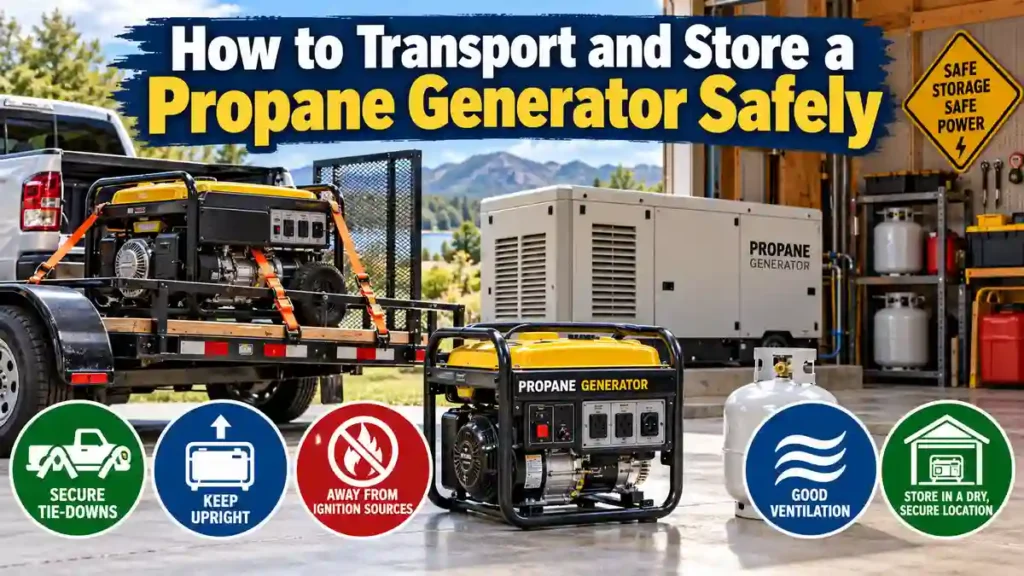
TL;DR — How do I transport and store a propane generator safely?
I would shut down the generator, disconnect its electrical loads, close the propane cylinder valve, disconnect the LPG hose as directed by the manual, and let the engine and muffler cool completely before moving it. I transport the generator upright, secured against shifting, and never while running. I handle the propane cylinder as a separate item: close its valve, keep it upright and restrained in a ventilated transport location, never carry a leaking cylinder, drive straight to the destination, and remove it from the vehicle immediately. For storage, propane cylinders belong outdoors in a ventilated location away from ignition sources—not in a garage, basement, shed, or vehicle. The disconnected generator itself can be kept dry in an appropriate manufacturer-approved storage location after its gasoline and maintenance needs are addressed. Never operate a portable propane generator indoors, even when a cylinder is stored elsewhere.
How to transport and store a propane generator safely sounds like a simple equipment-handling question, but there are two different hazards I want you to manage: a heavy engine-driven machine, and a pressurized container of flammable fuel. The generator can have a hot exhaust, residual gasoline in a dual-fuel tank, electrical connections, oil and fragile controls. The propane cylinder has its own valve, pressure relief device, inspection requirements and rules for how it is carried and stored.


I would never solve one problem by creating another. For example, moving the generator into a garage may protect it from rain, but operating it in that garage can create deadly carbon monoxide. Putting a propane cylinder inside beside the machine may look convenient, but a leaking or heat-activated relief valve can release fuel into an enclosed space. The safe arrangement treats the generator and the cylinder as two separate assets that need different storage rules.
Here is the procedure I would use as a planning checklist for a U.S. homeowner, RV user or small-jobsite operator. For construction-specific sizing and economics, I also compare portable propane generators for job sites: pros and cons. It covers propane-only and gasoline/propane dual-fuel portable models. A permanently installed home standby generator is different: I would never attempt to transport or relocate one myself; moving it involves licensed electrical and gas work, permits, and recommissioning.
Quick Safety Rules: Generator vs. Propane Cylinder
| Question | Generator (engine/equipment) | Propane cylinder (fuel container) |
|---|---|---|
| Before transport | Stop, cool, isolate loads and fuel | Close valve, disconnect as directed, inspect |
| Transport orientation | Keep upright and secure per manual | Keep upright with valve/relief arrangement in proper position |
| Cargo security | Tie down to prevent rolling or tipping; protect controls | Restrain upright against sliding or falling; protect valve |
| Inside a passenger vehicle | Follow maker’s equipment/fuel restrictions; avoid fuel vapor | Avoid passenger area; ventilated/open-bed transport preferable |
| Storage location | Dry, secure, manufacturer-approved, away from ignition | Outdoors in a well-ventilated location |
| May it be used indoors? | Never operate a portable fuel-burning generator indoors | Never use/store a standard portable LPG cylinder in an enclosed building |
| What if it smells of gas? | Do not start or move into an enclosed area | Evacuate; contact propane supplier/emergency services |
For a deeper understanding of the fuel-side hazard, I recommend my guide on detecting and preventing propane generator leaks. It explains why an engine can run normally even when the fuel system has a dangerous defect. The first rule here is that if you suspect an active leak, you should leave the area and call for help—not continue handling or transporting the cylinder.
1. Shut Down and Cool the Generator Before Moving It
I never try to roll, lift or load a generator that is still producing power. I first follow the model-specific shutdown sequence, which normally means removing electrical loads and stopping the engine using its controls. For propane operation, the manufacturer may call for closing the cylinder valve and following a particular shutdown order; I use the manual rather than assuming every fuel-selector design works alike.


The muffler and exhaust are especially important. They can remain hot after the engine stops. I would wait for the engine and muffler to cool enough for safe handling and follow any specified cooling interval. For some Champion dual-fuel inverter models, the operator’s manual describes roughly 15–30 minutes before moving, but that is an example, not a universal timer for every generator.
I also verify that the generator has stopped automatically restarting and cannot energize attached equipment. Unlike a loose portable unit, a standby machine may have automatic exercise and outage-start functions that require qualified isolation before servicing.
| Pre-move item | Why it matters | My action |
|---|---|---|
| Electrical loads | Cords may snag or energized circuits may be hazardous | Unplug loads after normal shutdown sequence |
| Engine and exhaust | Hot metal can burn skin or ignite nearby materials | Cool completely before handling or loading |
| Propane fuel supply | Hose can stretch or fitting can be damaged during movement | Close valve and disconnect/store hose as manufacturer directs |
| Gasoline tank on a dual-fuel unit | Residual gasoline can spill or release vapor | Follow model’s fuel-emptying/transport directions |
| Engine oil and vents | Tilting may cause leaks or oil migration | Keep within specified orientation limits |
| Wheel kit and handles | Some folding handles are not rated for lifting | Use only approved lift points and moving method |
2. Disconnect the Propane Cylinder Correctly
A portable dual-fuel generator usually uses a model-approved hose-and-regulator assembly connected to a cylinder. Once the unit has been shut down according to its manual, I close the cylinder valve and arrange for the hose to be disconnected and stored the way the manufacturer specifies. I don’t leave a cylinder connected while transporting the machine unless the manufacturer’s instructions and applicable transport rules explicitly permit the arrangement—and my default is to keep them separate.
This matters because an attached hose can be pinched underneath the frame or used unintentionally as a handle. Pulling on it may damage the regulator, valve connection or engine fuel inlet. I also protect the disconnection point against dirt and physical damage using the approved cap where supplied.
I would never improvise a new connector, force a threaded fitting, or treat a generic barbecue regulator as a universally suitable substitute. If the hose or valve looks damaged, I stop using it and contact a propane professional. For more detail, see how a portable dual-fuel generator propane regulator works.

3. Transport the Generator Upright and Secure It Against Movement
For the generator itself, I begin with the operating manual and shipping/moving instructions. Some compact inverter models have a rated lifting handle, while larger open-frame units need ramps, lifting assistance or equipment appropriate to their weight. A folding wheel handle may be designed for rolling but not for suspending the entire machine.
Once in a vehicle or trailer, I want it to remain upright and not shift during braking, corners or rough roads. I use proper tie-downs attached to suitable rated points without crushing the control panel, fuel line or muffler shroud. I would avoid allowing other cargo to contact the engine or battery terminals.
For a large unit, the weight on the carton is not the entire handling problem. The generator may be unbalanced because of the engine and alternator, the center of gravity may be high, and the wheel kit can let it roll when you least expect it. If I cannot safely load or restrain it, I arrange assistance rather than trying to lift a 200-pound machine alone.
| Typical portable class | Illustrative weight range | Transport consideration |
|---|---|---|
| Compact inverter, about 2–2.5 kW | 40–65 lb | May have an approved carry handle; secure against tipping |
| Mid-size inverter, about 4–5.5 kW | 80–130 lb | Use appropriate ramp/lift and restraints |
| Open-frame home-backup, about 7–10 kW | 170–250 lb | Ramp, helpers or powered lifting may be appropriate |
| Very large open-frame portable | 250–400+ lb | Heavy handling, vehicle load rating, trailer considerations |
These are broad illustrative weight ranges, not specifications for particular brands. Use the actual dry and operating weight listed in the manual, and check vehicle payload and tie-down ratings. Don’t try to carry a generator from a collapsible handle unless the manufacturer clearly identifies it as a lifting point.


4. Transport Propane Cylinders Separately, Upright, and Secured
Here is where I make the biggest distinction. A propane cylinder should stay upright and be restrained so it cannot fall, slide or roll. The valve should be closed and protected from damage. When possible, I use a ventilated pickup bed or another suitable transport arrangement rather than a passenger compartment.
The Propane Education & Research Council advises people not to leave cylinders inside vehicles. Drive directly to the destination and unload promptly. A vehicle can heat rapidly when parked; a relief device or leak can fill an enclosed area with flammable vapor. I would never use my trunk, cargo area or passenger space as overnight storage.
Transport limits depend on the country, state, vehicle and cylinder type. PERC’s U.S. consumer guidance for closed-bodied vehicles lists no more than four 20-lb cylinders, no individual cylinder larger than 45-lb propane capacity, and no more than 90 pounds of propane in total. Those are conditional U.S. limits, not a recommendation to fill a vehicle to the maximum. Different commercial or local restrictions may apply, so I check with the propane supplier and carrier before moving anything unusual.
| Cylinder example | Approx. propane when filled | My transport approach |
|---|---|---|
| One 20-lb barbecue-style cylinder | 20 lb propane; ~4.7 U.S. gal | Upright and restrained; unload promptly |
| Two 20-lb cylinders | 40 lb propane; ~9.4 U.S. gal | Restrain each separately; avoid passenger area |
| One 40-lb cylinder | 40 lb propane; ~9.4 U.S. gal | Confirm safe handling and carrier restrictions |
| One 100-lb cylinder | 100 lb propane; ~23.6 U.S. gal | Use appropriate open-bed/commercial handling; not the closed-vehicle category above |
| Empty exchange cylinder | Residual vapor may remain | Treat as potentially hazardous, valve closed |
The stated weights are propane content, not the full weight you lift; a full steel cylinder weighs more after including its empty tare weight. A cylinder labeled “100 lb” also is not the same thing as a 100-gallon stationary tank. I would not lay ordinary vertical-service portable cylinders on their sides for convenience because keeping the valve/relief arrangement correctly oriented matters.
5. Never Transport or Store a Leaking Propane Cylinder
If I smelled propane, heard escaping gas or saw a visible vapor release, I would not put that cylinder in my vehicle and drive it to a refill station. That creates a moving hazard for people on the road. I leave the area, avoid ignition sources and call the propane supplier or emergency services from a safe place. Closing a readily accessible valve is appropriate only when it can be done without approaching the leak or putting anyone at risk.
I don’t use a match, lighter or a running generator to identify a leak. I also don’t continue an improvised soap test when an active leak is suspected. The cylinder and any affected equipment must be declared safe by qualified personnel before reuse or transport.
6. Where Should You Store a Propane Generator?
The answer depends on whether you mean the disconnected generator equipment or the propane cylinder. This is the distinction most casual storage advice fails to make. The equipment and the fuel supply have different risks.
For a portable generator that is off, cooled, disconnected from LPG, and properly prepared for storage, I look for a clean, dry, well-protected area allowed by the manufacturer. If it’s a dual-fuel unit, I also account for gasoline remaining in its built-in tank or carburetor. Gasoline vapor can make a location unsuitable, even though the propane cylinder has been removed.
For propane cylinders, the answer is much stricter: store them outdoors, upright, ventilated, secured against tipping, and away from heat and ignition sources. The propane industry’s consumer safety guidance specifically warns against keeping portable cylinders in enclosed areas such as garages, basements, sheds and tents. I would never make an exception because the cylinder looks empty.
| Storage location | Disconnected generator equipment | Portable propane cylinder |
|---|---|---|
| Dry, secure equipment storage area | May be acceptable if manual and fuel condition allow | No, if it is enclosed |
| Garage | Only for suitably prepared, non-operating equipment if manufacturer/fire rules allow | Do not store standard cylinders there |
| Outdoor open-air cylinder rack | Not normally needed for generator itself | Appropriate when stable, protected and compliant |
| Garden shed | Equipment only when storage conditions allow; never operate there | Not an enclosed cylinder storage location |
| Inside vehicle/trunk | Not for long-term storage; observe fuel and transport rules | Never leave a cylinder parked inside |
| Basement or living space | Do not operate; avoid storing fuel-containing equipment | Never store cylinder |
I do not claim that every indoor storage spot is safe for every generator. The manual may specify that the gasoline tank be empty and the carburetor dry, or that the battery be removed or maintained in a particular way. Local fire rules and building conditions also matter. I would not place any generator near a furnace, water heater, pilot light or another ignition source.
7. Should You Drain Gasoline From a Dual-Fuel Generator Before Storage?
This is one place where the term “propane generator” can be misleading. Many portable propane models are actually gasoline/propane dual-fuel machines. If you’ve ever filled the gasoline tank, removing the LPG cylinder does not eliminate the stored gasoline.
Gasoline left for months can age and form deposits in a carburetor, while fumes and accidental spills create additional fire hazards. I follow the generator’s manual on whether to stabilize gasoline, run the engine to circulate treated fuel, drain the tank/carburetor, or use another approved long-storage method. I don’t mix instructions from two different brands because some modern fuel systems and storage procedures differ.
I would never drain gasoline near an open flame or use a fuel pump or siphon in an enclosed space. The manual may specify additional steps for battery maintenance, oil, spark plugs and air intake protection. I handle all fuel outdoors in safe conditions and dispose of old gasoline appropriately.
8. Long-Term Storage: My 30-, 90-, and 180-Day Plan
My practical approach is to prepare for how long the generator will be idle, not simply throw a tarp over it. The following is my proposed planning framework, not an alternative manufacturer maintenance schedule. Some models require an exercise or storage procedure earlier than the timeframes below.
| Expected downtime | Generator-side plan | Cylinder-side plan |
|---|---|---|
| Less than 30 days | Cool, clean, dry, isolate loads; follow manual’s exercise guidance | Valve closed, disconnected, stored outdoors |
| Around 30–90 days | Review fuel and battery condition; check exact storage instructions | Visually inspect condition and secure outdoor storage |
| Around 90–180 days | Follow extended-storage procedure for gasoline, oil, battery and corrosion protection | Keep outdoors; check inspection date/condition |
| More than 180 days | Document storage steps and plan recommissioning before use | Verify cylinder eligibility and safe connections before reuse |
I prefer to record the last operating date, generator hours, fuel type last used, oil-service status, battery condition and whether the approved LPG hose is safely stored. That makes it easier to return the machine to service without guessing months later.
9. Protect the Generator From Dust, Moisture, Rodents, and Corrosion
A generator stored properly isn’t the same thing as a generator wrapped airtight. Moisture trapped under an impermeable cover may encourage corrosion, while a cover that blocks airflow or contacts hot surfaces can be a hazard. I clean and dry the unit before putting on a manufacturer-approved breathable protective cover after it is completely cool.
I check for leaves, debris, insects and rodent activity around the air intake and exhaust openings before the next use. Rodents can damage wiring and flexible hoses, while moisture can corrode outlet terminals or starter connections. I never block an exhaust with improvised material and then forget to remove it before startup.
I also don’t store the generator under piles of other equipment. Heavy objects can break the housing, controls or fuel-system fittings, and restricted access makes it harder to inspect the machine after a storm.
10. Batteries Need Their Own Storage Plan
Electric-start propane generators may have a 12-volt starter battery or a different battery arrangement depending on the model. The battery can discharge during storage even when the generator isn’t running. I read the maker’s recommended charging and storage procedure, including whether the battery should remain connected, be removed, or be maintained with a suitable charger.
A generator that has fresh propane and a clean engine may still be unable to start because the battery has discharged. I avoid placing charging equipment near propane cylinders or fuel vapors. For routine engine upkeep, my propane generator maintenance checklist covers the other parts I would inspect before relying on backup power.
11. The Difference Between Transporting a Portable Unit and Relocating a Standby Generator
A portable generator is designed to be moved when properly shut down. A permanent standby generator normally sits on a pad and is connected to fixed electrical transfer equipment and a propane service line. It may also have an automatic starting circuit. Trying to lift or move it without isolation can damage live electrical connections or gas piping.
For a standby unit, I would involve a licensed electrician and qualified propane contractor or authorized installer. Moving the unit can require permits, inspection, fuel-line redesign, clearances, gas-pressure verification, transfer-switch checks, and a return-to-service commissioning process. That is much more than disconnecting a hose.
If you’re planning a permanent installation or relocation, see when professional propane generator installation is required and standby generator fuel-system sizing.
12. Important Transport and Storage Numbers
I keep useful figures in one place, but I do not treat them as universal limits. Measurements from a model’s manual take priority over illustrative ranges, and cylinder transportation law changes by jurisdiction and use.
| Number or specification | Reference value | Important qualification |
|---|---|---|
| 20-lb LPG cylinder liquid propane | About 4.7 U.S. gallons | Nominal properly filled cylinder |
| 100-lb LPG cylinder liquid propane | About 23.6 U.S. gallons | Too large for PERC closed-bodied vehicle limits |
| Closed-bodied U.S. vehicle: individual cylinder size | No more than 45-lb propane capacity under PERC guidance | Verify local and carrier restrictions |
| Closed-bodied U.S. vehicle: 20-lb cylinders | No more than 4 under PERC guidance | Additional total-weight restriction applies |
| Closed-bodied U.S. vehicle: propane content | No more than 90 lb under PERC guidance | Not an unconditional permit for all circumstances |
| Sample portable-generator cooling guidance | Often around 15–30 minutes on some models | Wait for actual safe handling temperature and follow manual |
| Portable generator operating distance | At least 20 ft from home when feasible under U.S. CO guidance | An operating rule, not a cylinder-storage setback |
One distinction I emphasize: the 20-foot carbon-monoxide guidance concerns operating a portable generator near occupied buildings. It is not automatically the same setback for storing a propane cylinder or installing a large stationary tank. Those situations involve separate manufacturer instructions, fuel-gas codes and site-specific requirements.
13. Safe Travel With a Propane Generator for Camping or RV Use
For camping, I would plan the trip in two parts: how to pack the generator and how to transport the cylinder. The generator should be fully stopped and cool, securely restrained, and positioned as directed in its manual. The cylinder should be upright, valve closed, and secured against movement. I would travel directly to the campsite or intended destination, unload promptly, and store the cylinder outdoors in a suitable ventilated position.
At the campground, I don’t operate the generator in a tent, vehicle, enclosed campsite shelter or RV cargo bay. Even a quiet inverter produces carbon monoxide. I follow site-specific generator-hour rules, choose a safe outdoor operating location away from openings, and direct exhaust away from people and occupied spaces.
If you’re choosing a compact unit for camping, see my guide to inverter propane generators for sensitive electronics and whether propane generators are quieter than gasoline models.
14. What If the Generator Gets Wet or Flooded in Storage?
I wouldn’t start a generator immediately after flooding, deep water exposure or an impact that may have damaged the engine or electrical system. Water can contaminate the oil and fuel, corrode components and create shock hazards. A flooded unit may also have compromised hoses, valves, wiring or automatic controls.
Instead, I would secure the area and arrange a qualified inspection before returning it to use. If you see damaged propane fittings or smell gas, follow the propane-leak emergency procedure rather than inspecting the connections yourself. The worst time to discover a faulty generator is when the power has already failed, which is why I take post-storm inspections seriously.
15. A Two-Tag Handoff System I Would Use
Here’s an original organization idea I would use when multiple family members move or store the equipment. I would attach two separate non-safety-critical record tags or keep a log card: one for the generator’s state and one for the fuel cylinder’s state. This is a memory aid, not a substitute for valves, safety labels, inspections or professional testing.
| Tag / record | What I would write | What confusion it prevents |
|---|---|---|
| Generator equipment record | Last use, date cooled, fuel used last, gasoline storage preparation, battery status, manual reference | Someone assuming a dual-fuel unit contains no gasoline |
| Cylinder record | Valve-closed confirmation, whether disconnected, outdoor location, supplier, inspection/recertification status | Someone placing a cylinder indoors beside stored equipment |
| Travel check card | Approved loading method, straps, destination, immediate unload plan | Cylinder left in a hot car or unsecured during the trip |
| Return-to-service card | Visible damage check, service due, manual startup procedure, qualified checks when required | Engine restarted with missing maintenance or damaged fuel components |
I like this method because “the generator is put away” can hide two very different conditions. The equipment may be cool and safely covered while its propane cylinder has accidentally been left beside a furnace. The separate records make that mistake less likely, particularly when a household rotates who operates the backup system.
16. My Before-Transport and Before-Storage Checklist
- Finish the normal shutdown. I remove electrical loads and stop the generator following its exact manual.
- Keep the fuel system safe. I close the cylinder valve and follow the approved LPG hose-disconnection procedure; I never handle a suspected leak.
- Allow proper cooling. I wait until the engine and muffler can be handled safely.
- Consider gasoline in dual-fuel units. I review the manufacturer’s transport or extended-storage instructions before moving or storing fuel-containing equipment.
- Inspect without dismantling. I look for obvious damage, fuel odor, loose panels, worn wheels or broken handles, then arrange service if needed.
- Secure the generator upright. I use rated restraints and approved lift points and avoid crushing outlets, fuel lines or controls.
- Secure the cylinder separately. It stays upright with valve closed, away from passenger areas when feasible, and never left parked inside a vehicle.
- Choose different storage locations. A suitably prepared generator goes to a dry approved place; portable propane cylinders are kept outdoors in proper ventilation.
- Log battery and maintenance needs. I note the last start, service hours and how the next user should prepare the generator.
- Check the return-to-service procedure. After extended storage or suspected damage, I follow the model’s inspection and testing requirements before an outage.
Frequently Asked Questions
Can I transport a propane generator with the tank attached?
I would normally disconnect the portable LPG cylinder and store the hose as the generator manual instructs before moving. An attached tank or dangling hose can suffer damage, and transport rules may impose separate requirements on the cylinder. Do not move a running or hot generator.
Can I store a propane generator in my garage?
A disconnected, shut-down generator may be stored in an appropriate dry area if its manual and fuel-storage conditions allow, but never operate a portable generator in a garage. Do not store its portable propane cylinder in a garage, even if the cylinder is apparently empty.
Should propane tanks be stored inside a shed?
No. Standard portable propane cylinders should be stored outdoors, upright and well ventilated, away from ignition sources and heat. An enclosed shed is not appropriate cylinder storage. Follow supplier and local requirements for approved outdoor storage arrangements.
Can I leave a propane tank in the car overnight?
No. I would travel directly to my destination and remove cylinders from the vehicle promptly. A parked vehicle can heat up, and leaked propane may accumulate in enclosed spaces.
Can I transport a 100-lb propane cylinder in an SUV?
I would not use a closed-bodied passenger vehicle for a 100-lb propane cylinder. The PERC closed-vehicle consumer guidance cited here limits individual cylinders to 45-lb propane capacity. Ask your propane supplier about suitable open-bed or commercial transport instead.
Do I need to drain oil before moving a generator?
Not necessarily. I follow the specific generator manual. The bigger routine concern is keeping it at the approved orientation and preventing leakage. Some shipping or service procedures can differ from ordinary wheeled transport.
What is the best way to store a dual-fuel generator for six months?
I prepare the gasoline side using the manufacturer’s extended-storage instructions, ensure the unit is cooled and dry, address battery needs, and disconnect/store the LPG cylinder outdoors. Before restarting, I inspect the generator and follow the prescribed return-to-service steps.
Can I store a propane cylinder upside down or on its side?
Ordinary vapor-service portable cylinders should be kept upright with the relief valve correctly oriented. Some specialized cylinders are designed for different service, but I would not apply those exceptions to an ordinary 20-lb generator cylinder.
What if I smell propane while loading the generator?
I stop and leave the area. I would not load or transport a leaking cylinder, operate vehicle controls near a suspected gas cloud, or continue testing the fitting. Contact the propane supplier or emergency responders from a safe place.
Is a propane generator safe to run inside if I use a long exhaust hose?
No. A homemade exhaust extension does not make indoor portable-generator operation safe. Carbon monoxide can build up rapidly, and propane equipment must remain in an approved outdoor operating location. See my indoor propane generator safety guide.
My Final Advice: Move the Machine, Protect the Fuel, and Keep Them Separate
If I had to reduce this to one principle, it would be this: don’t treat a propane generator and a propane cylinder as one object. The generator needs a proper shutdown, cooling period, protected transport, dry storage and scheduled maintenance. The cylinder needs valve protection, upright transport, immediate unloading and approved outdoor storage. They are connected during proper outdoor operation, but they should have separate handling plans when you’re preparing for the next outage.
I would also prioritize the written manual over generalized advice because some models have gasoline-storage instructions, special lifting provisions, battery requirements or a specific LPG hose procedure. If the system has been flooded, impacted, or exposed to a suspected gas leak, I’d involve qualified professionals before reuse. That’s a far better preparation strategy than finding out during a blackout that something was damaged or stored unsafely.
Safety and research note: This guide reflects propane-cylinder transport and storage guidance published by the Propane Education & Research Council, portable-generator carbon monoxide guidance from the U.S. Consumer Product Safety Commission, and moving/storage guidance in dual-fuel generator manuals. The illustrative weight and planning tables do not replace actual equipment specifications or local law. The two-tag checklist is an original organizational recommendation, not an official safety procedure. No outbound links are included.

Mike is an experienced propane technician with over 15 years of professional experience in the field. He has dedicated his career to helping customers with their propane needs, from installation to maintenance and repair. Together with Jeremy, he co-founded this website to provide useful information and guidance to customers seeking reliable propane services.