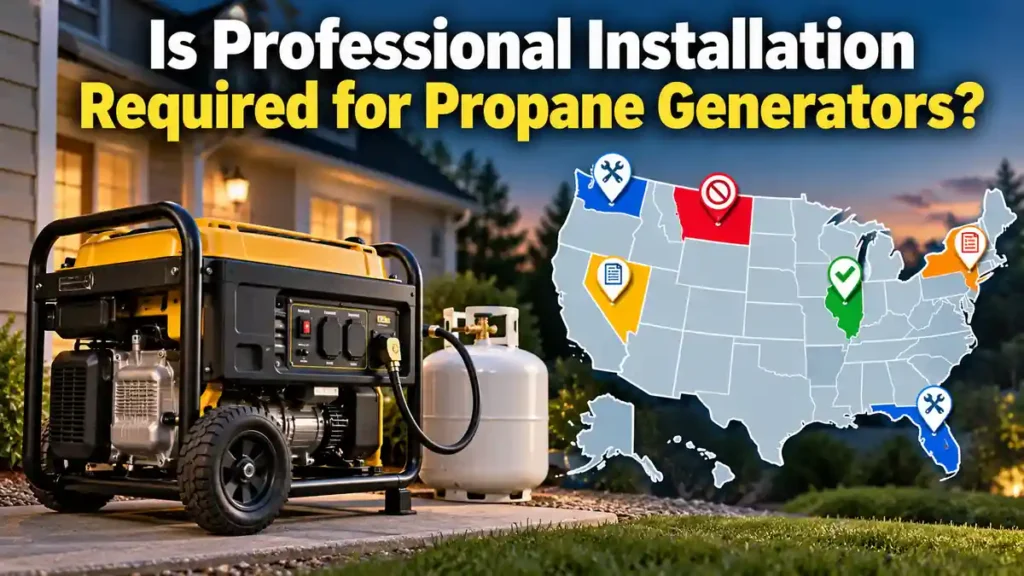
When you ask me, “Is professional installation required for propane generators?” I don’t start with the size printed on the generator. I start with one question: What exactly will be connected to your home? A movable generator supplying a refrigerator through a properly rated cord is a fundamentally different project from a permanent standby machine tied to your electrical panel and large propane tank. Treating those two setups as the same can make a supposedly inexpensive purchase costly—or unsafe.
My practical rule is to divide the decision into three approvals: property, power, and propane. Your property determines where the generator may go. Power determines how it connects without backfeeding the utility. Propane determines who may size, install, test, and approve the fuel system. The state-by-state guide below shows where I would begin, but it is a research checklist rather than a substitute for a ruling from your local authority having jurisdiction (AHJ).
Is a professional installer legally required for a propane generator?
The answer depends on the work involved and the exact address. Many jurisdictions require licensed electricians for nonexempt electrical work, and permanent generator connections normally trigger electrical permitting and inspection. Permanent propane tanks, regulators, and piping can involve a separately qualified fuel-gas contractor, LP-gas dealer, plumber, or gas fitter. A generator manufacturer may also condition warranty coverage on qualified installation and code-compliant commissioning.


That does not mean every homeowner plugging in a portable propane generator must hire an installer. If you’re operating a portable model outdoors and connecting compatible appliances directly using manufacturer-approved cords, the setup can be an ordinary consumer operation. It becomes an installation project when you alter your house wiring, add a generator inlet, install transfer equipment, trench a fixed propane line, or create a permanent pad and enclosure.
| Your proposed setup | Professional trade involvement | Permit question to ask |
|---|---|---|
| Portable propane generator with direct extension cords | Usually no installation contractor for normal consumer operation | Check local temporary-use, noise, fire and placement rules |
| Portable generator feeding house circuits through inlet and transfer equipment | Use a qualified, appropriately licensed electrician; mandatory in many jurisdictions | Is an electrical permit/inspection required for inlet, wiring and isolation? |
| Permanent propane standby generator with automatic transfer switch | Plan for a licensed electrical contractor and qualified propane/fuel-gas installer | Which electrical, mechanical/fuel-gas, building and fire permits are required? |
| Existing LP tank feeding a new fixed generator | Fuel supplier or licensed LP-gas professional should evaluate capacity and piping | Is new piping, regulator work, pressure testing or inspection required? |
| Homeowner-permit installation where an exemption may exist | Possible only if your jurisdiction expressly allows it; skill and safety remain critical | Can an owner perform this specific scope, and who must inspect/sign off? |
Portable propane generators versus permanent standby units
I would not use the same installation advice for both types. Portable units are intended to move between approved outdoor locations and use the fuel connection specified by their manufacturer. Permanent standby generators are fixed equipment, typically served by a substantial LP-gas installation and a transfer switch. Their commissioning can involve electrical load testing, propane pressure measurements, controller programming, and coordination with the propane supplier.
For a home backup project, first read my guide on calculating your home’s power needs for a propane generator. A correctly sized unit is easier to install and avoids unnecessary gas-line and electrical modifications. If you are still comparing portable and standby options, my propane generator size guide for a house explains the power side separately from this article’s legal and permitting focus.
What laws and codes apply to professional propane generator installation?
Codes are not the same thing as licenses. A code tells you how equipment should be installed. A licensing law determines who may perform the work. A permit is the authorization to undertake a regulated project, and an inspection checks the finished work. You can comply with one and still fail another. This distinction is why I ask for the complete permit path before ordering the generator.


| Rule or authority | What it commonly addresses | My practical takeaway |
|---|---|---|
| National Electrical Code (NFPA 70), as locally adopted | Generator electrical connections, grounding/bonding, overcurrent protection and optional standby systems | Ask which code edition and local amendments your inspector enforces |
| NFPA 37, where adopted or referenced | Stationary engine fire-safety installation and operating provisions | Confirm generator-specific clearance and site rules |
| NFPA 58, where adopted or referenced | LP-gas storage, tank placement, piping, regulators and safety requirements | Ask the propane supplier about approved tank and fuel arrangement |
| Local building, fire, mechanical and zoning codes | Pads, clearances, property lines, noise, flood zones and fire access | Get location approval before pouring a pad or trenching |
| State trade-licensing rules | Who may legally contract for and perform electrical, gas, or mechanical work | Verify the license matches the actual work, not just the company name |
| Manufacturer instructions and warranty terms | Model-specific spacing, fuel pressure, commissioning and service requirements | Use your exact model manual; no universal clearance applies to every generator |
One detail worth checking: the latest published code edition is not necessarily the edition in force where you live. Local authorities can adopt a different edition or add amendments. For example, Oregon’s 2026 electrical code took effect in October 2026, while other jurisdictions apply different rules. I would never select a transfer switch solely from a generic national diagram and assume it has local approval.
Propane generator installation requirements by U.S. state
How to read this 50-state table: The first column tells you where I would begin asking about contractor licenses and installation oversight. The next column identifies the specific issue to verify. It is deliberately not a claim that every permanent generator always needs the same permit or that homeowners are legally barred from all DIY work in a particular state. State licensing systems, city ordinances, exemptions, and county inspections can differ even across neighboring addresses.
For every state, start with your city or county building department, ask which authority reviews a permanently connected residential LP-gas standby generator, then confirm electrical contractor licensing and propane-system qualifications. For portable-only operation, ask whether temporary placement and noise rules apply rather than assuming a permanent-installation permit is needed.
| State | First licensing / permitting contact | State-specific issue to verify |
|---|---|---|
| Alabama | Electrical Contractors Board; local building office | Electrical permit, LP-gas contractor credentials, and fire review where applicable |
| Alaska | State electrical licensing office; municipality or borough | Whether state electrical rules or additional local inspections govern the site |
| Arizona | Registrar of Contractors; city or county | Correct electrical and gas contractor classifications plus outdoor setbacks |
| Arkansas | State electrical licensing authority; LP-Gas Board | Who may connect a stationary LP system and who inspects the installation |
| California | Contractors State License Board (CSLB); local building office | C-10 electrical scope, gas work classification, and local fire/air rules |
| Colorado | State Electrical Board; local building department | State electrical permit path and the local LPG/fire approval |
| Connecticut | Department of Consumer Protection; municipal building office | Electrician and gas-fitting credentials, zoning, and inspections |
| Delaware | Board of Electrical Examiners; county or municipal authority | Local electrical permits and any propane or fire review |
| Florida | DBPR electrical licensing; local building office | Certified or registered contractor scope, fuel-gas permits, and hurricane siting |
| Georgia | Construction Industry Licensing Board; local inspectors | Electrician credentials, LP-gas piping authorization, and site placement |
| Hawaii | DCCA professional licensing; county permit office | County permits, electrician qualification, and coastal or noise restrictions |
| Idaho | Division of Occupational and Professional Licenses; local office | Electrical permit, fuel-gas work scope, and local fire requirements |
| Illinois | City or county electrical/building authority | Local electrician licensing and LPG/fire rules; verify municipality first |
| Indiana | Local building and electrical authority; fire prevention office | Whether the jurisdiction issues separate electrical and propane approvals |
| Iowa | Iowa Electrical Examining Board; local permitting | Electrical contractor credentials and local gas/fire inspections |
| Kansas | Municipal or county electrical authority; fire official | Local contractor license, transfer equipment approval, and propane siting |
| Kentucky | Department of Housing, Buildings and Construction; local office | Electrical permit process and gas piping contractor qualifications |
| Louisiana | State Licensing Board for Contractors; local authority | Applicable contractor classification and flood/elevation rules |
| Maine | Electrical Examining Board; fuel board; local office | Both electrical and fuel-installation licensing and outdoor placement |
| Maryland | State Board of Master Electricians; county permit office | State electrical licensing versus local permit and propane requirements |
| Massachusetts | Electrical and plumbing/gas-fitting boards; local inspectors | Trade license categories, gas permit, electrical permit, and setbacks |
| Michigan | LARA Bureau of Construction Codes; local building office | Licensed electrical/mechanical work and local permit inspections |
| Minnesota | Department of Labor and Industry; fire officials | Electrical permit and inspection; LP-gas installation and winter access |
| Mississippi | State contractor licensing authority; local building/fire office | Project license thresholds, gas work and local permits |
| Missouri | City or county building/electrical department | Licenses and approvals vary widely by locality; check the exact address |
| Montana | State Electrical Board; local permit and fire officials | Electrical permit, fuel-gas review, and cold-weather site access |
| Nebraska | State Electrical Division; State Fire Marshal/local office | Electrical contractor qualification, inspection and LP-gas rules |
| Nevada | State Contractors Board; local building authority | Contractor classification, gas piping work and noise/setback rules |
| New Hampshire | Electricians Board; State Fire Marshal/local authority | Electrical licensing and fire/gas code application |
| New Jersey | Board of Examiners of Electrical Contractors; municipal office | Electrical contractor credentials and local construction/gas permits |
| New Mexico | Construction Industries Division; local authority | Electrical and mechanical contractor license scopes and permits |
| New York | City or county electrical/building office | Highly local licensing; NYC has particularly specific licensed-trade rules |
| North Carolina | Board of Examiners of Electrical Contractors; LP-gas authority | Electrical credentials, fuel-system approval and local inspections |
| North Dakota | State Electrical Board; local building/fire authority | Electrical permit, LP-gas work qualification and cold-weather siting |
| Ohio | Local building/electrical authority; state contractor licensing where applicable | Residential versus commercial licensing and local fuel-gas approvals |
| Oklahoma | Construction Industries Board; LP Gas Administration | Electrical contractor and LP-gas technician qualifications |
| Oregon | Building Codes Division; local building department | Electrical permits for transfer equipment and licensed installation |
| Pennsylvania | Municipal building office under Uniform Construction Code | Local electrician rules, UCC permits, and gas/fuel inspection |
| Rhode Island | State building office and electrical licensing authority | Permits, licensed electrical work and LP-gas review |
| South Carolina | Department of Labor, Licensing and Regulation; local office | Trade contractor authorization, zoning and gas approval |
| South Dakota | State Electrical Commission; local building/fire authority | Electrical inspection and propane system authorization |
| Tennessee | Board for Licensing Contractors; local code officials | License classifications and thresholds; electrical/fuel-gas permits |
| Texas | Texas Department of Licensing and Regulation; Railroad Commission LP-Gas | Electrical contractor license, LP-gas licensing and local code adoption |
| Utah | Division of Professional Licensing; local building office | Electrical and gas contractor licensing, permits and setbacks |
| Vermont | Division of Fire Safety; local planning/zoning authority | Electrical and gas compliance plus local siting approval |
| Virginia | DPOR contractor/trades boards; local building office | Trade credentials and electrical/gas permits under local enforcement |
| Washington | Department of Labor and Industries; local permit office | Electrical permits/contractor rules and fuel-gas or fire requirements |
| West Virginia | State contractor licensing authority; State Fire Marshal | Contractor license, electrical review and propane approval |
| Wisconsin | Department of Safety and Professional Services; local inspectors | Electrical and gas permits, installer credentials and frost protection |
| Wyoming | State fire prevention/electrical safety authority; local office | Electrical inspection jurisdiction and local LP-gas/setback rules |
I especially separate state licensing from city permitting in states such as Illinois, Missouri, New York, Ohio, and Pennsylvania, where local conditions can substantially change the answer. In New York City, for example, permanently installed backup systems have detailed licensed-trade and permit requirements. In Oregon, state guidance says transfer equipment connecting a generator to house wiring needs an electrical permit and properly licensed work. California’s CSLB defines C-10 electrical contracting, Florida regulates paid electrical contracting, and Texas has statewide nonexempt electrical licensing. Those are useful signals—not permission to skip your local review.
My three-gate test: property, power, and propane
Gate 1: Is the location permitted?
I start outside, before looking at breaker panels. Is there enough space around the unit? Are there windows, vents, doors, property boundaries, utilities, flood hazards, or protected landscaping nearby? Could exhaust drift toward a neighbor? Does the HOA require approval? Some standby enclosures may be approved closer to certain walls than portable units, but those model-specific allowances cannot be borrowed from a different machine or a generic online sketch.

For portable generators, I follow outdoor carbon-monoxide guidance: operate them well away from openings—federal emergency guidance commonly recommends at least 20 feet from doors, windows, and vents—and account for exhaust direction. That is not a universal standby-generator setback law. For stationary units, verify the listing, manufacturer’s manual, NFPA provisions adopted locally, and fire official’s requirements. For a deeper safety explanation, see whether a propane generator can be operated indoors.
Gate 2: Can the electrical system be isolated safely?
A transfer switch or approved interlock arrangement is meant to keep the generator from energizing utility lines while providing controlled power to intended circuits. I would insist that a qualified electrician evaluate panel compatibility, the neutral and grounding arrangement, service equipment, conductor size, breaker rating, and whether the transfer equipment is listed and approved for the installation. The wrong approach can put utility workers and occupants in danger.
Never improvise a double-male “suicide cord” or connect a generator to a dryer receptacle to energize a house. Also, a portable generator’s wattage is not proof that an electric dryer, central HVAC system, or well pump will start correctly. Those are load-design problems addressed in my home generator sizing article.
Gate 3: Can the propane supply support full load?
A permanently installed generator can demand substantial fuel flow precisely when the weather is cold and the home’s furnace is also running. I would ask the LP-gas installer to calculate simultaneous fuel demand, vaporization performance at the lowest expected ambient temperature, pressure drop along the line, regulator capacity and placement, and whether the tank is large enough for the outage duration you expect.


A generator may start successfully during a mild-weather demonstration and still struggle when the propane tank gets cold or several appliances operate. The technical discussion is covered in what size propane regulator a standby generator needs and why propane pressure can drop when a generator starts. I would have the fuel professional perform all required testing instead of experimenting with regulator adjustments.
Who should install each part of a permanent propane generator?
I prefer a lead contractor who clearly identifies who is legally responsible for each trade. One dealer may arrange the entire project, but that does not automatically authorize its staff to perform every electrical or propane task. A strong bid names each licensed subcontractor, who obtains each permit, and who documents the final tests.
| Installation activity | Who I would ask to handle it | Evidence I would request |
|---|---|---|
| Site survey, load calculation, location plan | Experienced standby-generator contractor / qualified designer | Written scope, model and positioning plan |
| Concrete pad, anchoring, civil work | Qualified contractor within local license rules | Pad specification and any building permit |
| Panel, transfer switch, inlet, wiring | Qualified, appropriately licensed electrical contractor | Electrical permit and inspection record |
| Propane tank, trenching, fixed pipe, regulators | LP-gas supplier or properly licensed gas/mechanical contractor | Gas permit if required, test documentation |
| Generator commissioning and load exercise | Manufacturer-trained technician with relevant trade partners | Start-up report, load-transfer results and warranty documentation |
Can a homeowner install a propane generator without a contractor?
Some jurisdictions recognize owner-builder or homeowner electrical permits for certain work on an owner-occupied residence. Others limit those exemptions, especially for gas work or service equipment. The existence of a permit application does not automatically mean you are qualified to do the work, and a permit may not override a manufacturer’s installation requirements. I would ask the inspector to confirm the specific scope, in writing if possible.
In a DIY-friendly jurisdiction, I would still keep the work appropriately divided. You may be able to clear the approved area or prepare certain nonregulated site details while licensed trades make the electrical and fuel connections. Never treat a licensed contractor’s final inspection as a way to legalize work performed outside the law; inspectors can require rework or exposure of buried materials.
My decision threshold is simple: if the job changes fixed wiring, a fuel-gas system, or a utility interface, I would not DIY it just to save a line item. I value a documented, inspectable system far more than a weekend installation claim.
What permits might be required?
A permanent standby project may require more than one approval. Some places issue a single combined permit; others separate electrical, mechanical/fuel-gas, building, fire, excavation, or zoning review. A propane tank also brings its own placement, capacity and delivery-access questions. Your contractor should verify the actual permits before the equipment is positioned. If anyone says “no permits are needed anywhere,” I would ask them to identify the jurisdiction and exemption.
| Possible approval | Common trigger | What I would ask |
|---|---|---|
| Electrical permit | New transfer equipment, feeder, panel alteration or fixed connection | Who pulls it and schedules the final inspection? |
| Fuel-gas / mechanical permit | Permanent propane line or appliance connection | Who sizes, tests and signs off the gas system? |
| Building / zoning review | Pad, enclosure, location or accessory equipment | What clearances and property-line restrictions apply? |
| Fire / LP-gas review | Tank storage, cylinder bank or certain stationary systems | Does the fire authority approve placement or storage capacity? |
| HOA or property approval | Neighborhood covenants or shared property | What written approval is needed before construction? |
How much can professional installation change the project cost?
I would compare installed scope, not a generator’s sticker price. A lower-priced machine that needs extensive trenching, a larger propane tank, electrical service alterations and difficult inspections can cost more overall than a better-positioned unit. Instead of publishing a universal dollar figure that would be wrong in many zip codes, I use a bid breakdown. Ask for the cost of the generator, transfer equipment, electrical labor, propane piping, tank work, pad, permits, commissioning and any restoration to landscaping.
If the contractor cannot separate these items, ask for a revised quote. Two bids can look different because one includes propane system upgrades and the other assumes your current regulator and tank will suffice. For a future fuel budget, see what size propane tank a generator needs and the cost comparison between gasoline and propane generators.
Questions I would ask before hiring an installer
Here is my original four-signature acceptance packet. It is not an official form; it is the documentation standard I would personally request from a contractor. The aim is to make responsibility visible before a storm makes the generator essential.
- Location signature: written approval or permit documentation showing the selected site, model and required setbacks.
- Electrical signature: electrician’s license details, transfer equipment specification, inspection status and explanation of neutral/ground treatment.
- Propane signature: fuel supply sizing, approved tank/pipe/regulator arrangement and recorded leak or pressure test as required.
- Commissioning signature: successful start, automatic or manual transfer, measured operating results, owner orientation and warranty registration.
I would also ask whether permits are included in the quoted price, who repairs landscaping after trenching, what happens if the inspector requests a change, how the installer handles winter startup failures, and who will maintain the system. A qualified electrician is essential for the electrical portion, but that alone doesn’t make them the right person to configure an LP-gas supply.
Installation mistakes I would avoid
The most expensive mistakes often begin before anyone opens a toolbox. The homeowner buys a unit too large for the planned location, the propane supplier has not checked vaporization capacity, or the electrical contractor discovers that the chosen transfer equipment does not match the service setup. These are coordination failures, not just mechanical mistakes.
- Ordering the generator before the propane and electrical contractors confirm the scope.
- Assuming the installer who sells the unit also carries every electrical and gas license required.
- Using a portable-generator clearance recommendation as a blanket stationary-unit installation rule.
- Pouring the pad or trenching before the authority approves location and access.
- Skipping permit closeout or commissioning, then discovering a problem during an outage.
- Assuming a generator rated at a given output on gasoline provides the identical output on propane.
If a unit loses output when appliances cycle, the answer is not always “buy a bigger generator.” The cause can be a starting surge or insufficient LP-gas delivery. I cover those diagnostic distinctions in why propane generators lose power under load. For ongoing ownership, my propane generator maintenance checklist explains what should happen after the installer leaves.
What if a manufacturer says professional installation is required?
I would follow the exact unit’s installation manual and warranty terms, and ask the dealer to define “professional installer.” Some manufacturers explicitly require professional standby installation for safety and warranty eligibility. That is a separate obligation from state licensing: a manufacturer’s requirement can apply even in a jurisdiction that provides a narrow homeowner exemption. Conversely, a manufacturer brochure cannot waive a permit the city requires.
A permanently installed propane generator should not be judged solely by whether it starts after the first connection. The system needs to transfer load correctly, supply consistent fuel pressure, operate safely outdoors and meet the conditions of any permit and warranty. Keep all paperwork with the generator model and serial information.
Frequently asked questions
Can I install a portable propane generator myself?
For normal outdoor portable use with properly rated, manufacturer-approved extension cords and the intended fuel hookup, many homeowners do not need a professional installer. You still need to follow the manual, fuel-handling guidance, carbon-monoxide precautions and local temporary-use restrictions. Do not use a portable unit inside a garage, porch enclosure, shed or home.
Do I need an electrician for a propane generator transfer switch?
I strongly recommend an appropriately licensed electrician, and many jurisdictions require one for the fixed electrical work. The legal requirement depends on local licensing laws and any qualifying homeowner exemption. A transfer switch is not merely an accessory: it is part of the protection against dangerous backfeeding.
Does a propane company install the generator itself?
Some propane suppliers can install or arrange fuel tanks, piping and regulators, and some partner with generator dealers. I would ask specifically whether they supply the electrician and commissioning specialist and whether each contractor holds the necessary credentials. Do not assume a fuel delivery account covers electrical construction.
Does a standby generator always require a permit in every state?
There is no responsible single-word answer for all 50 states. For permanently connected residential standby systems, I would plan for electrical and possibly gas/building permits until the local authority confirms the actual rule. Jurisdiction, project scope and exemptions matter. A permit rule is not interchangeable with professional licensing.
Can I legally connect a generator to my electrical panel?
Only through equipment and wiring approved for that purpose, with required permits and qualified installation. Do not attach it directly to a household outlet or improvise an unsafe backfeed connection. Ask the electrical inspector which transfer equipment is approved for your service.
Can the generator sit next to a propane tank or house?
Placement depends on the tank and generator specifications, applicable adopted codes, property conditions and the local authority’s approval. I would not guess from a photo. The propane supplier and installer should verify the tank, openings, ventilation, building materials, property lines and maintenance access before any permanent work.
My final recommendation
For a portable propane generator used independently, learn safe operation and follow the manufacturer’s setup instructions; a permanent-installation contractor is generally unnecessary for that narrow use. For a fixed standby system connected to house wiring and propane piping, hire the appropriate licensed professionals, obtain the permits your jurisdiction requires and insist on final commissioning documentation. Even if a legal homeowner exemption exists, the safety and warranty stakes make that my preferred route.
I would make three calls before spending money: your local building/electrical inspector, a qualified propane supplier, and a standby-generator electrical contractor. Ask them to agree on one location, one electrical design and one fuel specification. That simple coordination step can prevent most of the expensive surprises I would worry about. The rest—brand comparisons, fuel runtime and maintenance—can be handled once the installation itself is legal, safe and practical.

Mike is an experienced propane technician with over 15 years of professional experience in the field. He has dedicated his career to helping customers with their propane needs, from installation to maintenance and repair. Together with Jeremy, he co-founded this website to provide useful information and guidance to customers seeking reliable propane services.