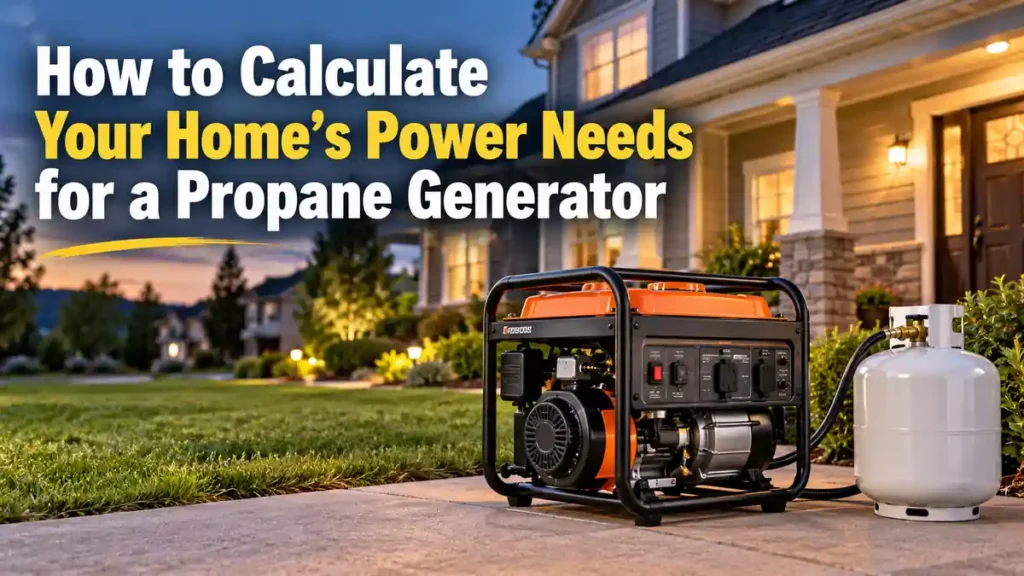
TL;DR — Quick answer: To calculate the propane generator power your home needs, list the appliances you intend to run at the same time, add their running watts, then account for the largest realistic motor-starting surge. As a first-pass calculation, use required peak watts = simultaneous running watts + the largest additional starting watts. Allow a practical operating margin, check the generator’s propane (LP) rating rather than its gasoline rating, and verify 120/240-volt circuits, starting performance, and fuel supply before buying. In the worked example below, 2,080 running watts plus a 1,800-watt sump-pump starting increment produces a 3,880-watt starting event—not a reason to buy a 20-kW unit automatically.
My approach: I would size a backup generator around the outage you actually want to live through, not around the number of rooms in your house. For the legal and permit side of a permanent setup, read my state-by-state propane generator installation guide. A refrigerator, a well pump, and a central air conditioner behave very differently even when they sit in homes with similar square footage. In this guide, I’ll show you how I would build a useful power inventory, test realistic combinations, and turn the results into a propane-generator specification you can discuss with an installer.
What does “my home’s power needs” actually mean?
I distinguish between connected load, simultaneous load, and starting load. Connected load is everything you could switch on. Simultaneous load is the smaller set you genuinely expect to use together during an outage. Starting load is the brief electrical demand created when a motor or compressor turns on.
Suppose your house has an electric oven, dryer, water heater, air conditioner, and a workshop compressor. Adding every nameplate value may produce an alarming number, but you might never operate all five on generator power. The opposite mistake is adding only the ordinary running watts of your refrigerator and sump pump, then discovering the pump cannot start.


I also separate power from energy: watts or kilowatts tell me how much load the generator must carry at a moment; kilowatt-hours tell me how much electrical energy you consume over time. Generator size is mainly a power question. Propane tank size and runtime are energy-and-fuel questions. Mixing them leads to expensive decisions.
Four numbers I write down before calculating
One kilowatt equals 1,000 watts. For an appliance marked 120 V and 10 A, multiplying volts by amps gives 1,200 volt-amperes (VA). It equals 1,200 watts only when the power factor is 1. Motors and some electronics may have a lower power factor, so I use actual input-watt figures where available, and I make sure the installer checks VA, current, and motor starting separately. A simple multiplication of volts and amps is a useful upper-level screening tool—not a complete motor-sizing method.
Step 1: Decide what you want to keep running
Before I open a generator catalog, I make three lists. My survival list includes refrigeration, essential lights, communications, medical equipment where applicable, and any sump or well pump that protects the property or supplies water. My comfort list includes a furnace blower, selected cooling, kitchen appliances, and useful outlets. My whole-home list includes major electric heating, water heating, cooking, laundry, and other loads that could drive the purchase into a larger class.
A standby generator with load management and a portable generator feeding selected circuits are different projects; neither guarantees all major loads can operate together.


I use this practical appliance reference only to begin an inventory. These figures are illustrative ranges, not nameplate specifications for your equipment. Read your own labels and manuals or measure safely with appropriate equipment.
When I see microwave “1,000 W” on the front, I do not assume that is its electrical input; it may describe cooking output. The data label is the more useful reference. Likewise, a gas-powered furnace still needs electricity for its controls and blower. I list the electrical draw, not the propane heat rating in BTU/h.
Step 2: Build a home generator load worksheet
I like a worksheet with four columns: must run, running watts, starting watts, and likely on together. This does more for accuracy than a home-size chart. I recommend recording whether each item uses 120 V or 240 V and whether the load is fixed to a circuit, because that affects connection and load balancing.
For unknown values, I start with a manufacturer’s rated input or an appropriate instrument reading, then ask an electrician to validate difficult equipment. A plug-in watt meter can help with many small 120-V plug loads, but it cannot safely replace professional measurements on hardwired HVAC equipment or a well pump. I never remove an electrical panel cover or probe energized wiring just to fill in my table.
I also list what I can defer: a dryer can wait; a storm-driven sump pump often cannot.

Step 3: Add running watts—but only for realistic simultaneous loads
Here is my illustrative essential-backup household. I have intentionally included two compressor appliances and two motor-driven systems, because a smooth average-power calculation would hide the important starting events.
My running total is 180 + 140 + 900 + 600 + 120 + 20 + 90 + 30 = 2,080 W for everything operating together.
If I cannot guarantee the pump and blower never run together, I count both.
Step 4: Add a realistic motor-starting event
For a simple first-pass estimate, I find the largest additional startup demand and add it to the running total:


Estimated peak event = running watts of the planned simultaneous loads + largest (starting watts − running watts).
For my essential-load example, the largest extra is the sump pump’s 2,700 − 900 = 1,800 W. My calculated event becomes 2,080 + 1,800 = 3,880 W. I neither assume that every motor starts together nor pretend startup can be ignored.
This shortcut is not a guarantee. Two motors can restart together when utility power returns or when a transfer switch changes sources. A well pump and central AC may have more complicated starting characteristics. If overlapping starts are plausible, I model that overlap or ask the installer to test the worst credible sequence. Also, some standby sets need enough voltage stability to start a compressor even when the arithmetic looks comfortable.
I usually allow about 15–25% operating headroom as a planning allowance, not as a universal code requirement or a fix for poor starting capability. At a simple 20% allowance, the example points to about 2,496 W of continuous capability and 4,656 W of momentary capability. I would then compare actual LP-rated models, breaker limits, outlet configuration, and starting performance; a model with around 5,000 running watts and 6,000 starting watts on propane may be a candidate, not an automatic recommendation.
Step 5: Calculate a partial-home comfort scenario
Suppose I want to keep more than the essentials operating: a window air conditioner, microwave, and coffee maker are added to the previous household, and lighting and TV demand are a little higher. In this intentionally conservative example, all listed devices could be on together.
Applying the same optional 20% planning allowance gives approximately 6,888 W continuous and 9,048 W peak. In practice, I might stop here and change the operating rules: don’t brew coffee while using the microwave, or let the AC cycle before the pump starts where control equipment permits. Removing just the 1,000-W coffee maker from the simultaneous case drops the running estimate to 4,740 W and the single-surge event to 6,540 W, before headroom.
This is why I think load scheduling deserves a line item in the buying budget. Sometimes a clearly communicated household rule costs nothing. For a permanent installation, professional load-management hardware may shed selected high-draw appliances automatically. But I never rely on a family member noticing an overloaded generator faster than a breaker trips.
Step 6: Check 120 V, 240 V, and the two hot legs
A U.S. home commonly has 120/240-V split-phase service. A generator may advertise enough total watts but still lack the 240-V output required for a well pump or central HVAC system. I check the receptacle or transfer-switch arrangement before celebrating the total kW figure.
With a 30-A 120/240-V connection, I cannot place 5,000 W of 120-V loads on a single leg just because the generator’s marketing label says “7,500 W.” Load balancing and the actual circuit design matter. Watts and volt-amperes are not interchangeable for every load; the equations above show VA limits derived from voltage and current.
If you need a permanent connection, I recommend a qualified electrician who can verify wiring, grounding/bonding arrangements, protection, approved transfer equipment, and applicable local codes. Never backfeed a wall outlet or use a makeshift double-male cord. Portable generators belong outdoors, away from doors, windows, and vents, with CO alarms in the home; see why propane generators cannot run indoors.
Step 7: Read the propane generator’s real specification sheet
Dual-fuel portable generators may have different output figures on gasoline and propane. I also break down the three different fuel-specific running-watt ratings in my tri-fuel generator comparison. I ignore the biggest number on the box until I find LP continuous watts and LP peak watts for the exact model. Standby sets may list separate LP and natural-gas ratings. I also check altitude and temperature derating, transfer-switch size, total harmonic distortion where sensitive equipment matters, and whether the maker publishes motor-starting capability.
I would not apply a blanket “propane always makes 10% less power” rule. Some models have different ratings by fuel, and the difference varies. I use the manufacturer’s published propane values, not a percentage guessed from a gasoline nameplate.
For a deeper model-selection discussion, I would read my companion article on what size propane generator you need to run a house after completing this calculation. That page focuses on generator class; this guide focuses on building the electrical load estimate that supports the class selection.
Step 8: Don’t overlook tank vaporization and fuel delivery
One of the most expensive mistakes is selecting a generator whose electrical rating looks right but treating the propane supply as an afterthought. A tank contains energy, yet the generator also needs enough vapor flow at the specified inlet pressure during cold weather and high demand. Tank surface area, liquid level, ambient temperature, regulator capacity, pipe sizing, and other propane appliances sharing the system can all matter.
I ask the propane supplier or installer to check maximum generator fuel demand, not merely average fuel consumption. A small portable cylinder can sometimes hold enough energy for a short session but fail to vaporize propane fast enough for a large sustained load in cold conditions. A larger tank doesn’t repair an incorrectly sized regulator, and electrical oversizing does not repair insufficient gas pressure.
If you notice power sag when a pump starts, compare your calculated starting event with the generator rating and see why a propane generator can lose power under load. If the problem involves gas supply at startup, my article about propane pressure dropping when a generator starts covers a different diagnostic path. Fuel-system work should be performed by appropriately qualified personnel.
Step 9: Calculate runtime separately from generator size
After checking electrical output, I estimate fuel endurance with runtime hours = usable propane gallons ÷ expected gallons per hour. The hourly fuel rate changes with generator model and electrical load, so I use its LP consumption chart, not a universal gallons-per-kW shortcut. A nominal 250-gallon stationary tank is commonly filled to about 80% (roughly 200 gallons), but your starting fuel level and desired reserve change what you can actually use. For a practical fuel example, see how long a 9,500-watt generator runs on propane. Tank endurance and generator capacity are separate questions.
My three-envelope method for preventing an oversized purchase
This is the decision framework I would put on a single sheet of paper. I create three load envelopes instead of committing to one frightening sum of every appliance in the house.
Then I calculate running and starting needs for each envelope and compare the cost of the next generator size with the inconvenience of load management. I prefer the smallest system that honestly covers the envelope you choose, rather than automatically jumping to Envelope C.
Then I ask the restart question: can the system handle a well pump and air conditioner trying to restart together, or must the controller sequence them? If I cannot answer, my single-motor shortcut is not enough.
This is my practical way of documenting assumptions for an installer to challenge before the first outage.
How I translate the result into a shopping range
These are rough planning bands, not equipment recommendations; similar-sized homes can have dramatically different loads.
I would compare the numbers with whole-home propane generator options, not choose by square footage alone. For broader context, my separate guide to generator sizing by house and appliance needs can help you distinguish portable and standby approaches.
Frequently asked questions
How many watts do I need to power a refrigerator and a sump pump?
I would add their actual simultaneous running watts, then include the largest additional startup demand. A refrigerator at 180 running/700 starting watts and a sump pump at 900 running/2,700 starting watts produce 1,080 W running and an illustrative 2,880 W peak event when the sump pump starts while the fridge is running. Real equipment and concurrent starts can change the result.
Can I calculate generator size from my home’s square footage?
Only as a very rough orientation. I would never make the final choice from area alone. Square footage does not reveal whether heating is electric, whether there’s a 240-V well pump, how large the air conditioner is, or which loads you can switch off.
Should I add 20% to the calculated power needs?
I often use 15–25% as a planning margin, but it is not a required formula for every installation. Starting kVA, altitude, temperature, load step response, and manufacturer limits can matter more than a generic percentage. I would not use margin to cover unknown motor ratings.
How do I size a generator for central air conditioning?
I check the HVAC unit’s electrical information, running current, compressor starting behavior, and compatibility with any soft-start equipment. A qualified installer can assess starting kVA, voltage dip, and whether staged load management is necessary. I do not assume every AC has the same startup multiple.
Is a 10-kW propane generator enough for a house?
It can be enough for selected circuits or a carefully managed home, but it may be too small for unrestricted electric heating, cooking, and large HVAC. Check LP output, startup, voltage and simultaneous loads.
Can I use a portable propane generator through my electrical panel?
Only with a properly designed, code-compliant connection and an approved transfer arrangement installed by a qualified electrician. I would never connect it through a standard household outlet or improvised backfeed cord.
Does a bigger generator use more propane?
Not necessarily more in every operating situation, but the size and efficiency of the engine and its percent load affect fuel consumption. I compare the model’s LP fuel chart at different load levels and follow the propane generator maintenance schedule.
Final checklist: the calculation I want you to take to an installer
Before I select a model, I want a load list with actual nameplate data, a simultaneous-running total, credible motor-starting events, voltage and circuit information, load-shedding assumptions, the manufacturer’s LP-rated output, and a fuel-delivery assessment. I want the installer to validate the electrical design and the propane supplier to validate the tank, regulator, and piping.
The main takeaway: I do not ask, “How big a generator fits my house?” I ask, “Which outage loads am I promising to keep running, and what is the hardest believable moment my generator must handle?” Once you answer those questions with numbers, choosing a propane generator becomes a defensible decision rather than a guess.

Mike is an experienced propane technician with over 15 years of professional experience in the field. He has dedicated his career to helping customers with their propane needs, from installation to maintenance and repair. Together with Jeremy, he co-founded this website to provide useful information and guidance to customers seeking reliable propane services.