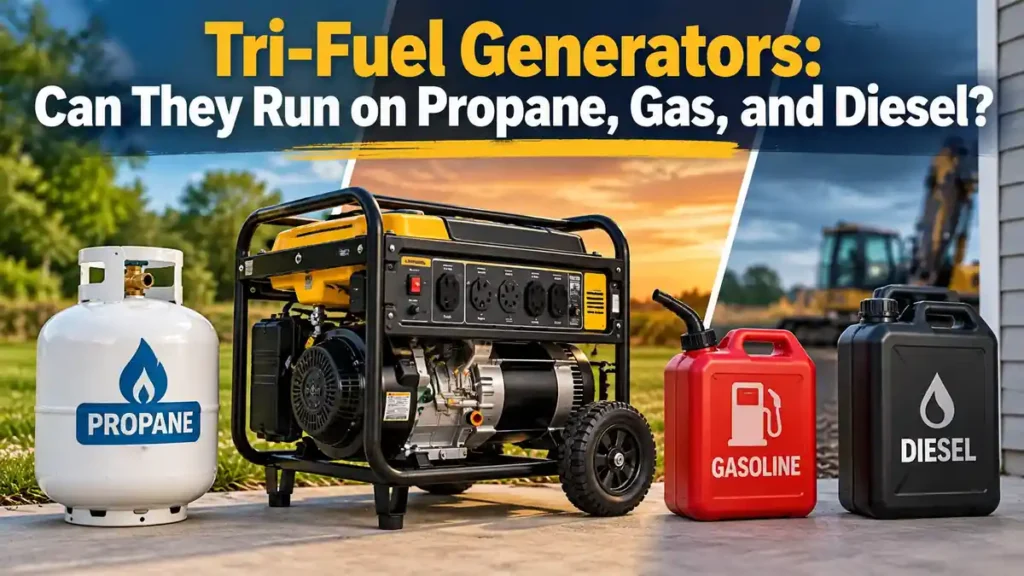
If you see a listing that promises a generator can run on propane, gas, and diesel, I would examine it very carefully. The word gas could mean gasoline or natural gas, and the word tri-fuel sometimes gets used loosely in advertisements. Those ambiguities matter because filling a gasoline generator with diesel can damage it, while connecting the wrong gas supply can create a serious fire or carbon-monoxide risk.
My approach is to look beyond the number of fuels on the box. I want to know which fuel each mode actually means, what electrical output I get in each mode, and whether the fuel will be available during the exact emergency I am preparing for. I’ll compare actual model specifications, explain why diesel is different, and give you a practical checklist for choosing a tri-fuel generator you can use safely.
What is a tri-fuel generator, and what three fuels does it use?
A typical consumer tri-fuel generator is a single spark-ignition engine equipped with the approved components needed to operate on unleaded gasoline, liquid propane gas (LPG) delivered as vapor, or utility natural gas. The engine drives an alternator that produces household electricity. It does not burn three fuels at the same time; you select the allowed fuel mode and follow the manufacturer’s switching procedure.


| Fuel mode | Normal source | What goes into the engine | Diesel-compatible? |
|---|---|---|---|
| Gasoline | Approved gasoline tank | Atomized or vaporized gasoline mixed with air | No |
| Propane (LP/LPG) | Approved propane cylinder or engineered LP supply | Propane vapor mixed with air | No |
| Natural gas (NG) | Approved residential natural gas supply | Natural gas mixed with air | No |
| Diesel | Diesel tank and compression-ignition fuel system | High-pressure diesel injection; special engines may also use gaseous pilot-fuel systems | Not on a standard tri-fuel generator |
The usual tri-fuel advantage is flexibility: stored gasoline for an immediate outage, bottled propane for longer shelf life, and an approved natural gas hookup where that utility service exists. Some areas have no natural gas network, so the third mode may not offer any practical benefit to that homeowner. This is why I never treat the marketing label as proof you will have three usable energy sources at your address.
Can tri-fuel generators run on diesel?
No, not the ordinary gasoline/propane/natural-gas tri-fuel generators sold for household backup. Diesel and gasoline engines use different ignition and fuel-delivery designs. A conventional gasoline-type generator relies on a spark plug to ignite a mixture of fuel and air; a diesel engine normally uses compression heat to ignite precisely injected diesel fuel. The approved fuel systems, combustion characteristics, and engine hardware are not interchangeable.
I would never experiment by mixing diesel with gasoline or putting diesel into a generator’s gasoline tank. That is not a workaround when a storm closes gasoline stations. The safest interpretation is simple: if the manufacturer’s fuel specification says gasoline, propane and natural gas, those are the only three operating fuels for that model unless the manufacturer explicitly authorizes something else.
There is a legitimate technology that causes confusion here: diesel-gas dual-fuel generation. Some larger compression-ignition engines burn natural gas or propane in combination with a smaller diesel pilot injection. Other purpose-built industrial designs can switch between gas and liquid-fuel operating modes. These systems have engineered controls and are not normal home-center tri-fuel portable generators. The term “dual fuel” is used differently in the industrial and consumer markets, which is why I always ask for the exact engine specification.


| Engine arrangement | Fuel options | How ignition works | Typical use |
|---|---|---|---|
| Consumer dual-fuel portable | Gasoline or propane | Spark ignition | Home, RV, portable backup |
| Consumer tri-fuel portable | Gasoline, propane or natural gas | Spark ignition | Home backup, jobsite, outdoor use |
| Conventional diesel generator | Diesel fuel | Compression ignition | Commercial/industrial or specialized home backup |
| Diesel-gas dual-fuel system | Diesel alone or diesel plus approved gas | Diesel pilot ignites gas-air mixture | Engineered commercial/industrial systems |
| Purpose-built industrial multi-fuel unit | Only its certified fuel configurations | Depends on specific engine design | Specialized installations |
Real tri-fuel generator wattage: gasoline vs. propane vs. natural gas
Here is the specification difference I would check before ordering. The 11,500-watt-class Westinghouse WGen11500TFc and Champion model 100416 both advertise three fuels, but the electrical ratings are lower on propane and natural gas than on gasoline. These are manufacturer-published model figures, not average performance claims for every generator.
| Model and rating | Gasoline | Propane (LP) | Natural gas (NG) |
|---|---|---|---|
| Westinghouse WGen11500TFc — running | 11,500 W | 10,500 W | 9,500 W |
| Westinghouse WGen11500TFc — starting/peak | 14,500 W | 13,500 W | 12,000 W |
| Champion 100416 — running | 8,000 W | 7,200 W | 7,000 W |
| Champion 100416 — starting/peak | 10,000 W | 9,000 W | 8,750 W |
On the Westinghouse example, propane running output is about 91% of its gasoline rating, while natural gas output is roughly 83%. For the Champion example, propane is 90% and natural gas about 88% of gasoline-rated power. I would not turn those percentages into a universal formula; they demonstrate that each engine and fuel system needs its own published ratings.
Suppose your essential loads total 8,200 running watts, and you buy the Westinghouse example because the 11,500-watt gasoline rating looks comfortable. The available running output would still be above that load in all three modes on paper, but your motor-starting requirements and operating margin might leave very little headroom on natural gas. My preferred calculation is to start with the 9,500-watt natural gas continuous rating if NG is the fuel I plan to use most often, then verify starting performance separately. For more detailed appliance calculations, use my home power needs calculation guide.
Why do tri-fuel generators produce less power on propane or natural gas?
An engine’s usable output depends on how efficiently its fuel and air charge produces torque. Gasoline, propane, and natural gas differ in energy content per unit of volume and in how their fuel systems meter the combustion mixture. A spark-ignition engine designed to accommodate all three may deliver less rated electrical power when running on gaseous fuel. Altitude, ambient temperature, engine condition, and installation conditions can reduce the available output further.
I focus on rated running watts instead of assuming the starting-watt figure is available all day. Starting watts are short-duration capacity intended for brief loads, including motor starts. A refrigerator compressor, well pump, and central air system can demand extra current at startup. If you ignore those transients, the generator may trip even though the average appliance wattage seems reasonable.

If you’re deciding whether the efficiency difference justifies the fuel choice, my related article on propane versus gasoline generator efficiency compares that decision from a different angle. The point here is straightforward: a tri-fuel label does not give you three identical generators in one box.
Technical comparison chart: what changes with each fuel?
| Specification | Gasoline | Propane | Natural gas |
|---|---|---|---|
| Fuel storage | Portable approved liquid container or generator tank | Approved LP cylinder or bulk tank | Utility supply; usually no homeowner-owned fuel tank |
| Long-term storage | Fuel quality can deteriorate; stabilizer helps when used properly | No gasoline-style degradation of stored propane | No on-site reserve if distribution fails |
| Fuel connection | Manufacturer’s gasoline system | Correct LPG hose, valve, regulator and vapor supply | Correct approved gas hose, pressure and flow |
| Power rating | Often highest on consumer tri-fuel units | Frequently lower than gasoline | Often lowest of the three |
| Supply risk during outage | Station pumps may lose power or close | Cylinder runs empty; supplier deliveries may be delayed | Distribution may remain on but is not guaranteed |
| Maintenance considerations | Carburetor and gasoline storage care | Gas-hose condition, connections and fuel-system checks | Approved installation, pressure and hose checks |
| Typical purchase decision | Best if easily accessible in an outage | Attractive for stored portable backup | Useful when approved utility service is dependable |
I would also check how the manufacturer defines fuel use. Gasoline and propane consumption are often presented in gallons per hour or as runtime from a particular tank. Natural gas use may appear in cubic feet per hour or BTU per hour. Comparing two fuels only by raw gallons is misleading because their energy contents and supply methods differ.
How much does it cost to run a tri-fuel generator on each fuel?
I avoid claiming one fuel is universally cheapest, because electricity demand, local utility tariffs and supplier charges differ. Instead, I use a transparent calculation that you can update using your real prices. The key is to compare cost per running hour at the same electrical load, not the cost per liquid gallon alone.
The example below is entirely hypothetical; the prices and consumption rates are illustrations, not current retail quotes or specifications for a named model. They simply demonstrate how I would work out operating costs with a fuel-use sheet.


| Fuel | Assumed consumption at chosen load | Illustrative unit price | Illustrative hourly fuel cost |
|---|---|---|---|
| Gasoline | 1.00 gal/hr | $3.50/gal | $3.50/hr |
| Propane | 1.20 gal/hr | $2.80/gal | $3.36/hr |
| Natural gas | 110 cubic ft/hr | $1.60/therm | About $1.76/hr (if 100,000 BTU/therm and 1,000 BTU/ft³) |
In that hypothetical comparison, natural gas is least expensive per operating hour. But you may not have gas service, the gas meter could need an upgrade, or your generator might not support the necessary pressure. A utility connection charge or permitted installation can outweigh a modest hourly advantage if you use the machine only a few hours each year. I would compare the total setup cost plus likely emergency operating hours, not fuel price alone.
For a propane-versus-gasoline breakdown and more cost considerations, see my gasoline vs. propane generator operating-cost comparison. It helps keep the fuel economics separate from this article’s more important question: which fuels can the engine safely use?
How long will a tri-fuel generator run on propane?
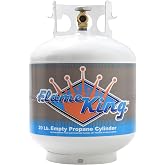
A propane generator’s runtime depends on the load, fuel consumption rate, the amount of propane actually in the cylinder, and its ability to vaporize fuel fast enough. A typical full 20-lb propane cylinder holds roughly 4.7 US gallons. The Westinghouse WGen11500TFc product information lists up to seven hours at 50% load from a 20-lb tank. That is a model-specific reference point, not a promise for every tri-fuel unit.
| Fuel source or scenario | Approximate amount or input | How I’d calculate runtime |
|---|---|---|
| 20-lb LP cylinder | 4.7 gal when properly filled | 4.7 ÷ published LP gal/hr |
| 100-lb LP cylinder | 23.6 gal when properly filled | 23.6 ÷ published LP gal/hr |
| 250-gal nominal bulk tank | About 200 gal at 80% fill | 200 ÷ published LP gal/hr, less reserve |
| 500-gal nominal bulk tank | About 400 gal at 80% fill | 400 ÷ published LP gal/hr, less reserve |
| Natural gas utility | Meter flow and supply pressure govern | Operating time depends on continuous approved utility supply |
| Gasoline tank | Model’s actual liquid-gallon capacity | Usable gasoline gallons ÷ gasoline gal/hr |
This is where I prefer to plan for an actual outage rather than a laboratory test. If I need three days of essential circuits, I would add a refueling margin and account for likely overnight load. An underfilled exchange cylinder does not automatically contain the full 20 pounds of propane. Cold weather and vapor delivery can further limit a generator’s performance even before the cylinder is empty.
For quick comparisons of cylinder sizes, 250- and 500-gallon tanks, refill reserve and example hours, use my propane tank size chart for generators. I would choose the fuel source first, then work backward from desired hours and the generator’s LP consumption data.
Natural gas hookup: the third-fuel advantage is not automatic
Natural gas readiness can be the most attractive feature for a house already connected to a dependable gas utility. You avoid moving heavy cylinders during an outage, and you do not have to store a large amount of gasoline. However, a generator’s included natural-gas hose does not authorize you to make an unapproved connection to house piping.
A qualified gas professional should verify that the meter, service regulator, pipe diameter, piping length and available pressure can support the generator plus other appliances. Some manufacturer’s instructions specify a narrow acceptable gas pressure range and a substantial BTU-per-hour input. Those specifications are model-specific; using the wrong gas pressure or a restricted hose can make the engine fail under load. If you have no natural-gas service, the NG mode may simply be unusable.
I would inspect the installation plan with the same care as the electrical connection. A natural gas utility may remain available during some power failures, but it is not guaranteed during a major emergency. My backup strategy would not rely on a single utility fuel source in a disaster-prone location. And before wiring the generator to your home, review the propane generator professional-installation and permit guide.
Can you switch fuels while a tri-fuel generator is running?
Sometimes—but only when the specific manufacturer and model instructions permit it. For example, Westinghouse markets certain units with switching capability between gasoline, propane and natural gas without shutting down. Other generators require you to remove load, stop the engine, reposition valves or hoses, or restart in a prescribed order. I would never transfer that procedure from a different brand’s video to a generator sitting in my yard.
I think of the fuel selector as a controlled operating procedure, not a convenience switch you can flip at random. If the manual requires the engine stopped, I stop it. If a fitting must be changed, I follow the documented steps and check for leaks using approved methods. Never use an open flame to test a connection, and never improvise adapters to connect propane to a natural-gas port or vice versa.
My three-fuel readiness audit before you buy
Here is the decision worksheet I would use. It is an original planning framework rather than a legal or engineering standard. I score each fuel mode by three things: usable power, actual access and safe connection. A fourth fuel choice is not a bonus if your home cannot use it.
| Readiness check | Gasoline mode | Propane mode | Natural gas mode |
|---|---|---|---|
| Power test | Running and surge watts cover target loads | LP running and surge watts cover loads | NG running and surge watts cover loads |
| Access test | Safe stored fuel or reliable purchasing plan | Approved cylinder/bulk delivery available | Live gas service at property |
| Connection test | Proper liquid-fuel system | Approved regulator, hose, adequate vapor flow | Gas contractor confirms meter, line and pressure |
| Outage test | Plan if stations close | Plan cylinder exchanges or refill delays | Plan if gas utility is interrupted |
| Maintenance test | Fuel turnover and carburetor storage care | Inspect LP hoses and connections | Check dedicated NG supply and shutoff arrangements |
If one fuel mode fails these checks, I would not count it as reliable redundancy. For example, a generator labeled “tri-fuel” may effectively be a dual-fuel system for a rural home with no natural gas mains. Conversely, a household with NG service but no legal connection point needs professional work before that mode becomes useful. The label gives potential flexibility; the property and installation determine how much of it is real.
Tri-fuel vs. dual-fuel vs. diesel: which would I choose?
For an occasional outage, I would consider a dual-fuel gasoline/propane generator if natural gas will never be available. It can be simpler to buy and maintain, though specific models vary. If I had an approved utility gas connection and wanted flexibility across multiple emergencies, I would consider a tri-fuel machine—provided its natural-gas output rating meets my power requirement.
If my priority were long operating hours, high continuous load, commercial service or an industrial jobsite, I would research a dedicated diesel generator as its own category. Diesel is not automatically better for every homeowner: noise, emissions, fuel storage, servicing, local restrictions and installation costs matter. A commercial diesel-gas dual-fuel system should be designed and supported as a distinct project, not treated as a modified portable tri-fuel unit.
| What you value most | Equipment class to evaluate | Main trade-off |
|---|---|---|
| Portable power with two widely available fuels | Gasoline/propane dual fuel | No natural gas backup |
| Three separate approved fuel options | Gasoline/LP/NG tri fuel | Fuel-specific power output and connection requirements |
| Dedicated long-duration high-load power | Purpose-built diesel generator | Separate maintenance and fuel logistics |
| Industrial gas plus diesel pilot operation | Engineered diesel-gas dual fuel | Specialized controls, approvals and service |
| Automatic residential whole-home backup | Approved stationary LP or NG standby unit | Professional installation, transfer system and fuel sizing |
Can you convert an existing gasoline or propane generator to tri-fuel?
Aftermarket conversion kits exist for some engine models, but I would not assume a conversion makes a generator equivalent to a factory-certified tri-fuel unit. Fuel metering, regulators, emissions compliance, available electrical output, warranty coverage and fuel-switching controls can all differ. An unauthorized modification may make the machine unsafe or noncompliant with the requirements where you use it.
My preference is a model sold and supported for all three fuels from the factory. If you already own a generator and are investigating conversion, get the exact engine model, manufacturer approval and installation guidance before spending money. Any fixed natural-gas connection requires appropriate design and local permits. I would not give a step-by-step homemade gas conversion procedure because a wrong fuel pressure or improper connection can cause a fire or carbon-monoxide hazard.
Safety rules I would never ignore with any fuel
All three usual fuels feed a combustion engine, which produces carbon monoxide. Switching from gasoline to propane or natural gas does not make outdoor-only equipment safe to use indoors. Portable generators belong outdoors, far from doors, windows and vents; public-health guidance commonly specifies at least 20 feet away where feasible, with exhaust pointed away. Keep working CO alarms inside your home.
- Never operate a portable generator inside a garage, shed, enclosed porch or home, even with doors open.
- Never backfeed a household socket or panel through an improvised cord. Have approved transfer equipment installed by a qualified electrician.
- Never pour diesel into a tri-fuel machine designed for unleaded gasoline.
- Never improvise fuel-gas hoses, regulators or adapters. Follow the model’s approved supply specifications and gas code.
- Never assume a natural-gas utility is always available. Have a backup plan for pressure or service loss.
- Never refuel hot gasoline equipment. Follow shutdown and cool-down instructions in the manual.
For an explanation of why outdoor placement matters even on LP fuel, see my article about operating propane generators indoors. And when a generator starts but stalls under household loads, check the manufacturer’s troubleshooting section before assuming that switching fuel will solve the problem. My guide on propane generators losing power under load explores the possible causes.
Frequently asked questions
Does “gas” on a tri-fuel generator mean gasoline or natural gas?
It depends on how the seller wrote the listing. For the standard tri-fuel lineup, the three fuels are separately named gasoline, propane and natural gas. I would read the actual specifications instead of interpreting a shortened label. The fuel selector and included hoses should match the manufacturer’s supported operating modes.
Can I add diesel to a tri-fuel generator’s gasoline tank?
No. Diesel fuel is not a permitted substitute for gasoline in a standard spark-ignition tri-fuel engine. Stop before refueling if the fuel label is unclear. If diesel was already added by mistake, do not run the generator; consult its manufacturer or a qualified service professional about safe handling.
Can a diesel generator also run on propane?
Some purpose-built or professionally engineered diesel-LPG dual-fuel systems can use propane together with pilot diesel fuel. That does not mean every diesel generator accepts propane, nor does it mean it can operate on propane alone. The engine and control package must be explicitly rated for that arrangement.
Which fuel produces the most watts in a tri-fuel generator?
Gasoline often has the highest published continuous wattage on consumer units. Propane and natural gas commonly produce less, but the exact ranking and reduction depend on the model. My first check is the three separate running-watt ratings, followed by the motor-starting ratings for the fuel I expect to use.
Is natural gas cheaper than propane in a tri-fuel generator?
It may be in some service territories, but I would compare real gas tariffs, propane delivery price, the generator’s fuel consumption at the same electrical load, and installation costs. An appliance may consume NG measured in cubic feet or therms, while LP is commonly purchased in gallons or pounds. A cost comparison must use compatible units.
Is a tri-fuel generator suitable for a whole house?
Potentially for selected circuits or some homes, but not solely because it has three fuel modes. You must calculate running watts, starting loads, 120/240-volt requirements, output on your chosen fuel, and safe electrical connection equipment. I would never assume a generator’s gasoline peak wattage equals the power available to the entire house on natural gas.
Will running on propane increase generator lifespan?
Propane can avoid some gasoline storage and carburetor issues, but I would not promise a longer lifespan from fuel choice alone. Engine loading, maintenance, oil changes, cooling, operating conditions and manufacturer’s instructions matter. See my propane generator maintenance checklist for the relevant upkeep.
My final verdict: the best tri-fuel generator is the one with three truly usable modes
If I were buying a tri-fuel generator today, I would not pay extra solely for a third fuel printed on the carton. I would confirm the exact fuels in the manual, size my home to the lowest output I expect to use, check the propane and natural-gas supply requirements, and decide whether the third mode will really be accessible during an outage. I would also keep the manufacturer’s allowed switching procedure beside the unit.
For most consumer models, the answer to the headline is definitive: gasoline, propane and natural gas—yes; diesel—no. Diesel-gas technology is real, but it belongs to another engine category. The useful innovation is not a claim that one small engine can burn everything: it is a backup plan that connects three approved fuel sources to real household needs, with the necessary safety margins.

Mike is an experienced propane technician with over 15 years of professional experience in the field. He has dedicated his career to helping customers with their propane needs, from installation to maintenance and repair. Together with Jeremy, he co-founded this website to provide useful information and guidance to customers seeking reliable propane services.