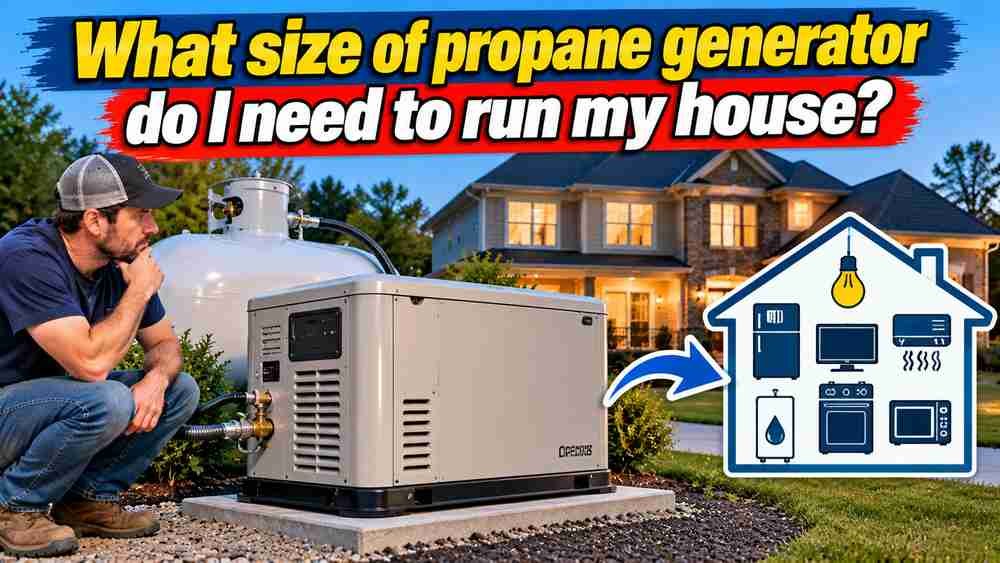
TL;DR — What size generator do I need to run my house?
For essential backup circuits, I would start my planning around a 4,000–8,000-watt generator for many U.S. homes, provided the actual appliance list fits. For whole-home propane standby power, 14–26 kW is a common residential planning range, but some homes need less, and large all-electric houses can need 30 kW or more. A 2,000-square-foot house might work with an 18–22 kW standby unit, or far less if you only want lights, refrigeration and a furnace blower. Square footage alone cannot determine the right generator. Add your simultaneous running watts, allow for the largest additional motor-starting surge, check 120/240-volt demands and manage heavy loads. Have a qualified installer validate the final size and the propane supply.
Published: October 28, 2026. Figures are illustrative planning estimates, not a replacement for measured appliance ratings, manufacturer specifications or a professional load calculation.


When someone asks me, “What size generator do I need to run my house?” I usually hear a second question hiding inside it: Do I want to keep my family comfortable during an outage, or do I want almost everything to run as if the utility never failed? Those goals can require very different generator sizes, even in two identical homes.
I’ve seen homeowners start with a simple rule such as one kilowatt for every 100 square feet. I wouldn’t rely on that shortcut. A modest ranch house using electric resistance heat, a well pump and an electric water heater can require more backup power than a large home with gas heat, city water and carefully managed appliances.
In this guide, I’ll give you usable U.S. house-size ranges, an appliance wattage table, a worked calculation, and my own three-level outage-load plan for selecting a propane generator without buying capacity you may never need. I’ll also show where propane tank sizing is a separate decision from generator wattage.
Quick Generator Size Chart by U.S. House Square Footage
For context, the U.S. Census Bureau reports that the median newly completed single-family home in 2025 measured 2,142 square feet. That does not mean a 2,142-square-foot house has any fixed electrical demand. The table below groups common small, medium and large U.S. house sizes as illustrative scenarios, not statistically measured categories or automatic purchase recommendations.


| House size | Essentials-only planning range | Broad whole-home propane standby range | Main reason size changes |
|---|---|---|---|
| 800–1,200 sq. ft. | 3–5 kW | 8–14 kW | Window AC vs central AC; electric heating; well pump |
| 1,200–1,600 sq. ft. | 4–7 kW | 10–18 kW | Gas furnace vs heat pump; water heating |
| 1,600–2,000 sq. ft. | 5–8 kW | 14–22 kW | Central AC start current; electric range |
| 2,000–2,500 sq. ft. | 5–10 kW | 18–24 kW | HVAC size, sump or well pump, kitchen circuits |
| 2,500–3,000 sq. ft. | 6–10 kW | 20–26 kW | More than one AC zone and simultaneous appliances |
| 3,000–4,000 sq. ft. | 7–12 kW | 24–36 kW+ | Multiple HVAC systems, pool equipment and electric loads |
| 4,000+ sq. ft. | Custom load calculation | 30–48 kW+ may be necessary | Multiple electric heating/cooling systems; luxury and workshop loads |
How I would read this chart: the first wattage column assumes I deliberately exclude major heating elements, EV charging, electric ovens or large air-conditioning systems from backup. The standby column is a broad illustration of what might cover substantially more of the home with sensible load management. Neither column guarantees that every appliance will run together, and a home with electric strip heat may exceed the suggested ranges by a wide margin.
Notice that I haven’t converted square footage directly into watts. I use the house size only to begin the conversation about likely HVAC capacity. Then I inventory the actual equipment. A certified installer should confirm electrical capacity using the applicable load-calculation method and nameplate data.
What Does “Run My Whole House” Actually Mean?
I divide backup expectations into three options. The first is survival and safety: refrigerator, lights, communication, and any medically necessary equipment. The second is livable comfort: the essentials plus a furnace blower, a selected air conditioner or a water pump. The third is close to normal living: large HVAC equipment and multiple high-draw appliances, subject to any automatic load-shedding controls.
| Backup goal | Typical equipment selected | Example generator class | What I would usually leave off |
|---|---|---|---|
| Essential circuits | Fridge/freezer, LED lighting, internet, TV, selected outlets | 3–6 kW portable/inverter or suitable fixed system | Electric oven, dryer, HVAC resistance heat |
| Comfort-focused backup | Essentials plus furnace blower, well/sump pump, selected cooling | 7–14 kW or larger depending on starts | EV charging and nonessential heating elements |
| Managed whole-home | Most circuits, central cooling and large loads sequenced | 14–26 kW standby is often worth evaluating | Simultaneous high-draw appliances when capacity is limited |
| High-demand all-electric whole-home | Heat pumps with resistance backup, multiple ACs, induction/range, dryers, EV chargers | Detailed design; 30 kW+ may be warranted | Depends on agreed load management |
I often prefer the middle option for homeowners who want comfort without paying to run every electrical appliance simultaneously. You can keep food safe, power lighting and Wi-Fi, run a water pump when needed and potentially cool the most important living area. That is very different from promising you can roast dinner, charge an EV, dry clothes and run resistance heat at the same time.
Running Watts vs Starting Watts: The Number Most People Miss
A generator must satisfy continuous running load and short starting peaks. Refrigerators, well pumps, sump pumps and many air-conditioning compressors draw extra current when their motors start. Some modern variable-speed equipment or approved soft-start devices have lower startup demands, so the real label and manufacturer data are more useful than a one-size-fits-all multiplier.

Here’s the calculation method I use for preliminary planning. First, I list all loads that may operate together and add their continuous watts. Next, I identify the largest additional starting surge—the difference between a motor’s starting watts and its running watts. Finally, I verify that the candidate generator can support that starting condition, including its rated surge capability, voltage, transfer arrangement and any load sequencing. If multiple motors may start together, I consider overlapping surges rather than assuming they will never coincide.
Illustrative sizing formula: required peak watts ≈ total concurrent running watts + largest additional starting surge. I may leave a planning margin for uncertainty, but I don’t replace the manufacturer’s published surge and load-management data with a blanket percentage.
Common Household Appliance Wattage Chart
These figures are practical examples, not ratings for every appliance. Actual consumption depends on equipment size, age, design, seasonal operation and startup characteristics. To get a final answer, I use your appliance nameplates and an electrician’s assessment.
| Appliance / equipment | Illustrative running watts | Illustrative starting or peak watts | Notes |
|---|---|---|---|
| Refrigerator | 300–800 W | 900–2,200 W | Compressor startup varies widely |
| Standalone freezer | 300–600 W | 900–1,800 W | Do not assume both compressors always start together |
| LED lighting, several rooms | 150–400 W | About same | Depends on number of fixtures |
| Wi-Fi, router, laptop and TV | 150–500 W | About same | Small load but important for many families |
| Gas furnace blower | 500–900 W | 1,200–2,300 W | Gas heat still needs blower electricity |
| Sump pump, 1/2 hp | 800–1,200 W | 1,800–2,500 W | Startup and lift affect sizing |
| Well pump, 1/2 hp | 700–1,200 W | 1,500–2,500 W | Depends on depth and equipment |
| Central AC, roughly 3 tons | 2,500–5,000 W | 6,000–18,000 W | Compressor LRA, soft-start and efficiency affect peak |
| Microwave (input electricity) | 1,200–1,800 W | About same | Output cooking wattage differs from electrical draw |
| Electric water heater | 4,000–5,500 W | About same | Resistance element is a major sustained load |
| Electric dryer | 4,500–6,000 W | Can exceed running value briefly | Heating element dominates |
| EV Level 2 charger | 7,200–11,500 W | Generally steady | Can consume much of a residential generator’s capacity |
As you can see, a freezer or Wi-Fi router may be small compared with an electric water heater. A central air conditioner is different again because its starting surge may be much higher than its normal operating demand. That is why I ask which appliances must run during an outage before I ask how many bedrooms you have.


My Worked Example: Generator Size for a 2,000-Square-Foot House
Let’s imagine you have a 2,000-square-foot U.S. house with a propane or gas furnace, central air conditioning, a refrigerator, a freezer, a sump pump, LED lighting and ordinary electronics. You want them to run on backup power, but you agree to avoid the electric dryer and oven during outages. These are made-up demonstration loads, not an actual homeowner’s measurements.
| Simultaneous load | Running watts | Illustrative starting watts | Additional starting surge |
|---|---|---|---|
| Refrigerator | 650 W | 1,600 W | 950 W |
| Freezer | 450 W | 1,100 W | 650 W |
| Furnace blower | 650 W | 1,500 W | 850 W |
| Sump pump | 900 W | 2,200 W | 1,300 W |
| Central AC | 3,800 W | 10,500 W | 6,700 W |
| Lighting | 350 W | 350 W | 0 W |
| Wi-Fi, TV and electronics | 300 W | 300 W | 0 W |
| Total running demand | 7,100 W | — | Largest extra surge: 6,700 W |
My preliminary maximum would be 7,100 + 6,700 = 13,800 watts under the assumption that the AC is the only motor starting while the other loads are already running. If I use a 15% planning buffer for uncertainty, the number becomes about 15,870 W. That suggests comparing a properly rated 18 kW propane standby generator, but it is not proof that any particular 18 kW unit can start that AC. An electrician must validate the real startup data, generator surge capability and load sequence.
Now imagine I install professionally approved controls that delay the sump pump or prevent the dryer and AC from demanding power simultaneously. I might lower the required generator size without sacrificing the most important needs. Conversely, adding 10 kW of heat strips would dramatically change my calculation. That is the reason I never promise that every 2,000-square-foot home needs the same generator.
Generator Sizing Examples for Common U.S. House Sizes
The table near the top is a quick screening tool. Here’s how I’d apply it to individual homes. I always ask whether you have electric heat, city water or a private well, central AC, and a need to operate appliances simultaneously.
What Size Generator for a 1,000-Square-Foot House?
For a compact one-story home, I might evaluate a 3–5 kW generator if you only need the refrigerator, lights, charging outlets and modest electronics. To include a furnace blower, a small air conditioner or a pump, I’d calculate the actual startup demands instead of assuming that 5 kW is enough. A modest whole-home standby system might be in the 8–14 kW class, but electric resistance heating can push the requirement far beyond that range.
What Size Generator for a 1,500-Square-Foot House?
I’d start the essential-circuit discussion around 4–7 kW, then check whether your outage priorities include a well pump or central AC. For a home with gas heat and selective load management, a 10–18 kW standby unit may be worth comparing. A 1,500-square-foot home with an electric heat pump and backup strips is a different electrical project; I would not buy from a square-foot chart alone.
What Size Generator for a 2,000-Square-Foot House?
This is a common question because 2,000 square feet is close to the middle of the new-home size range in the United States. I often start whole-home discussions with 18–22 kW propane standby options, then check the actual AC start demand, heating method and appliance list. A smaller 5–10 kW system can be perfectly useful if you only need selected circuits. Compare the worked 2,000-square-foot example above to your own equipment instead of copying its wattage totals.
What Size Generator for a 2,500-Square-Foot House?
I would look at 20–26 kW for an illustrative managed whole-home propane setup, but I would also ask if there are multiple air-conditioning zones, a pool pump, an electric cooking range and an electric water heater. A homeowner who can postpone dryer and oven use might need much less capacity than someone insisting all major circuits run together.
What Size Generator for a 3,000-Square-Foot House?
My initial comparison might include 22–30 kW models with professionally designed load management. If the home has two central AC systems or large electric heating loads, it might require 30–36 kW or more. I would ask an installer to quantify those loads rather than treat 3,000 square feet as proof that a 30 kW generator is necessary.
What Size Generator for a 4,000-Square-Foot or Larger Home?
At this size, I would stop recommending any single number. Larger houses often have multiple HVAC systems, detached buildings, workshops, water features and substantial electrical appliances. Some may run essential circuits from 10–12 kW; others need an engineered 30–48 kW or larger standby system for ambitious whole-home expectations. Exact fuel delivery, service equipment, zoning and automatic load controls become major design decisions.
Why a 200-Amp Electrical Panel Does Not Mean You Need a 48 kW Generator
A 200-amp residential service at 240 volts has a theoretical product of 48,000 volt-amperes. That is not a measurement of what your family uses continuously, and volt-amperes are not always identical to real watts. Most households have diversified loads: the water heater, dryer, oven and air conditioner aren’t all necessarily operating at their highest input at once.
I would ask a qualified electrician to calculate the legally applicable service or optional-standby loads, determine whether loads will be managed, and confirm how the transfer switch and generator will connect. I would not buy a 48 kW generator just because the main breaker says 200 A.
| Nominal output at 240 V | Equivalent current at unity power factor | Why I would check it |
|---|---|---|
| 7.5 kW | About 31 A | Often a portable-backup class with limited circuits |
| 10 kW | About 42 A | Essential/selected circuits or carefully managed loads |
| 14 kW | About 58 A | Midrange standby scenarios with load sequencing |
| 18 kW | 75 A | More HVAC and household capacity |
| 22 kW | About 92 A | Common managed whole-home standby class |
| 26 kW | About 108 A | Higher-demand residential installations |
| 30 kW | 125 A | Larger or more heavily electrified homes |
Those values are a simple output-power conversion, not breaker selection or a wiring recommendation. Real installations also depend on voltage, power factor, the generator breaker, conductor ratings and the transfer equipment. Only a qualified professional should specify electrical components.
Portable Propane Generator or Automatic Standby Generator?
For a few essential appliances, I often prefer a properly sized portable dual-fuel or propane generator because the initial investment can be lower. But I need a safe, code-compliant means of connecting it to hardwired circuits. A permanently installed propane standby generator is a different category: it can start and transfer automatically, potentially power central HVAC systems, and integrate load management.
I look at rated running watts on propane, not only the largest wattage printed on a dual-fuel generator carton. Portable units can have different continuous and starting ratings on propane versus gasoline. Your choice must use the propane rating if that is the fuel you plan to burn.
| Feature | Portable propane / dual-fuel | Permanent propane standby |
|---|---|---|
| Typical use | Select appliances and prioritized circuits | Automatic backup for designated or whole-home circuits |
| Wattage to check | Propane rated running and peak watts | Continuous LP-rated kW and motor-start capability |
| Electrical connection | Manufacturer-approved cords or professionally installed transfer equipment | Professionally installed transfer switch and controls |
| Starting | Usually manual or electric start | Typically automatic after outage detection |
| Fuel arrangement | Cylinder or suitable approved supply | Professionally sized tank, piping and regulator |
| Best suited to | Occasional, economical essential backup | Convenience and sustained residential backup |
If you’re shopping for equipment, I cover residential models separately in my whole-home propane generator comparison and explain purchasing options in where to buy a portable propane generator online. I keep this article focused on the load calculation, not brand rankings or dealer listings.
How Much Propane Will a House-Size Generator Use?
After you pick a wattage class, the next question is whether the tank can supply enough fuel for your planned outage duration. Generator kW and propane tank gallons are different calculations. A 22 kW machine does not consume 22 gallons per hour, and a 500-gallon tank doesn’t provide 500 usable liquid gallons when correctly filled to a normal maximum fill level.
For a concrete reference, Generac’s published fuel chart for its next-generation air-cooled standby models lists approximate propane consumption at half load. These are model-specific examples, not universal burn rates for every brand or for every load.
| Manufacturer example | Load used for the example | Propane used per hour | Over 24 h | Over 72 h |
|---|---|---|---|---|
| 14 kW standby model | 50% load (about 7 kW) | 1.76 gal | 42.2 gal | 126.7 gal |
| 22 kW standby model | 50% load (about 11 kW) | 2.45 gal | 58.8 gal | 176.4 gal |
Notice that these examples do not run the same number of household watts; half load is different for each generator. I would never use this table to claim one model is more efficient under identical conditions. Actual fuel use can rise sharply with heavy loads, weather and engine design.
A typical 500-gallon stationary propane tank may have approximately 400 gallons of liquid propane at an 80% fill. At a hypothetical constant 2.45 gallons per hour, 400 ÷ 2.45 gives about 163 operating hours, before accounting for other propane appliances, fuel reserve, changes in load and the need to keep sufficient vaporization capacity. That’s about 6.8 days in a simplified calculation—not a guaranteed outage duration.
For the separate fuel-capacity question, see what size propane tank a generator needs. For smaller portable setups I also explain 20-lb cylinder runtime and 100-lb cylinder runtime. I don’t assume a small portable cylinder can reliably supply the vapor demand of a large automatic standby unit.
Six Mistakes I Would Avoid Before Buying
First, choosing solely by square footage. I write down the appliances, heating method and outage priorities. Floor area is a clue to possible HVAC demand, not an electrical test.
Second, using gasoline wattage for a propane purchase. On dual-fuel equipment, I check the propane-specific rated continuous and peak output. Otherwise the plan can fail on the fuel I’ll actually use.
Third, ignoring starting current. A large AC compressor or well pump can demand a brief surge above steady running watts. I ask for manufacturer startup values and evaluate compatible load management or approved soft-start solutions.
Fourth, treating every appliance as essential. I decide in advance whether the dryer, oven, EV charger and electric water heater can be deferred. Scheduling those loads may avoid buying a considerably larger generator.
Fifth, sizing the generator without the propane supply. The tank, piping, regulator and vaporization capacity must support fuel demand at the coldest relevant conditions. I ask the propane professional to verify the supply, particularly where the tank also heats the house.
Sixth, assuming a generator can be plugged into a normal wall outlet. I never backfeed a household receptacle or bypass an approved transfer arrangement. Portable units must run outdoors, sufficiently far from doors, windows and vents, with exhaust directed away. I use qualified electrical and propane installers for permanent connections.
My Three-Level Outage Load Ladder: A Practical Way to Choose
Here’s the original decision framework I would put on the refrigerator before contacting a dealer. I separate every electrical appliance into three levels rather than asking a vague question about “running everything.” Level A must operate for safety and basic living. Level B makes a long outage comfortable. Level C is optional until the grid returns. This classification is my planning tool, not an electrical code calculation.
| Priority | My example loads | Sizing decision |
|---|---|---|
| A — Must keep running | Refrigerator, freezer, essential lighting, internet, required medical devices | Count these first and document their surge requirements |
| B — Important for comfort | Furnace blower, one cooling zone, sump/well pump, microwave | Check startup overlap and whether sequencing is possible |
| C — Can wait | Electric dryer, oven, pool heater, EV charger, optional workshop | Keep these off or load-manage during emergency backup |
I then test my assumptions with two questions: What if the outage happens at the hottest or coldest time of year? And what if a motor starts while the other priority loads are already running? A good installation plan answers both instead of assuming the electrical peak will never occur.
Finally, I hand the prioritized list and appliance nameplate information to the installer. The professional can check motor starting, power factor, demand, phase, fuel supply, transfer equipment and applicable local electrical requirements. My checklist helps you make the priorities clear before that calculation.
Frequently Asked Questions
Will a 10,000-watt generator run my entire house?
It might operate a small, lightly electrified house with managed loads, but I would never promise it for every home. Ten kilowatts may power many essentials while excluding a central AC system, electric water heater, range, dryer or heat strips. I would verify simultaneous demand and the generator’s surge rating first.
Can a 22 kW generator power a 2,500-square-foot house?
Often it can support a managed whole-home arrangement, but not necessarily every high-draw appliance together. A 2,500-square-foot house with gas heat and one AC system has very different needs from an all-electric home with backup resistance heat and multiple HVAC systems.
Is a 15 kW generator enough for a 2,000-square-foot house?
Possibly, particularly with selected circuits and load management. The worked example above calculates approximately 13.8 kW of running-plus-additional-starting demand before allowing for uncertainty. I would confirm the specific motor-start capacity rather than simply purchasing the nearest nameplate rating.
What size generator do I need for central air conditioning?
I need your AC’s actual electrical data, not only the tonnage. Compressor design, starting current and approved soft-start options matter. A professional can compare the required surge with a generator’s documented starting capability and determine whether other loads must be delayed.
Does a bigger generator automatically use more propane?
Not in a simple size-for-size ratio. Fuel usage depends on engine design, load fraction and operating conditions. A larger generator may use more fuel overall, but comparing two units at different fractions of their ratings doesn’t prove which is more efficient. I check actual manufacturer fuel-consumption charts and then budget for outage duration.
What should I do after choosing the generator wattage?
I would have an electrician validate the loads and transfer arrangement, ask a propane professional to verify tank and regulator capacity, and set up a service plan. My related guide on propane generator maintenance explains the oil, battery and exercise checks I use to keep a home system ready.
Final Answer: Choose by Appliances First, Square Footage Second
If you have decided to use LP gas, my propane generator sizing guide for U.S. homes goes one step further by checking LP-rated power, full-load gas input, tank vaporization and runtime.
For many homes, my starting point is 4–8 kW for carefully selected essential circuits or around 14–26 kW for a more complete propane standby arrangement. A larger, heavily electrified property may need 30 kW or more. These are planning ranges, not substitute ratings for your actual house.
I would rather see you choose a properly installed generator that reliably powers your priority loads than pay for an oversized machine or buy an undersized one based only on square footage. Make your appliance list, calculate simultaneous running and starting needs, plan your propane supply, and have the design checked before ordering.

Mike is an experienced propane technician with over 15 years of professional experience in the field. He has dedicated his career to helping customers with their propane needs, from installation to maintenance and repair. Together with Jeremy, he co-founded this website to provide useful information and guidance to customers seeking reliable propane services.