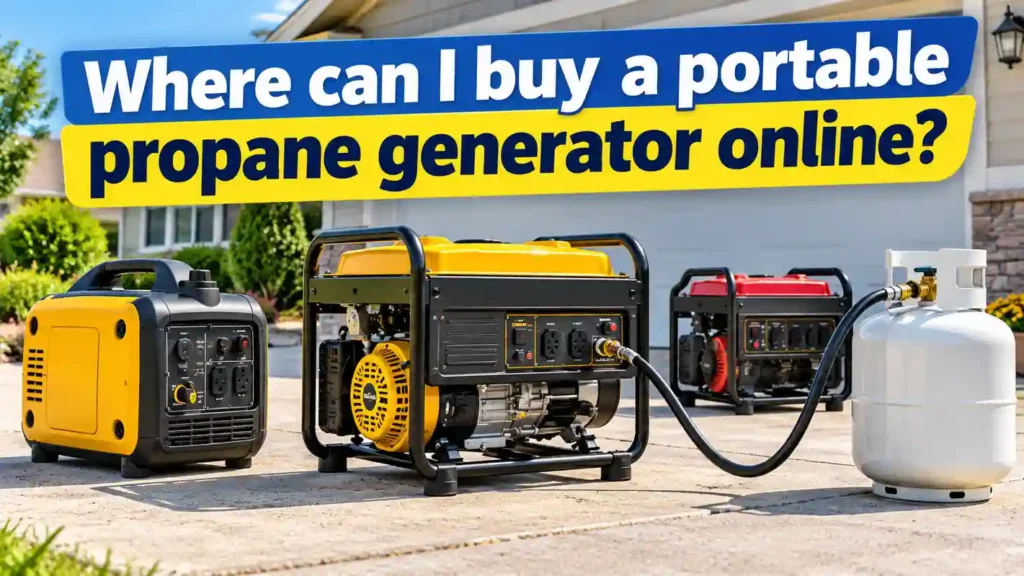
TL;DR — Where can I buy a portable propane generator online?
In the U.S., I would start with Home Depot, Lowe’s, Tractor Supply, Northern Tool, and the online stores or authorized-dealer networks of Champion, Westinghouse, and DuroMax. Major marketplaces can offer additional sellers, but I check who actually sells and ships the unit before ordering. Most portable “propane generators” are dual-fuel models that run on either propane (LPG) or gasoline. Before paying, I compare running watts on propane—not just gasoline peak watts, outlets, inverter design, noise, included propane hose/regulator, warranty, return policy, and shipping freight fees. For home power, I also verify safe transfer-switch compatibility and choose a propane cylinder that can supply enough vapor.
Where can I buy a portable propane generator online? If you’re shopping in the United States, the places I’d check first are national home-improvement retailers, farm-and-ranch stores, power-equipment specialists, and manufacturers’ own dealer or shopping channels. The right seller depends on whether you need a quiet inverter for camping, a mid-size unit to keep essential appliances running, or a heavy open-frame generator with 120/240-volt output for home backup.


I don’t buy based on the largest wattage printed on a listing thumbnail. I compare the exact model number against the manufacturer’s specification sheet, then check the retailer’s shipping, return and warranty handling. Otherwise, it’s easy to buy a generator that looks powerful online but delivers fewer watts on propane than you expected.
This guide focuses on U.S. online retailers and 120-volt or 120/240-volt, 60-Hz products. Retail listings and inventory change frequently. I checked current public storefronts for this 2026 buying guide; any price references are examples rather than guaranteed checkout quotes. To keep this article self-contained, I’ve used no outbound purchase links; search the exact model number on the retailer’s website.
Best Places to Buy a Portable Propane Generator Online
| Online retailer/channel | What I would shop for | Why consider it | What I verify |
|---|---|---|---|
| Home Depot | Champion, Westinghouse, DuroMax and other dual-fuel portable generators | Broad selection, product filtering and delivery/pickup options | Exact SKU, local inventory, delivery dates and returns |
| Lowe’s | Dual-fuel open-frame and home-backup-ready portable models | Useful comparison of wattage, outlets and nearby availability | Seller, regional restrictions and included accessories |
| Tractor Supply | Portable propane/gas generators for farms, RVs and backup | Generator-focused listings plus possible store pickup | Freight handling, warranty and store availability |
| Northern Tool + Equipment | Small dual-fuel inverters through higher-output machines | Detailed equipment specifications and shipping information | Whether shipping is factory-direct, liftgate charges, item availability |
| Manufacturer-direct / authorized dealer | DuroMax and other brand-supported models | Direct specification and warranty documentation | Authorized sales channel, shipping eligibility and service network |
| Online marketplaces | Listings from multiple sellers and brands | Convenience and potentially wider selection | Actual seller identity, new versus refurbished, returns and valid warranty |
I would compare the same model on at least two reputable storefronts. An apparent $100 discount can disappear when one retailer adds freight delivery, excludes an electric-start battery, or charges a restocking fee for a heavy engine-powered product.
1. Home Depot: A Strong Starting Point for Comparing Models
Home Depot is one of the first places I’d check because its dual-fuel generator category contains portable inverters and larger open-frame units with clearly labeled brands and model numbers. Recent storefront listings include Champion’s 201507 8,500-running-watt gasoline model (7,650 running watts on propane), DuroMax’s XP5500HX, and several Westinghouse dual-fuel options.


I use Home Depot mainly for three tasks: compare the exact model’s specifications, check whether a store can accept an order for pickup or delivery, and review what is included. An inverter and a conventional generator might both say “4,500 watts” in their titles, but they can differ substantially in noise, continuous output, weight and power quality.
When you see a retailer heading such as “10,625/8,500 watts,” don’t assume both figures apply to LPG. Those may be gasoline starting/running ratings. Scroll to the detailed propane table or check the model number against the manufacturer’s specification sheet.
2. Lowe’s: Useful for Home-Backup Shopping
I would also check Lowe’s, especially if you are shopping for a generator intended to feed household circuits using an approved transfer switch or interlock. Its portable generator category includes current Westinghouse and Generac dual-fuel listings, and it often lets you filter by starting watts, fuel type, local store and delivery availability.
My first question is whether a product is 120V only or 120/240V. A 120V-only inverter may be excellent for extension-cord appliances or an RV but may not suit the inlet and transfer equipment you expect to use at home. I’d rather find that out before checkout than after a power outage.
I also confirm who fulfills the order. Some online marketplaces and retail websites offer products through third-party sellers, with returns or shipping handled differently from ordinary store-stock products. The same recognizable logo at the top of a page doesn’t always mean the retailer itself is the seller.



3. Tractor Supply: Worth Checking for Farm, Cabin, and Emergency Power
Tractor Supply carries online dual-fuel portable generators, including Westinghouse and Champion models and smaller budget units. I consider it useful when the generator will serve a rural property, cabin, or an emergency backup role and you want the option of checking nearby pickup or delivery.
I would look closely at the packaging and propane accessories. Some dual-fuel generators include a factory hose and regulator, while others need model-specific accessories. The presence of an LPG fuel selector doesn’t mean a loose cylinder or any generic grill regulator is compatible.
If you are ordering a 150- to 250-pound unit, I would verify how it’s delivered, whether it arrives on a pallet, and whether you need help unloading it. That matters just as much as the advertised purchase price.
4. Northern Tool: Good for Technical Shopping and Larger Machines
Northern Tool has listings from small propane-capable portable inverters to large open-frame dual-fuel generators. I like it for buyers who want to study a generator’s detailed equipment listing, compare outlet configurations and look closely at freight arrangements. One example currently cataloged is a Powerhorse 4,500-watt-class dual-fuel portable unit, alongside heavier models.


A large generator may ship from the factory and require liftgate service or another delivery arrangement. That’s not automatically a disadvantage, but I would get a clear landed total and confirm delivery to my address before buying.
For shop use or construction equipment, I check running amperage, outlet type and whether the unit is intended for the planned duty. For home use, I concentrate on electrical transfer compatibility, propane performance and carbon-monoxide safeguards.
5. Manufacturer Websites and Authorized Dealers
For some brands—particularly DuroMax—the manufacturer’s online product catalog also operates as a direct shopping channel. On other manufacturer websites, the easiest path is a dealer locator or “where to buy” feature. I usually start with the manufacturer even when I eventually order elsewhere, because its model-specific specs are a useful baseline.
For example, the DuroMax portable generator catalog includes dual-fuel models from compact inverter classes to high-output open-frame machines. Champion and Westinghouse publish detailed propane and gasoline ratings for models sold through their dealer and retail networks.
This is also where I check warranty requirements and authorized repairs. A generator shipped cheaply from an unfamiliar seller can become expensive if the brand doesn’t recognize the sale, replacement parts are hard to obtain, or the return conditions are restrictive. I prefer a traceable invoice, new serial-numbered equipment and a clear service route.
6. Amazon, Walmart, and Other Marketplace Listings
Online marketplaces may be convenient for comparing sellers, shipping dates and customer feedback, but I treat them differently from a manufacturer-direct sale. I check the actual merchant name, product condition, whether the generator is a current model, and if the shipping address and warranty coverage apply to my state.
I also don’t treat hundreds of positive reviews as proof that every seller ships genuine equipment. A listing may mix product variations or model generations, and a review for a gasoline-only version can appear near a dual-fuel version. I match the manufacturer part number rather than relying on the headline.
For expensive models, I would rather pay a little more to a reputable seller with straightforward returns than gamble on a much cheaper listing with no detailed product information or seller support.
Portable Propane Generator Models I Would Compare Before Ordering
I would not choose a model merely because it’s popular. The following are real, published manufacturer examples across several size classes. I use the propane continuous (running) watts because that number is more relevant than gasoline peak output for someone who expects to use LPG.
| Model | Running watts on propane | Gasoline running watts | Key specifications |
|---|---|---|---|
| Champion 201271 2,400W dual-fuel inverter | 1,620 W | 1,800 W | 120V; 53 dBA at 23 ft; 50.9 lb; 3-year limited warranty |
| Westinghouse iGen5000DFc inverter | 3,500 W | 3,900 W | 120V; 52 dBA published; ≈106 lb; inverter |
| Westinghouse WGen7500DFc | 6,750 W | 7,500 W | 120/240V; L14-30R; 72 dBA published; ≈202 lb |
| Champion 201507 open-frame | 7,650 W | 8,500 W | 120/240V; L14-30R; 74 dBA at 23 ft; 209 lb |
| DuroMax XP13000EH open-frame | 10,000 W | 10,500 W | 120/240V; 50A outlet; published 74 dB; approx. 234 lb dry |
These are manufacturer specifications for specific model numbers, not my own load-test results. Some model generations and retailer pages differ, particularly when updated CO-sensor variants are introduced. Sound ratings may be measured under different loads and distances, so I wouldn’t rank one model as quieter based solely on a two-decibel difference.
I also note that the Champion 201271 is a lightweight choice for modest loads, while a DuroMax XP13000EH is a large machine that needs much more careful storage, transport and fuel-supply planning. Neither is automatically the better buy.
How Much Should You Spend on a Portable Propane Generator?
Price matters, but I start by grouping generators according to power and intended use. There are small dual-fuel inverters, mid-size portable machines, and high-wattage units designed for heavier emergency loads. An enclosed inverter usually costs more per running watt than a conventional open-frame model because you’re paying for a different design and control system.
These illustrative shopping budgets are not guaranteed retail prices or exact quotes for the models above. Promotions, regional restrictions and freight can change the total.
| Shopping category | Illustrative purchase budget (USD) | Best match for |
|---|---|---|
| Compact dual-fuel inverter | $400–$900 | Camping, lights, phones, router and small essentials |
| Mid-size inverter or portable | $700–$1,500 | RV and selected home appliances |
| Large open-frame dual fuel | $900–$2,500+ | Home backup circuits, larger motors and several simultaneous loads |
| Very high-output portable | $2,000–$5,000+ | Heavy loads with suitable fuel and electrical connection |
When I compare real offers, I don’t ignore accessories: a generator inlet and transfer equipment, suitable outdoor-rated cords, maintenance supplies, a approved fuel hose, a battery if required, and the propane tank itself. A cheaper generator may be the more expensive system after you’ve added everything needed to use it safely.
Do You Need an Inverter or an Open-Frame Propane Generator?
If you want quiet power for camping or electronics, I’d begin with an enclosed inverter. If you need to run pumps, multiple appliances or some household circuits, an open-frame unit may offer more watts for the money. Neither design eliminates the need to check power quality and actual load requirements.
| Feature | Enclosed dual-fuel inverter | Open-frame dual-fuel generator |
|---|---|---|
| Typical strength | Quieter light-load use, compact design | Higher electrical capacity per purchase dollar |
| Common limitation | Lower available watts or higher price per watt | Greater size, weight and noise |
| Electrical output | Often 120V on smaller units | Many mid/large units offer 120/240V |
| Engine-speed behavior | Often variable in economy mode | Often fixed-speed operation |
| Ideal purchase question | Is quiet, efficient light-load operation my priority? | Do I need more starting and running power? |
Noise isn’t simply a propane-versus-gasoline question; engine and enclosure design matter more. My guide to whether propane generators are quieter than gasoline generators covers dBA comparisons and placement considerations.
Check These 8 Specifications Before Clicking Buy
- Propane running watts: I find the LPG rating, not the higher gasoline rating advertised in the headline.
- Starting watts on LPG: Refrigerators, air conditioners and well pumps need startup surge capacity.
- Voltage and outlets: I compare 120V versus 120/240V, RV TT-30, 30A L14-30R or 50A connections as applicable.
- Inverter and THD: For sensitive equipment, I look at the manufacturer’s published total harmonic distortion and approved device recommendations.
- Tank and regulator requirements: The supplied hose and regulator must be correct for the model and the cylinder must vaporize enough propane.
- Weight and mobility: I plan how to move a 50-pound inverter versus a 200-pound open-frame generator.
- Safety systems: I compare low-oil shutdown, overload protection, CO shutdown features and the manufacturer’s placement instructions.
- Warranty and support: I verify warranty term, service availability, product registration, and return conditions before checkout.
If the generator has no published propane-specific electrical ratings, I move on to another listing. That’s a warning sign that the seller may be presenting gasoline-only specifications for a dual-fuel machine.
What Size Portable Propane Generator Should I Buy?
I size it from the appliances I truly need during an outage. A compact inverter might cover small essentials, but it will not necessarily start a well pump or run a central air conditioner. I also allow for the fact that propane mode often has lower running output than the gasoline mode of the same machine.
| Example appliances | Illustrative running watts | Important consideration |
|---|---|---|
| LED lights and router | 50–200 W combined | Small steady load |
| Refrigerator | 100–800 W | Compressor starting surge |
| Small microwave | 900–1,600 W input | Large short-time draw |
| Portable heater | 1,500 W | Sustained load |
| Small sump/well pump | 500–2,000+ W | Starting watts may be several times running |
| Window air conditioner | 500–1,800+ W | Compressor starting surge |
For example, if my selected appliances add up to 2,200 continuous watts, I would not buy a generator rated at just 2,000 starting watts. I want enough propane running capacity for the actual steady demand, plus enough starting capability for the largest simultaneous motor surge. The nameplate and manual—not a generic wattage chart—should determine the final selection.
If you’re shopping for extended home backup, read my guide to whole-home propane generators for reliability in 2026 to understand how a permanently installed standby system differs from a portable unit.
How Long Will a Portable Propane Generator Run on One Tank?
Tank runtime is another reason I look beyond the sales headline. A nominal 20-lb cylinder holds about 4.7 U.S. gallons of propane when properly filled, while a 100-lb cylinder holds about 23.6 gallons. But the generator’s fuel consumption and the cylinder’s ability to vaporize propane determine how long it can run.
| Cylinder | Approximate propane | At 0.40 gal/h | At 0.75 gal/h |
|---|---|---|---|
| 20 lb | 4.7 gal | 11.8 hours | 6.3 hours |
| 40 lb | 9.4 gal | 23.5 hours | 12.5 hours |
| 100 lb | 23.6 gal | 59 hours | 31.5 hours |
These are illustrative arithmetic runtimes calculated from nominal full-cylinder quantity divided by constant consumption. They are not a claim that every cylinder or generator is approved for those fuel flows, especially in cold weather. Some listed portable inverters are exceptionally economical at a quarter load; larger generators can burn much more fuel under heavy load.
For a more detailed discussion, I recommend my 20-lb propane cylinder runtime guide and my 100-lb tank runtime comparison. If you are considering larger stationary storage, see what propane tank size your generator needs.
Is Propane Cheaper Than Gasoline for Generator Operation?
I don’t assume propane is cheaper simply because the pump or refill price is lower. Gasoline has more energy per gallon, while the two fuel modes of a dual-fuel generator may operate at different efficiencies. I use the manufacturer’s fuel-consumption data at comparable electrical loads and calculate fuel cost per kWh.
For instance, at an illustrative propane price of $3 per gallon, a generator consuming 0.60 gallon per hour costs $1.80 per hour in propane alone. If you run it for eight hours at that constant consumption, that’s $14.40 in fuel—not counting maintenance, delivery or equipment costs. Those are examples, not current quoted fuel prices.
My articles on propane versus gasoline generator efficiency and whether gasoline or propane costs less to run go through the calculations without confusing gallons, kWh and watts.
How I Avoid Online Generator Scams and Misleading Listings
Before ordering a large power-equipment item online, I slow down and check the seller. I want to see a verifiable business, a complete model number, manufacturer photos and specification data that match, a clear warranty, and an addressable return process. Unusually deep discounts with a demand for off-platform payment, gift cards or bank transfers are warnings—not reasons to rush.
I also confirm whether the listing is new, open-box, refurbished or used. For a used machine, I want an engine-hour reading and service history, but I understand a photo of the meter doesn’t guarantee its accuracy. A damaged or previously flooded generator can create electrical and mechanical hazards.
When a retailer claims a model is “CARB compliant” or legal in all 50 states, I check the exact model and emissions certification. Product variants can have different emissions approvals, and a seller may be displaying details from a neighboring SKU. This matters especially if you are shipping to California.
Shipping, Warranty and Return Policy: What I Check First
| Checkout issue | What could go wrong | My buying check |
|---|---|---|
| Heavy freight delivery | Extra liftgate fee or curbside-only delivery | Confirm total landed cost and unloading arrangements |
| Wrong or incomplete package | Missing propane hose, regulator or battery | Check included-item list against manufacturer documentation |
| State shipping restrictions | Order canceled or unsuitable model | Confirm emissions compliance for destination |
| Third-party seller returns | Different restocking/shipping policy | Read seller-specific terms in writing |
| Warranty service | Repair requires a distant service center | Confirm authorized parts and service near the delivery address |
| Freight damage | Engine or frame damaged in transit | Photograph carton and inspect promptly under retailer policy |
I retain the order confirmation, serial number, sales invoice, and the manufacturer’s warranty document. If anything arrives damaged, I document it immediately and follow the carrier and retailer’s claims process. For large generators, waiting several weeks to check the carton can complicate a return.
What About Amazon Affiliate Listings?
Some websites, including buyer’s guides like this one, may eventually use affiliate links. When I evaluate a generator, I would still make the recommendation based on its actual specifications and suitability, not affiliate commission. The retailer and manufacturer should remain responsible for the sale and warranty according to the actual purchase terms.
At the moment, this article deliberately includes no outbound shopping links. I name the major storefronts and model numbers so you can search them directly, compare legitimate sellers and avoid a product page that changes unexpectedly.
Safety: Buying the Right Generator Is Only Half the Job
A portable propane generator is a fuel-burning engine that produces deadly carbon monoxide, just as a gasoline generator does. I never run a portable generator in a garage, house, enclosed patio, shed, under a window, or other partially enclosed area—even if the garage door is open. I operate it outdoors, far from windows, doors and vents, with exhaust pointed away from occupied buildings. A common safety recommendation is at least 20 feet from buildings when feasible; always follow the manufacturer’s clearances and local rules.
If I want to supply house circuits, I do not plug the generator into a household wall receptacle or use a male-to-male cord. A qualified electrician should install and assess a code-compliant transfer switch or approved interlock and inlet. Whether a particular generator’s neutral bonding and GFCI configuration works with that system must be checked before purchase.
Likewise, I use only an approved propane cylinder, hose and regulator specified for the generator. A larger cylinder doesn’t automatically cure fuel-pressure problems, and I would never improvise fuel adapters. For selecting the fuel connection, see my guide to portable dual-fuel generator regulators.
Frequently Asked Questions
Can I buy a generator that runs only on propane?
Yes, propane-only units exist, but most consumer portable products marketed for LPG use are dual-fuel models designed for gasoline and propane. I check the manufacturer’s approved fuels rather than assuming I can convert a gasoline-only engine.
Does Home Depot or Lowe’s sell portable propane generators online?
Yes. Their portable-generator categories include gasoline/propane dual-fuel models. Specific inventory, brands, prices and delivery eligibility depend on your location and the date you shop.
Is it safer to order from the manufacturer’s website?
A genuine manufacturer-direct or authorized seller may make model verification and warranty handling easier, but I still read the shipping and return terms. Major retailers can also be legitimate choices when the seller and SKU are clear.
What is the best portable propane generator for camping?
I usually look at a compact enclosed inverter with enough LPG running watts for the campsite and a published low dBA figure. The Champion 201271 and Westinghouse iGen5000DFc illustrate two different output classes. Always check campground generator rules.
Can I power my whole house with a portable propane generator?
Some high-output 120/240-volt portable units can power many home circuits when connected through properly installed transfer equipment. But I would not promise that a portable unit can run every major household load simultaneously. Calculate running and starting loads, and compare it with a dedicated standby system if automatic whole-home backup is your goal.
Will a 20-lb propane tank be enough for a big generator?
Not necessarily. Even if the cylinder contains enough fuel for a short period, it may not vaporize propane fast enough for a large generator in cold weather or at high load. DuroMax, for example, specifies a larger minimum propane tank for some high-output units. Follow the exact model’s instructions.
Should I buy a dual-fuel or tri-fuel generator?
I buy based on which fuels are realistically available and approved for the unit. Dual-fuel usually means gasoline and LPG; tri-fuel typically adds natural gas. The available watts, correct fittings and pressure requirements can differ among modes.
Are portable propane generators shipped with a propane tank?
Usually I would not assume a cylinder is included. A listing may include a propane hose and regulator but exclude the cylinder itself. Read the box contents carefully before checkout.
My Final Recommendation: Where I Would Buy
If I were shopping for a small inverter, I’d check Home Depot, Lowe’s and Tractor Supply alongside the manufacturer’s current model sheet. If I needed a large portable home-backup unit or heavy-duty machine, I’d also compare Northern Tool and DuroMax’s official sales channels. If a marketplace offers the lowest listed price, I would still confirm the seller’s reputation, actual model number and support before paying.
Most importantly, I’d buy by propane running watts, safe outlet compatibility, reliable service and total delivered cost—not by whichever seller writes the largest peak-watt number in a headline. That gives you a far better chance of getting a generator that is useful during a real outage rather than merely impressive in an online listing.
Research note: Retailer availability examples and model specifications were checked against public U.S. listings and manufacturer product information for the 2026 buying season. Prices and seller availability may change. Illustrative cost and runtime tables are estimates rather than vendor offers or measured testing. No outbound links are included in this article.

Mike is an experienced propane technician with over 15 years of professional experience in the field. He has dedicated his career to helping customers with their propane needs, from installation to maintenance and repair. Together with Jeremy, he co-founded this website to provide useful information and guidance to customers seeking reliable propane services.