TL;DR — Underground or above-ground propane tank for a generator?
I would choose an above-ground tank for most homeowners when cost, inspection access and future replacement matter most. An underground-rated tank makes sense when appearance and usable yard layout justify excavation, corrosion protection and extra ownership obligations. Either can supply a properly sized whole-house generator. A publicly listed 2026 regional installation example prices a 500-gallon above-ground package from $5,587 and an underground package at $12,049—a $6,462 gap, not a nationwide average. Burial doesn’t automatically increase generator output or reduce propane consumption. I would check setbacks, soil, groundwater, full-load propane vapor capacity, delivery access, and twenty-year ownership costs before choosing.
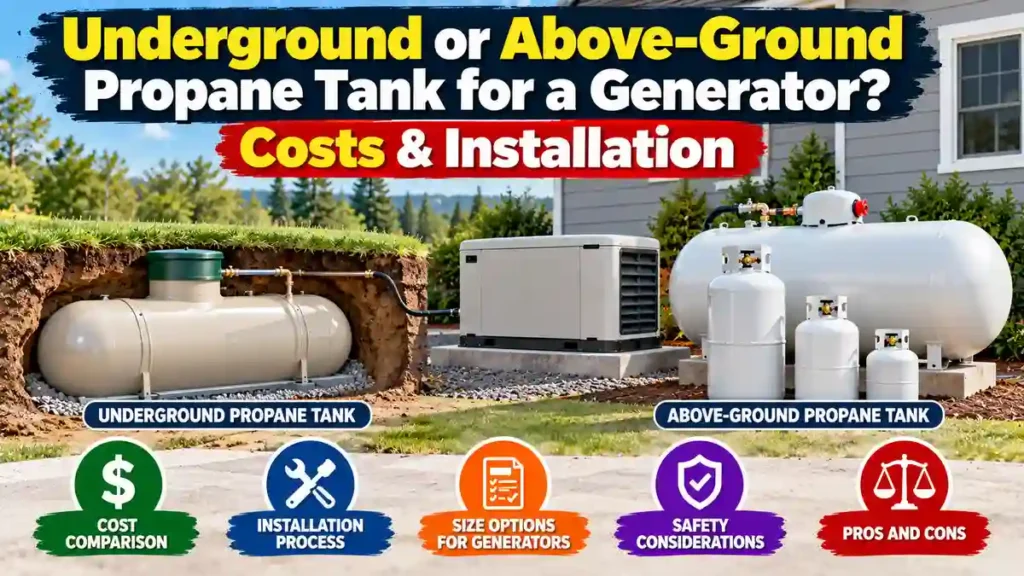
The choice between an underground vs above-ground propane tank for a generator is about more than hiding a large container behind landscaping. Both types hold liquid propane and supply vapor through regulators and piping. The practical differences are the property work required, the condition of the surrounding soil, how easily you can inspect the tank, and who pays if a buried system needs repair.


I would make this decision before signing the generator-installation contract. If your electrical demand is still uncertain, start with how to calculate your home’s power needs for a propane generator. A tank that fits the yard visually may not have acceptable setbacks, delivery access or vapor capacity on a freezing night. And an inexpensive tank quotation may leave out trenching, regulators or permits. Here’s how I would evaluate a U.S. home that needs dependable standby power.
1. How a Propane Tank Supplies a Standby Generator
A stationary ASME propane tank stores liquid LPG under pressure. Heat entering the tank vaporizes part of that liquid. The generator typically draws propane vapor through a properly engineered pressure-regulation and piping system. The installer sizes that system for the exact engine’s required pressure and maximum fuel-flow rate, not simply for the number of gallons in storage. For the pressure-design side, see what size propane regulator a standby generator needs.
A 20kW, 22kW, 24kW or 26kW standby generator may consume several gallons per hour at substantial output. A useful approximate fuel heat value is 91,500 BTU per U.S. gallon: a modeled 3 gal/h represents roughly 274,500 BTU/hour of input fuel, not 274,500 BTU/hour of electrical power. Gas-line design must also account for any furnace, water heater or range drawing from the same storage tank.
Both buried and exposed tanks can deliver that fuel when properly selected. A buried tank is not an upgraded generator engine. If you need to choose the generator output first, see my 20kW versus 26kW propane generator comparison.


2. Underground vs. Above-Ground: Technical Comparison
| Consideration | Above-ground ASME tank | Underground-rated ASME tank |
|---|---|---|
| Installation | Approved supports/pad; exposed shell | Excavation, bedding, burial, accessible dome |
| Common capacities | 120, 250, 500, 1,000 gallons | Commonly 500 and 1,000 gallons; smaller sizes depend on supplier |
| Initial cost | Usually lower | Usually higher |
| Inspection access | Shell, valves and supports easy to see | Dome accessible; buried shell not directly visible |
| Corrosion protection | Coatings and above-ground maintenance | Burial coating plus cathodic protection and testing |
| Soil and groundwater | Mainly pad stability and drainage | Major factors for corrosion and tank stability |
| Storm impacts | Exposed to debris and vehicle contact | Buried shell protected from some surface impacts |
| Repairs and replacement | More accessible | May require excavation and site restoration |
| Appearance | Visible vessel | Mostly a small service dome |
| Best fit | Price-sensitive and accessible rural/suburban locations | Appearance-sensitive site with suitable soil |
I wouldn’t call one tank universally safer. Their engineered protections address different exposures. A compliant underground tank remains a pressure vessel and can still leak; an above-ground tank can also operate safely for many years with appropriate protection and inspection.
3. Above-Ground Tank Advantages and Drawbacks
My seven strongest reasons to choose an above-ground tank are lower installation cost, no major burial excavation, visible shell inspection, accessible fittings, simpler maintenance, easier replacement, and broad suitability on rural properties. If the regulator or piping needs attention, a technician can often reach the relevant external equipment without disturbing a lawn or driveway.
But I would plan around six drawbacks: the tank is visible, takes usable space, faces rain and sunlight, may need protection against vehicles or mowing equipment, is subject to placement restrictions, and can have vaporization limits during cold weather. None of these means it is unsuitable. A properly selected location, protective coating, approved supports and an adequately sized tank can address many of them.
I also don’t assume landscaping can hide anything. The installer and fuel-delivery driver need clear access to valves, the filling connection and required safety clearances. Dense shrubs, fencing or a decorative enclosure can create new problems rather than solve the appearance issue.
4. Underground Tank Advantages and Drawbacks
I would consider burial when hiding the visible tank is a substantial homeowner priority, the yard design benefits from fewer above-ground obstructions, and the surrounding soil temperature may be less variable than outdoor air. Properly buried steel is also shielded from some impacts and surface weather. A small service dome stays accessible above grade for filling and maintenance.

The tradeoffs are excavation, specialized burial-rated construction, protective coatings, sacrificial anodes or other cathodic protection, testing, drainage issues and harder removal. Wet soil is particularly important: it affects corrosion exposure and may complicate installation. High groundwater may require a professional buoyancy/anchoring assessment and a different construction method.
I would never bury an ordinary above-ground-only tank. The supplier must provide a container specifically approved for underground installation, with its required corrosion-control system and installation instructions. PERC describes underground tanks as needing cathodic protection because of contact with soil and moisture.
5. Underground vs. Above-Ground Installation Costs in 2026
Because national cost summaries mix leased tanks, bare-tank prices and completed installations, I prefer a verifiable seller quote that lists what is included. Tankfarm Steel currently advertises complete installed packages in Connecticut, Massachusetts, Rhode Island and parts of New Hampshire. Those regional examples cannot be treated as a national average; its tanks are sold with its propane-service arrangement.
| Nominal tank | Above-ground package | Underground package | Price status |
|---|---|---|---|
| 120 gallons | From $2,444 | Not listed | Seller’s regional published starting price |
| 250 gallons | Quote required | Quote required | No comparable verified installed package |
| 500 gallons | From $5,587 | $12,049 | Both seller-listed installed options; underground includes excavation |
| 1,000 gallons | $7,825 | $14,860 | Both seller-listed installed options; underground includes excavation |
At 500 gallons, that published difference is $12,049 − $5,587 = $6,462, or around 116% above the above-ground starting price. The 1,000-gallon published difference is $7,035. Local terrain, included gas lines, trenching length, tank delivery, permits, taxes and generator connections can change the actual invoice.


I use the following line-item checklist to prevent false “cheap versus expensive” comparisons. The estimated entries are examples of what a contract might include, not separately verified seller charges.
| Cost item | Above-ground scope | Underground scope |
|---|---|---|
| Pressure vessel | Above-ground-rated 250/500/1,000-gal tank | Burial-rated tank with appropriate coating |
| Site preparation | Level pad/blocks, access | Survey, site protection, excavation plan |
| Excavation / spoil | Usually none for tank vessel | Pit excavation, spoil haul-off, backfill |
| Supports / bedding | Approved supports or pad | Approved bedding and stabilization |
| Corrosion protection | Exposed coating/paint maintenance | Anodes, connections and accessible test point |
| Regulators and piping | Tank-to-generator line and regulator stages | Line, protective routing, approved fittings |
| Permits / inspections / labor | Local requirements and safe commissioning | Same plus burial-related work and inspections |
| Total installed cost | Contractor’s complete bid | Contractor’s complete bid |
A 500-Gallon Generator Installation: My Cost Example
Imagine a homeowner installing a 22kW propane standby generator on a property with normal access and no unusual bedrock. Using the verified Tankfarm regional listed packages as starting benchmarks, the exposed option is $5,587 and burial $12,049. To illustrate sensitivity, suppose separate extra trenching, permit and landscaping items add $900 above ground and $2,100 underground. The modeled totals are $6,487 versus $14,149, a $7,662 difference. Those additional charges are hypothetical—not a quote from Tankfarm.
If the yard contains rock, a retaining wall, buried utilities, or groundwater, the excavation portion can rise sharply. I would ask each contractor for a written “unexpected rock/water” change-order schedule before digging. This is a cost-control question that online installation averages rarely address.
6. Professional Above-Ground Installation: What Happens?
The propane contractor first surveys the site, confirms legal setbacks and fuel-delivery access, checks the combined generator/appliance BTU demand, and obtains required permits. Next comes an approved supporting surface, delivery and placement of the tank, installation of the regulator stages and correctly sized piping, then pressure/leak testing, inspections and generator commissioning.
I would ask who owns responsibility for each handoff: tank supplier, gas-line contractor, electrician and generator installer. A generator that starts once is not proof that its regulator and piping can maintain pressure at full electrical load.
7. Professional Underground Installation: What Happens?
Burial adds additional planning before the tank is lowered: property evaluation, underground utility locating, groundwater and soil assessment, permits, selection of a burial-approved vessel, excavation dimensions, specified bedding, and protection of the coating as the tank is handled. The installer arranges cathodic protection and the means to test it, runs approved piping, performs required leak/pressure checks and inspections, and backfills with approved material before site restoration.
A shortcut at this stage can be expensive. Sharp rocks or improper backfill may damage the coating; standing water may complicate stability; and an untestable anode connection can leave an owner unable to demonstrate corrosion protection later. I would require photographs of the installation, the tank data plate, corrosion-system documentation and a plan of the buried line route before final payment.
For installation responsibilities more broadly, see when professional propane generator installation is required. These are descriptions of contractor work, not DIY instructions for handling pressurized gas.
8. How Far Must a Propane Tank Be From a House or Generator?
NFPA 58 is the main U.S. LPG installation benchmark, but the edition actually adopted locally, container water capacity, orientation, fill point and site conditions matter. AmeriGas summarizes common residential guidance as approximately 10 feet for many 125–500-gallon above-ground tanks and underground tanks up to 2,000 gallons; some larger above-ground tanks require 25 feet unless specific exceptions apply. Other distances apply to filling connections and ignition sources.
| Nominal residential tank | Common building/property-line baseline | Important qualification |
|---|---|---|
| 120 gallons | Small-tank rules can allow closer placement | Below 125 gallons water capacity; opening/ignition and fill-point rules still apply |
| 250 gallons above ground | Typically 10 ft | Verify actual water capacity, other tanks, local rules |
| 500 gallons above ground or buried | Typically 10 ft | Opening/fill-point and ignition-source requirements also matter |
| 1,000 gallons above ground | Generally 25 ft | Some single-container installations ≤1,200 gal may qualify for 10-ft reduction |
| 1,000 gallons underground | Commonly 10 ft | Site configuration and authority approval required |
I would not place the propane tank or generator using this table alone. For an on-site-filled ASME tank, the filling connection and liquid-level gauge can have an independent minimum clearance from ignition sources and certain air intakes. Generator enclosures, exhaust outlets, windows, doors and electrical equipment introduce additional manufacturer and code requirements. A propane tank setback is not a carbon-monoxide exhaust clearance.
9. What Tank Size Is Best for a Whole-House Generator?
I first choose a tank based on two requirements: enough gallons for the outage and enough vapor delivery for peak BTU/hour demand. For many homes, 250 or 500 gallons is a starting discussion; a 1,000-gallon tank deserves consideration for long outages or multiple propane appliances. The generator’s nominal kW number alone is not a tank-size formula.
| Standby generator class | My planning question | Potential tank range to evaluate |
|---|---|---|
| 14kW | What loads and daily running hours? | 250–500 gal may be worth evaluating |
| 18kW | One HVAC or multiple essential circuits? | 250–500 gal, site dependent |
| 20kW | Cold-weather demand and hours? | 500 gal or larger for longer backup |
| 22kW | Other propane appliances connected? | 500–1,000 gal for extended outages |
| 24kW | Can the existing tank vaporize full demand? | 500–1,000 gal depending site |
| 26kW | Large fuel draw plus winter minimum fill? | 500–1,000 gal; supplier calculates |
These are discussion ranges, not minimum code requirements or manufacturer endorsements. See my full propane generator tank-size guide for a more detailed fuel-storage calculation.
10. Runtime: 8 Hours, 72 Hours and a Full Week
For a simple example, assume the generator averages a constant 2.5 gallons of propane per hour. That’s an illustrative fuel rate for budgeting, not a specification for every 20–26kW machine. I plan from a typical 80% fill down to a 20%-of-nameplate reserve, leaving 60% of tank capacity available for scheduled operation.
| Storage tank | Fuel at 80% full | Budgeted gallons, 80%→20% | Hours at 2.5 gal/h |
|---|---|---|---|
| 120 gal | 96 gal | 72 gal | 28.8 hours |
| 250 gal | 200 gal | 150 gal | 60 hours |
| 500 gal | 400 gal | 300 gal | 120 hours |
| 1,000 gal | 800 gal | 600 gal | 240 hours |
| Run duration | Fuel used at 1.5 gal/h | At 2.5 gal/h | At 3.5 gal/h |
|---|---|---|---|
| 8 hours | 12 gal | 20 gal | 28 gal |
| 24 hours | 36 gal | 60 gal | 84 gal |
| 48 hours | 72 gal | 120 gal | 168 gal |
| 72 hours | 108 gal | 180 gal | 252 gal |
| 7 days (168 hours) | 252 gal | 420 gal | 588 gal |
At 2.5 gal/h, a 500-gallon tank with a 20% reserve provides around 120 hours, or five days; it does not cover a full week on that same reserve plan. A 1,000-gallon tank provides around ten days on paper. A furnace and generator sharing storage, colder weather, or a higher electrical load can reduce practical runtime. I also explain how to arrange propane delivery for your home generator before an extended outage.
To size fuel for a whole-home machine, verify the actual model’s gallons/hour at your expected load rather than relying on a chart. For a quick reference across common capacities, see my propane tank size chart for generators.
11. Does Burial Improve Winter Performance?
An underground tank can experience more stable soil temperatures than an exposed vessel, which may help in some climates. But I would never say burial automatically solves winter fuel supply. Propane vaporizes by absorbing heat, and its performance depends on soil/air temperature, how much liquid remains, tank surface area, and the generator’s fuel demand. At very low fill or extreme draw, either design can struggle.
The installer should check the coldest expected site condition and combined BTU/hour demand; never heat a tank with an improvised burner or other external heat source. Tank size and regulator design often matter more than the visual difference between a buried and exposed vessel.
12. Maintenance and Cathodic Protection
| Maintenance task | Above ground | Underground |
|---|---|---|
| Tank shell/paint | Look for exposed corrosion or damage | Coating buried; inspect via approved professional methods |
| Corrosion protection | Maintain coating and supports | Qualified cathodic protection monitoring/testing |
| Regulators and accessible valves | Inspect/maintain as required | Accessible dome components still need service |
| Foundations and drainage | Monitor pad stability and surface runoff | Monitor groundwater, dome drainage and grading |
| Leaks / damaged piping | Stop use and arrange professional test | Stop use and arrange professional test |
| Tank replacement | More accessible lifting/removal | Excavation and backfill likely |
| Records | Service, fill and condition history | Add cathodic test and burial documentation |
Underground propane tanks normally need coating plus cathodic protection, such as sacrificial anodes, that is tested periodically and documented. A propane supplier’s NFPA 58 guidance describes testing at installation, a follow-up after roughly 12–18 months and further intervals not exceeding 36 months for the cited system; check the adopted edition, design and jurisdiction for your exact obligations. I would not borrow the EPA’s petroleum underground-storage-tank regulations as if they directly govern every residential propane tank.
If I smell propane or suspect leakage, I leave the area and call the propane supplier or emergency services from a safe place. I do not dig, operate electrical controls near escaping gas, or conduct my own pressurized-gas repair.
13. Which Tank Lasts Longer?
I don’t promise a universal 20-, 30- or 40-year service life for either design. A properly installed and maintained steel tank may last many years; how long depends on manufacturing, protective coating, soil chemistry, cathodic system performance, weather, physical impacts and documented inspection history.
The buried option can resist some above-ground impacts but faces soil corrosion. The exposed option is easier to inspect but needs weather and impact protection. I would pay more attention to the condition and maintenance record of the specific vessel than to a seller’s unsupported claim that all buried tanks last longer.
14. Should I Buy or Lease the Propane Tank?
| Decision factor | Buy the tank | Lease from supplier |
|---|---|---|
| Upfront cash | Usually higher | Often lower setup cost |
| Fuel suppliers | May have more choices subject to equipment and contracts | Often tied to tank owner’s supplier |
| Routine maintenance | Owner duties defined by applicable law and service contract | Supplier duties defined by lease |
| Underground corrosion work | Owner must understand testing/repair obligations | Clarify who performs and pays for testing |
| Relocation or removal | Owner arranges | Contract may specify excavation/removal fees |
| Long-term cost | Tank value and maintenance costs remain with owner | Rent and delivery terms may change |
I would ask for lease terms in writing, particularly who owns a buried tank, who repairs or replaces the anodes, and who pays to excavate or restore landscaping if the agreement ends. A low rental fee can be attractive, but the removal obligation could matter more years later. Don’t assume a leased underground tank is automatically removed at no cost.
15. Twenty-Year Ownership Cost: A Transparent Model
For a simple hypothetical 500-gallon, 20-year comparison, I begin with the two verified regional package prices, then invent explicit maintenance and contingency allowances to demonstrate the financial decision. This isn’t a predicted repair schedule or evidence that a particular tank will fail.
| 20-year modeled cost | Above-ground | Underground |
|---|---|---|
| Initial 500-gallon installation | $5,587 | $12,049 |
| Routine inspection/maintenance allowance | $1,000 | $1,800 |
| Paint/coating or cathodic protection allowance | $250 | $900 |
| Landscaping and access upkeep | $100 | $500 |
| Potential repairs contingency | $700 | $1,500 |
| Removal/replacement reserve | $800 | $1,500 |
| Illustrative 20-year total | $8,437 | $18,249 |
The modeled difference is $9,812 over twenty years. That does not mean burial is a poor decision for every homeowner: an attractive yard or preserved open space can have personal value. But I would not claim it saves propane fuel. At the same actual electrical demand, a properly functioning underground tank does not automatically reduce the generator’s gallons/hour.
16. Ten Mistakes I Would Avoid
I wouldn’t: (1) size from generator kW alone; (2) ignore winter vaporization; (3) select the spot before checking setbacks; (4) assume excavation is fixed-price; (5) overlook groundwater; (6) bury a nonapproved vessel; (7) omit cathodic test documentation; (8) block fuel-truck access; (9) forget maintenance access; or (10) leave lease removal terms unclear. I would also calculate the propane furnace’s winter demand alongside the generator, not as an afterthought.
Each mistake can be prevented by getting the supplier, qualified gas installer and local authority involved before the tank is purchased. I want a drawing of the approved site, the fuel-demand worksheet and one itemized total—not three separate contractors each assuming someone else is responsible for testing.
17. My Decision Matrix and Three Property Scenarios
| Property condition | My first preference | Why |
|---|---|---|
| Rural open space, firm ground, budget-sensitive | Above-ground | Lower excavation risk, easier inspection |
| Tight landscaped property; compliant location | Underground, if feasible | Less visible storage |
| High groundwater or poor drainage | Above-ground first | Avoid costly burial/stability measures |
| Vehicle traffic and mowing hazards | Either with engineered protection | Site design and protection control risk |
| Need easy replacement or supplier flexibility | Above-ground | Less complicated future handling |
| Long outages with major propane heating demand | Size tank/fuel system first | Volume and vapor capacity decide performance |
Rural home, 20kW generator: If the owner has room and wants the lowest installed cost, I would start with a properly supported above-ground 500-gallon tank, then check whether 500 gallons covers the outage target.
Suburban home, 24kW generator: If visibility is the main objection and the soil is suitable, a buried 500-gallon tank may be worth the premium. The installer still needs service access and adequate generator clearances.
Large property, 26kW generator plus propane heat: I’d calculate combined winter BTU demand and target runtime before choosing 500 versus 1,000 gallons. If groundwater makes burial costly, a well-placed above-ground 1,000-gallon tank might be the technically better choice.
18. Frequently Asked Questions
Is an underground propane tank better for a generator?
Not automatically. It is less visible and may have more stable temperature exposure, but either type can reliably supply a properly designed standby system.
How much more does underground propane storage cost?
One regional seller lists $12,049 for an installed 500-gallon buried package versus from $5,587 above ground—$6,462 more. Your site may differ greatly.
Can I bury a 500-gallon propane tank?
Yes, if it’s a specifically approved underground vessel installed professionally with suitable coating, cathodic protection, excavation and permits.
Is 500 gallons enough for a whole-home generator?
Sometimes. On an illustrative 2.5 gal/hour fuel demand, it gives about 120 hours from an 80% fill to 20% reserve. Other appliances and winter vapor delivery can change the answer.
How far does a buried tank need to be from a house?
A common NFPA 58 residential guideline is 10 feet for many buried tanks up to 2,000 gallons; exact adopted rules, filling points and site geometry still require professional approval.
Do underground tanks rust?
They can corrode if their coating or cathodic system fails. That’s why approved burial designs include corrosion controls and ongoing testing.
How long do underground propane tanks last?
Many years when properly installed, protected and maintained, but I would not guarantee a fixed lifespan without considering the exact tank and soil conditions.
Can a buried propane tank leak?
Yes. A buried tank, fitting or connected line can leak. Suspected releases require emergency precautions and qualified investigation.
Are buried tanks safer than exposed tanks?
Both can be safe when installed and inspected correctly. Their risks differ: underground corrosion and access versus exposed shell, weather and vehicle impacts.
Can a delivery truck refill an underground tank?
Yes, through its accessible above-ground filling connection, provided the supplier has suitable, code-compliant delivery access.
Does a buried tank work better below freezing?
The surrounding soil can moderate temperatures, but it is not a guarantee. Tank surface, fill level, total fuel demand and propane system design still determine vapor delivery.
Is a 1,000-gallon tank worth buying?
It may be when outages are long, delivery is difficult or the generator shares fuel with major heating appliances. I’d compare the reserve and winter vapor capacity against added installation cost.
Final Verdict: Choose the Tank That Fits Your Site and Ownership Plan
My default choice for a homeowner who has adequate outdoor space is an above-ground propane tank: less excavation, easier inspection and potentially simpler replacement. I would seriously consider an underground-rated tank when appearance justifies the premium and the installer confirms suitable soil, drainage, corrosion protection, setbacks and long-term maintenance access.
I would make the decision from four written items: a code-compliant site plan, a full-load propane vapor-delivery calculation, comparable complete installation bids and a clear twenty-year ownership/lease responsibility sheet. That gives you a defensible answer without pretending buried tanks always run generators better.
Research and pricing note: Named installed package prices reflect publicly advertised Tankfarm Steel offers for its limited Northeastern U.S. service area in the 2026 buying season; availability, terms and prices can change. All extra site-work examples, runtime rates, reserve rules and twenty-year cost assumptions are illustrative. Site setbacks and corrosion checks require confirmation against the locally adopted NFPA 58 edition and supplier instructions. No outbound links are included.

Mike is an experienced propane technician with over 15 years of professional experience in the field. He has dedicated his career to helping customers with their propane needs, from installation to maintenance and repair. Together with Jeremy, he co-founded this website to provide useful information and guidance to customers seeking reliable propane services.