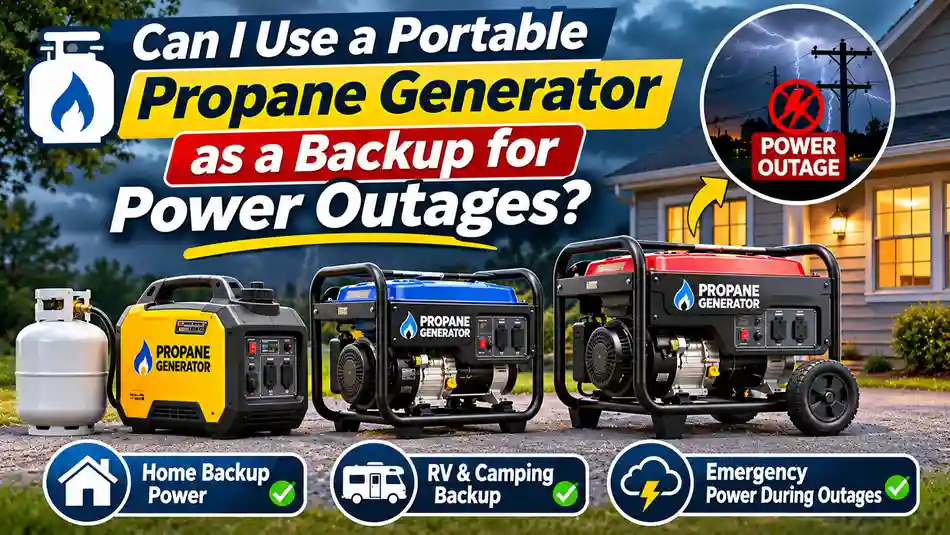
Can a portable propane generator power a house? Yes—if you define the appliances you need, choose a generator with enough continuous watts on propane, and connect it safely. A modest unit can keep food cold and essential electronics running; a larger 120/240-volt model may supply carefully selected home circuits. Neither automatically duplicates the unlimited convenience of utility service.
TL;DR — Quick answer: I would start with 2,000–3,500 propane running watts for a few small essentials, 4,000–7,500 watts for broader backup with managed loads, and 8,000–12,000+ watts when several major circuits must operate. These are shopping classes, not guarantees. Compare the appliance running load plus its likely starting surge, check the generator’s propane rating and outlets, and plan fuel before storms. Use appropriately rated cords for individual appliances or have an electrician install an approved transfer switch or compatible interlock where permitted. Never backfeed a receptacle. A permanently installed standby system is usually the better match for automatic backup and heavy simultaneous demands.
How a Portable Propane Generator Powers a House
The engine burns propane to turn an alternator, which generates electricity delivered through the outlets on the generator. Portable machines need you to set them up, supply fuel, start them and manage connected appliances; a standby system is permanently installed and typically starts and transfers loads automatically.
Two ratings matter. Running watts describe continuous output; starting watts describe short-duration capacity for motor startup. Refrigerators, pumps and air conditioners can briefly demand several times their normal operating power. A generator can appear powerful enough until two compressors start together.


Dual-fuel models typically publish separate gasoline and propane ratings. For example, a Champion 3500-class model is rated at 3,500 running watts on gasoline but 3,150 on propane. A Westinghouse WGen9500DF is rated at 9,500 running watts on gasoline and 8,500 on propane. Always read the specific model’s data plate, not just the big wattage printed on the box.
A 120V-only generator can power compatible 120V appliances but cannot independently supply a conventional 240V well pump or central AC. A 120/240V model may supply suitable 240V circuits if its outlets, current ratings and professional connection method match. Even a high-wattage generator has per-outlet and per-leg limits.
What Size Portable Propane Generator Do You Need?
I would size the machine from the outage plan—not square footage. A small all-electric house can demand more emergency power than a larger house heated with natural gas or propane. For a deeper explanation of sizing, see my home generator sizing guide. The following classes assume the listed number is continuous output on propane, not advertised peak output.
| Propane running-watt class | Reasonable emergency applications | Main limitation |
|---|---|---|
| 2,000W | Refrigerator, basic lights, router, charging, selectively | Motor starts and simultaneous appliances |
| 3,500W | Cold food, lighting, electronics, fan, perhaps an occasional small appliance | Kettle, heater, pump or microwave at the same time |
| 5,000W | Essentials plus selected sump pump, microwave or furnace blower | Major 240V appliances; startup surges |
| 7,500W | More managed circuits and several motor loads | Central AC, electric heat and multiple heavy loads |
| 9,500W | Broader 120/240V outage backup where equipped | Still not necessarily unrestricted whole-house power |
| 12,000W+ | Larger selected household loads and greater surge headroom | Electrical configuration, fuel logistics and heavy simultaneous use |
A higher rating is not always the smartest purchase. Bigger engines can burn substantial fuel while lightly loaded. If your plan consists of a refrigerator, lights, internet and phone charging, oversized capacity may buy more noise and refilling work than resilience.


Household Appliance Wattage Chart
Use these numbers only to build an initial worksheet. Actual wattage depends on model, thermostat cycles, efficiency, and compressor or motor design. The starting column gives an illustrative total while that device starts, not an additional amount automatically added to its running wattage.
| Appliance | Typical running watts | Illustrative starting watts | Planning note |
|---|---|---|---|
| Refrigerator | 100–300 | 600–1,200 | Intermittent compressor |
| Chest freezer | 80–250 | 500–1,000 | Stagger compressor starts |
| LED lights (group) | 40–120 | 40–120 | Usually no large surge |
| Wi-Fi router/modem | 10–30 | 10–30 | May need backup for internet service |
| Television | 50–150 | 50–150 | Check screen size |
| Laptop | 40–100 | 40–100 | Charger label is an upper bound |
| Phone chargers (group) | 10–50 | 10–50 | Low-power loads |
| Microwave | 1,000–1,600 | 1,000–1,800 | Input wattage exceeds advertised cooking power |
| Coffee maker | 700–1,200 | 700–1,200 | Heat-producing load |
| Washing machine | 400–900 | 900–1,800 | Motor and cycle variation |
| Sump pump | 500–1,000 | 1,500–3,000 | Prioritize flood protection |
| Well pump | 700–2,000 | 2,000–6,000+ | Often requires 240V; verify nameplate |
| Gas-furnace blower | 300–800 | 900–1,800 | Furnace electronics also need power |
| Window air conditioner | 500–1,500 | 1,200–3,500 | Compressor startup can dominate |
| Portable air conditioner | 900–1,800 | 1,500–3,500 | Verify startup and venting |
| Central air conditioner | 2,000–6,000+ | 5,000–15,000+ | Highly equipment dependent; often 240V |
| Electric water heater | 3,000–5,500 | About running watts | Sustained heating load |
| Electric range/oven | 1,500–5,000+ | About running watts | One element vs multiple elements differs |
The table’s most important lesson is what operates together. A 1,200W microwave is manageable if the compressor loads are quiet; it may trigger overload when paired with a pump start, electric heater and heavy battery charger. Plan to operate heat-producing appliances one at a time. See my separate multiple-appliance wattage guide for more simultaneous-load examples.
Three Generator Sizes in Actual Outage Plans
Scenario 1: 3,500W — The Essentials Plan
Here is a hypothetical household using one refrigerator, a freezer, LED lights, Wi-Fi, a fan and charging. These are assumed measured-equivalent running loads; your appliances could differ.
| Load | Running watts |
|---|---|
| Refrigerator | 180 |
| Freezer | 140 |
| LED lighting | 80 |
| Router | 20 |
| Fan | 70 |
| Charging and laptop | 90 |
| Total | 580W |
If the refrigerator’s start rises from 180W to 900W while everything else is operating, demand becomes 1,300W (580 − 180 + 900). The freezer could increase that further if both start together. A generator providing 3,500 propane running watts with adequate short-term surge headroom should have generous capacity for this illustrative bundle. Avoid adding a 1,500W heater or large microwave without rechecking the totals.
Scenario 2: 5,000W — The Essentials-Plus Plan
Add a gas-furnace blower and a sump pump to that same house. Your assumed running demand increases from 580W to 1,730W if the blower uses 450W and sump pump 700W. A 2,400W pump-start event in place of its 700W running demand brings the temporary total to 3,430W. Verify the generator’s surge capability and whether a second compressor might start simultaneously.



| Event | Illustrative load |
|---|---|
| Base essentials | 580W |
| Furnace blower | 450W |
| Sump pump running | 700W |
| Simultaneous running | 1,730W |
| While pump starts | 3,430W |
My practical rule here is to switch off the microwave and coffee maker when pump activity is likely. If the house can flood, the sump pump takes priority over convenience loads. Do not assume a 5,000W 120V-only model can operate a 240V pump.
Scenario 3: 9,500W — The Selected-Circuits Plan
Suppose your essentials total 580W, a 700W well pump runs, a 600W furnace blower operates and a 1,200W microwave is used. Their simultaneous running demand is 3,080W. Replace the well pump’s 700W with a hypothetical 3,500W starting demand, and the temporary requirement becomes 5,880W.
| Event | Illustrative load |
|---|---|
| Base essentials | 580W |
| Well pump running | 700W |
| Furnace blower | 600W |
| Microwave | 1,200W |
| Simultaneous running | 3,080W |
| While well pump starts | 5,880W |
A generator rated 9,500 running watts on propane, with suitable surge, voltage and 120/240V capability, could plausibly serve this plan through correctly installed transfer equipment. But it does not mean the electric water heater, range, clothes dryer and central AC should all be enabled. Those loads can overwhelm even a large portable unit.
How to Calculate Your Emergency Power Requirement
I use a six-step worksheet. First, write down the appliances you cannot reasonably lose—often refrigeration, a medically essential device, a sump pump, a furnace blower and some communications equipment. Second, record nameplate or measured running watts. Third, note startup demand for each motor.


Fourth, add the devices that will truly run simultaneously, then model the largest realistic startup event. Fifth, compare those figures against the generator’s continuous and surge ratings on propane. Sixth, allow operating headroom, taking account of altitude, ambient temperature and manufacturer guidance. Do not rely on a fixed percentage as a substitute for a tested startup match.
Example: 350W refrigerator + 600W furnace blower + 100W lights + 50W communications + 800W sump pump = 1,900W running. If the pump briefly needs 2,400W rather than 800W, the event demand is 3,500W. A 3,500W running-rated generator might have sufficient starting capability, but you must check its propane surge rating, outlet configuration and any other simultaneous motor starts.
Adding every appliance’s peak starting wattage is unnecessarily conservative when starts can be managed; ignoring all surges is too optimistic. Where the consequences of overload matter—especially well pumps or medically necessary loads—get equipment-specific measurements or professional assistance.
Safely Connecting a Portable Generator to Your Home
Never plug a generator into a dryer outlet or household wall receptacle. Backfeeding can energize utility lines and put lineworkers and neighbors in danger. The correct method depends on whether you need individual appliances or fixed household circuits.
| Connection method | What it powers | Illustrative US cost* | Practical limitation |
|---|---|---|---|
| Outdoor-rated heavy-duty cords | Individual plug-in appliances | $30–$150+ for suitable cords | No fixed hardwired loads; amperage and cable-length limits |
| Electrician-installed manual transfer switch and inlet | Selected compatible circuits | $600–$2,500+ installed | Circuit count and capacity are limited |
| Approved compatible panel interlock and inlet, where permitted | Chosen circuits subject to generator capacity | $400–$1,800+ installed | Panel- and jurisdiction-specific; careful load management |
Budgeting illustrations, not verified national installation quotes. Local labor, permits, distance and panel work can materially change the price.
For a few plug-in appliances, use grounded, outdoor-rated cords sized for current and distance; avoid damaged cables and overheating. For hardwired circuits, hire a qualified electrician to specify and install proper utility isolation and inlet arrangements. A manual transfer switch or an approved panel-specific interlock can work where local code permits.
Ask the electrician about neutral bonding, grounding, GFCI compatibility, split-phase load balancing and inlet limits. These electrical details can affect compatibility even when generator wattage looks sufficient. I would never improvise a special adapter to bypass a protective device.
Can Portable Propane Generators Run Central Air Conditioning?
Sometimes, but I would not promise it from a generator’s advertised watts alone. Compressors can require substantial short-term current, and most conventional central systems need 240V. A compatible soft-start device may reduce the surge, but it cannot create missing continuous capacity or correct voltage.
| Cooling type | Illustrative running watts | Potential starting demand | Planning advice |
|---|---|---|---|
| Small window unit | 500–900 | 1,200–2,000 | Possible on a modest generator after verification |
| Larger window/portable unit | 1,000–1,800 | 2,000–4,000 | Verify other loads and startup |
| Central AC, smaller system | 2,000–3,500 | 5,000–10,000+ | 240V and compressor-specific assessment |
| Central AC, larger system | 3,500–6,000+ | 8,000–15,000+ | Large generator or standby system may be needed |
A useful alternative during a summer blackout is to cool one room with a compatible window unit instead of demanding whole-house cooling. This can preserve fuel and spare capacity for refrigeration and pumps.
How Long Will a Propane Generator Run?
Runtime depends on the liquid gallons actually available divided by the generator’s propane consumption at your load. A nominal 20-pound cylinder contains about 4.7 gallons when properly filled; a 100-pound cylinder about 23.6 gallons. Stationary tank sizes are normally water-capacity designations, and a typical 500-gallon tank holds about 400 liquid gallons at an 80% fill.
The estimates below use 0.5 gallon/hour, solely to show the effect of capacity. A larger machine may burn much more. Actual usable fuel can be lower because of reserve targets, weather and supply-system constraints. For more sizes, use my propane tank size chart.
| Tank | Approximate liquid propane when full | Runtime at 0.5 gal/hour | Caution |
|---|---|---|---|
| 20-lb cylinder | 4.7 gal | 9.4 hours | Refills frequent; cold vapor supply matters |
| 30-lb cylinder | 7.1 gal | 14.2 hours | Check generator-approved connection |
| 40-lb cylinder | 9.4 gal | 18.8 hours | Heavy to transport |
| 100-lb cylinder | 23.6 gal | 47.2 hours | Qualified sizing may be necessary |
| 120-gallon stationary tank | Up to 96 gal | 192 hours | Professionally designed supply |
| 250-gallon stationary tank | Up to 200 gal | 400 hours | Delivery and reserve planning |
| 500-gallon stationary tank | Up to 400 gal | 800 hours | At 20% tank-level refill point, only 300 gal is budgeted from 80% |
Important: The three stationary-tank rows are mathematical comparisons, not recommendations to attach a portable generator directly to a house tank. A qualified propane professional must assess regulator stages, vapor withdrawal, piping, demand and approved connections. Never swap hoses or alter pressure controls to obtain more flow.
How Much Propane Does It Burn Per Hour?
I prefer the manufacturer chart at 25%, 50% and 100% load. If it is unavailable, the following illustrative planning assumptions show how fuel needs can scale. The generators are labeled by propane continuous-output class; the actual electrical load in column two is lower.
| Propane-running-watt class | Assumed actual load | Hypothetical gal/hour | 8-hour fuel use | 24-hour fuel use |
|---|---|---|---|---|
| 2,000W | 800W | 0.23 | 1.84 gal | 5.52 gal |
| 3,500W | 1,500W | 0.45 | 3.60 gal | 10.80 gal |
| 5,000W | 2,500W | 0.60 | 4.80 gal | 14.40 gal |
| 7,500W | 3,750W | 0.85 | 6.80 gal | 20.40 gal |
| 9,500W | 4,750W | 1.05 | 8.40 gal | 25.20 gal |
| 12,000W | 6,000W | 1.35 | 10.80 gal | 32.40 gal |
Runtime = available gallons ÷ gallons per hour. For example, a 20-pound cylinder at 0.45 gal/hour lasts approximately 4.7 ÷ 0.45 = 10.4 hours. At 0.85 gal/hour, the same cylinder lasts 4.7 ÷ 0.85 = 5.5 hours. This explains why I plan fuel from realistic hours of load, not just the generator’s size.
As an independent published reference, a Champion dual-fuel generator rated at 3,150 propane running watts advertises 10.5 hours at 50% load on a 20-pound cylinder. That is model-specific information—not a generic promise for every 3,500W-class generator. My 9,500-watt generator runtime guide covers larger models separately.
What Does Portable Propane Backup Cost to Run?
To make costs comparable, I will assume $3.50 per gallon of propane. This is a sample calculation, not a verified national retail price. Cylinder exchange often costs more per gallon than a measured refill, and bulk delivery has its own pricing, minimums and fees. Compare fuels in my gas-versus-propane operating cost guide.
| Assumed use | Fuel per hour | Cost/hour | 8 hours | 24 hours | 72 hours |
|---|---|---|---|---|---|
| Light backup | 0.23 gal | $0.81 | $6.44 | $19.32 | $57.96 |
| Small essentials | 0.45 gal | $1.58 | $12.60 | $37.80 | $113.40 |
| Medium backup | 0.60 gal | $2.10 | $16.80 | $50.40 | $151.20 |
| Larger backup | 0.85 gal | $2.98 | $23.80 | $71.40 | $214.20 |
| Extensive backup | 1.05 gal | $3.68 | $29.40 | $88.20 | $264.60 |
These totals assume continuous operation for the full stated interval at the same fuel rate. Running eight hours per day, rotating appliances and using a suitable battery solution during quiet periods can change consumption considerably. Never interrupt power to critical medical equipment simply to save fuel; make an independent medically appropriate backup plan.
Portable Propane Generator vs. Whole-Home Standby Generator
| Decision point | Portable propane generator | Installed standby generator |
|---|---|---|
| Purchase cost | Usually lower; depends on watts and features | Usually considerably higher |
| Installation | None for direct cord use; electrician for home circuits | Professional site, fuel and electrical work |
| Startup | Usually manual | Typically automatic |
| Power coverage | Chosen appliances/circuits | Selected circuits or broad whole-home service by design |
| Fuel | Cylinders or an approved designed bulk supply | Usually professionally connected bulk propane or natural gas |
| Weather/noise | Must establish safe outdoor operating location | Purpose-built outdoor enclosure; noise varies |
| Maintenance | Engine oil, checks, exercise and fuel system | Scheduled service and automatic readiness checks |
| Best fit | Occasional outages, flexible essentials | Frequent outages, limited manual capability, high load needs |
I consider a portable unit good value when the family can safely set it up and tolerate managed power. I lean toward standby for people needing automatic restart, sustained well or sump pumping with minimal intervention, or major heating/cooling loads. Standby is not magically unlimited either; it must be sized and maintained for the home.
Propane vs. Gasoline During an Outage
Propane stores without the liquid-fuel aging concerns of gasoline, and dual-fuel models let you choose a fuel that is available. Gasoline may deliver more rated watts from the same model and can be easier to obtain in some locations; fuel pumps may be inaccessible when regional power is out.
Propane’s tradeoffs include lower rated output on many dual-fuel engines, cylinder logistics and possible vaporization limits in cold weather. Both fuels power combustion engines that produce deadly carbon monoxide. Neither choice eliminates oil changes, engine maintenance or the need for safe outdoor placement.
The Advantages—and the Drawbacks
I value portable propane backup for fuel storage convenience, relatively accessible equipment prices and flexibility. A modest generator can protect refrigerated food, support communications and run a sump pump when a household loses electricity. A dual-fuel unit can provide two fuel options without requiring two separate generators.
The downsides are real: manual setup, noise, weather precautions, fuel replacements, maintenance and finite power. Portable engines can be heavy. Large heating appliances and whole-house air conditioning may be impractical. If your home depends on uninterrupted 240V pumping, automatic switching or extensive simultaneous loads, obtain a professionally designed solution before disaster season.
Where to Place the Generator Safely
Operate the generator outside, at least 20 feet from the house, with exhaust facing away from doors, windows, vents and nearby buildings. Do not run it in garages, sheds, enclosed patios, carports or basements—even with openings left ajar. Install working battery-powered or battery-backup CO alarms in the home.
Set the unit on a stable surface, follow all manufacturer-required clearances, and protect it from rain only with a manufacturer-approved running cover or suitable setup that does not trap exhaust or restrict airflow. Keep electrical connections dry and never operate wet equipment. Put cylinders upright and position them as the maker specifies; keep hoses away from exhaust and hot parts. A CO shutdown feature is a last line of defense, not permission to operate indoors. I cover placement mistakes in can you run a propane generator indoors?
What If the Generator Runs Out of Propane?
The engine may stop and appliances lose power suddenly. The freezer begins warming, internet equipment goes offline and pumps stop operating. Some appliances restart automatically when electricity returns; others may need manual checks. A battery UPS can protect selected electronics from abrupt interruptions, but it is not a substitute for generator-sized backup.
I keep a simple log of hours operated and refills, then establish a reserve sufficient for the expected delivery or refill delay. For delivery options, see how to get propane delivered for a home generator. Before reconnecting fuel after depletion, follow the generator manual rather than repeatedly attempting improvised starts. Check the propane system if you smell gas or suspect a leak; stop use and seek qualified help. Read what happens when a propane generator runs out of fuel for the fuel-depletion checklist.
Storm-Season Preparation Checklist
| Task | Why I do it | When |
|---|---|---|
| List essential loads and startup watts | Avoid buying too small | Before selecting equipment |
| Review manual and approved outlets | Prevent connector mismatch | Before first use |
| Ask electrician about inlet/transfer equipment | Protect utility isolation and circuits | Well before storm season |
| Inspect cords, hoses, regulator | Find visible damage | Before each use |
| Confirm cylinder fill and backup fuel | Avoid mid-outage shortage | Before severe weather |
| Run a safe supervised test outdoors | Check starting and load behavior | On maintenance schedule |
| Maintain oil, filter and spark plug | Reduce starting problems | Per manual |
| Test CO alarms | Detect dangerous indoor CO | On alarm schedule |
| Choose a safe dry outdoor location | Minimize CO and electrical hazards | Before an outage |
| Write a load-switching plan | Protect pumps and surge headroom | Before an outage |
Four Practical Home-Backup Examples
A. Small home, essentials only: Assume 500W of continuously selected loads and a short 1,200W refrigerator-start event. A 2,000–3,500 propane-running-watt class may work if the actual surge and outlet requirements are met. At an illustrative 0.23–0.45 gal/hour, eight hours takes 1.84–3.60 gallons.
B. Family home, three-day outage: Assume 1,600W running, with a pump or refrigerator startup approaching 3,400W. I would investigate 4,000–5,000 propane running watts and stagger cooking appliances. At an assumed 0.60 gal/hour for eight hours daily over three days, fuel is 14.4 gallons, around three properly filled 20-pound cylinders—not including reserve.
C. Rural home with well pump: Assume 2,100W running and a short 5,500W event when the 240V pump starts. I would compare 7,500–9,500 propane-running-watt, 120/240V models only after verifying pump data, starting current and transfer equipment. A high-wattage 120V-only generator would be the wrong tool regardless of its label.
D. Larger house with central AC: Assume 5,000W running with an AC starting demand that pushes the simultaneous peak beyond 10,000W. A 9,500W-class generator is not automatically sufficient; verify the equipment, 240V supply, any soft starter and other loads. For reliable automatic whole-home cooling and several heavy appliances, installed standby power may be preferable.
Common Mistakes I Would Avoid
The first is shopping from the gasoline peak-watt number instead of propane running watts. The second is overlooking starting currents on refrigerators, sump pumps and well pumps. The third is confusing the presence of a 240V outlet with unlimited 240V power; receptacle and circuit limits still apply.
Other mistakes are using thin or damaged extension cords, neglecting oil maintenance, running out of fuel unexpectedly, trying to power every kitchen heating appliance at once, and placing the generator close to an open window. The most dangerous mistake is backfeeding a home outlet instead of using approved transfer equipment.
Frequently Asked Questions
Can a portable propane generator power an entire house?
It can supply many essential appliances, and larger models can serve a range of professionally selected circuits. But “entire house” can include central AC, electric heating, electric cooking and large water-heating loads. Whether everything runs together depends on measured demand, starting surges, propane output and electrical compatibility. Most portable systems work best with a planned subset of loads.
How many watts do I need during an outage?
For light essentials, I would examine models in the 2,000–3,500 propane-running-watt range. Broader emergency support might call for 5,000–9,500W or more. Those are starting points, not universal home-size formulas. Add your actual simultaneous running loads and realistic largest startup event, then verify the specific model’s surge and voltage capabilities.
Can a 3,500W propane generator run a house?
It can keep a refrigerator, lights, router and selected electronics operating when planned carefully. It normally cannot supply every circuit in a typical house. Remember that a product marketed as “3,500W” on gasoline may have a lower continuous propane rating. Compare the true propane specifications and manage loads to prevent overload trips.
Can a 5,000W propane generator power essential appliances?
Often yes: refrigeration, lighting, communications and selected pump or blower loads may be reasonable. The decisive question is whether their motors start without exceeding surge capability. A 5,000W 120V-only generator still cannot directly run a conventional 240V appliance. Ask an electrician about any hardwired circuits and safe isolation from utility power.
Can a 9,500W propane generator power a whole house?
A model delivering 9,500 running watts on propane may support a substantial chosen load, but it is not unlimited. Some generators called “9,500W” are rated that way on gasoline and produce less on propane. Central AC, electric dryers, ranges and water heaters can exceed the available output when combined. Check the label and actual household loads.
Will it run a refrigerator and freezer?
Usually a modest generator can handle both if their combined startup demand fits. Refrigerators and freezers cycle unpredictably; both compressors can attempt to start around the same time. Record each appliance’s wattage, use adequate surge headroom and avoid starting a microwave or heater during compressor startup. Keep appliance doors closed to reduce cycling.
Can it run central air conditioning?
Possibly, but large compressor startup surges and 240V requirements make this a specialized calculation. The compressor nameplate, matched soft-start equipment if used, outdoor unit and indoor air handler all count. Do not assume a generator can start central AC merely because it can run a refrigerator. A qualified HVAC/electrical assessment is often worthwhile.
How do I connect a portable generator safely?
For plug-in equipment, connect it directly using appropriate outdoor-rated grounded cords and observe outlet limits. For fixed home circuits, have a qualified electrician install a suitable transfer switch or an approved panel-specific interlock where permitted, with a matching inlet. Never connect it through a dryer outlet or wall receptacle. Follow local rules and manufacturer guidance.
Do I need a transfer switch?
You do not need a transfer switch simply to run stand-alone plug-in appliances from the generator’s outlets. You do need approved utility-isolation equipment to supply the home’s wiring safely. A professionally installed manual transfer switch is common; a compatible interlock may be acceptable in some jurisdictions. Your electrician should determine the correct arrangement.
How long does a 20-pound propane tank last?
A properly filled cylinder contains about 4.7 gallons. Divide that quantity by your generator’s consumption at the actual load. At 0.45 gallon/hour, the arithmetic gives about 10.4 hours; at 0.85 gallon/hour, about 5.5 hours. Actual duration can change because of cold-weather vaporization, fuel remaining, design and load changes.
How much propane for a three-day outage?
Multiply fuel use per hour by the hours you expect to run daily and by three days. At 0.60 gallon/hour for eight hours per day, you need 14.4 gallons before reserve. That is about three full 20-pound cylinders by liquid volume, although I would plan a separate safety margin. A 24-hour-per-day schedule would triple fuel demand.
Can I run a portable propane generator overnight?
Only where the manufacturer permits continuous operation and you can keep it outdoors in a safe approved location, away from people and openings, with working indoor CO alarms. Never bring it into a garage or enclosed area to reduce noise or protect it from rain. Consider noise rules, unattended operation, fuel availability and whether critical loads need an automatic backup system.
Is propane better than gasoline for home backup?
Propane can be convenient for long-term storage and eliminates gasoline aging inside a dual-fuel generator’s carburetor when used solely on propane. Gasoline often gives more running watts and may be easier to buy locally. Both require maintenance and outdoor CO precautions. I like dual-fuel models when fuel flexibility is genuinely useful during outages.
Can I use it in heavy rain?
Do not operate wet generator equipment or expose electrical connections to standing water. Use only the weather protection and operating arrangement approved by the manufacturer, maintaining full ventilation and safe outdoor separation. An ordinary tarp draped over a running generator is not a safe solution. If the conditions cannot be controlled safely, delay operation or use another approved backup arrangement.
Is a portable propane generator worth buying?
For many homes, yes—particularly when the goal is keeping food cold, communications working and essential pumps operating without paying for a permanent standby installation. The real value depends on how much power you need, outage frequency, safe operating space and fuel logistics. Budget for cords or professional transfer equipment, maintenance and enough propane for realistic outage durations.
Final Recommendation: Build an Essentials Plan First
If you live in a small home, I would prioritize a quiet, fuel-efficient generator sized to actual essentials. In a medium home, I would add surge capacity for pumps and the furnace blower. In rural properties, I would first confirm well-pump voltage and starting current. For households expecting central cooling, extensive electric heating or automatic power restoration, I would investigate a professionally installed standby system.
The most useful first purchase is not always the biggest engine. List your five most important loads, measure their watts, decide which will run together, and calculate the fuel for a three-day outage. Then match the generator and the safe connection method to that plan.

Mike is an experienced propane technician with over 15 years of professional experience in the field. He has dedicated his career to helping customers with their propane needs, from installation to maintenance and repair. Together with Jeremy, he co-founded this website to provide useful information and guidance to customers seeking reliable propane services.