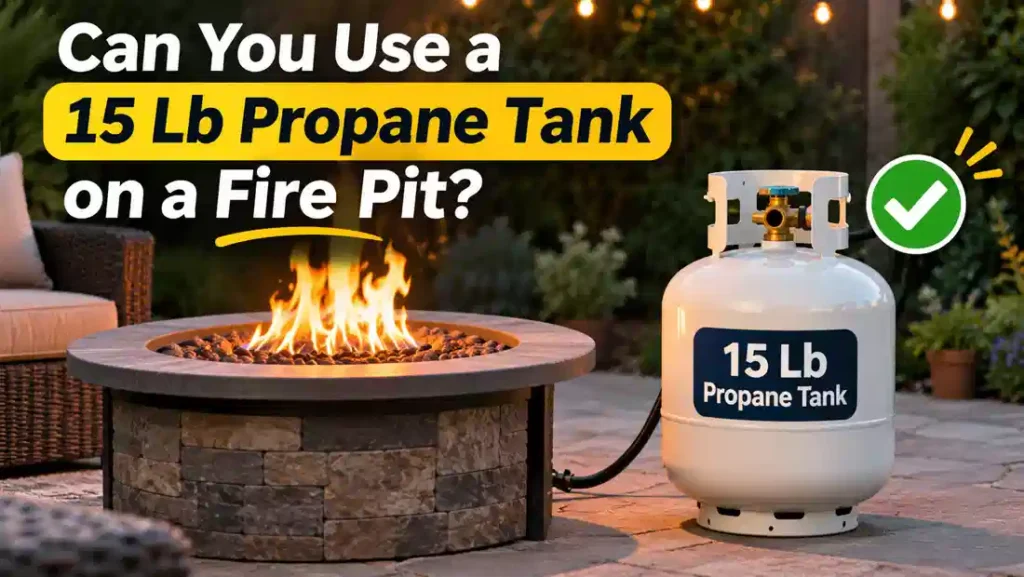
Can you use a 15 lb propane tank on a fire pit? In many cases, you can use 15 lb of propane inside a standard 20 lb-capacity exchange cylinder with a fire pit designed for that standard cylinder. But a physically smaller cylinder actually rated to hold 15 lb is a separate compatibility question. I would never assume two tanks are interchangeable simply because their fuel contents are similar.
Quick Answer
Yes, usually a standard 20 lb-capacity cylinder containing 15 lb of propane can fuel a fire pit designed for that cylinder. Many retail exchanges provide 15 lb of propane in a cylinder rated for 20 lb. At a 50,000 BTU/hour fire pit input, 15 lb gives about 6.5 hours of theoretical full-high runtime, compared with 8.6 hours for a full 20 lb load. If you have a genuine 15 lb-rated cylinder rather than a 20 lb exchange cylinder, use it only if the fire pit manufacturer approves its dimensions, valve, regulator, vapor-delivery capacity and placement.
First, What Does a 15 Lb Propane Tank Actually Mean?
This is the most important distinction in the entire article. People use the phrase ’15 lb propane tank’ for two situations: a cylinder whose rated propane capacity is 15 lb, and a conventional 20 lb cylinder that happens to contain 15 lb of fuel. Those are not necessarily the same hardware. A retail exchange label showing ’15 lb net weight’ can describe the contents, not the cylinder’s maximum safe fill.


The distinction is supported by the way exchange cylinders are sold in the United States. Some major suppliers publish a 15 lb net fill for their commonly exchanged 20 lb cylinders. The fuel quantity affects runtime, but it does not by itself change an otherwise manufacturer-approved cylinder’s physical connection.
| What the label means | Cylinder capacity | Propane inside | What I check |
|---|---|---|---|
| 20 lb cylinder, filled to rated amount | 20 lb | 20 lb | Manufacturer approval and cylinder condition |
| 20 lb exchange cylinder, 15 lb net fill | 20 lb | 15 lb | Label net contents and standard approved connection |
| A distinct 15 lb-rated cylinder | 15 lb | Up to 15 lb | Exact dimensions, valve, approval and vapor withdrawal |
| Partly used 20 lb cylinder | 20 lb | Maybe 15 lb or less | Actual measured remaining fuel |
For this guide, I use 15 lb fuel load to describe the quantity of propane in most calculations. When I discuss a physically different cylinder, I call it a 15 lb-rated cylinder. That wording prevents a surprisingly common mistake: confusing how much fuel you bought with which gas system the appliance is built to accept.
Will a 15 Lb Fuel Load Work With a Fire Pit Designed for 20 Lb Tanks?
If your fire pit specifies a standard 20 lb vapor-withdrawal cylinder with the proper valve, hose and regulator, the same specified 20 lb cylinder containing 15 lb of propane generally remains the correct cylinder type. It simply has less fuel to burn. You should still follow the manual’s cylinder and connection instructions, inspect its condition and perform the prescribed leak check.
For a different cylinder actually rated at 15 lb, don’t assume yes. Even if an adapter appears to fit, the cylinder could have different dimensions, valve specifications or vaporization performance. A fire pit compartment may also require a particular base ring or securement arrangement. I would treat the manufacturer’s approval as the deciding factor, not a photograph or an online suggestion.


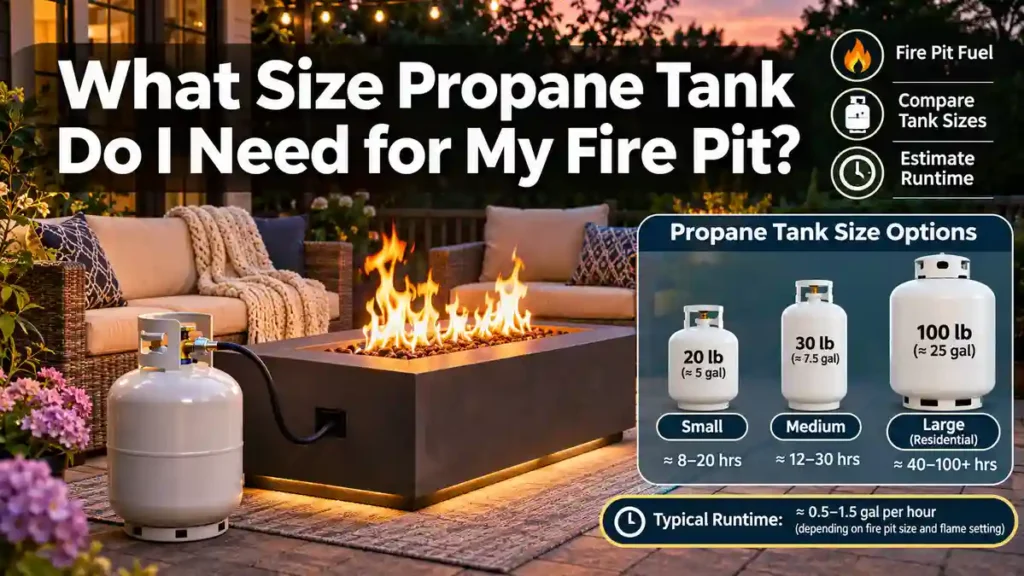
If you need to select among multiple cylinder sizes, I covered the sizing process in What Size Propane Tank Do I Need for My Fire Pit?. That guide compares tank capacities and explains why fuel calculations and physical compatibility are separate decisions.
15 Lb vs 20 Lb Propane: Technical Comparison
A propane pound holds about 21,500 BTU of chemical energy, and one gallon approximately 91,500 BTU. The exact energy content changes slightly with composition and temperature, so I round these figures for consumer planning. A 15 lb fuel load has roughly three quarters the energy of a 20 lb load.
| Specification | 15 lb fuel load | 20 lb fuel load | Difference |
|---|---|---|---|
| Propane weight | 15 lb | 20 lb | 5 lb less |
| Approximate liquid volume | 3.54 gal | 4.72 gal | 1.18 gal less |
| Total fuel energy | 322,500 BTU | 430,000 BTU | 107,500 BTU less |
| 50,000 BTU/h rated runtime | 6.45 h | 8.60 h | 2.15 h less |
| 30,000 BTU/h rated runtime | 10.75 h | 14.33 h | 3.58 h less |
| Share of full 20 lb contents | 75% | 100% | 25% less propane |
These figures refer to the fuel only. The empty cylinder adds weight, and the full weight depends on its stamped tare weight. Do not mistake a steel cylinder weighing around 18 lb empty for ’18 lb of usable propane.’ The cylinder’s mass is never part of the energy calculation.
15 Lb Propane Fire Pit Runtime Chart by BTU Rating
Here is the quick-reference chart I’d use before a backyard party. Find the BTU/hour input on your fire pit’s rating label. Divide 322,500 BTU by that input to estimate continuous full-high runtime with 15 lb of propane.
| Fire pit input | Fuel used each hour | 15 lb fuel runtime | 20 lb fuel runtime |
|---|---|---|---|
| 20,000 BTU/h | 0.22 gal / 0.93 lb | 16.1 h | 21.5 h |
| 30,000 BTU/h | 0.33 gal / 1.40 lb | 10.8 h | 14.3 h |
| 40,000 BTU/h | 0.44 gal / 1.86 lb | 8.1 h | 10.8 h |
| 45,000 BTU/h | 0.49 gal / 2.09 lb | 7.2 h | 9.6 h |
| 50,000 BTU/h | 0.55 gal / 2.33 lb | 6.5 h | 8.6 h |
| 60,000 BTU/h | 0.66 gal / 2.79 lb | 5.4 h | 7.2 h |
| 65,000 BTU/h | 0.71 gal / 3.02 lb | 5.0 h | 6.6 h |
| 75,000 BTU/h | 0.82 gal / 3.49 lb | 4.3 h | 5.7 h |
| 80,000 BTU/h | 0.87 gal / 3.72 lb | 4.0 h | 5.4 h |
| 100,000 BTU/h | 1.09 gal / 4.65 lb | 3.2 h | 4.3 h |
These are idealized fuel-energy calculations, not guaranteed burn times. Low temperatures, limited cylinder vaporization, wind-related flame adjustments and incomplete fuel delivery can change actual operating time. The other big variable is your flame setting: maximum rated input is not necessarily your average input during a normal evening.



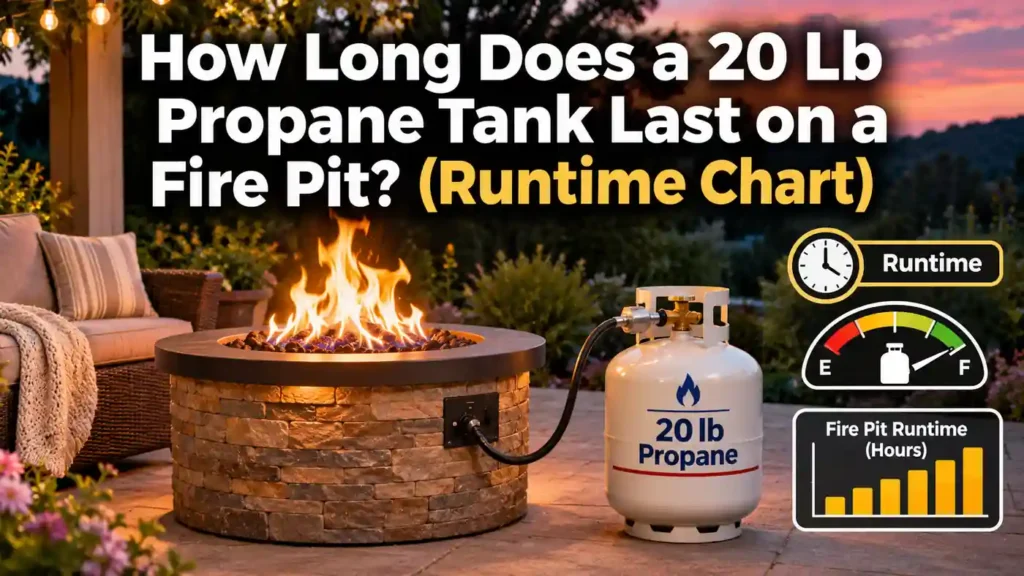
For the detailed 20 lb side of this comparison, including the effect of exchange fills, read How Long Does a 20 Lb Propane Tank Last on a Fire Pit? (Runtime Chart).
Worked Example: A 50,000 BTU Fire Pit for a Three-Hour Party
Imagine you have a fire table rated at 50,000 BTU/hour. You bought an exchange cylinder labeled ’15 lb net weight’ and want to entertain guests for three hours. Rather than relying on a guess, I would calculate the fuel energy needed for the party and compare it to the amount received.
| Step | Calculation | Result |
|---|---|---|
| Energy required | 50,000 × 3 hours | 150,000 BTU |
| Propane used | 150,000 ÷ 21,500 | 6.98 lb |
| Gallons used | 150,000 ÷ 91,500 | 1.64 gal |
| Starting propane | 15 lb | 322,500 BTU |
| Calculated remaining fuel | 15 − 6.98 | 8.02 lb |
| Theoretical hours remaining | 8.02 × 21,500 ÷ 50,000 | 3.45 h |
The calculation suggests that the same 15 lb fuel load could cover two three-hour sessions at maximum input, with a small amount of fuel left. For an important gathering, though, I would not plan around using the final fraction of a pound. Fuel labels and measurements can differ, and real-world operating conditions rarely match a perfect calculation.
The useful conclusion is not just ‘yes, 15 lb will work.’ It is: yes, if the equipment is compatible, and here’s how many hours that quantity should support. That is a better way to decide whether to exchange, refill or have a spare ready.


Interactive Runtime Estimates: Open Your Burner Size
Choose your fire pit’s input rating below to expand a detailed comparison. This interactive, no-JavaScript feature works through expandable tables on the published page. You can compare partially filled cylinders, typical 15 lb exchange quantities and full 20 lb loads without leaving the guide.
30,000 BTU/hour — see fuel and runtime estimates
| Available propane | Estimated full-high runtime | Three-hour session equivalents |
|---|---|---|
| 5 lb propane | 3.6 hours | 1.2 three-hour sessions |
| 8 lb propane | 5.7 hours | 1.9 three-hour sessions |
| 10 lb propane | 7.2 hours | 2.4 three-hour sessions |
| 12 lb propane | 8.6 hours | 2.9 three-hour sessions |
| 15 lb propane | 10.8 hours | 3.6 three-hour sessions |
| 18 lb propane | 12.9 hours | 4.3 three-hour sessions |
| 20 lb propane | 14.3 hours | 4.8 three-hour sessions |
40,000 BTU/hour — see fuel and runtime estimates
| Available propane | Estimated full-high runtime | Three-hour session equivalents |
|---|---|---|
| 5 lb propane | 2.7 hours | 0.9 three-hour sessions |
| 8 lb propane | 4.3 hours | 1.4 three-hour sessions |
| 10 lb propane | 5.4 hours | 1.8 three-hour sessions |
| 12 lb propane | 6.5 hours | 2.1 three-hour sessions |
| 15 lb propane | 8.1 hours | 2.7 three-hour sessions |
| 18 lb propane | 9.7 hours | 3.2 three-hour sessions |
| 20 lb propane | 10.8 hours | 3.6 three-hour sessions |
50,000 BTU/hour — see fuel and runtime estimates
| Available propane | Estimated full-high runtime | Three-hour session equivalents |
|---|---|---|
| 5 lb propane | 2.1 hours | 0.7 three-hour sessions |
| 8 lb propane | 3.4 hours | 1.1 three-hour sessions |
| 10 lb propane | 4.3 hours | 1.4 three-hour sessions |
| 12 lb propane | 5.2 hours | 1.7 three-hour sessions |
| 15 lb propane | 6.5 hours | 2.1 three-hour sessions |
| 18 lb propane | 7.7 hours | 2.6 three-hour sessions |
| 20 lb propane | 8.6 hours | 2.9 three-hour sessions |
60,000 BTU/hour — see fuel and runtime estimates
| Available propane | Estimated full-high runtime | Three-hour session equivalents |
|---|---|---|
| 5 lb propane | 1.8 hours | 0.6 three-hour sessions |
| 8 lb propane | 2.9 hours | 1.0 three-hour sessions |
| 10 lb propane | 3.6 hours | 1.2 three-hour sessions |
| 12 lb propane | 4.3 hours | 1.4 three-hour sessions |
| 15 lb propane | 5.4 hours | 1.8 three-hour sessions |
| 18 lb propane | 6.5 hours | 2.1 three-hour sessions |
| 20 lb propane | 7.2 hours | 2.4 three-hour sessions |
75,000 BTU/hour — see fuel and runtime estimates
| Available propane | Estimated full-high runtime | Three-hour session equivalents |
|---|---|---|
| 5 lb propane | 1.4 hours | 0.5 three-hour sessions |
| 8 lb propane | 2.3 hours | 0.8 three-hour sessions |
| 10 lb propane | 2.9 hours | 1.0 three-hour sessions |
| 12 lb propane | 3.4 hours | 1.1 three-hour sessions |
| 15 lb propane | 4.3 hours | 1.4 three-hour sessions |
| 18 lb propane | 5.2 hours | 1.7 three-hour sessions |
| 20 lb propane | 5.7 hours | 1.9 three-hour sessions |
If your appliance has a different rating, use the calculation method below. For low settings, a manufacturer-specified reduced BTU input or actual measured consumption produces a better estimate than assuming the dial percentages are linear.
The Simple Formula for a 15 Lb Propane Fire Pit
For 15 lb of propane: 322,500 ÷ burner BTU/hour. For a 50,000 BTU/hour appliance: 322,500 ÷ 50,000 = 6.45 hours.
I recommend calculating with the amount of propane actually in the tank, not the nominal cylinder capacity. If you weigh your cylinder and determine that only 9 lb of propane remains, plug in 9 lb. A 50,000 BTU fire table would then have about 3.87 theoretical hours left at full input.
If you don’t know the exact rating, check your instruction manual rather than inferring it from how tall the flame looks. A decorative gas flame’s appearance is not a calibrated fuel meter.
Does a Smaller Tank Make the Fire Pit Burn Less Hot?
Not simply because there is less propane inside it. A properly supplied and regulated gas appliance is designed to operate at its specified gas input and pressure. The amount of fuel remaining mainly changes how long it can continue, not necessarily its normal flame temperature or immediate heat output.
There is an important limitation. A small cylinder may have insufficient vaporization capacity for a high-input appliance, particularly as the liquid level falls or temperatures drop. This can lead to weak flames or shutdowns even with liquid remaining. That is a supply-performance issue rather than evidence that a 15 lb fuel quantity inherently produces less heat.
I would never try to ‘fix’ low flames by bypassing the regulator, enlarging orifices or warming the cylinder. If the model’s approved configuration cannot sustain its required supply, stop and consult the manufacturer’s instructions or a qualified propane technician.
How Much Does a 15 Lb Propane Fill Cost to Burn?
The cost per hour depends on the actual price you pay per pound or gallon of propane and the fire pit input. A burner does not automatically become more economical because the fuel is in a 15 lb exchange fill instead of a 20 lb refill. Equal gas input uses approximately equal fuel energy per hour.
For price scenarios, I use hypothetical $3, $4 and $5 per gallon refill costs. Those numbers are examples, not current prices from any retailer, and exclude tax, cylinder acquisition and delivery charges.
| Burner input | Gallons per hour | At $3/gal | At $4/gal | At $5/gal |
|---|---|---|---|---|
| 30,000 BTU/h | 0.328 | $0.98/h | $1.31/h | $1.64/h |
| 40,000 BTU/h | 0.437 | $1.31/h | $1.75/h | $2.19/h |
| 50,000 BTU/h | 0.546 | $1.64/h | $2.19/h | $2.73/h |
| 60,000 BTU/h | 0.656 | $1.97/h | $2.62/h | $3.28/h |
| 75,000 BTU/h | 0.820 | $2.46/h | $3.28/h | $4.10/h |
For a three-hour evening at 50,000 BTU/hour with propane priced at $4 per gallon, the cost is roughly $6.56. A 15 lb fill contains approximately 3.54 gallons; the same hypothetical price values that fuel at about $14.16. Actual exchange programs may charge a different price per unit of fuel than a local refill station.
Exchange Price vs Refill Price: Which Gives Better Value?
Here is an original comparison that makes the pricing question easier. Instead of comparing the number on the exchange cage with the refill receipt, I calculate dollars per pound of propane delivered and estimated dollars per operating hour for the same burner. This removes the misleading effect of unequal fuel quantities.
| Illustrative purchase | Fuel delivered | Example price | Cost per lb | Cost per hour at 50k BTU/h |
|---|---|---|---|---|
| 15 lb exchange | 15 lb | $23.00 | $1.53 | $3.57 |
| 15 lb exchange | 15 lb | $26.00 | $1.73 | $4.03 |
| Full 20 lb refill | 20 lb | $18.00 | $0.90 | $2.09 |
| Full 20 lb refill | 20 lb | $24.00 | $1.20 | $2.79 |
These examples are not retailer quotations. The calculation divides price by net pounds, then multiplies by a 50,000 BTU burner’s fuel consumption of approximately 2.326 lb per hour. It illustrates why a refill might offer a lower cost per hour even when its initial price looks higher than expected. Your actual results depend on local pricing, refill policies and the condition of the cylinder.
For a fair comparison, also consider convenience. An exchange can be easier if your existing cylinder is near its inspection or requalification limit, while a reputable refill may offer better per-pound value for a serviceable cylinder. Neither method should be chosen without reading the product label and following safe handling requirements.
Does a 15 Lb Fill Last for Multiple Gatherings?
I think this is one of the more useful ways to plan backyard propane use. Instead of asking only for one total runtime number, translate the result into the number of complete evenings you can expect. Here is a chart based on full rated input and 15 lb of propane.
| Burner rating | 2-hour gatherings | 3-hour gatherings | 4-hour gatherings |
|---|---|---|---|
| 30,000 BTU/h | 5 | 3 | 2 |
| 40,000 BTU/h | 4 | 2 | 2 |
| 50,000 BTU/h | 3 | 2 | 1 |
| 60,000 BTU/h | 2 | 1 | 1 |
| 75,000 BTU/h | 2 | 1 | 1 |
A 50,000 BTU fire pit should theoretically cover three complete two-hour sessions on 15 lb of propane. It should cover two three-hour evenings, with only about 0.45 hours left mathematically. I would plan a refill before a third long evening rather than ask guests to count on the last few minutes.
My method for households that entertain often is to keep a simple notes log with the date, estimated flame level, total burning time and whether the propane was a refill or an exchange. After a few sessions, your own pattern can tell you more than a general chart.
How to Check Whether Your Tank Still Has 15 Lb Left
A scale can help you distinguish a true 15 lb load from a cylinder that only used to contain 15 lb. Find the tare weight stamped on the collar, often abbreviated TW. Weigh the cylinder upright with a suitable scale while it is cool and handled according to the supplier’s instructions. Subtract its tare weight to estimate how many pounds of fuel remain.
| Example cylinder measurement | Value |
|---|---|
| Stamped tare weight (TW) | 18 lb |
| Measured total weight | 33 lb |
| Estimated propane remaining | 15 lb |
| Available fuel energy | 322,500 BTU |
| Rated 50k BTU/h runtime | 6.45 hours |
| If measured weight drops to 28 lb | 10 lb fuel remaining |
Do not assume every propane cylinder has the same empty weight. If you use the wrong tare number, you can overestimate fuel. Similarly, pressure-only gauges are often poor measures of remaining liquid propane because cylinder pressure depends on temperature. Weighing provides a more direct approximation of fuel quantity.
Can You Connect a Physically Smaller 15 Lb-Rated Cylinder?
This is where I become more cautious. The fire pit may be designed for a specified vapor-withdrawal cylinder with a particular valve, connection style, stand and storage arrangement. Even if a different tank has enough fuel, its physical dimensions or operating characteristics may make it unsuitable for the appliance.
I would check the manual for allowed cylinder size, maximum cylinder dimensions, proper upright positioning, regulator and hose specifications, and whether the cylinder must be outside the fire table. Don’t force a cylinder into an enclosure or rely on an aftermarket adapter without manufacturer approval.
If the manual only specifies a standard 20 lb cylinder and the product label shows a 15 lb fuel fill in that exact type of cylinder, that is normally a different question from substituting a physically different cylinder. The first is a fuel-quantity issue; the second is a hardware-compatibility issue.
What About Propane Pressure, Regulators and BTU Demand?
The fire pit’s regulator is intended to supply the appliance at the pressure specified by its manufacturer. Higher pressure is not a shortcut for getting more runtime. The rated input is determined by the approved system, not just by the cylinder’s propane quantity. I always separate the cylinder’s energy content from the regulator’s ability to deliver the required gas flow.
| Component or condition | What it affects | What you should do |
|---|---|---|
| Actual propane pounds | Available total energy | Use net contents for runtime |
| Burner BTU/hour input | Fuel consumption per hour | Read rating plate/manual |
| Regulator and connection | Proper gas pressure and supply | Use manufacturer-approved parts |
| Outdoor air temperature | Cylinder vaporization | Follow cold-weather restrictions |
| Cylinder dimensions | Secure fit and safe placement | Check allowed cylinder specifications |
| Hose routing and ventilation | Safe installation and combustion | Follow appliance clearances |
If a new exchange cylinder causes an abnormally low flame, do not automatically assume the 15 lb fill is the reason. Follow the manual’s approved startup and connection checks. If you smell propane or see damage, stop use and seek qualified help rather than experimenting with pressure.
Cold Weather: Why a Tank Can Act Empty Before It Is
Propane is stored primarily as a liquid under pressure. A normal outdoor fire pit typically draws vapor. Vaporization depends on the cylinder’s temperature, exposed liquid surface and remaining fuel quantity. As an evening gets colder and the tank empties, a high-demand burner can encounter vapor supply limits.
The energy chart is still useful, but it cannot predict every cold-weather shutdown. If you need a fire pit for winter gatherings, verify the appliance’s temperature requirements and the permitted fuel arrangement. Do not wrap an unapproved heater around the cylinder or pour hot water over it.
A useful distinction: an early shutdown in cold weather does not prove the tank has no propane. But the presence of remaining liquid is not permission to force the system to run. Follow the manufacturer’s operating instructions and consult a professional if the issue repeats.
My Decision Guide: When Would I Choose a 15 Lb Fill?
| Situation | My recommendation | Why |
|---|---|---|
| Existing fire pit approved for standard 20 lb cylinder | 15 lb exchange fill can be practical | Same specified cylinder type, less fuel |
| Three-hour evening with a 50k BTU pit | Check 15 lb net contents first | About 6.45 h theoretical total |
| Seven-hour event with a 50k BTU pit | Arrange another approved fuel supply | 15 lb likely insufficient at full input |
| Smaller 15 lb-rated cylinder of different dimensions | Do not assume compatibility | Hardware may not meet manufacturer requirements |
| Cold, high-demand setting | Confirm vaporization suitability | Fuel energy alone does not guarantee delivery |
| Frequent weekend gatherings | Compare net-weight pricing and refills | Cost per pound may vary significantly |
For a casual evening I would be comfortable planning from a correctly labeled 15 lb fill when the cylinder and fire pit are an approved match. For an important long gathering, I would prefer to bring a compatible reserve rather than depend on the last estimated hour. I also would not recommend buying a physically different cylinder just because it appears easier to carry.
Fire Pit Safety Rules I Would Not Compromise
A propane fire pit is an outdoor combustion appliance. Never operate it in a house, garage, tent or enclosed location that the manufacturer prohibits. Carbon monoxide can accumulate in confined spaces even when the flames look normal. Keep all required clearances from people, combustible objects, structures and overhead surfaces.
For standard vapor-withdrawal cylinders, keep the tank upright and secured as directed. Follow the specific fire pit instructions regarding tank placement: some units use approved ventilated compartments, while others require the cylinder outside the structure. Do not substitute an oversized cylinder in a compartment built for another size.
After connecting or changing a tank, use the manufacturer-prescribed leak-check process. Never test for leaks using a flame. If you smell gas or hear hissing, shut off the supply if it is safe to do so, avoid ignition sources, move people away and follow your propane supplier’s or local emergency instructions.
Never alter the regulator, enlarge burner holes, connect multiple cylinders through a homemade manifold or heat the cylinder to boost flow. Do not leave a fire pit burning unattended or operate it while everyone sleeps. Keep children and pets away from hot surfaces even after the flames are off.
Common Problems When Using a 15 Lb Exchange Fill
| Problem | Possible explanation | Safer response |
|---|---|---|
| Fire pit stops sooner than expected | Only 15 lb supplied rather than 20 lb | Check net contents and prior use |
| Low flame soon after replacement | Connection or flow-restriction issue | Shut down and follow manual procedure |
| Weak flame on a cold evening | Limited vapor production | Stop use and check approved cold-weather guidance |
| Cylinder does not fit correctly | Wrong dimensions or type | Do not force the fit; verify model compatibility |
| Strong gas smell or hissing | Potential leak | Stop use and follow emergency guidance |
I would avoid turning every weak-flame complaint into a tank size recommendation. Sometimes fuel quantity is the issue, but incorrect components, temperature and system condition can all matter. If something seems abnormal, correct the underlying problem before using the fire pit again.
Frequently Asked Questions
Is a 15 lb propane exchange tank really a 20 lb tank?
Often, yes. A common retail arrangement is a cylinder rated for a maximum 20 lb propane fill that is sold with 15 lb of fuel. Read both the cylinder markings and net-contents label. A 15 lb fuel fill is not always a separate 15 lb-rated cylinder.
How long will 15 lb of propane run a 50,000 BTU fire pit?
Approximately 6.45 hours at continuous full rated input, based on 322,500 BTU of fuel energy. This is a mathematical estimate; real operating time can vary with equipment performance, settings and conditions.
Can I use 15 lb of propane in my 20 lb fire pit tank?
Yes, a correctly filled and approved 20 lb cylinder does not need to hold its maximum rated quantity for the appliance to operate. A standard 20 lb exchange cylinder containing 15 lb of propane can be used with compatible fire pits according to their instructions.
Will a 15 lb fill make flames lower?
Not inherently. A properly regulated burner should normally have its intended input while adequate vapor is available. A low flame can signal cold-weather vapor constraints, a connection issue or another problem requiring the approved checks.
How many gallons is 15 lb of propane?
Approximately 3.54 U.S. liquid gallons using the rounded conversion in this article. The exact conversion varies slightly with fuel composition and temperature.
Is it cheaper to buy a 15 lb exchange or refill a 20 lb cylinder?
Compare the total price to the net pounds or gallons received. An exchange might be convenient, but a refill can offer more fuel per dollar depending on local prices and service policies. Use the cost table above rather than only the sticker price.
Can I use a 15 lb-rated cylinder with a regulator made for 20 lb?
Only where the fire pit manufacturer approves that particular cylinder and connection configuration. A connector that physically fits does not establish appropriate regulator performance, vapor delivery or installation safety.
Should I keep a second tank for longer parties?
An approved spare cylinder can be useful when a gathering may exceed your estimated available hours. Store and handle spare cylinders according to the supplier’s instructions and applicable rules; never keep spares in occupied indoor spaces.
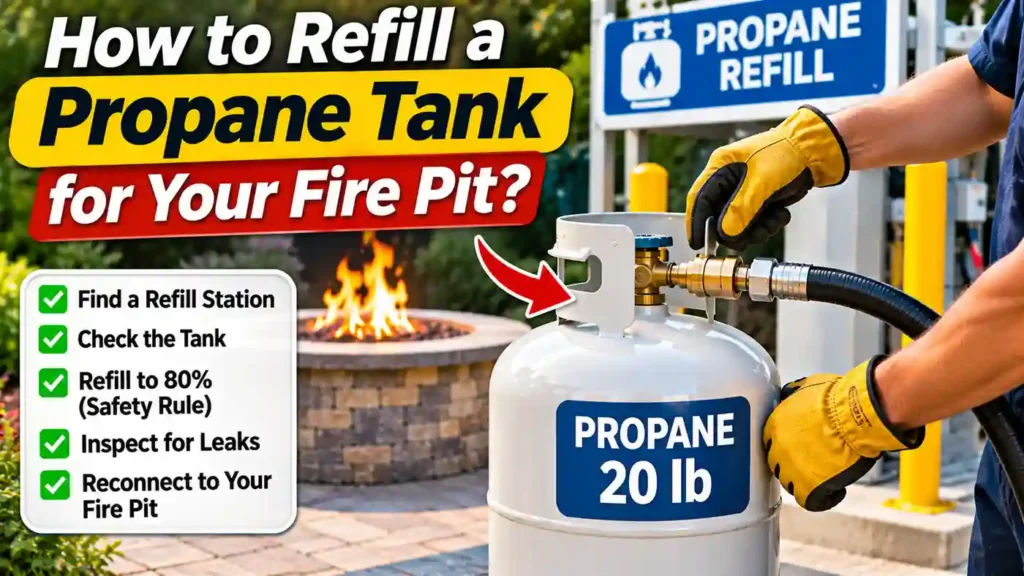
For the next step after choosing an exchange or refill, read How to Refill a Propane Tank for Your Fire Pit? for safety and cost calculations.
Final Thoughts: The Label Matters More Than the Nickname
My answer is yes, you can commonly use a 15 lb propane fill with a fire pit designed for a standard 20 lb exchange cylinder, because the cylinder is still the manufacturer-specified type. The important caveat is that a genuine 15 lb-rated tank might be different equipment and needs its own compatibility approval.
For planning, start with the label’s net propane amount and the fire pit’s BTU/hour input. At 50,000 BTU/hour, expect about 6.5 theoretical hours from a 15 lb load. Use the expandable scenarios to compare other burners, check whether the fuel will cover your gathering and allow a reasonable reserve.
For the next questions in your planning journey, see What Size Propane Tank Do I Need for My Fire Pit? and How Long Does a 20 Lb Propane Tank Last on a Fire Pit? (Runtime Chart). Both articles are part of the Propane Fire Pits category and help you choose a compatible supply and calculate realistic fuel needs.

Mike is an experienced propane technician with over 15 years of professional experience in the field. He has dedicated his career to helping customers with their propane needs, from installation to maintenance and repair. Together with Jeremy, he co-founded this website to provide useful information and guidance to customers seeking reliable propane services.