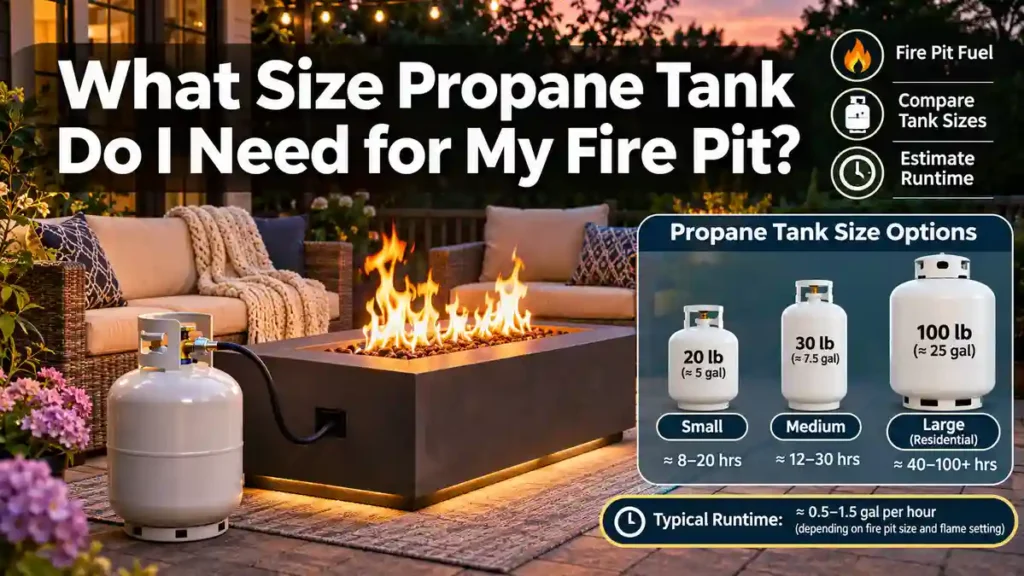
What size propane tank do I need for my fire pit? I recommend choosing the tank by looking at three things together: your fire pit’s maximum BTU-per-hour input, the number of hours you want it burning, and the cylinder sizes the manufacturer actually allows. A giant tank is not automatically better, and a 20 lb cylinder is not automatically enough for every fire table.
Quick Answer
For many portable outdoor propane fire pits, a standard 20 lb propane cylinder is the practical starting choice because it is widely used with equipment designed for it. At a rated 50,000 BTU/hour, a genuinely full 20 lb cylinder provides about 8.6 theoretical hours at maximum input. A 10 lb cylinder provides about 4.3 hours and a 40 lb cylinder about 17.2 hours under the same assumptions. Only use a tank size and connection arrangement approved by your fire pit manufacturer.
If your first question is simply how many hours a typical tank will last, my companion guide, How Long Does a 20 Lb Propane Tank Last on a Fire Pit? (Runtime Chart), gives a deeper consumption comparison. This article takes the next step: choosing an appropriate size before you buy, refill, or set up your outdoor fire pit.


Propane Fire Pit Tank Size Chart: Find the Best Fit
The chart below compares nominal cylinder contents, estimated useful fuel energy and runtime for a fire pit that operates at 50,000 BTU/hour continuously. This is an energy calculation rather than a certification of equipment compatibility. Your manufacturer’s label, manual and approved connection requirements take priority.
| Nominal propane amount | Approx. liquid gallons | Fuel energy | 50,000 BTU/h runtime | Typical planning use |
|---|---|---|---|---|
| 5 lb | 1.18 gal | 107,500 BTU | 2.2 h | Very short sessions if expressly approved |
| 10 lb | 2.36 gal | 215,000 BTU | 4.3 h | A shorter gathering if expressly approved |
| 15 lb actual fill | 3.54 gal | 322,500 BTU | 6.5 h | Often a partial fill in a 20 lb-capacity cylinder |
| 20 lb | 4.72 gal | 430,000 BTU | 8.6 h | Common nominal portable fire pit fuel supply |
| 30 lb | 7.08 gal | 645,000 BTU | 12.9 h | Longer use where compatible and approved |
| 40 lb | 9.44 gal | 860,000 BTU | 17.2 h | Frequent use where compatible and approved |
| 100 lb | 23.6 gal | 2,150,000 BTU | 43.0 h | Dedicated professional evaluation needed |
Gallons are calculated from an approximate 4.24 lb per gallon and values are rounded. In ordinary use, tanks can contain less fuel than their rated maximum. The 15 lb row means 15 pounds of propane in a cylinder, not a universally standardized 15 lb cylinder connection.
I would never buy a larger cylinder solely because this chart shows a longer burn time. Check whether it fits safely outside the fire pit, whether the manufacturer approves its use, and whether local requirements apply. A 100 lb cylinder is not a casual upgrade for a tabletop fire bowl.
Start With the Fire Pit’s BTU Rating, Not Its Width
When I compare fire pits, I look first for the input marked BTU/h, BTU per hour, or BTUH. That number is a fuel consumption rating, not a promise of radiant heating delivered to your seating area. A large fire table with modest flames may consume less propane than a compact, high-output burner.


The BTU rating is usually on the appliance rating plate, packaging or instruction manual. If the fire pit has adjustable output, the published rating is commonly its maximum input. Unless the manufacturer supplies a low-setting rating, I use maximum input for conservative fuel planning rather than guess what the knob means.
| Fire pit input | Propane used per hour | 20 lb calculated runtime | 20 lb full-tank energy used in 3 hours |
|---|---|---|---|
| 25,000 BTU/h | 0.27 gal / 1.16 lb | 17.2 h | 17% |
| 30,000 BTU/h | 0.33 gal / 1.40 lb | 14.3 h | 21% |
| 40,000 BTU/h | 0.44 gal / 1.86 lb | 10.8 h | 28% |
| 50,000 BTU/h | 0.55 gal / 2.33 lb | 8.6 h | 35% |
| 60,000 BTU/h | 0.66 gal / 2.79 lb | 7.2 h | 42% |
| 75,000 BTU/h | 0.82 gal / 3.49 lb | 5.7 h | 52% |
| 100,000 BTU/h | 1.09 gal / 4.65 lb | 4.3 h | 70% |
I use these figures to make an initial estimate, then adjust according to the fuel amount actually delivered and the way the owner runs the burner. For detailed performance comparisons, see the 20 lb fire pit runtime chart. It covers partial exchange fills, low settings and runtime troubleshooting.
How I Calculate the Tank Size You Need
The mathematics is straightforward enough that you can apply it to almost any model. A pound of propane contains approximately 21,500 BTU of chemical energy. A gallon contains about 91,500 BTU. Divide the total expected energy demand by the energy per pound to find the fuel mass needed.
Then choose a manufacturer-approved cylinder with enough propane capacity for that fuel requirement plus a practical reserve.

Worked example: a four-hour gathering with a 50,000 BTU fire table
Suppose you want your 50,000 BTU/h fire table operating for four hours at full rated input. Multiply 50,000 by 4 to get 200,000 BTU. Divide by 21,500 BTU per pound. You need about 9.3 pounds of propane, or about 2.19 gallons, for that burning time.
| Planning step | Calculation | Result |
|---|---|---|
| Event energy demand | 50,000 × 4 | 200,000 BTU |
| Propane pounds needed | 200,000 ÷ 21,500 | 9.30 lb |
| Propane gallons needed | 200,000 ÷ 91,500 | 2.19 gal |
| Share of full 20 lb cylinder | 9.30 ÷ 20 | 46.5% |
| Full 20 lb estimated running time | 430,000 ÷ 50,000 | 8.6 hours |
On paper, a 10 lb tank has just enough propane for roughly 4.3 hours at this input. That tiny margin makes it a poor choice if a delayed dinner or slightly longer party would be inconvenient. Assuming your model approves a 20 lb cylinder, I would select that standard size for this example.
Here is where I add a useful distinction: minimum mathematical fuel and practical event fuel are different numbers. A margin gives you flexibility, but it is not a reason to ignore appliance compatibility or tank handling rules.
A Quick Tank Sizing Decision Guide
Before choosing among 5, 10, 20, 30 and 40 lb supplies, answer four questions. Is the cylinder size listed or otherwise approved in the fire pit instructions? Does the supply have the proper regulator and hose arrangement? How many burning hours do you want? Will you mind changing tanks or postponing the fire if it runs out?


| Your situation | Reasonable starting point | My advice |
|---|---|---|
| Small portable model; short sessions | Manufacturer-approved small cylinder | Confirm specified connector, vapor delivery and placement |
| Common 40k–60k BTU patio table | 20 lb cylinder if specified | Often a convenient capacity/runtime balance |
| 50k BTU table; 3–4 hour sessions | 20 lb cylinder if approved | Allows room beyond one session |
| 50k BTU table; 8-hour event | 20 lb plus approved spare supply | More dependable than using the last theoretical minute |
| Frequent multi-hour gatherings | Evaluate approved larger capacity or refill strategy | Compare handling, placement and local requirements |
| Permanent installation or household fuel connection | Qualified installation design | Never improvise adapters or convert fuel types yourself |
The 20 lb cylinder is a common recommendation, not a universal requirement. Some appliance designs specify smaller cylinders, built-in tank compartments or particular regulator components. If your model says a particular size only, do not interpret a longer-runtime table as permission to substitute a different one.
Interactive Runtime Estimates: Choose Your Fire Pit Scenario
Select a burner size below to reveal estimated running times by propane quantity. These expandable charts work on the published page without installing code. The figures assume the stated rated BTU input and a true full propane fill; they do not establish whether any cylinder is approved for your appliance.
30,000 BTU/hour fire pit — open runtime estimates
| Propane quantity | Rated-input runtime | Equivalent 3-hour sessions |
|---|---|---|
| 5 lb | 3.6 h | 1.2 three-hour sessions |
| 10 lb | 7.2 h | 2.4 three-hour sessions |
| 15 lb | 10.8 h | 3.6 three-hour sessions |
| 20 lb | 14.3 h | 4.8 three-hour sessions |
| 30 lb | 21.5 h | 7.2 three-hour sessions |
| 40 lb | 28.7 h | 9.6 three-hour sessions |
40,000 BTU/hour fire pit — open runtime estimates
| Propane quantity | Rated-input runtime | Equivalent 3-hour sessions |
|---|---|---|
| 5 lb | 2.7 h | 0.9 three-hour sessions |
| 10 lb | 5.4 h | 1.8 three-hour sessions |
| 15 lb | 8.1 h | 2.7 three-hour sessions |
| 20 lb | 10.8 h | 3.6 three-hour sessions |
| 30 lb | 16.1 h | 5.4 three-hour sessions |
| 40 lb | 21.5 h | 7.2 three-hour sessions |
50,000 BTU/hour fire pit — open runtime estimates
| Propane quantity | Rated-input runtime | Equivalent 3-hour sessions |
|---|---|---|
| 5 lb | 2.1 h | 0.7 three-hour sessions |
| 10 lb | 4.3 h | 1.4 three-hour sessions |
| 15 lb | 6.5 h | 2.1 three-hour sessions |
| 20 lb | 8.6 h | 2.9 three-hour sessions |
| 30 lb | 12.9 h | 4.3 three-hour sessions |
| 40 lb | 17.2 h | 5.7 three-hour sessions |
60,000 BTU/hour fire pit — open runtime estimates
| Propane quantity | Rated-input runtime | Equivalent 3-hour sessions |
|---|---|---|
| 5 lb | 1.8 h | 0.6 three-hour sessions |
| 10 lb | 3.6 h | 1.2 three-hour sessions |
| 15 lb | 5.4 h | 1.8 three-hour sessions |
| 20 lb | 7.2 h | 2.4 three-hour sessions |
| 30 lb | 10.8 h | 3.6 three-hour sessions |
| 40 lb | 14.3 h | 4.8 three-hour sessions |
75,000 BTU/hour fire pit — open runtime estimates
| Propane quantity | Rated-input runtime | Equivalent 3-hour sessions |
|---|---|---|
| 5 lb | 1.4 h | 0.5 three-hour sessions |
| 10 lb | 2.9 h | 1.0 three-hour sessions |
| 15 lb | 4.3 h | 1.4 three-hour sessions |
| 20 lb | 5.7 h | 1.9 three-hour sessions |
| 30 lb | 8.6 h | 2.9 three-hour sessions |
| 40 lb | 11.5 h | 3.8 three-hour sessions |
To calculate a different BTU rating, use the formula in the previous section. For a partly filled tank, substitute the pounds of propane actually present instead of the cylinder’s rated capacity. For lower flame settings, use the manufacturer’s specified reduced input or a carefully measured actual burn rate.
How Much Propane Should You Budget for a Weekend?
I like thinking about a weekend as a fuel budget. If you plan two sessions, don’t assume each one will last the same time or run at the same flame height. Count the total burning hours and multiply by rated consumption for an upper-end planning estimate.
| Weekend example, 50k BTU/h | Total hours | Approx. propane needed | Full 20 lb fill remaining |
|---|---|---|---|
| Friday night only | 2 h | 4.65 lb | 15.35 lb |
| Friday 2 h + Saturday 3 h | 5 h | 11.63 lb | 8.37 lb |
| Friday 3 h + Saturday 4 h | 7 h | 16.28 lb | 3.72 lb |
| Friday 4 h + Saturday 5 h | 9 h | 20.93 lb | Insufficient: exceeds one full 20 lb fill |
This is particularly useful if you only refill propane every few weeks. By making a simple Friday-and-Saturday plan, you can see whether a single cylinder is adequate or whether an approved spare makes more sense. I would rather have fuel ready before the guests arrive than interrupt the evening with a trip to an exchange rack.
How Long Do Different Tank Sizes Last at Common Fire Pit Ratings?
A sizing chart becomes more useful when it compares different appliances at once. Notice the relationship: doubling the quantity of propane roughly doubles the theoretical hours, while doubling BTU/hour input roughly halves them. This does not change your equipment’s approved tank sizes.
| Propane quantity | 30,000 BTU/h | 40,000 BTU/h | 50,000 BTU/h | 60,000 BTU/h |
|---|---|---|---|---|
| 5 lb | 3.6 h | 2.7 h | 2.2 h | 1.8 h |
| 10 lb | 7.2 h | 5.4 h | 4.3 h | 3.6 h |
| 15 lb | 10.8 h | 8.1 h | 6.5 h | 5.4 h |
| 20 lb | 14.3 h | 10.8 h | 8.6 h | 7.2 h |
| 30 lb | 21.5 h | 16.1 h | 12.9 h | 10.8 h |
| 40 lb | 28.7 h | 21.5 h | 17.2 h | 14.3 h |
If your fire pit runs on low heat much of the evening, real consumption can be below the full rated input. But don’t assume a halfway-turned knob saves exactly 50%: control valves may not change flow linearly. Treat these tables as a clear baseline and learn the unit’s actual fuel usage over several sessions.
Do You Really Need a 30 Lb or 40 Lb Propane Tank?
Bigger cylinders sound attractive because they can mean fewer trips for fuel. Yet the practical disadvantages matter. They are heavier when full, harder to transport and may not fit a designated enclosure. A cylinder that’s too large or used with an unapproved connection can create safety and compliance problems even though its capacity is sufficient.
For most ordinary 50,000 BTU fire table scenarios, I would first consider whether a 20 lb cylinder plus a properly stored approved spare offers better convenience than changing the setup to a larger cylinder. The answer depends on the actual fire pit manual, your handling needs and your local supplier’s rules.
| Factor | 20 lb cylinder | 40 lb cylinder |
|---|---|---|
| Nominal fuel quantity | 20 lb | 40 lb |
| Approximate gallons | 4.7 | 9.4 |
| Estimated runtime at 50k BTU/h | 8.6 h | 17.2 h |
| Fuel weight alone | 20 lb | 40 lb |
| Handling and transport | Usually easier | Heavier and more awkward |
| Compatibility | Common with many fire tables | Must be expressly verified |
A 40 lb cylinder’s propane alone weighs twice as much as a 20 lb cylinder’s propane. Add the empty tank weight and it becomes an increasingly important handling consideration. Always transport and store cylinders according to the supplier’s instructions, upright and secured, and never inside occupied living spaces.
What About a 100 Lb Propane Tank or a Permanent Supply?
Someone who uses a fire feature frequently might consider a 100 lb cylinder or a dedicated larger propane supply. But these are not merely drop-in alternatives to a portable 20 lb tank. Vapor capacity, regulator selection, pressure drop, hose routing, safe distances and code requirements can all become part of the design.
A 100 lb fuel load contains around 2.15 million BTU, enough energy for 43 theoretical hours at 50,000 BTU/h. That appealing number says nothing about whether the fire pit permits such a supply or whether the system can vaporize and regulate propane correctly at local design temperatures. A qualified propane professional should evaluate dedicated arrangements.
If your fire pit is designed only for its supplied cylinder-and-regulator configuration, don’t extend hoses, combine cylinders or attach it to a home gas line without approved instructions and qualified installation. Also remember that a natural-gas fire feature and a propane fire feature use different fuel specifications: conversion is not simply a different connector.
Propane Fire Pit Fuel Cost Scenarios
How much does the tank size affect cost? The burner uses the same energy per hour regardless of whether the fuel comes from an approved 20 lb or 40 lb cylinder. A larger cylinder does not inherently make the fire pit more efficient. What changes is how much propane you buy, what the supplier charges and how often you need refills.
Here are illustrative rates using hypothetical retail refill prices of $3, $4 and $5 per gallon. They are not live price quotations and exclude delivery, taxes, deposit charges and the cylinder’s purchase price.
| Burner rating | Gallons per hour | At $3/gal | At $4/gal | At $5/gal |
|---|---|---|---|---|
| 30,000 BTU/h | 0.328 | $0.98/h | $1.31/h | $1.64/h |
| 40,000 BTU/h | 0.437 | $1.31/h | $1.75/h | $2.19/h |
| 50,000 BTU/h | 0.546 | $1.64/h | $2.19/h | $2.73/h |
| 60,000 BTU/h | 0.656 | $1.97/h | $2.62/h | $3.28/h |
| 75,000 BTU/h | 0.820 | $2.46/h | $3.28/h | $4.10/h |
Worked cost example: four hours at 50,000 BTU/h
At an illustrative $4.00 per gallon, a 50,000 BTU/h fire pit consumes approximately 0.546 gallon per hour. Multiply by four hours and by $4.00: the fuel costs about $8.74 for that evening. If you host the same length gathering four times, your theoretical fuel cost is about $34.97 before other charges.
This makes a helpful comparison between a casual decorative flame and running a high-output burner for several hours. Turning down a genuinely adjustable burner may reduce fuel consumption, but the exact dollars saved require either a published input rating for that setting or measurement of actual propane used.
Tank Refill vs Exchange: Why Net Contents Change Your Choice
When a retailer advertises a ’20 lb propane tank exchange,’ that may describe the steel cylinder’s capacity rather than the propane quantity. Some exchange cylinders contain 15 lb. A refill provider may instead charge for the actual quantity added to an eligible cylinder. Both methods can be convenient; the key is comparing actual propane received.
| Example supply | Actual propane | Approx. gallons | 50k BTU/h runtime |
|---|---|---|---|
| Full 20 lb refill | 20 lb | 4.72 | 8.6 h |
| 15 lb exchange fill | 15 lb | 3.54 | 6.5 h |
| Half-full 20 lb cylinder | 10 lb | 2.36 | 4.3 h |
| Quarter-full 20 lb cylinder | 5 lb | 1.18 | 2.2 h |
Suppose, strictly for illustration, a 15 lb exchange costs $24 and a full 20 lb refill costs $28. The exchange is $1.60 per pound while the full refill is $1.40 per pound. The lower sticker price would not mean the exchange offers better value. Of course, condition, convenience, minimum fees and available services also influence the decision.
For a full explanation of how these fill differences affect burn hours, read my 20 lb propane tank runtime guide. I would evaluate the net contents before recommending one refilling method over another.
Cold Weather Can Affect Which Tank Arrangement Works
Propane must vaporize inside a standard vapor-withdrawal cylinder before it can be delivered to the burner. The rate of vaporization depends on ambient temperature, cylinder size, remaining liquid volume and the burner’s demand. A cylinder may still contain liquid propane when it can no longer maintain sufficient vapor flow to a high-output appliance in cold weather.
This means the smallest nominal tank that satisfies the energy calculation may not reliably support the appliance in every season. At higher burner input, colder temperatures and lower liquid levels, vapor-delivery capacity becomes especially important. This is why a fuel quantity chart is not a complete gas system design.
Never warm a cylinder with a torch, heater, heated enclosure, hot water or improvised blanket to increase vapor flow. Don’t bypass a regulator or change burner orifices. If your fire pit repeatedly develops a weak flame in cold weather, stop using it and consult the manual or a qualified supplier about approved solutions.
How to Tell How Much Propane Is Still in Your Tank
You can estimate remaining propane by weighing a cylinder. Read the tare weight stamped on the collar, often identified as TW. Weigh the cylinder upright using a suitable scale and subtract that empty tare weight. The result approximates the pounds of fuel left. Make sure all disconnected equipment is cool and follow manufacturer handling precautions.
| Illustrative weighing example | Weight or result |
|---|---|
| Stamped empty tare weight | 18 lb |
| Measured weight with fuel | 31 lb |
| Estimated propane remaining | 13 lb |
| Energy still available | About 279,500 BTU |
| Runtime at 50,000 BTU/h | About 5.6 hours |
A simple pressure gauge can be misleading because the pressure in a cylinder containing liquid propane is largely temperature-dependent. Some liquid-level tools can help, but weighing is particularly useful when you need a better estimate of fuel quantity. For a long celebration, I would still have an approved reserve instead of relying on a reading with no margin.
My Practical Recommendation: Design Around the Gathering
Here is the decision method I’d use for a home patio, built around the experience you want rather than the maximum number on a cylinder chart. First, write down the length of the gathering. Then check the BTU/h rating and calculate fuel needed at full input. Next, add your desired planning margin. Finally, choose only among tank sizes approved by the fire pit manufacturer.
For example, imagine a family that uses a 50,000 BTU fire table on Saturday evenings for three hours. One session burns roughly seven pounds of propane. A full 20 lb cylinder therefore has enough energy for two such evenings with a remaining margin. A third identical evening would be close to the limit and shouldn’t be promised without checking the actual fuel supply.
Someone who only wants a decorative flame for one hour occasionally may not need to optimize for maximum fuel capacity. Someone hosting a five-hour gathering every weekend may find it worthwhile to track actual consumption and compare refill methods. What I would not do is recommend a larger cylinder solely from usage frequency without confirming approval and placement.
Safety: The Right Size Is Also the Right Installation
A fire pit tank must match the appliance’s instructions for cylinder type, valve, regulator, hose, location and ventilation. Many portable propane fire pits are designed for a specific cylinder size. An apparently compatible connector is not proof that another cylinder or arrangement is approved. Never place an oversized cylinder in a fire table compartment designed for a smaller one.
Keep conventional vapor-withdrawal cylinders upright and secure. Inspect visible hoses and fittings for damage before lighting. Perform the leak check prescribed by the manufacturer after making connections, using the recommended leak detection solution—never a flame. If you smell gas or hear hissing, stop use, close the valve only if safe, keep people away from ignition and follow supplier or emergency guidance.
Use outdoor fire pits only where the manufacturer permits. A garage, home, enclosed porch or tent can allow dangerous carbon monoxide to build up. Maintain the specified clearances from overhead structures and combustible materials. Do not operate a fire pit unattended and don’t leave it burning while everyone goes inside or to sleep.
If you are unsure about a regulator, tank placement, cylinder compatibility or household supply conversion, a qualified propane technician is a better investment than a guessed connection. More nominal propane capacity never compensates for an unsafe setup.
Common Mistakes I Would Avoid
Choosing a cylinder solely by gallons
Capacity matters, but the manufacturer’s approved tank options and the necessary vapor supply matter just as much. Treat the chart as a fuel-planning tool, not an installation permit.
Assuming every exchanged 20 lb cylinder contains 20 lb
Always look at net propane contents. With 15 lb of propane, you have about 25% less fuel than with a true 20 lb fill. That difference can remove more than two hours of maximum-input burn time on a 50,000 BTU fire table.
Buying an oversized tank to avoid refilling
An oversized cylinder can introduce new handling or safety issues and might not be allowed with the appliance. I would compare the convenience of approved spare cylinders before considering a modified setup.
Treating knob position as a precise BTU measurement
Low flame usually consumes less fuel, but halfway on the knob doesn’t prove you are running at half the maximum input. If you want accurate projections, record actual fuel usage over several repeatable sessions.
Planning to use every last ounce of propane
Calculated burn time may exceed reliable usable time in some real-world conditions. A margin is especially important in cold weather or during an event where a sudden shutdown is inconvenient.
Frequently Asked Questions
Is a 20 lb propane tank enough for a fire pit?
For many common patio fire pits designed for that size, yes. A full 20 lb cylinder provides approximately 8.6 hours at a rated 50,000 BTU/h. Your actual suitability depends on the appliance instructions, operating time and weather.
What size propane tank do I need for a 50,000 BTU fire pit?
If approved by your appliance, a 20 lb cylinder is a practical starting point. It provides about 8.6 theoretical hours at full input; a true 10 lb fuel supply provides about 4.3 hours. Choose based on permitted cylinder sizes and event duration.
Can I use a 5 lb tank with my fire pit?
Only if the manufacturer approves that cylinder and its connection arrangement. A full 5 lb fuel supply contains enough energy for approximately 2.2 hours on a 50,000 BTU/h burner, but nominal runtime alone does not establish compatibility.
Will a 40 lb tank work with a fire pit made for 20 lb?
Not necessarily. The larger tank may have different physical dimensions and might be prohibited by the appliance’s enclosure, connection or placement requirements. Do not make the substitution unless it is specifically approved.
How much propane does a 60,000 BTU fire pit use?
About 0.66 gallon or 2.79 pounds per hour at full rated input. That corresponds to approximately 7.2 theoretical hours from a full 20 lb fuel load.
What is better: one large tank or two 20 lb tanks?
That depends on what your appliance allows and how you handle the cylinders. A spare full 20 lb cylinder can offer convenient replacement for a unit designed for standard cylinders. Never manifold tanks together or change connected supply arrangements without an approved design.
Can a propane fire pit run on my house’s natural gas line?
Only if the appliance is approved for natural gas and a qualified professional performs any required conversion and installation. A propane-only burner cannot safely be connected to natural gas merely by changing a hose.
Does using fire glass or lava rocks reduce tank size requirements?
Fire media affects flame appearance and heat distribution, but it doesn’t provide a predictable reduction in fuel demand. Use only approved media in the quantity and arrangement specified by your fire pit manufacturer.
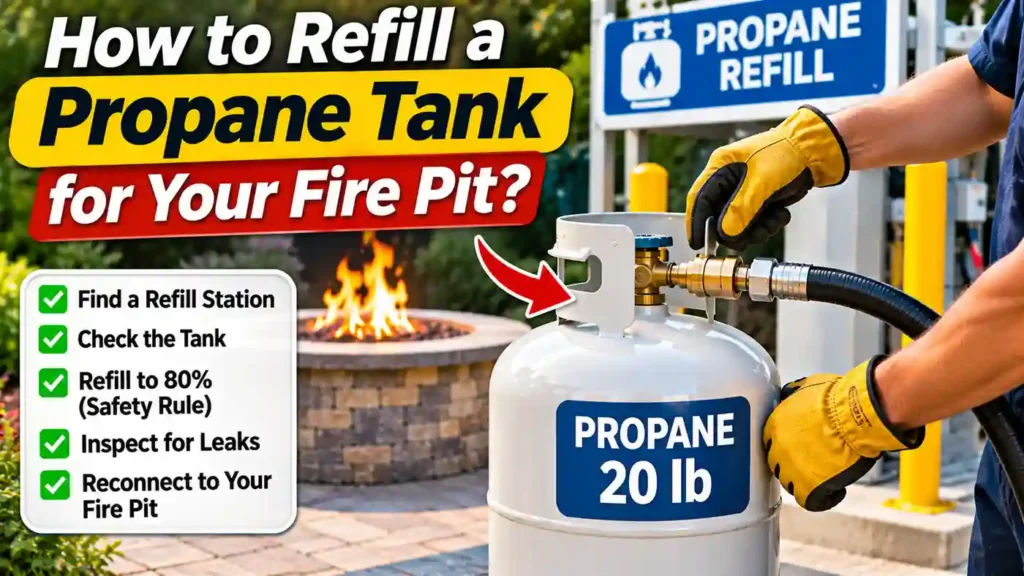
If your next step is getting more fuel, see How to Refill a Propane Tank for Your Fire Pit? for professional refilling, exchange comparisons and fuel costs.
Final Takeaway: Choose Compatibility First, Capacity Second
When someone asks me, ‘What size propane tank do I need for my fire pit?’ I start with the appliance manual, not a generic tank-size chart. For many portable 40,000–60,000 BTU patio models, a manufacturer-approved 20 lb cylinder is a convenient choice. The runtime calculation tells you how long that propane might last; it does not replace manufacturer requirements.
My recommended approach is to use the chart and expandable runtime scenarios above, calculate the propane you need for your next gathering, confirm the allowed cylinder arrangement and leave a sensible margin. Once you know your typical usage, a simple fuel log makes future estimates more accurate.
For deeper calculations, continue with How Long Does a 20 Lb Propane Tank Last on a Fire Pit? (Runtime Chart). You can also browse the Propane Fire Pits hub as new guides are published on 15 lb propane tank compatibility, fuel costs, connections and propane-versus-wood decisions.

Mike is an experienced propane technician with over 15 years of professional experience in the field. He has dedicated his career to helping customers with their propane needs, from installation to maintenance and repair. Together with Jeremy, he co-founded this website to provide useful information and guidance to customers seeking reliable propane services.