Quick Answer
Some natural gas fire pits can be converted to propane, but only when the manufacturer permits conversion for that exact model and specifies compatible parts. A qualified gas technician should complete the work, verify the supply and regulator requirements, perform leak and pressure checks, and confirm correct ignition and flame operation.
Do not attach a propane cylinder directly to an unconverted natural gas burner. A similar-looking hose or adapter does not make a system compatible. If the manufacturer does not approve conversion, I recommend keeping the natural gas configuration or buying a fire pit designed for propane.
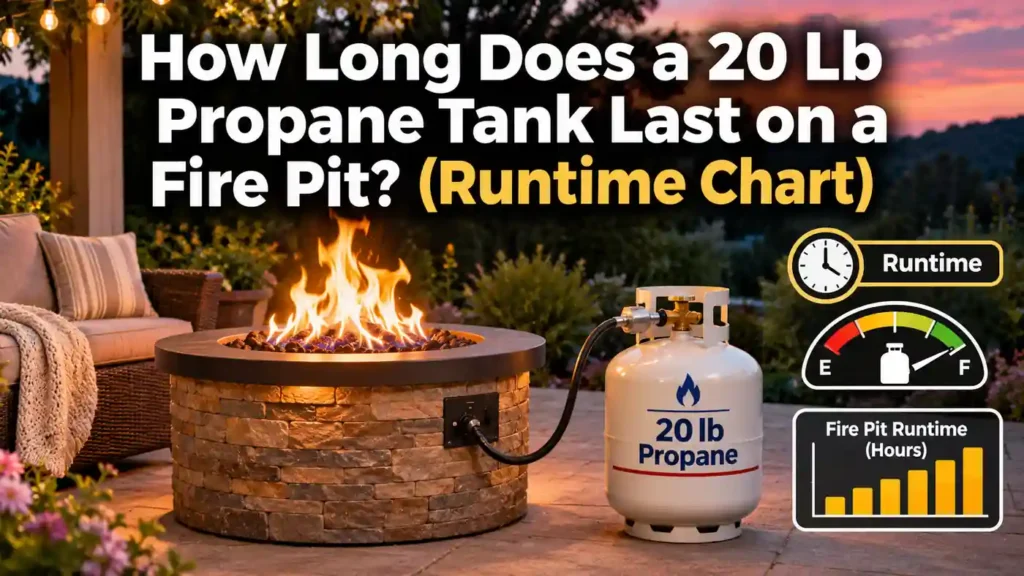
For fuel budgeting, a propane fire pit rated at 50,000 BTU/hour consumes about 0.55 gallon per hour at full input. With approximately 4.7 gallons in a properly filled 20-pound cylinder, theoretical runtime is 8.6 hours. Actual performance varies with fuel remaining, temperature, vaporization limits, and operating settings.
If you have a natural gas fire pit but want to place it somewhere without a natural gas connection, propane might seem like a simple solution. Both gases produce flame and both are used in outdoor decorative fire features. I understand why you might look for a conversion adapter before anything else.
My approach is different. I would first determine whether the original fire pit was engineered and approved for a second fuel configuration. Then I would compare the cost of a proper conversion with the price of a factory-built propane model. Finally, I would estimate the operating expense and check whether a portable cylinder can reliably meet the burner’s demand.
In this guide, I’ll help you make that decision using clear technical comparisons, realistic fuel calculations, and a checklist of what the installer should verify. The aim is to help you understand the project without encouraging dangerous, undocumented alterations to a gas appliance.
Can Every Natural Gas Fire Pit Be Converted to Propane?
No. Even when two fire pits have the same shape and burner rating, the manufacturer may sell them as different gas configurations with different components and certification conditions. Some models have an official natural-gas-to-propane kit. Others explicitly prohibit field conversion. Some are old enough that their parts and manuals are no longer available.


Before I would buy a single component, I’d look for the manufacturer’s name, complete model number, serial number, rating plate, and the installation manual that matches the product’s production revision. The rating plate often sits behind an access door or beneath the table. If those markings are missing, I would contact the manufacturer with photographs and proof of purchase.
The critical question isn’t, “Can someone find a part that fits?” It is, “Has this manufacturer approved an LP configuration for this specific appliance?” That distinction protects you from modifications that appear to work but may be outside the appliance’s engineered fuel and combustion limits.
| What you find | What it tells you | My recommended action |
|---|---|---|
| Manual provides an LP conversion procedure | The model may support conversion | Verify current kit and professional requirements |
| Manufacturer confirms kit for the serial/model revision | Approved components may be available | Request part numbers and installation quote |
| A similar propane model exists | Does not automatically establish conversion approval | Ask the manufacturer directly |
| Label or model number cannot be identified | Critical ratings are unknown | Stop until correctly identified |
| Manufacturer says conversion is not permitted | No approved field conversion | Choose a factory LP alternative |
It’s also worth checking warranty terms. An authorized conversion may have documentation requirements; an unauthorized one may void warranty coverage and create future servicing problems. If you plan to resell the unit or leave it with a property, a clear record of the approved fuel configuration is especially valuable.
Why Natural Gas and Propane Use Different Components
Natural gas and propane deliver different amounts of heat per unit volume. They are also typically supplied at different appliance pressures, and the appropriate pressure can differ among products and test points. A burner designed around one fuel may not meter the correct amount of the other fuel unless the manufacturer supplies fuel-specific parts.
The orifice is one of those parts. Its opening meters the gas moving into the burner system. Some models also require particular air-mixing components, regulator assemblies, gas valves, pilot hardware, or electronic ignition settings. Other models use different arrangements. That is why a universal parts list is not a substitute for the exact manual.

I would never recommend drilling an orifice, adjusting an unknown regulator, bypassing a safety control, or improvising an air mixer. A flame can look acceptable yet still have improper pressure or combustion. Incorrect conversion can lead to uncontrolled flames, soot, property damage, carbon monoxide exposure, and fire or explosion hazards.
For a deeper discussion of pressure specifications, you can read my guide to checking the right gas pressure for a propane fire pit. It explains why inlet pressure and manifold pressure must not be treated as interchangeable figures.
Natural Gas vs. Propane: Technical Comparison
Here are typical reference values that help explain the engineering differences. They are not settings to apply to your specific fire pit. The appliance rating plate, approved conversion documents, local rules, and technician’s measurements take precedence.
| Characteristic | Natural gas | Propane (LP) |
|---|---|---|
| Approximate energy content | Often about 1,000 BTU per cubic foot; utility gas varies | About 91,500 BTU per liquid gallon |
| Often-cited nominal supply reference | About 7 inches water column (0.25 psi) | About 11 inches water column (0.40 psi) |
| Examples of appliance inlet ranges | Some models use roughly 3.5–10.5 in. WC | Some models use roughly 8–13 in. WC |
| Fuel source | Utility meter and gas piping | Outdoor cylinder or stationary LP storage |
| Fuel-specific system | NG-metered burner and compatible controls | Approved LP orifice and possible other components |
| Nominal burner output | Defined by rated BTU input | Defined by rated BTU input; not inherently higher |
When a technician speaks about pressure, ask which pressure is being measured. A fire pit may have a required inlet range and a separate manufacturer-specified pressure at another location in the system. A generic 11-inch water-column figure is not permission to set every regulator or to connect any tank. The correct testing method depends on the appliance.


Technical details of different propane fire pit styles
Portable bowls, fire tables, linear burners, and custom installations have different ownership requirements. I use the following table as a planning reference. The BTU values are illustrative market ranges, not a promise that all products of a given type share those ratings.
| Style | Illustrative BTU input | What I would check | Propane supply consideration |
|---|---|---|---|
| Compact tabletop feature | 10,000–20,000 BTU/hr | Approved cartridge or hose, stability, clearances | Use only manufacturer-authorized fuel container |
| Portable fire bowl | 30,000–60,000 BTU/hr | LP-specific burner and regulator, wind exposure | 20-lb cylinder only where approved |
| Propane fire pit table | 40,000–60,000 BTU/hr | Ventilation and approved cylinder compartment | Integrated cylinder storage only if listed |
| Long linear burner | 60,000–150,000 BTU/hr | Ignition configuration and supply sizing | High demand may require larger LP supply |
| Large custom fire feature | 150,000–250,000+ BTU/hr | Engineered system and documented installer tests | Stationary tank and vaporization analysis likely |
A key point that rarely gets enough attention is vaporization capacity. A cylinder contains a certain total amount of energy, but it must also convert liquid propane into vapor quickly enough to serve the burner. At cold temperatures or low liquid levels, a small cylinder may struggle to support a large fire feature even though fuel remains. I would ask a qualified supplier or installer to evaluate this, rather than rely on energy arithmetic alone.
How an Approved Professional Conversion Should Be Managed
If your model is convertible, I recommend treating the conversion as a documented professional project. The following is a planning checklist—not a procedure for homeowners to remove gas valves, swap orifices, or make pipe connections.
- Confirm the exact appliance. Record model, serial number, existing fuel configuration, burner rating, and original certification information. The manual must match the product.
- Verify written manufacturer approval. Get the appropriate LP conversion kit number, instructions, and any restrictions on who may install it. Do not purchase a supposed universal adapter.
- Design the propane supply. The technician assesses cylinder or stationary-tank requirements, permitted location, vaporization capability, pressure, regulator capacity, piping, shutoffs, and clearances.
- Isolate the former natural gas service. A qualified person safely disconnects and terminates unused service according to the applicable rules. Do not leave an open or questionable gas connection.
- Install the authorized fuel-specific components. The technician follows the model-specific conversion directions, including any specified burner, valve, pilot, or ignition changes.
- Perform required verification. A qualified person checks for leaks, measures pressure at prescribed points, tests ignition and controls, and confirms proper operation and safety requirements.
- Provide final documentation. Keep the conversion marking if required, installer details, approved part numbers, test record, and current operating instructions with the fire pit.
I would ask for an itemized written quote that explicitly includes testing. A low labor price means less when it leaves the final condition unverified. The goal is to end up with an approved propane appliance—not a natural gas fire pit that happens to produce flame when connected to propane.
| Item | Purpose | What I would verify |
|---|---|---|
| LP burner/orifice part | Correct fuel metering | Exact manufacturer kit and rating |
| Approved regulator and supply assembly | Delivery of required flow and pressure | Model-specific capacity and connections |
| Air mixer or shutter parts, if specified | Designed fuel/air relationship | Only approved components and settings |
| Pilot/ignition hardware | Safe ignition and flame supervision | Compatibility with the specific control system |
| Shutoff and piping provisions | Correct supply isolation and routing | Qualified installation and local code |
| Fuel conversion marking and service record | Avoids future configuration mistakes | Completed labels and paperwork |
Choosing the Right Cylinder or Propane Tank
The fuel source should be selected only after you know the approved LP input and installation details. My first consideration is not whether a cylinder fits physically under a table; it is whether the product is approved for that placement and whether it can supply sufficient vapor under expected conditions.
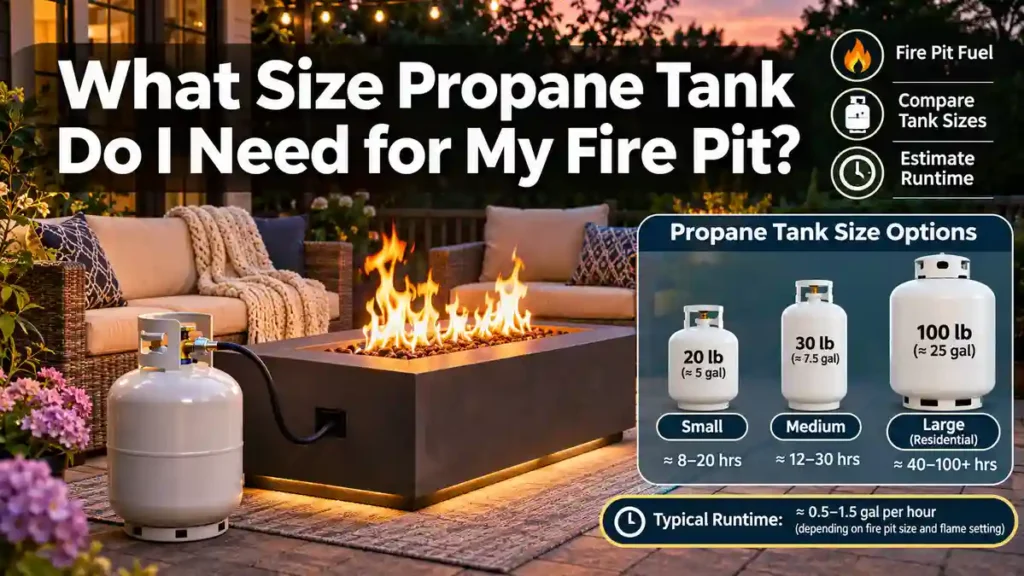
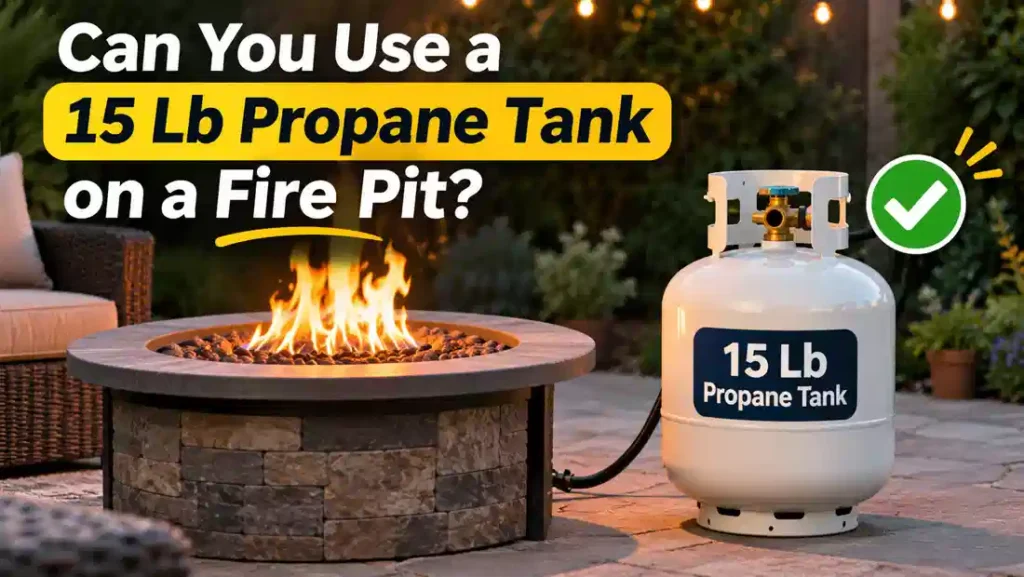
- Fuel amount: A properly filled 20-pound cylinder commonly contains about 4.7 gallons. A 15-pound exchange fill contains approximately 3.5 gallons and will provide proportionally shorter runtime.
- Full rated demand: The tank and regulator must serve the burner’s actual maximum input, not merely its appearance at a reduced flame setting.
- Weather and fill level: Low temperatures and diminishing fuel can reduce vapor delivery from a cylinder, especially for large burners.
- Location: Use only the cylinder arrangement, ventilation, and clearances permitted by the appliance’s manual and local rules.
- Service convenience: Frequent entertaining may make a larger approved tank or a factory-designed LP system more practical than repeated portable-cylinder exchanges.
For a closer tank-size comparison, read What Size Propane Tank Do I Need for My Fire Pit?. It helps you separate fuel capacity from the practical demands of a given fire pit.
Propane Fire Pit BTU Consumption and Runtime
I use 91,500 BTU per liquid gallon of propane for the estimates below. That is a useful planning approximation. Runtime figures assume steady operation at the stated input and all specified fuel being usable; real results vary. For high-demand burners, cylinder vaporization may limit operation before the energy estimate is exhausted.
| Fire pit rating | Fuel consumption | 20-lb fill (~4.7 gal) | 15-lb fill (~3.5 gal) |
|---|---|---|---|
| 20,000 BTU/hr | 0.219 gal/hr | 21.50 hours | 16.01 hours |
| 30,000 BTU/hr | 0.328 gal/hr | 14.34 hours | 10.68 hours |
| 40,000 BTU/hr | 0.437 gal/hr | 10.75 hours | 8.01 hours |
| 50,000 BTU/hr | 0.546 gal/hr | 8.60 hours | 6.41 hours |
| 60,000 BTU/hr | 0.656 gal/hr | 7.17 hours | 5.34 hours |
| 75,000 BTU/hr | 0.820 gal/hr | 5.73 hours | 4.27 hours |
| 100,000 BTU/hr | 1.093 gal/hr | 4.30 hours | 3.20 hours |
| 150,000 BTU/hr | 1.639 gal/hr | 2.87 hours | 2.13 hours |
At 30,000 BTU/hour, the model predicts about 14.34 hours from 4.7 gallons. At 50,000 BTU/hour, it predicts about 8.60 hours. At 100,000 BTU/hour, it predicts just 4.30 hours. The difference shows why an oversized fire feature can become expensive to operate even if the unit itself looks like a good deal.
These numbers are not a recommendation to run a 100,000- or 150,000-BTU appliance from a small cylinder. A qualified LP professional must verify adequate vapor capacity, regulator ratings, hose or pipe size, and overall supply design. For additional examples, see the 20-pound propane fire pit runtime chart.
The formulas I use
Gallons per hour = rated BTU per hour ÷ 91,500
Theoretical runtime (hours) = available gallons × 91,500 ÷ actual BTU per hour
Estimated hourly fuel cost = gallons per hour × price per gallon
My worked example: a 50,000-BTU fire table
Let’s say a qualified installer has converted an approved model and its new documented LP input is 50,000 BTU/hour. You purchase 4.7 gallons of propane at an illustrative price of $4 per gallon. Divide 50,000 by 91,500 to get 0.546 gallons per hour. Divide 4.7 by 0.546 to get about 8.60 theoretical hours. Multiply 0.546 by $4 to get an operating fuel cost of about $2.19 per hour.
For a three-hour evening, the estimated fuel consumption is 1.64 gallons and the fuel cost is $6.56. If you plan six evenings of that length in a month, you would use approximately 9.84 gallons and spend $39.34 on propane at the same price. This example is why I prefer forecasting by hours per month instead of guessing that one cylinder lasts an entire season.
If your equipment has a verified lower input setting, the calculation can be adjusted for that rated input. However, a control knob positioned at 50% is not proof that gas consumption falls to exactly half. A lower number should be treated as an estimate until supported by manufacturer documentation or measurements.
Propane Fuel Cost: Hourly and Monthly Scenarios
Fuel prices vary greatly across stores, regions, delivery plans, refill stations, and exchange services. I don’t want to imply that a sample price represents the current price in your town, so the next chart deliberately uses three illustrative price scenarios: $3, $4, and $5 per gallon.
| Rated input | Gallons/hr | $3/gal | $4/gal | $5/gal |
|---|---|---|---|---|
| 30,000 BTU/hr | 0.328 | $0.98 | $1.31 | $1.64 |
| 40,000 BTU/hr | 0.437 | $1.31 | $1.75 | $2.19 |
| 50,000 BTU/hr | 0.546 | $1.64 | $2.19 | $2.73 |
| 60,000 BTU/hr | 0.656 | $1.97 | $2.62 | $3.28 |
| 75,000 BTU/hr | 0.820 | $2.46 | $3.28 | $4.10 |
| 100,000 BTU/hr | 1.093 | $3.28 | $4.37 | $5.46 |
To see the monthly impact, consider the 50,000-BTU example again. At $4 per gallon, eight hours per month costs about $17.49, twenty hours costs $43.72, and forty hours costs $87.43. These totals cover fuel only. Cylinder purchase, transportation, delivery charges, taxes, and the conversion expense are separate.
I would keep a simple fuel log after the first few gatherings. Note the date, hours, estimated burner level, gallons purchased, and total paid. After several refills, the average observed cost per hour becomes more useful than any generic chart. I cover that method in How Much Does It Cost to Run a Propane Fire Pit?.
Natural Gas vs. Propane Running Costs
The meaningful comparison is cost for the same amount of heat input, not cost per cubic foot versus cost per gallon. One therm equals 100,000 BTU. Imagine, purely as an example, that your utility charges $1.80 per therm for natural gas and your propane costs $4 per gallon. A 50,000-BTU fire pit requires 0.5 therm per hour when operating on natural gas, or about 0.546 liquid gallon per hour if the approved LP configuration has that same input.
In this scenario, the natural-gas fuel expense is $0.90 per hour, while propane is about $2.19 per hour. That’s a difference of approximately $1.29 per hour. A conversion might still make sense if you need portability or have lost the natural-gas connection, but I would not recommend switching simply because propane seems like a more powerful fuel. The rated appliance input determines its nominal consumption.
| Burn hours | Natural gas ($1.80/therm) | Propane ($4/gallon) | Propane minus NG |
|---|---|---|---|
| 1 hours | $0.90 | $2.19 | $1.29 |
| 10 hours | $9.00 | $21.86 | $12.86 |
| 25 hours | $22.50 | $54.64 | $32.14 |
| 50 hours | $45.00 | $109.29 | $64.29 |
| 100 hours | $90.00 | $218.58 | $128.58 |
Interactive Propane Runtime and Cost Calculator
You can customize the following estimate to match a known propane BTU input, the actual available fuel, your local refill price, and the number of gatherings you host each month. The percentage field is only an illustrative fuel-load assumption; it does not represent a certified flame-knob setting or substitute for measuring actual consumption.
Fuel use: 0.546 gal/hr • Hourly cost: $2.19 • Monthly fuel: 6.56 gal • Monthly cost: $26.23
For planning only. Real runtime and the ability of a propane cylinder to deliver the required flow depend on installation, temperature, fill level, and manufacturer requirements. Do not use this estimator to select regulator settings or gas fittings.
How Much Does Conversion Cost?
A conversion quote should cover the correct manufacturer-approved components, qualified labor, safe isolation of any unused natural gas line, supply planning, leak and pressure testing, and required documentation. Some models need only a specific kit plus professional installation; other projects may involve expensive ignition changes or a different propane storage arrangement.
I would not promise a national conversion price because site conditions and appliance parts are highly variable. Instead, I would use a written estimate to compare complete installed cost with the price of replacing the fire pit. The budget below is hypothetical and shows how costs can add up; it is not a contractor price survey.
| Scenario | Parts | Labor and testing | Other supply work | Illustrative total |
|---|---|---|---|---|
| Simple approved conversion | $100 | $250 | $50 | $400 |
| More complex burner or ignition | $225 | $400 | $125 | $750 |
| Specialty unit needing additional supply design | $450 | $650 | $400 | $1,500 |
My rule is that the conversion has to make sense beyond the kit price. If the installed quote comes close to the cost of a comparable factory-built propane fire pit, I would lean toward replacing the appliance. You’ll often get clearer warranty terms, a configuration designed for the fuel from day one, and fewer future questions about which parts are installed.
To compare alternatives, see my Propane Fire Pit Buying Guide and propane fire pit price guide. Both help put the conversion quote in context.
My Three-Gate Conversion Decision Method
There are three questions I would answer before spending money. I call this my three-gate method because each stage can stop the project even if the other stages look favorable.
- Manufacturer approval: Does the exact model have a documented propane conversion procedure and obtainable approved parts? If not, I would stop and consider replacement.
- Safe supply feasibility: Can a qualified installer provide compliant LP storage, adequate vapor delivery, correct pressure, suitable shutoffs, and safe outdoor placement? If not, choose another installation.
- Ownership economics: Do portability, reduced dependence on a fixed gas line, and your expected operating pattern justify the conversion and higher or lower local fuel cost? If not, retain natural gas or buy a factory propane unit.
I think this decision approach is more useful than a list of generic conversion parts. It recognizes that a technically permitted project is not automatically a practical one. A large linear burner may be convertible but inconvenient to run from a portable cylinder. A small table might be economical to operate but prohibited on a particular patio by property rules.
Decision Guide: Convert or Replace?
| Situation | My recommendation | Next move |
|---|---|---|
| Approved kit available; NG supply being removed | Get a professional conversion quote | Compare kit, labor, supply, and testing |
| Approved kit exists; portability matters | Compare conversion against factory LP replacement | Check approved cylinder placement and runtime |
| No manufacturer conversion documentation | Do not convert | Buy a properly listed propane model |
| Existing NG service is reliable and inexpensive | Consider keeping natural gas | Compare monthly fuel expense |
| High-output burner and small planned cylinder | Reassess fuel supply | Ask a professional about vaporization capacity |
| Unknown model or missing rating plate | Do not order conversion parts | Identify product or replace it |
| Proposed indoor or enclosed-patio use | Do not use outdoor-only equipment there | Choose an appliance listed for that environment |
Safety Checks I Want Documented After Conversion
Once a qualified technician has finished an approved conversion, I would ask for a demonstration of the safe start-up and shutdown procedure. I also want to know where the supply shutoff is and what signs should trigger a service call. A homeowner should be able to use the fire pit confidently without guessing about gas controls.
- Check that the conversion has been documented and the instructions match the present LP configuration.
- Keep the fire pit in an approved outdoor location with the manufacturer’s required clearances and ventilation.
- Use only the cylinder storage arrangement and gas supply approved for that appliance.
- Keep burner media, drainage, ventilation openings, and access panels arranged as the manufacturer specifies.
- Stop operating the unit if you notice gas odor, visible damage, soot, uncontrolled flames, or repeated ignition failure.
- Do not diagnose suspected gas leaks with a flame, bypass safety components, or repair the fuel system yourself.
- Arrange professional service according to the manufacturer’s instructions and local requirements.
The most important reminder is that converting the fuel does not convert an outdoor-only appliance into an indoor heater. See Can You Use a Propane Fire Pit Table Indoors? and Are Propane Fire Pits Safe? for the wider safety discussion.
Common Mistakes I Would Avoid
- Buying an adapter before identifying the model. Similar-looking products can use different valves, burner designs, and ignition systems.
- Assuming a hose change is a fuel conversion. A hose does not establish approved propane metering or combustion.
- Using an unapproved orifice or drilling one. Burner parts must match the manufacturer’s documented LP configuration.
- Ignoring the unused natural gas line. The former supply must be safely isolated and terminated by a qualified person.
- Choosing a cylinder based only on total gallons. High burner demand can exceed the cylinder’s vapor-delivery capability under real conditions.
- Using flame height as the only performance test. Proper pressure, ignition, controls, and leak verification matter as much as flame appearance.
- Assuming outdoor propane equipment can be used inside. Fuel choice does not make an outdoor-only fire pit suitable for enclosed spaces.
I would also avoid using decorative fire glass or stones to conceal a poorly performing burner. Decorative media must be approved for the equipment and arranged according to its instructions. You can learn about suitable options in my decorative elements guide.
Does a Converted Propane Fire Pit Burn Hotter?
Not automatically. What matters is the appliance’s approved BTU input in its converted configuration, along with the burner geometry, flame pattern, operating conditions, and the way people sit around the fire. A model might have different NG and LP ratings, or the same rating for both fuels. I would read the manufacturer’s specifications rather than assume a stronger flame from the word propane alone.
More visible flame is not necessarily more useful warmth, and it is never a reason to use an oversized orifice or raise the pressure. If the goal is better comfort, consider a model with suitable rated output, an appropriate seating arrangement, wind conditions, and the manufacturer’s permitted installation clearances.
Keep a Simple Conversion and Ownership Record
I like a single-page service record for converted equipment. It helps when you move, sell the property, order service, or discover that an old installation manual no longer matches the appliance. It also gives you a convenient place to track fuel consumption after the first few gatherings.
| Record item | What to save |
|---|---|
| Original appliance identity | Brand, exact model, serial number and rating plate photo |
| Approved conversion kit | Manufacturer part number, instructions and revision |
| New fuel configuration | Documented propane rating and any required relabeling |
| Installer | Qualified company or technician and work date |
| Approved supply | Cylinder/tank type, regulator part and permitted location |
| Test results | Prescribed leak, pressure and operation checks |
| Operating cost log | Gallons purchased, total expense and hours of use |
| Current owner manual | Latest relevant lighting and shutdown instructions |
Frequently Asked Questions
Can I convert a natural gas fire pit to propane myself?
I would not recommend performing the physical conversion yourself. You can identify the product, request the approved kit details, and compare quotes, but gas-side modifications and verification should be performed by a qualified technician following the manufacturer and applicable rules.
Can I use a propane regulator on a natural gas fire pit?
Not as a standalone fix. The approved configuration may require fuel-specific orifices, burner components, valves, ignition hardware, and a compatible regulator. The regulator alone does not turn an NG appliance into a safely configured LP appliance.
Can I use a universal natural gas to propane kit?
I would use only the kit that the manufacturer approves for the exact fire pit and its production revision. Physical fit does not establish that a universal kit is safe or that it preserves the product’s listing.
How long will a 20-pound propane tank last?
At a verified 50,000-BTU/hour LP input, 4.7 gallons provides approximately 8.6 theoretical hours at full input. Actual runtime may be shorter, and sufficient cylinder vaporization and the correct supply remain essential.
Can I keep the cylinder under the fire pit table?
Only if the manufacturer’s approved installation expressly permits that cylinder and location. Never put a propane container inside an improvised cavity or unventilated decorative enclosure.
Is propane cheaper than natural gas for a fire pit?
That depends on local fuel rates. My illustrative comparison at $1.80 per natural-gas therm and $4 per propane gallon makes propane more expensive per BTU, but your local numbers may be different. Compare the same rated heat input, not equal volumes.
Can I convert back to natural gas later?
Only when the manufacturer permits that configuration and a qualified professional can reinstall and verify the required NG components. Keep the original documentation and service record for any future change.
What if I cannot find the fire pit’s model number?
I would pause the project until the manufacturer or dealer positively identifies it and confirms conversion approval. If that cannot be done, I consider a factory-built propane fire pit the clearer option.
Final Thoughts: Verify Compatibility Before Buying Parts
A natural gas to propane fire pit conversion can be a sensible option when you have a model designed to support it and a reason to leave the natural gas connection. But I would never treat it as a quick hose swap. The important steps are manufacturer approval, appropriate professional installation, verified safe operation, an approved fuel supply, and complete documentation.
My recommendation is to identify the exact model first, get the manufacturer’s answer in writing, and then compare a fully installed conversion quote against a factory-built propane alternative. Use the fuel tables and calculator to estimate ongoing operating expense, but let the actual appliance specifications and installer assessment determine whether the proposed setup is suitable.

Mike is an experienced propane technician with over 15 years of professional experience in the field. He has dedicated his career to helping customers with their propane needs, from installation to maintenance and repair. Together with Jeremy, he co-founded this website to provide useful information and guidance to customers seeking reliable propane services.